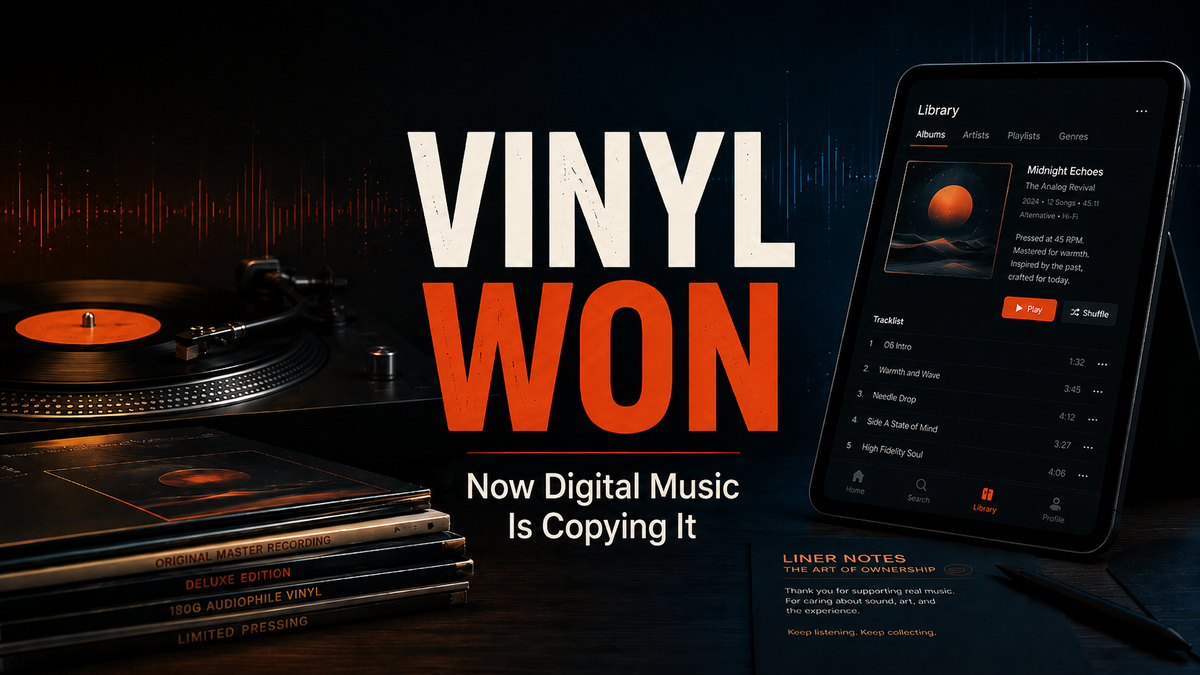
Vinyl Won. Now Digital Music Is Copying It.
Vinyl’s biggest victory may not be analog sound at all. As digital music begins borrowing the rituals of ownership, artwork, liner notes and intentional listening, the vinyl revival may have already changed how we value music.
For years, the resurgence of vinyl has been treated as a victory for analog.
Maybe we have been looking at it the wrong way.
What if vinyl’s real victory had less to do with grooves, cartridges and turntables, and more to do with reminding listeners what the digital music experience had stripped away?
Ownership. Artwork. Credits. Liner notes. Collecting. Intentional listening. The feeling that an album is something more than a collection of tracks sitting behind a search bar.
A new music player called Sleevenote is built around exactly that idea. And while I am not convinced everyone needs another $349 digital device, I think what Sleevenote represents is far more interesting than the product itself.
Because digital music may finally be starting to copy the things vinyl got right.
Streaming Solved One Problem and Created Another
There is no denying what streaming accomplished.
Virtually the entire history of recorded music is now available instantly. I can hear an album I have never encountered before within seconds. Discovery has never been easier. Access has never been greater.
I use streaming. I enjoy streaming. I certainly do not want to return to a world where hearing an obscure album means spending months searching record stores for a copy.
But convenience came with a tradeoff.
Music increasingly became something we access rather than something we own.
The album cover became a thumbnail.
Liner notes disappeared.
Credits became something you sometimes have to hunt for.
Albums compete with playlists, recommendations, notifications and an endless supply of whatever comes next.
We gained access to almost everything while arguably weakening our relationship with any one thing.
Vinyl went in precisely the opposite direction.
Vinyl Made Music Feel Important Again
Think about how you interact with a record.
You choose one.
You remove it from the shelf.
You look at the artwork.
You pull the record from the jacket.
You clean it, cue it and sit down.
When Side A finishes, you physically get up and flip it over.
That process may sound unnecessarily complicated to someone raised entirely on streaming.
That is also part of why many of us love it.
A record demands some level of participation.
And increasingly, I wonder whether that participation is actually more important to vinyl’s resurgence than analog sound itself.
Sound quality certainly matters to me. It is a huge part of this hobby and obviously something we discuss constantly on Vinyl Latte.
But sound quality alone cannot explain everything happening with physical music.
Look at CDs.
According to Luminate's 2026 Midyear Report, U.S. CD sales increased 16 percent during the first half of 2026 to 16.3 million units, significantly faster than vinyl, which grew approximately 2.4 percent during the same period.
Even more interesting is what younger consumers are doing.
Around half of Gen Z and Millennial consumers purchasing CDs reportedly do not even own a CD player.
Think about that for a moment.
They are buying the object even when the object is not necessarily how they listen to the music.
That suggests something bigger is happening.
Physical music is becoming part listening format, part collectible and part tangible connection with an artist.
And that is where Sleevenote becomes interesting.
What If You Could Own Digital Music Differently?
Sleevenote comes from musician and designer Tom Vek and takes a very different approach from the typical portable music player.
There is no Spotify.
No Apple Music.
No Qobuz.
Instead, the device is designed around music you actually own.
Purchased digital files can be stored locally, while the large square display emphasizes album artwork, sleeve designs, lyrics and credits.
The hardware supports hi resolution audio, includes 256GB of storage and can connect to external audio equipment, including a DAC.
In other words, it isn't really trying to compete with your phone.
It is trying to recreate something digital music largely abandoned.
The album experience.
And that is why I find the idea intriguing even if I am not sure I need the device.
Vinyl May Have Already Proven the Concept
For the better part of two decades, technology companies have been trying to make music easier.
Fewer steps.
More recommendations.
More personalization.
More songs.
More convenience.
Vinyl has been growing while doing almost exactly the opposite.
It is slower.
It takes up space.
Records require maintenance.
Turntables require setup.
You cannot instantly jump from Miles Davis to Massive Attack to Taylor Swift without physically changing records.
Yet millions of people continue choosing that experience.
Maybe that should tell us something.
Perhaps music consumers do not always want friction eliminated.
Sometimes friction is part of what creates value.
When selecting an album requires an actual decision, you may be more likely to listen to it.
When artwork occupies twelve inches instead of two inches on a phone screen, you may actually look at it.
When you own a record rather than simply having access to it, your relationship with that album changes.
Sleevenote appears to be asking whether some of that psychology can be transferred back into digital music.
I think that is a fascinating question.
But Would I Buy One?
This is where things become complicated.
The Sleevenote Day One Edition sells for $349.
That is not insignificant.
Most people already own multiple devices capable of playing digital music. A phone can store music. A computer can store music. Many audiophiles already own dedicated streamers, music servers, and DACs that cost considerably more than Sleevenote and offer enormous flexibility.
So I am not convinced the answer is simply another piece of hardware.
I also wonder how many people actually want to rebuild a purchased digital music library after spending years becoming accustomed to streaming.
Once you have access to almost every album imaginable for a monthly subscription, going back to purchasing individual downloads can feel strangely restrictive.
But that may also be the point.
Owning Music Changes How We Value It
There is a psychological difference between having access to 100 million songs and owning 500 albums.
The smaller collection has boundaries.
Those boundaries create choices.
Collectors understand this instinctively.
I can stream practically any pressing of an album digitally, yet I can still spend an embarrassing amount of time deciding which physical pressing deserves a place on my shelf.
That decision creates attachment.
And I suspect that is part of what younger CD buyers are discovering as well.
They may stream the actual music from their phones while buying the CD because they want something tangible that represents their connection to the artist.
Sleevenote takes the physical disc away but attempts to preserve the idea of a personal music library.
That is an interesting middle ground.
Vinyl's Biggest Contribution May Not Be Analog
I still love records.
I still believe a great analog pressing played through a properly configured system can provide an extraordinary listening experience.
Nothing about Sleevenote changes that.
But perhaps vinyl's most important contribution to modern music culture will ultimately be something broader.
Vinyl reminded an entire generation that music can be an experience rather than a utility.
It reminded us that artwork matters.
Credits matter.
Albums matter.
Ownership matters.
Collecting matters.
And perhaps most importantly, actively choosing what to play matters.
Streaming companies spent years making music increasingly invisible. Press play and an algorithm can keep going indefinitely.
Vinyl made music visible again.
Now digital products are beginning to rediscover those same ideas.
That does not mean vinyl is going away.
If anything, it demonstrates how influential the vinyl revival has become.
Maybe Vinyl Already Won
For years we have debated whether vinyl can survive streaming.
I think that question may be outdated.
Vinyl already changed the conversation.
Physical music sales continue showing that listeners want something more than unlimited access. CDs are growing again. Artists increasingly create elaborate physical editions. Collectors care about packaging, artwork and ownership.
And now companies are experimenting with ways to bring those ideas back into digital listening.
So perhaps the future isn't analog versus digital.
Perhaps it is intentional listening versus passive consumption.
If that is where music is heading, vinyl has been showing us the way for years.
And ironically, the next generation of digital music may end up looking a lot more like a record collection than Spotify.
Would something like Sleevenote interest you, or does digital music lose the entire point once you remove the physical object? More importantly, what keeps you buying records today: sound quality, ownership, collecting, the listening ritual, or some combination of all of them?
Let me know in the comments.


Comments ()