
Capital Audiofest 2026 Day 3: Vinyl, Analog Innovation, and Final Thoughts
Capital Audiofest 2026 concludes with a closer look at SUPATRAC, DS Audio, TriangleArt, and Lockwood, plus Vinyl Latte's final thoughts on three days of analog innovation and high-end audio.
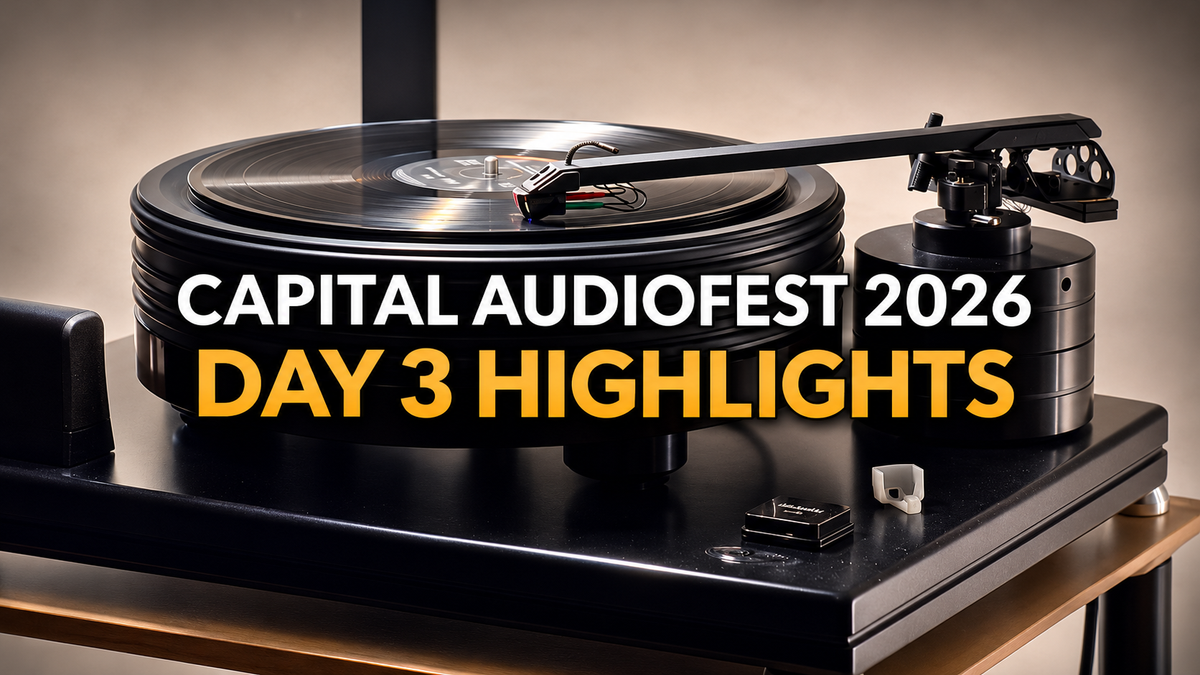
Sunday, November 15, 2026 | Rockville, Maryland
Three days, countless listening rooms, and one recurring question: What does it really take to reproduce recorded music convincingly?
Capital Audiofest 2026 has come to a close, bringing another weekend of ambitious audio engineering, extraordinary equipment, and opportunities to discover technologies that challenge how we think about sound reproduction.
Friday introduced us to a nearly $3.8 million Børresen and Aavik system, Swiss analog electronics from FM Acoustics, and United Home Audio's $55,000 Apollo-Z reel-to-reel tape deck.
Saturday explored a different side of the industry, contrasting the relatively attainable systems from Clayton Shaw and Margules with reference-level demonstrations featuring Vitus, Estelon, VAC, and Magico.
For this final installment, we're turning our attention toward something particularly close to Vinyl Latte's heart: analog playback.
From unconventional tonearm designs to ambitious turntables and traditional loudspeaker engineering, several additional demonstrations illustrate why the pursuit of better sound remains so interesting.
And after three days of covering equipment at dramatically different price points, there are some broader lessons worth considering.
This is the third and final installment in Vinyl Latte's Capital Audiofest 2026 series. Catch up on our earlier reports:
Day 1: Capital Audiofest 2026 Highlights
https://blog.vinyllatte.com/capital-audiofest-2026-day-one-highlights
Day 2: From Open-Baffle Speakers to Six-Figure Sound
https://blog.vinyllatte.com/capital-audiofest-2026-day-two-highlights
1. Dr. Vinyl: SUPATRAC Meets an Optical Cartridge
Room 609 | Dr. Vinyl
Of all the remaining analog demonstrations worth exploring, the Dr. Vinyl system holds particular interest for me.
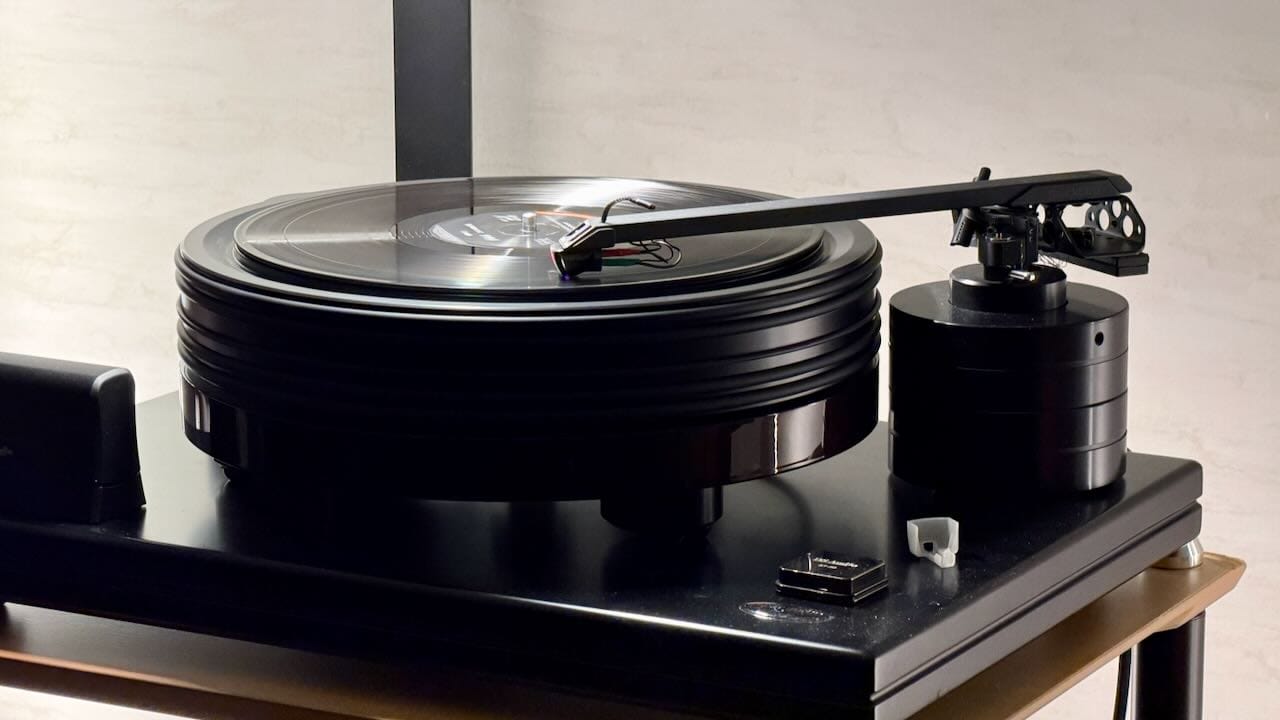
The centerpiece was a Pear Audio Aras turntable equipped with a SUPATRAC Blackbird tonearm and DS Audio W3 optical cartridge.
According to the exhibitor's equipment sheet, the analog front end consisted of:
- Pear Audio Aras turntable: $12,000
- SUPATRAC Blackbird tonearm: $7,500
- DS Audio W3 optical cartridge: $5,500
The remaining system included a Backert Labs Optik 1.1 phono preamplifier, Rhythm 1.4a preamplifier, Thrax Teres monoblock amplifiers, and QLN Prestige 3 Gen 2 loudspeakers.
The combination is interesting because both the tonearm and cartridge depart from some established approaches to analog playback.
Why the Blackbird is different
Most conventional tonearms employ familiar bearing arrangements designed to allow the stylus to follow a record groove with minimal resistance.
SUPATRAC takes a less conventional approach.
The Blackbird uses a side-mounted, suspended bearing arrangement designed to address mechanical behavior and stability during playback.
Its approach to horizontal and vertical motion differs significantly from a conventional gimbal-bearing tonearm.
That distinction is particularly relevant to my own listening experience.
I've been using the SUPATRAC Blackbird on my reference Rega P10 turntable, where its design has encouraged me to investigate tonearm geometry, cartridge alignment, and the mechanical relationship between the stylus and groove more closely.
Seeing the Blackbird incorporated into a completely different analog system provides an interesting opportunity to examine how a manufacturer or dealer approaches those same challenges.
The DS Audio optical cartridge adds another dimension
The DS Audio W3 introduces a second unconventional technology.
Traditional moving-magnet and moving-coil cartridges generate an electrical signal through electromagnetic induction.
DS Audio's optical cartridges instead use an optical system to detect the movement associated with the stylus tracing the record groove.
The approach requires dedicated equalization electronics and differs fundamentally from the operation of a conventional moving-coil cartridge.
Advocates of optical cartridge technology point to potential advantages involving moving mass, signal generation, and mechanical behavior.
But as with any audio technology, the underlying engineering claims should be separated from conclusions about audible performance.
A cartridge's actual presentation depends on more than its signal-generation method. Stylus profile, tracking behavior, tonearm compatibility, record condition, and setup remain important.
There is also an interesting practical consideration: the DS Audio system cannot simply be connected to a conventional moving-coil phono input.
For collectors who already own substantial investments in traditional phono amplification, switching to an optical cartridge involves a broader system decision.
The Dr. Vinyl demonstration therefore brings together two intriguing approaches to vinyl reproduction.
The question isn't simply whether either component is more technically sophisticated than a conventional alternative.
It's whether those differences produce meaningful improvements under controlled listening conditions.
That is a subject deserving more than a brief show-floor audition.
2. TriangleArt: How Far Can Vinyl Playback Evolve?
Room 625 | TriangleArt
If the Dr. Vinyl demonstration explored unconventional engineering within a relatively familiar turntable arrangement, TriangleArt provided another perspective on high-end analog playback.
The company's Capital Audiofest demonstration included an extensive selection of turntables, tonearms, cartridges, and electronics.
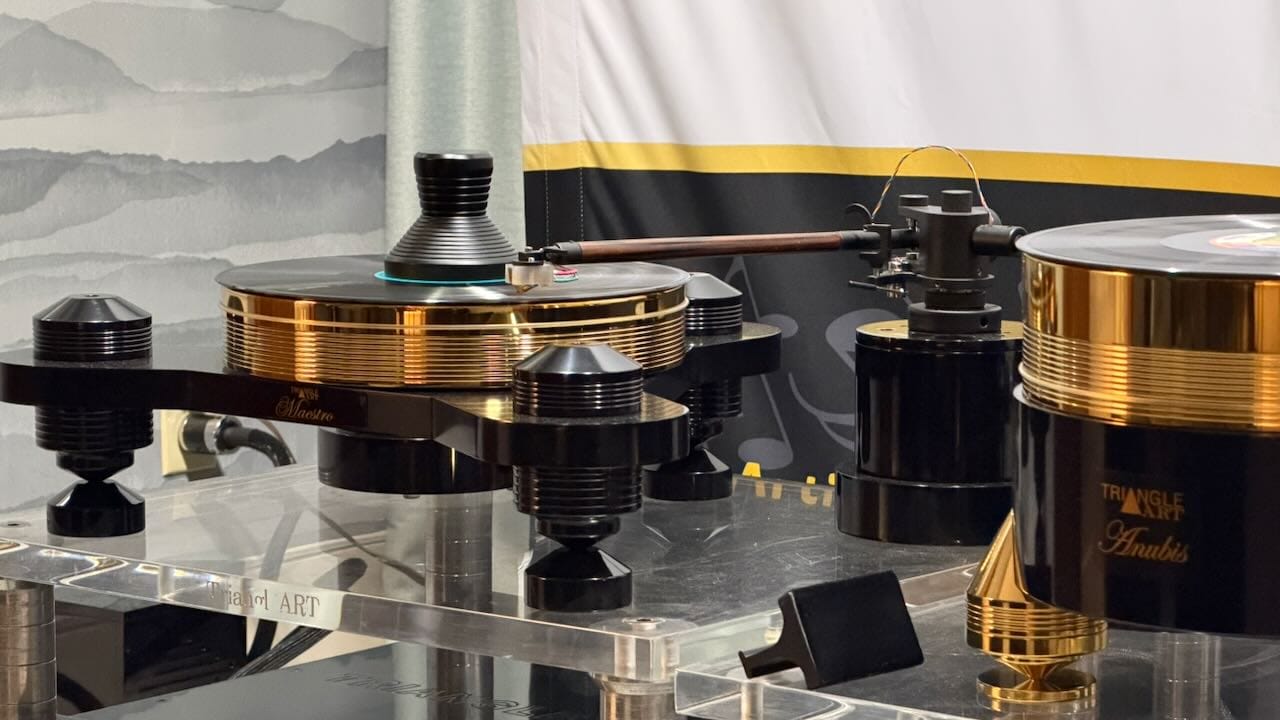
Its equipment sheet identified three turntable models:
- TriangleArt Hathor
- TriangleArt Maestro
- TriangleArt Anubis
The supporting analog components included the 12-inch Horus tonearm, 12-inch Osiris MK2 Diamond tonearm, Zeus MC cartridge, and Apollo MC cartridge.
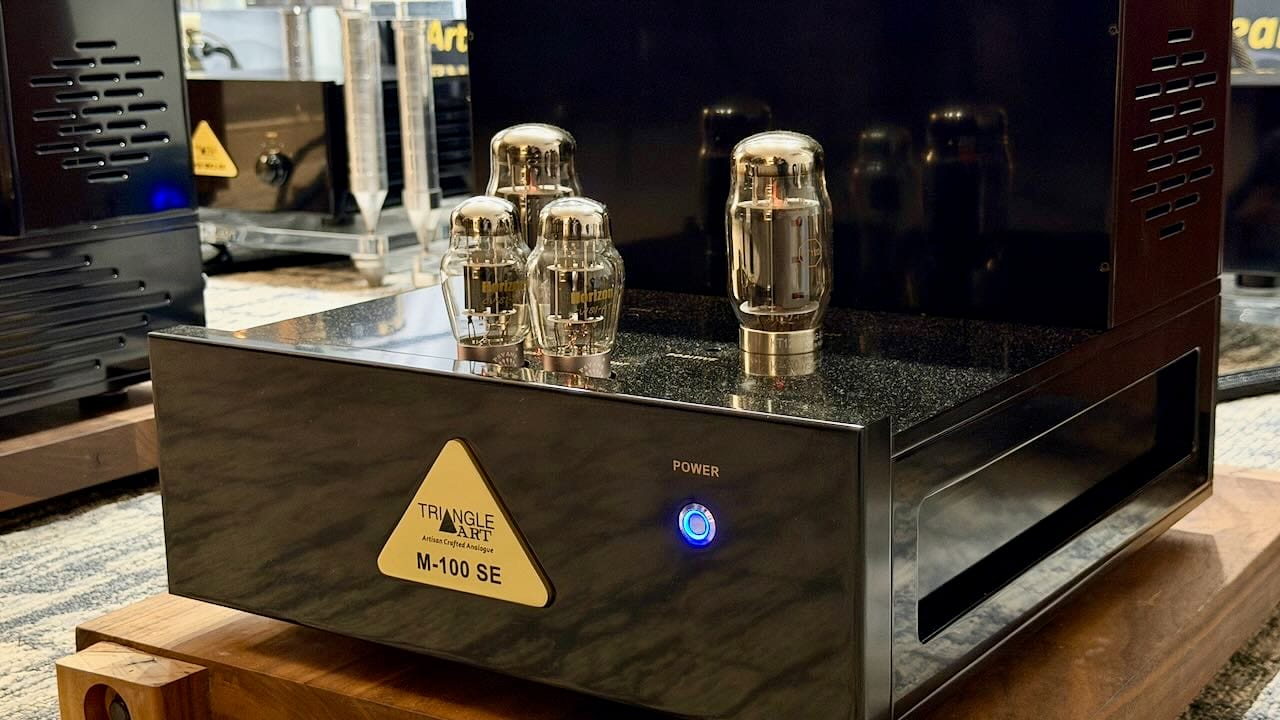
TriangleArt also listed its P200 dual tube phono stage, L200 MK2 SE dual-mono line stage, M100 SE monoblocks, and I-20 integrated amplifier.
It was a demonstration centered on a substantial part of the analog playback chain rather than a single new component.
Why turntable design still matters
At first glance, the fundamental operation of a turntable hasn't changed dramatically.
A motor rotates a record, a stylus follows its groove, and the resulting movement is converted into an electrical signal.
But the apparent simplicity of that process conceals a considerable number of engineering challenges.
A turntable must maintain stable rotational speed while minimizing vibration, mechanical noise, and unwanted energy reaching the stylus.
The tonearm must support the cartridge while allowing it to trace a groove containing extraordinarily small physical movements.
And the cartridge must extract that information without introducing excessive distortion or losing contact with the groove.
Manufacturers continue to approach these problems through differences in platter mass, motor control, bearing design, material selection, and mechanical isolation.
TriangleArt's extensive lineup provides a useful reminder that there is no single accepted engineering solution.
Some designs emphasize substantial mass and rigid construction. Others prioritize different approaches to resonance control and mechanical behavior.
The relationship between the turntable and tonearm is equally important.
A heavier, more elaborate turntable does not automatically guarantee superior playback, and a longer tonearm introduces its own combination of potential advantages and compromises.
The limits of what we can hear at a show
There is another consideration worth emphasizing.
When listening to a premium analog system, we are hearing the combined performance of the turntable, tonearm, cartridge, phono electronics, amplification, loudspeakers, and room.
Separating the contribution of any one component is difficult without controlled comparisons.
That is especially true when evaluating turntables costing many thousands of dollars.
It is possible to appreciate the ambition behind an elaborate design while remaining cautious about attributing every audible characteristic to a particular component.
For me, demonstrations like TriangleArt's are most valuable when they encourage deeper questions.
Which mechanical problems are being addressed?
How does the manufacturer verify the effectiveness of its approach?
And could the same improvements be achieved through better setup, cartridge matching, or more modest equipment?
Those questions are just as relevant to someone using a $2,000 turntable as they are to an enthusiast considering a much more expensive analog front end.
Photos: Vinyl Latte
3. Lockwood and 2WA Group: Traditional Loudspeakers Still Have Something to Say
Rooms 628 and 649 | 2WA Group
After exploring sophisticated analog playback systems, the Lockwood demonstrations provided a useful change of perspective.
Much of modern loudspeaker development concentrates on advanced cabinet materials, proprietary drivers, digital correction, and increasingly complex engineering.
But traditional approaches to loudspeaker design remain relevant.
Lockwood's presence across two 2WA Group rooms highlighted several speaker models paired with electronics and analog sources from other manufacturers.
In Room 649, the listed equipment included Lockwood Stanley 1 loudspeakers at $5,500 per pair and Stanley 2 loudspeakers at $7,800 per pair.
The supporting electronics included SPL's Director MK2 preamplifier/DAC, SPL 1200 amplifier, and SPL Phonos phono stage.
Analog playback came from a VPI Forever One turntable, while an Ideon Ayazi DAC provided another digital conversion option.
Room 628 presented a more ambitious configuration.
Its equipment list included:
- Lockwood Mini loudspeakers: $13,500 per pair
- Lockwood Academy 1 loudspeakers: $21,000 per pair
- Trafomatic Rhapsody integrated amplifier: $26,900
- Trafomatic Luna phono preamplifier: $21,000
- VPI Avenger Direct turntable: $40,000
An Ideon Nous preamplifier, streamer, and DAC completed the listed digital front end.
Why older ideas remain relevant
The interesting story here isn't that traditional loudspeaker approaches have somehow resisted technological progress.
It's that loudspeaker engineering involves tradeoffs that don't disappear simply because a design is newer.
Driver size, enclosure volume, radiation pattern, sensitivity, and crossover behavior all influence how a loudspeaker performs.
Different manufacturers assign different priorities to those variables.
A large loudspeaker employing comparatively traditional principles may approach dynamic capability and tonal reproduction differently from a compact design using sophisticated driver materials and complex crossover networks.
Neither approach guarantees better sound.
The result depends on execution, room interaction, and the listener's preferences.
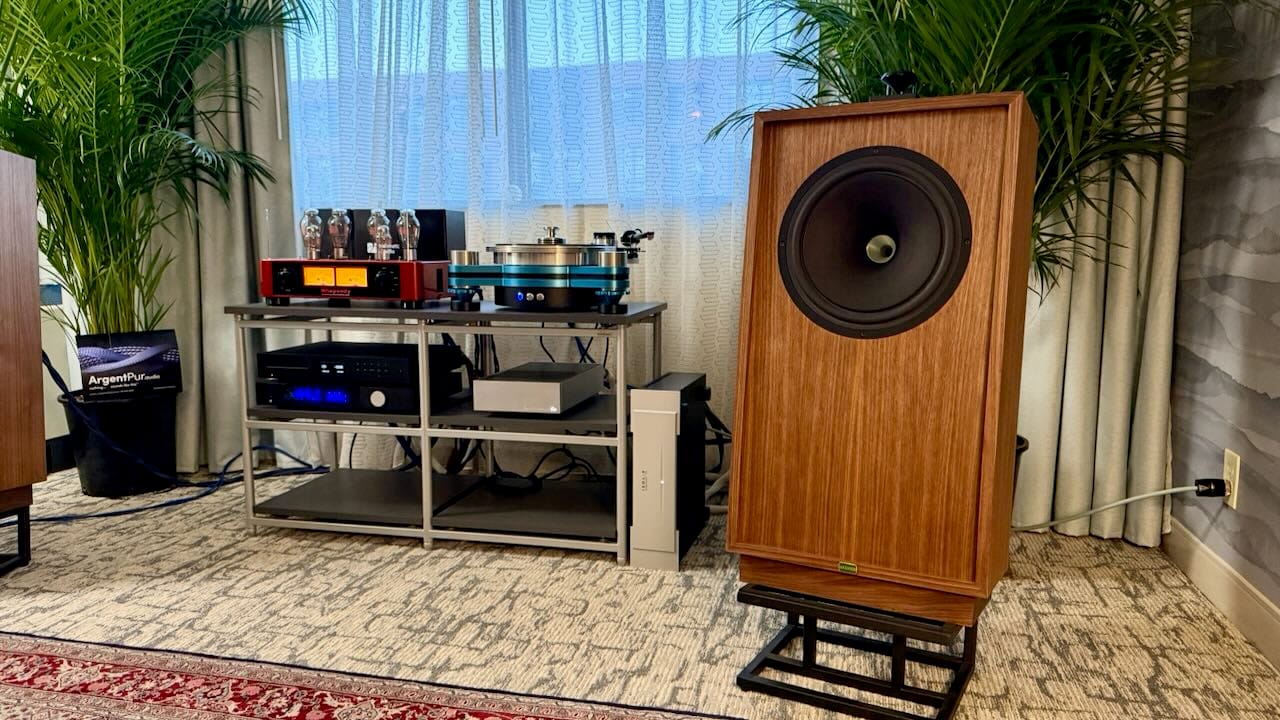
After encountering Clayton Shaw's open-baffle loudspeakers on Saturday and Magico's extensively engineered enclosures, the Lockwood systems offer another useful perspective.
High-end audio isn't progressing along a single technological path.
Instead, manufacturers continue to revisit fundamental acoustic principles while exploring different methods of putting them into practice.
That diversity is something the industry should preserve.
Three Days at Capital Audiofest: What Stood Out?
After documenting systems ranging from relatively attainable hi-fi to configurations approaching $3.8 million, several recurring themes emerge.
1. Analog innovation is far from finished
One of the most interesting aspects of Capital Audiofest 2026 was the continued investment in analog playback.
United Home Audio introduced a $55,000 reel-to-reel machine. SUPATRAC demonstrated a radically different tonearm architecture. DS Audio continues developing optical cartridge technology, while manufacturers such as TriangleArt pursue increasingly ambitious turntable designs.
These products serve different audiences and price points, but they share something important.
Their manufacturers believe there is still meaningful engineering work to be done in technologies that have existed for decades.
For vinyl enthusiasts, that is encouraging.
It also means we should continue demanding evidence that these innovations produce audible benefits, rather than accepting novelty as proof of improved performance.
2. Loudspeaker design remains remarkably diverse
Consider just four of the approaches represented during the weekend.
Clayton Shaw's open-baffle loudspeakers operate without conventional enclosed cabinets.
MBL's Radialstrahler speakers distribute sound in a fundamentally different way from traditional forward-firing loudspeakers.
Estelon emphasizes distinctive cabinet geometry and material engineering.
Magico employs substantial aluminum enclosures and highly developed drivers.
All four manufacturers are attempting to address familiar acoustic challenges.
Yet their solutions look, operate, and interact with listening rooms very differently.
That is a reminder that loudspeaker design requires balancing competing objectives rather than following a universal recipe.
3. Price remains an imperfect indicator of performance
It's impossible to attend an event like Capital Audiofest without noticing the extraordinary sums involved.
From expensive cables and isolation devices to loudspeakers exceeding $1 million per pair, the upper reaches of the market can seem disconnected from the experience of most music lovers.
But the existence of such products doesn't diminish the value of more attainable equipment.
Saturday's Clayton Shaw and Margules demonstrations were useful examples of manufacturers pursuing serious audio reproduction at substantially lower prices.
The important question is not whether the most expensive system at a show is impressive.
It's what measurable or audible improvements justify moving from one price level to another.
And that question cannot be answered simply by comparing equipment in different hotel rooms.
What I Want to Explore Beyond Capital Audiofest
Audio shows are valuable opportunities to discover products, meet designers, and understand the philosophies guiding manufacturers.
But they are not ideal environments for definitive equipment evaluation.
Listening rooms vary considerably in their dimensions, acoustics, placement options, and background noise.
Demonstrations often involve unfamiliar music, different playback levels, and limited time.
Those conditions make direct comparisons unreliable.
The equipment that interests me most isn't necessarily the equipment carrying the highest price.
It's the technology that raises questions worth investigating in a familiar listening environment.
The SUPATRAC and DS Audio pairing is one example. Clayton Shaw's approach to open-baffle loudspeakers is another.
And the continued development of analog playback, from phono stages to turntable engineering, provides plenty of material for future Vinyl Latte coverage.
I'd rather spend meaningful time understanding what a component actually contributes than declare it exceptional after a few minutes of listening.
Capital Audiofest 2026: Final Thoughts
Capital Audiofest has once again demonstrated that high-end audio is a surprisingly diverse industry.
Some manufacturers pursue performance through enormous engineering investments and elaborate systems.
Others revisit established technologies, reconsider conventional design assumptions, or concentrate on bringing serious audio reproduction to more accessible price points.
All of these approaches have a place.
The challenge for consumers, reviewers, and manufacturers is separating meaningful progress from marketing claims, personal preferences, and the sometimes overwhelming influence of price.
For me, the most interesting takeaway from the weekend is that the pursuit of better sound remains an ongoing conversation.
There are still new ideas to explore, familiar technologies to question, and plenty of opportunities to improve how we experience recorded music.
But ultimately, the purpose of all this equipment should remain straightforward.
It should bring us closer to the music, not distract us from it.
That's a fitting place to conclude Vinyl Latte's Capital Audiofest 2026 coverage.
Thank You for Following Our Capital Audiofest Coverage
Thank you for joining Vinyl Latte throughout three days of Capital Audiofest 2026.
We've explored extraordinary reference systems, relatively attainable audio equipment, innovative loudspeakers, advanced analog playback, and several technologies deserving closer examination.
While the show has concluded, our coverage doesn't end here.
Additional video features, interviews, and equipment discussions will continue on the Vinyl Latte YouTube channel and publication.
If you enjoy independent audio journalism and firsthand show reporting, please consider subscribing to or supporting Vinyl Latte.
Your support helps make continued reporting, equipment evaluations, and music coverage possible.
Comments ()