
Fluance’s New $700 Turntable Gets Something Many Expensive Turntables Don’t
Fluance’s $699.99 RT86 introduces an adjustable carbon fiber tonearm, a heavier acrylic platter, and two compelling cartridge options. Explore why its engineering matters and how it compares with the RT85 and flagship RT87.
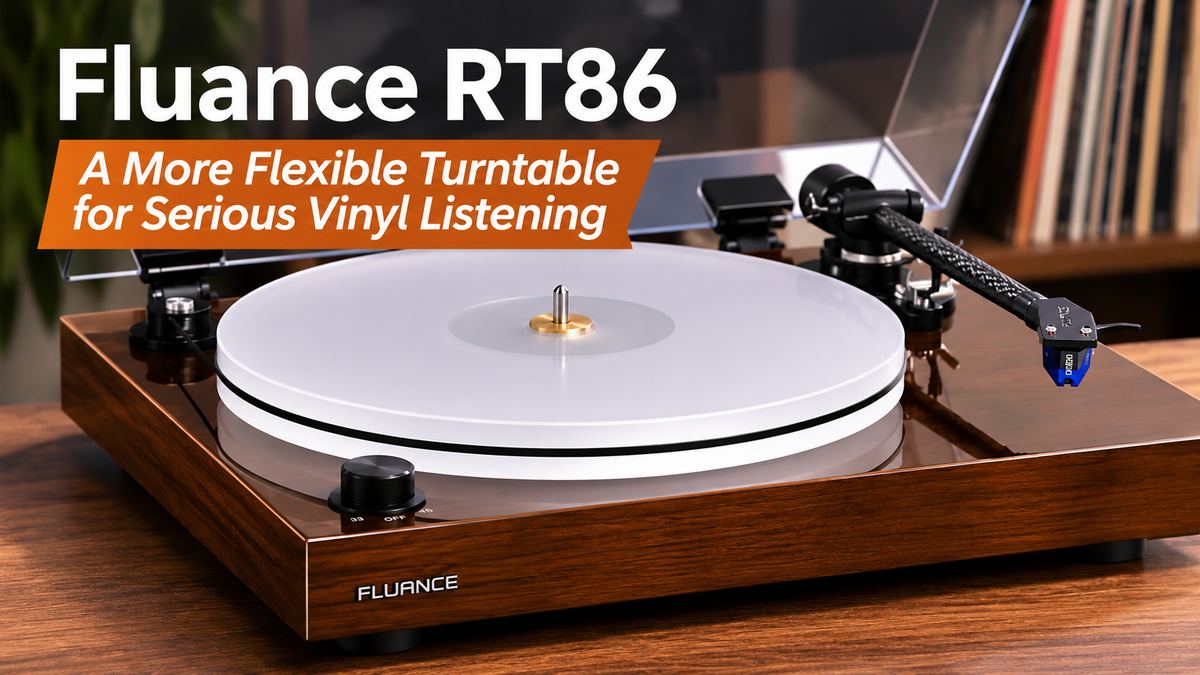
The Fluance RT86 brings adjustable tonearm height, a carbon fiber tonearm, and two compelling cartridge options to an accessible price point. But its most interesting feature may be the flexibility it offers vinyl enthusiasts.
Buying a turntable is relatively straightforward. Buying one that can evolve alongside your record collection and listening preferences is another matter.
Fluance's new RT86 raises an interesting question about what consumers should expect from a modern turntable.
Rather than relying exclusively on heavier construction, premium materials, or cosmetic refinements, the RT86 places greater emphasis on something experienced vinyl enthusiasts appreciate: adjustability.
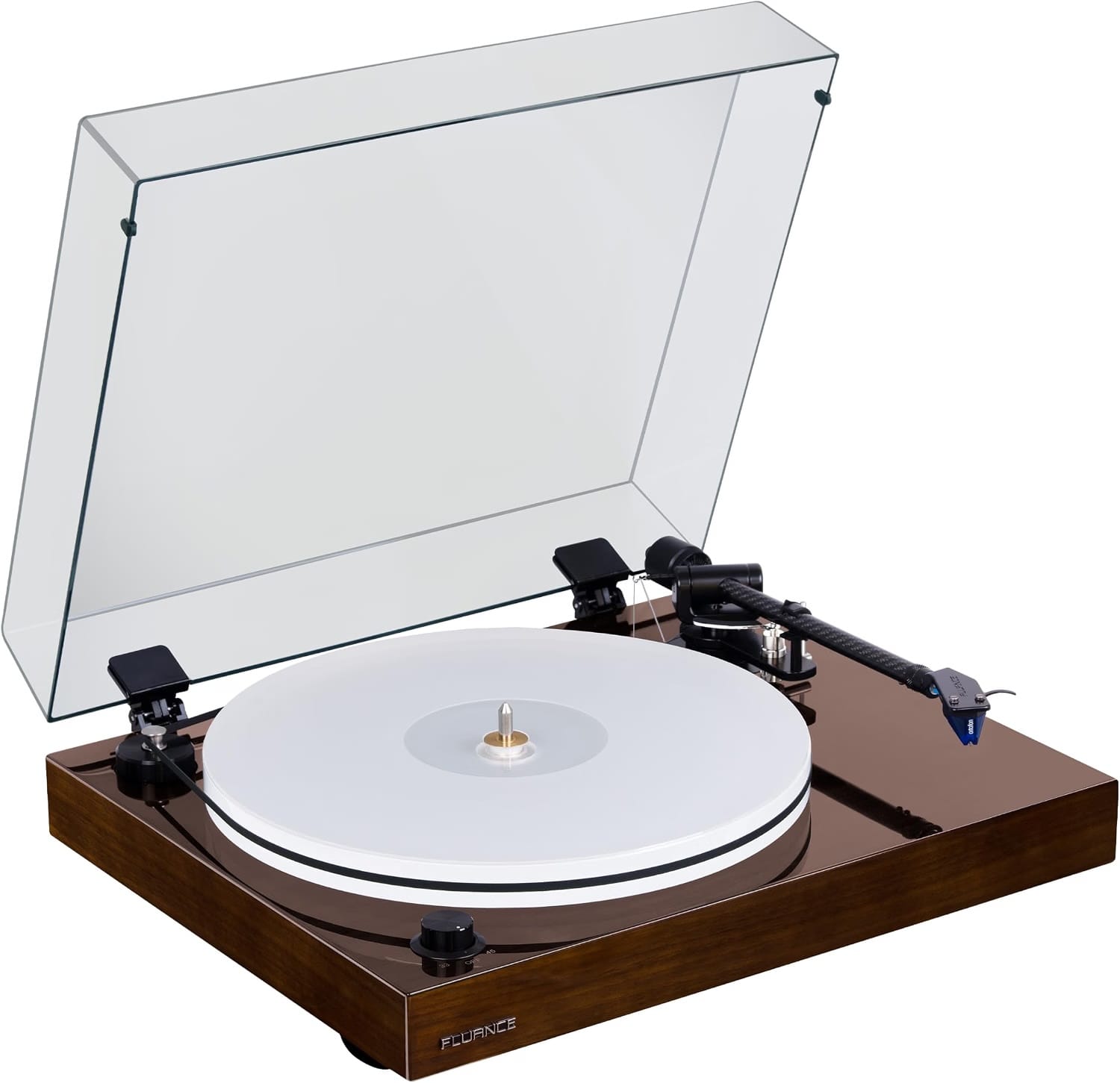
Among its most notable features is a tonearm with adjustable height, allowing owners to accommodate cartridges with different physical dimensions and refine their vertical tracking angle (VTA) and stylus rake angle (SRA).
It may not be the most glamorous feature on a turntable's specification sheet, but it could be one of the most useful.
And at $699.99, Fluance is bringing that flexibility to a particularly competitive segment of the analog playback market.
Fluance Brings Its Flagship Tonearm to a More Affordable Turntable
Earlier this year, Fluance introduced the RT87, its flagship Reference Series turntable, featuring a dual-plinth architecture designed to reduce unwanted vibration.
The new RT86 retains many of the RT87's features while reducing the price from $799.99 to $699.99.
The most significant difference is the construction of the plinth. Rather than separating the motor and tonearm assemblies through a dual-plinth architecture, the RT86 employs a conventional single-plinth design.
However, it retains the flagship's adjustable carbon fiber tonearm, heavier acrylic platter, and choice of moving magnet cartridges.
For prospective buyers, that raises an interesting question: how much of the RT87's potential performance comes from its isolation architecture, and how much comes from the components the two models share?
Only controlled measurements and listening comparisons can answer that question conclusively.
Nevertheless, Fluance's decision to retain the more sophisticated tonearm is particularly encouraging.
Why Adjustable VTA Matters
Vertical tracking angle is one of the more frequently discussed, and sometimes misunderstood, aspects of turntable setup.
VTA describes the angle associated with the vertical movement of the stylus and cantilever assembly relative to the record surface.
Closely related is stylus rake angle (SRA), which describes the orientation of the stylus's contact geometry relative to the record surface.
Although the two are related, they are not interchangeable.
Adjusting the height of a tonearm changes both angles, allowing the user to compensate for differences in cartridge height and potentially optimize how the stylus interacts with the groove.
Some turntables have fixed tonearm heights. Others require spacers beneath the tonearm mounting assembly to accommodate cartridges of different dimensions.
Neither approach is inherently inferior. A correctly configured fixed-height tonearm can deliver exceptional performance, and eliminating adjustable interfaces can simplify mechanical construction.
However, for listeners who intend to experiment with different cartridges, an adjustable tonearm offers considerably more convenience.
The RT86 provides 6 mm of tonearm height adjustment and supports cartridges between 15 and 21 mm tall, according to Fluance.
That flexibility becomes particularly relevant when using more advanced stylus profiles, where the orientation of the diamond can influence its contact with the groove.
It is worth emphasizing that adjusting tonearm height alone does not guarantee correct stylus alignment. Manufacturing tolerances, cantilever geometry, tracking force, and the mounting of the diamond itself can all influence the final result.
Vinyl Latte previously explored the importance of precise cartridge setup in our review of the WallyLoupe, a tool designed to help enthusiasts examine cartridge and stylus geometry.
The RT86 gives enthusiasts another tool for addressing that setup process without requiring extensive modifications to the turntable itself.
Two Cartridges, Two Different Approaches
Fluance offers the RT86 with either an Audio-Technica AT-VM95ML or an Ortofon 2M Blue moving magnet cartridge.
Both configurations cost $699.99, making cartridge selection a question of playback priorities rather than purchase price.
The most fundamental difference is the stylus profile.
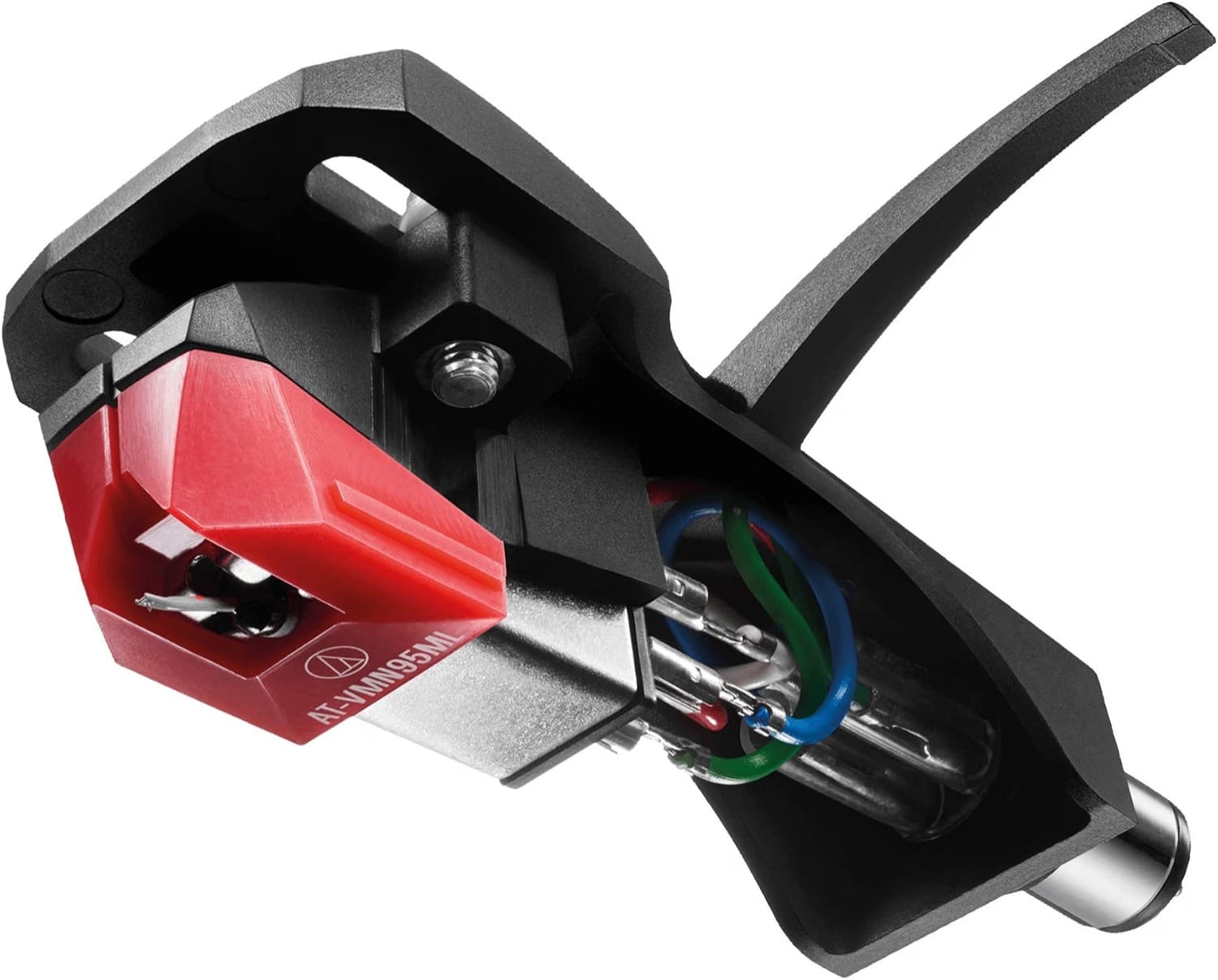
Audio-Technica AT-VM95ML
The AT-VM95ML uses a nude MicroLine stylus, an advanced contact profile designed to trace fine groove modulations accurately.
Its narrow scanning radius can help reduce tracing distortion, particularly toward the inner grooves of a record, where the linear velocity of the groove beneath the stylus decreases.
This can be particularly valuable when playing densely arranged recordings, demanding vocal passages, or records with music cut close to the label.
Its longer vertical contact area also distributes tracking pressure differently from a conventional elliptical stylus.
However, realizing these potential advantages depends on correct cartridge alignment, tracking force, and electrical loading.
Another advantage of the VM95 platform is its range of interchangeable styli, allowing owners to explore different stylus profiles without replacing the entire cartridge.
Ortofon 2M Blue
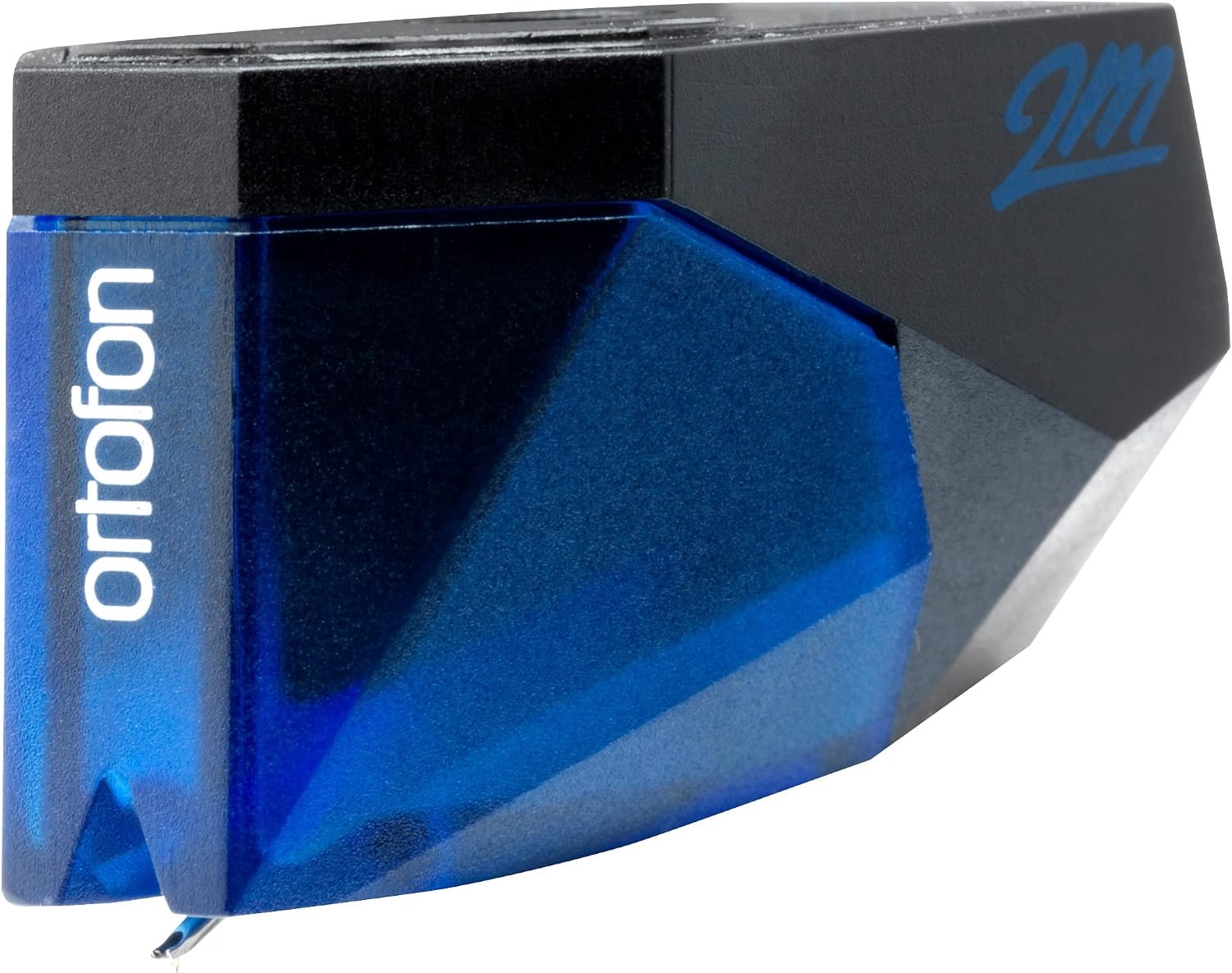
The 2M Blue uses a nude elliptical diamond and is a familiar cartridge among vinyl enthusiasts.
Its elliptical profile offers improved tracing capability over a conventional conical stylus while providing a relatively straightforward introduction to higher-performance moving magnet cartridges.
The 2M Blue also produces a higher output voltage than the AT-VM95ML, something worth considering when matching cartridges to a phono stage or conducting listening comparisons.
The 2M platform offers replaceable styli, although Ortofon's Red and Blue cartridge bodies differ from those used in the Bronze and Black models.
Which Cartridge Would Vinyl Latte Choose?
At the same purchase price, the AT-VM95ML would be our starting recommendation for listeners prioritizing groove tracing, inner-groove performance, and information retrieval.
The inclusion of a MicroLine cartridge on a $700 turntable is arguably one of the RT86's strongest selling points.
That recommendation is based on stylus geometry and cartridge specifications rather than a direct listening comparison of the two RT86 configurations.
Personal preferences, system matching, and setup accuracy remain important considerations.
A Carbon Fiber Tonearm Is Only Part of the Story
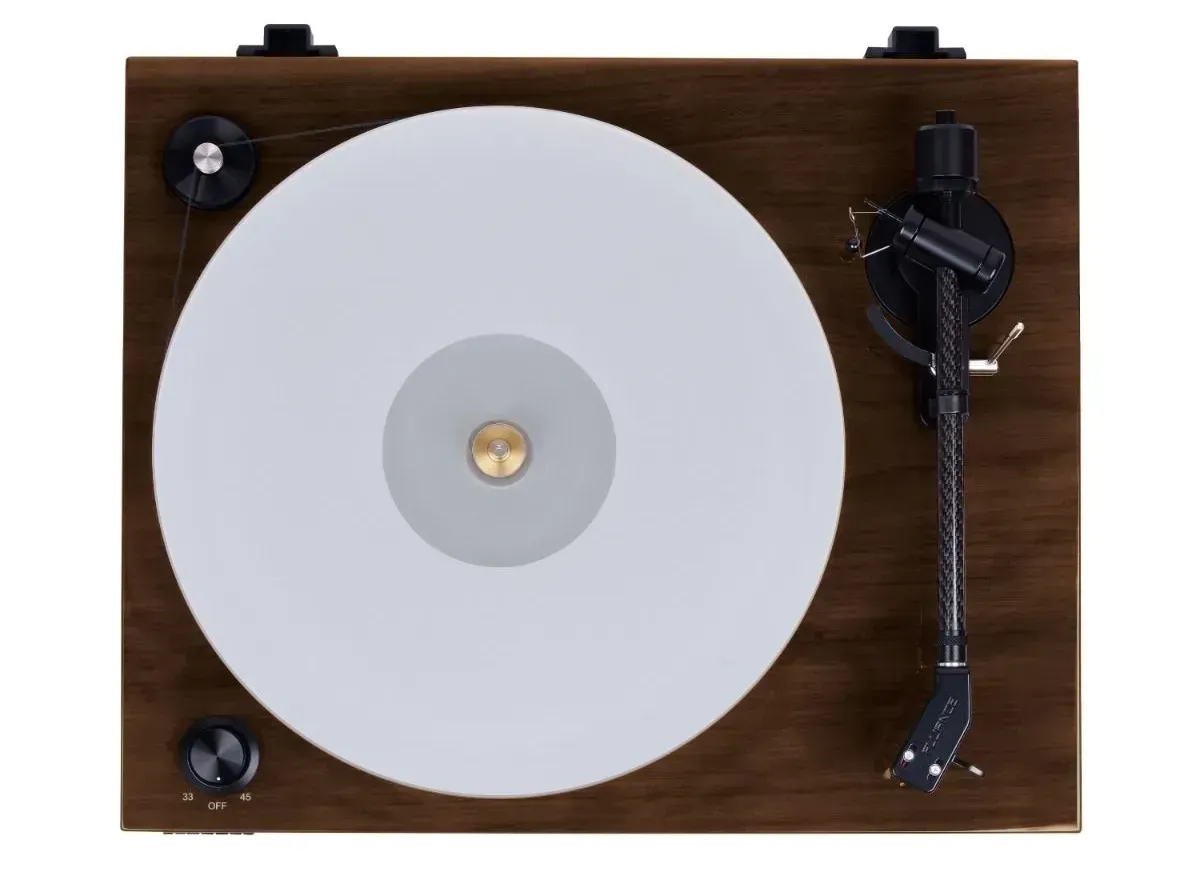
The RT86 incorporates a straight, nine-inch carbon fiber tonearm with a removable headshell, adjustable counterweight, and hanging-weight anti-skating mechanism.
Carbon fiber is attractive in tonearm construction because it can offer high stiffness relative to its weight.
However, the material alone does not determine tonearm performance.
Bearing quality, effective mass, structural resonance, cartridge compliance, and mechanical tolerances are equally important considerations.
A well-engineered aluminum tonearm can outperform a poorly executed carbon fiber design.
The RT86's removable headshell is another practical feature, particularly for collectors who enjoy experimenting with cartridges.
It allows complete cartridge and headshell assemblies to be exchanged more easily, although each change still requires verification of tracking force, anti-skating, alignment, and tonearm height.
That combination of adjustability and convenience makes the RT86 potentially interesting as a platform for exploring analog playback rather than simply buying a turntable and leaving it unchanged.
What Does a Heavier Acrylic Platter Actually Do?
Fluance has increased the platter weight from approximately 3 pounds on the RT85 to 4.1 pounds on the RT86.
The new 22 mm acrylic platter is designed to operate without a separate turntable mat.
Increasing platter mass can increase rotational inertia, potentially helping resist short-term disturbances in rotational speed.
Acrylic is also commonly used in turntable construction for its mechanical damping characteristics.
However, a heavier platter does not automatically produce better speed stability or superior sound.
Motor torque, bearing design, platter mass distribution, belt characteristics, and the behavior of the motor controller all influence the final result.
Fluance specifies wow and flutter of 0.06% for the RT86, compared with 0.07% for the RT85.
That is an encouraging specification, but independent measurements would be needed to establish actual performance and whether the difference is meaningful during playback.
Fluance RT85 vs. RT86 vs. RT87
The RT86 occupies an interesting position within Fluance's Reference Series.
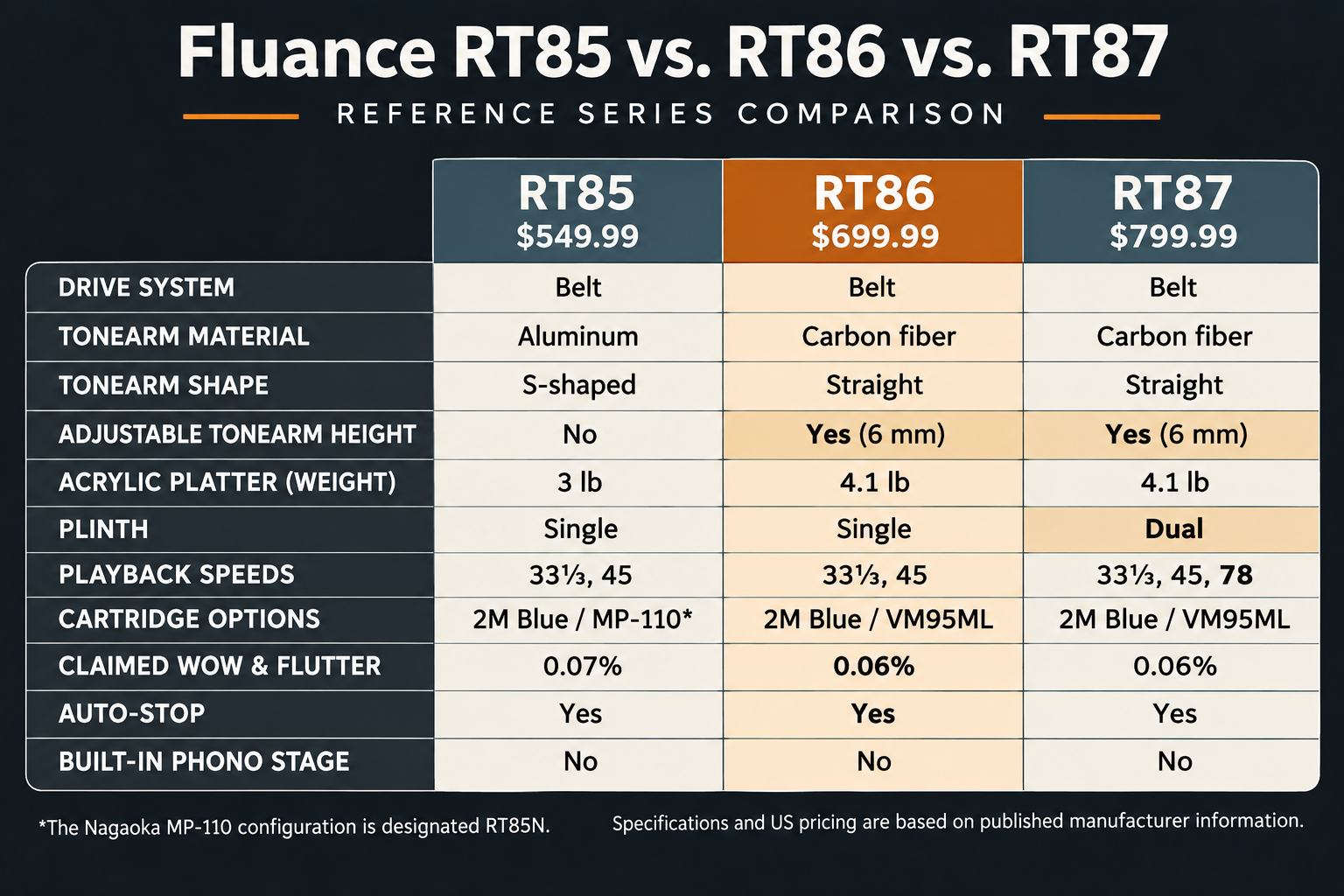
The $150 difference between the RT85 and RT86 buys more than a different tonearm material. It introduces tonearm height adjustment, a heavier platter, and access to the MicroLine cartridge configuration.
Meanwhile, the additional $100 required for the RT87 primarily brings a more elaborate isolation design and 78 RPM playback support.
Collectors intending to play vintage 78 RPM records should note that an appropriate stylus is also necessary. Neither of the supplied modern LP cartridges should be assumed suitable for conventional shellac 78s.
Is the RT87 Worth the Extra $100?
This may be the most difficult purchasing decision within Fluance's current lineup.
The RT87 uses a dual-plinth construction intended to reduce the transmission of unwanted mechanical vibration to the cartridge.
In principle, that additional isolation could be beneficial, especially in systems where the turntable is exposed to vibration from loudspeakers, subwoofers, or supporting furniture.
But the existence of an additional isolation mechanism does not establish how effective it is.
The relevant questions are whether the RT87 produces measurably lower mechanical noise, better resistance to acoustic feedback, or audible improvements under otherwise identical conditions.
For someone already using a dedicated turntable support or isolation platform, the RT86 may offer a particularly attractive balance of features.
For someone whose turntable must share furniture with loudspeakers, the RT87's isolation architecture may deserve closer consideration, although it should not replace proper equipment placement.
With only $100 separating the two, the RT87 remains a compelling option on paper.
A direct comparison using identical cartridges, alignment, phono stages, and playback levels would be necessary to determine whether its additional engineering justifies the expense.
Should Existing RT85 Owners Upgrade?
The RT86's introduction does not suddenly make the RT85 obsolete.
For someone who already owns an RT85, enjoys its performance, and has no intention of experimenting with cartridges of different heights, the new model may offer limited practical advantages.
A cartridge or stylus upgrade, improved isolation, or a better-matched phono stage could represent a more sensible investment, depending on the existing system.
The RT86 becomes more interesting for enthusiasts who have encountered the limitations of a fixed-height tonearm or want a more flexible platform for future cartridge experimentation.
For someone purchasing their first serious turntable, however, the RT86's additional adjustability could reduce the likelihood of outgrowing the platform.
That distinction is important.
The best upgrade is not necessarily the newest product. It is the one that addresses an identifiable limitation in your existing system.
What Vinyl Latte Would Want to Test
Specifications provide a useful starting point, but they cannot tell us everything about how a turntable performs.
A proper evaluation of the RT86 would examine several areas:
- Speed accuracy and stability: Independent measurements of rotational speed, wow, and flutter.
- Tonearm performance: Bearing behavior, cartridge compatibility, resonance, and tracking performance.
- Cartridge comparison: A level-matched evaluation of the AT-VM95ML and 2M Blue using identical records and appropriate electrical loading.
- Mechanical isolation: Resistance to motor vibration, environmental disturbances, and acoustic feedback.
- Adjustment usability: Whether the tonearm height mechanism is precise, repeatable, and convenient for cartridge changes.
- RT87 comparison: Whether the flagship's dual-plinth construction produces measurable or audible improvements.
These tests would help distinguish meaningful engineering benefits from features that simply look impressive on a specification sheet.
They would also help determine whether the RT86 is a worthwhile upgrade for existing RT85 owners or primarily a more versatile option for someone purchasing a new turntable.
Pricing and Availability
The Fluance RT86 is priced at $699.99 in the United States, with a choice of the Audio-Technica AT-VM95ML or Ortofon 2M Blue cartridge.
Available finishes include Natural Walnut, Piano Black, and Piano White.
The turntable does not include a built-in phono preamplifier. Buyers will need either an integrated amplifier with a compatible phono input or a separate moving magnet phono stage.
The Bigger Story Is Flexibility
The most encouraging aspect of the Fluance RT86 is not its carbon fiber tonearm, acrylic platter, or even its MicroLine cartridge in isolation.
It is the combination of these features within a platform that encourages owners to explore and refine their analog playback systems.
Experienced vinyl enthusiasts understand that cartridge setup can be just as important as cartridge selection.
A more expensive cartridge installed incorrectly may deliver less satisfying results than a modest cartridge that has been carefully aligned and matched to the tonearm and phono stage.
The RT86 gives listeners greater control over that process.
Whether Fluance has delivered a genuinely higher-performing turntable remains a question for independent testing.
But on paper, the company appears to have identified something important: a turntable does not need to be extraordinarily expensive to provide meaningful setup flexibility.
And for vinyl enthusiasts who enjoy discovering what their records are capable of delivering, that flexibility may be one of the most valuable features of all.
Editorial note: This article is an independent product analysis based on published specifications and engineering principles. Vinyl Latte has not yet conducted hands-on testing or listening evaluations of the Fluance RT86.
Enjoy independent coverage of vinyl, music, and high-fidelity audio? Subscribe to Vinyl Latte to support independent audio journalism.
Sources & Further Reading
Fluance RT86 Official Product Page
https://www.fluance.com/rt86-turntable-vinyl-record-player-vm95ml-black
Fluance Turntable Comparison Guide
https://www.fluance.com/turntable-comparison-chart
Audio-Technica Official Website
https://www.audio-technica.com/
Ortofon Official Website
https://ortofon.com/
Fluance RT86 Coverage from ecoustics
https://www.ecoustics.com/products/fluance-rt86-turntable/



Comments ()