
WallyLoupe Review: The Cartridge Alignment Tool That Replaced My Jeweler’s Loupe
The WallyLoupe started as a cartridge alignment tool, but it quickly became one of the most useful accessories on my turntable setup. In this review, I look at how it replaced my jeweler’s loupe, why it makes cartridge setup easier, and the unexpected ways it helps with record inspection.
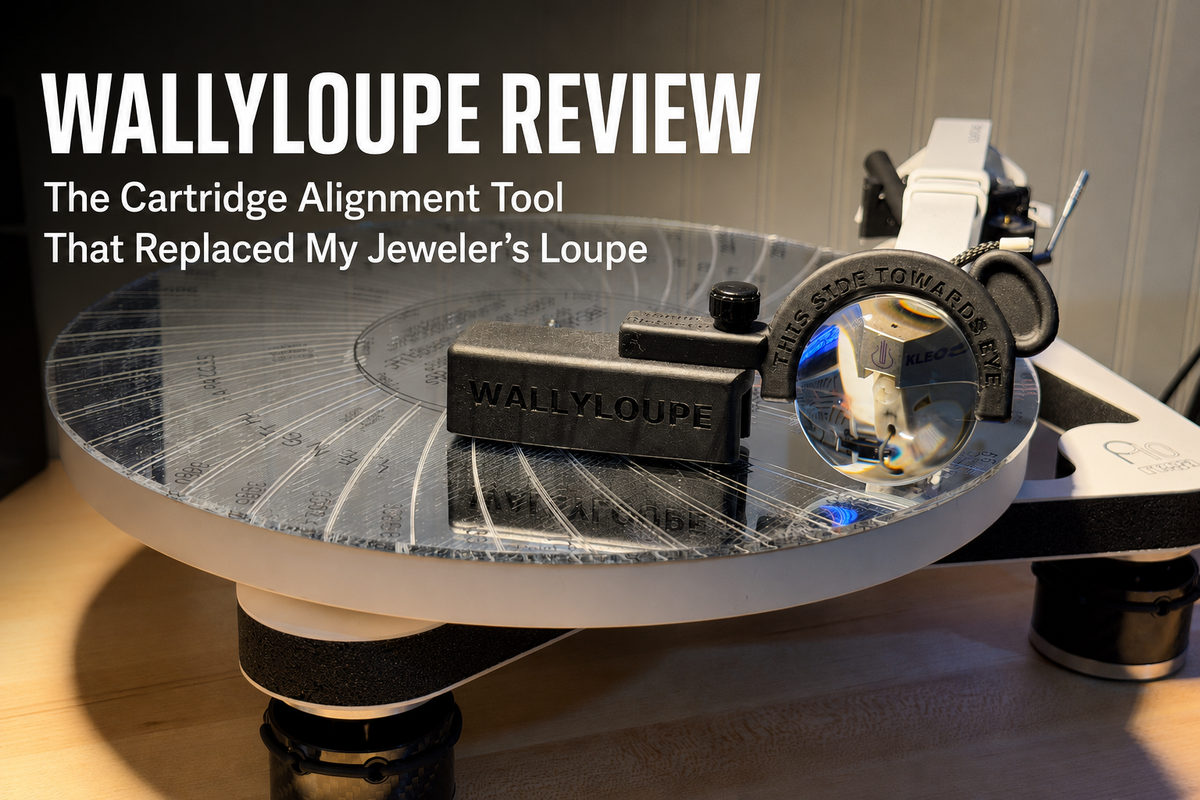
Cartridge alignment is one of those jobs that sounds simple until you are actually doing it.
You lower the stylus onto your protractor, lean over the turntable, check the grid, adjust the cartridge, check again, move your head slightly, and suddenly you are not sure if the stylus is exactly where you thought it was. A jeweler’s loupe helps, but it also adds another thing to hold, angle, and steady while you are already trying to be precise.
That is why the WallyLoupe appealed to me.
It is not an alignment system. It is not a sonic tweak. It is not going to magically make your turntable sound better. It is a purpose-built magnification tool that makes it easier to see the stylus on your preferred protractor.
That may sound basic, but for cartridge setup, seeing clearly is half the battle.
Why I Wanted Something Better Than a Jeweler’s Loupe
For years, I used a jeweler’s loupe when setting up cartridges. It worked, but it was never especially convenient.
The problem was not magnification. The problem was everything around it. Holding the loupe steady, bending over the turntable, trying to keep the viewing angle consistent, managing lighting, and figuring out whether I was actually seeing the stylus tip clearly or just convincing myself I was close enough.
Anyone who has spent time aligning a cartridge knows this part of the process. You make a tiny adjustment. You check again. You move your head slightly and the view changes. You check again. You wonder if the cantilever is actually straight or if your viewing angle is playing tricks on you.
That is the problem the WallyLoupe solves for me. Not alignment itself, but the visibility problem that makes alignment harder than it needs to be.
The Real Purpose: Seeing the Stylus on the Protractor
The main purpose of the WallyLoupe is not to align the cartridge body. It is to help you see the stylus as it sits on your alignment protractor.
That distinction matters.
A lot of setup conversations focus on making the cartridge body look square on the grid. That can be helpful, but it is not always the full story. Cartridge bodies are not always perfectly square. Cantilevers are not always perfectly centered. The stylus is what actually traces the groove.
So when I am aligning a cartridge, I care most about the stylus position and the cantilever orientation relative to the protractor. The WallyLoupe gives me a clearer view of that area without having to hold a traditional loupe in one hand while trying to make a careful judgment.
It does not replace the protractor. It supports the process.
Whether you use a WallyTractor, Dr. Feickert, Mint, Rega arc protractor, or another alignment tool, the WallyLoupe’s job is simple: make the stylus easier to see.
Does It Improve the Sound?
Not directly.
The WallyLoupe is not going to make your turntable sound better on its own. It is not a tonearm upgrade, a cartridge upgrade, or a phono stage upgrade. It is a setup aid.
What it can do is give you more confidence that you have aligned the stylus properly. If that clearer view helps you make a more accurate setup decision, then yes, the end result can contribute to better sound. But the improvement comes from the alignment, not from the loupe itself.
That is an important distinction, and it is one of the reasons I like the tool. It does not need exaggerated claims to be useful.
Replacing My Jeweler’s Loupe
The WallyLoupe has largely replaced my jeweler’s loupe for cartridge alignment because it fits the task better.
A jeweler’s loupe is a general magnification tool. The WallyLoupe feels more purpose-built for the turntable. It sits in the setup environment more naturally, gives me a useful view of the stylus area, and removes some of the awkwardness that came with using a handheld loupe over a protractor.
That does not mean a jeweler’s loupe is useless. It still works. But once I got used to the WallyLoupe, I found myself reaching for it instead.
That is usually the sign of a good tool. Not because it is dramatic, but because it quietly becomes the thing you use.
Other Setup Uses
Stylus alignment is the main reason to own one, but I have found a few other uses around the turntable.
It can help with visual azimuth checks, especially if you are using a ruler, mirror, or another visual reference. It can also be useful when cleaning the stylus because it gives you a closer look at the stylus area before or after cleaning.
I would not position it as a replacement for a proper microscope if you are trying to evaluate stylus wear. That is a different task requiring a different level of magnification and lighting. But for quick visual checks, the WallyLoupe is practical.
It is the kind of tool you keep nearby because you know you will use it.
My Favorite Secondary Use: Inspecting Records
The surprise use case for me has been record inspection.
If I pull a record from the sleeve and see something questionable, I can grab the WallyLoupe and quickly inspect the surface. A mark, a bit of debris, a pressing flaw, a scuff, something stuck in the groove. It is not a laboratory-level inspection tool, but it is quick, convenient, and gets the job done.
That convenience matters. I do not always want to set up a more involved inspection process just to answer a simple question: what am I looking at?
The WallyLoupe makes that easy. It is already near the turntable, it is simple to use, and it gives me a better look than my eyes alone.
That secondary use has made it more valuable than I expected.
What It Is Not
The WallyLoupe is not a cartridge alignment system by itself. It will not choose your geometry. It will not correct a bad protractor. It will not compensate for poor lighting, rushed setup, or misunderstanding the process.
It is also not a sonic tweak.
It is a visibility tool. That may sound basic, but in cartridge setup, visibility is a big part of confidence. And confidence matters when you are making tiny adjustments to a stylus that is supposed to sit precisely on a printed point or line.
The WallyLoupe helps me verify what I am seeing. That is the value.
Who Should Consider It?
The WallyLoupe makes the most sense for someone who takes cartridge setup seriously and wants the process to be easier to see and confirm.
If you change cartridges, experiment with alignment, use precise protractors, or simply hate the awkwardness of using a jeweler’s loupe over a turntable, this is worth considering.
If you rarely touch your cartridge and are comfortable with a basic visual setup, it may be more tool than you need.
For me, it has earned a permanent place in the setup kit because it removes friction from a task I already care about.
Final Thoughts
The WallyLoupe is not exciting in the way a new cartridge, tonearm, or phono stage is exciting. It is not something I would describe with big sonic claims. Its value is more practical than that.
It helps me see the stylus better when aligning it on a protractor. It gives me more confidence in the setup. It is useful for quick visual checks around the turntable. And as a bonus, it has become one of my favorite tools for quickly inspecting records.
That is why it replaced my jeweler’s loupe.
Not because it changed the sound of my system by itself, but because it made an important part of setup easier to do properly.



Comments ()