Is Vinyl Collecting Becoming Too Data Driven?
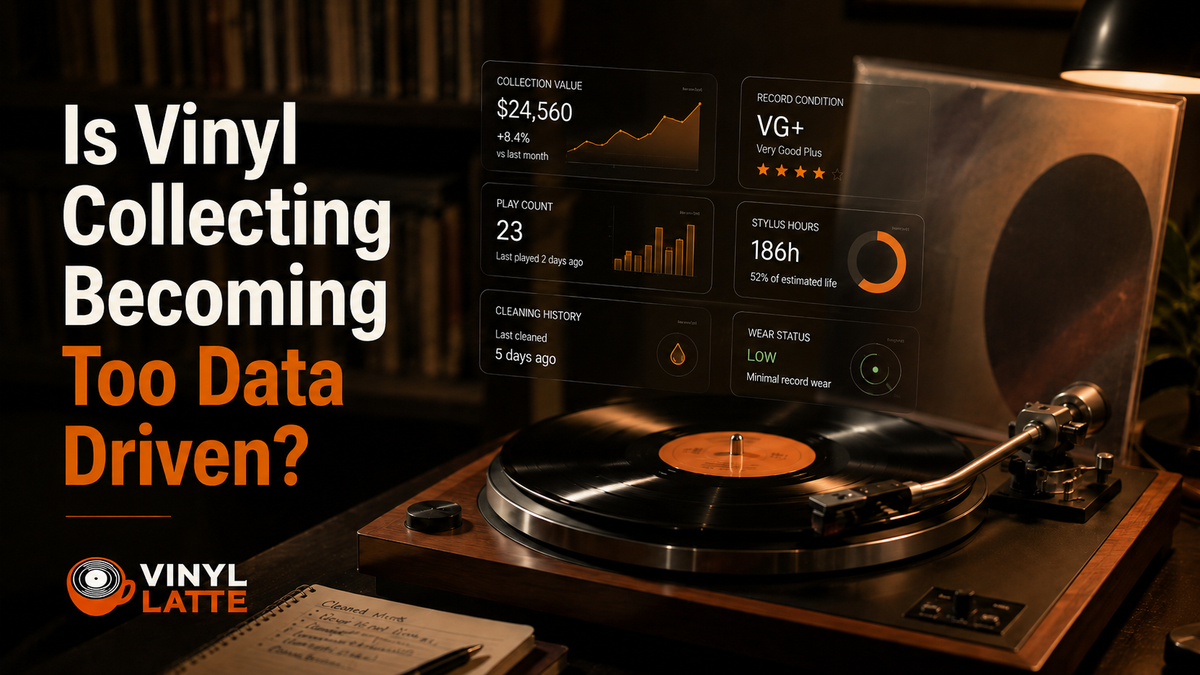
As new tools promise to track record wear, play counts, cleaning history, and cartridge life, vinyl collecting may be entering its data-driven era. But does better information help us enjoy our records, or make us afraid to play them?
Vinyl collecting has always involved a little bit of record keeping.
Some people keep a mental list. Some keep a spreadsheet. Many of us use Discogs to avoid buying the same record twice, track pressing details, or quietly watch the value of our collections rise and fall like a very dusty stock portfolio.
But a new tool from Secret Chord Analogue raises a more interesting question: are we entering the age of the fully monitored record collection?
The company has launched Vinyl Record Tracker, or VRT, a system designed to monitor a record collection over time rather than simply catalog what you own. The system can track play history, wear, cartridge condition, and collection health during normal use. It is also designed to work alongside Secret Chord Analogue’s Record Restore products and compatible hardware such as the AFI FLAT.DUO.
That is a lot more involved than simply knowing whether your copy of Kind of Blue is a 180 gram reissue, a six-eye original, or the version you bought because it was the only clean one in the bin.
And honestly, I understand the appeal.
Records are not cheap anymore. Good cartridges are not cheap. Stylus wear is real. Groove wear is real. Cleaning history matters. If you are buying expensive pressings, rare originals, audiophile reissues, or anything you might eventually resell, having a more complete record of condition and usage could be incredibly useful.
It also makes sense for dealers, archivists, and serious collectors. If a record has been professionally cleaned, flattened, inspected, played a certain number of times, and tracked against a specific cartridge, that information could become part of the record’s story. In some cases, it may even help justify condition claims in a market where “near mint” can sometimes mean “I looked at it quickly under bad lighting.”
So no, I do not think this is a silly idea.
But I do think it points to something bigger happening in the hobby.
Vinyl collecting is becoming more data driven.
We already track pressing plants, matrix numbers, mastering engineers, resale values, variant counts, cleaning methods, cartridge hours, stylus profiles, azimuth, VTA, VTF, and whether a record was stored in a rice paper inner sleeve or a paper sleeve that somehow produces more debris than the factory floor it came from.
Now we may start tracking every spin.
That can be useful. It can also become exhausting.
There is a fine line between caring for your records and becoming afraid to play them.
That is where this topic gets interesting. The entire point of a record is to be played. It is not just an asset. It is not just an object. It is not just a line item in a database. It is music, and music needs to leave the sleeve.
The more we monitor our collections, the more we risk turning listening into maintenance. Every play becomes a little event. Every record becomes something to preserve. Every cartridge hour becomes a countdown. Every favorite album becomes a question: should I play this one again, or am I slowly taking value out of it?
That mindset is dangerous because it turns the hobby inward. Instead of asking, “What do I want to hear tonight?” we start asking, “What should I avoid wearing out?”
That is not healthy.
At the same time, pretending condition does not matter is not realistic either. Anyone who has spent real money on records knows the frustration of noisy vinyl, groove damage, warps, non-fill, bad cleaning habits, and mystery abuse from previous owners. A record collection does need care. A stylus does need monitoring. A cartridge does not last forever.
So maybe the issue is not the data itself.
Maybe the issue is what we let the data do to us.
A tool like Vinyl Record Tracker could be a good thing if it helps collectors make better decisions. It could remind you when a stylus is nearing the end of its life. It could help you understand which records are getting played the most. It could create a more reliable history of cleaning, treatment, and condition. It could even encourage people to take better care of the records they already own instead of constantly chasing the next purchase.
That is the best version of this idea.
But the worst version is that it adds another layer of anxiety to a hobby that already has plenty.
Vinyl has become expensive enough that many collectors already hesitate before playing certain records. Limited editions, one-step releases, out-of-print pressings, numbered box sets, and $60 reissues have changed the way people interact with their shelves. Some records now feel less like albums and more like collectibles that happen to contain music.
That is not entirely the fault of collectors. The market has pushed us there.
When a new record costs $35, $45, $60, or more, people are naturally going to be more careful. When used records are graded aggressively and priced optimistically, condition becomes a bigger part of the buying decision. When audiophile labels produce limited runs that disappear quickly, collectors start thinking about scarcity whether they want to or not.
Data fits perfectly into that world.
It gives us control. Or at least the feeling of control.
But records have always been imperfect. That is part of the charm. They are physical objects. They age. They collect history. They sometimes have a little noise. They are handled, cleaned, flipped, stored, pulled out, and played again. A record that is loved will show some evidence of being loved.
And that is okay.
The danger is not that we now have better tools. Better tools are welcome. The danger is that we start confusing preservation with participation.
A perfectly preserved record that never gets played is not really a listening experience. It is inventory.
For some people, that is fine. There is a place for archival collecting. There is a place for investment-grade records. There is a place for serious preservation. But for most of us, the joy of vinyl is still the ritual: choosing the record, cleaning it, dropping the needle, reading the jacket, and living with an album for twenty minutes at a time.
If data supports that experience, I am all for it.
If data replaces that experience, we have a problem.
So is Vinyl Record Tracker the future of collecting? Maybe for some people. For dealers, archivists, high-end collectors, and anyone managing a serious collection, this kind of tool may make a lot of sense. It could bring more transparency to record care and condition history. It could help collectors avoid neglecting stylus wear or forgetting when a record was last cleaned.
But for the average listener, the question is more personal.
Would tracking every play make you enjoy your records more?
Or would it make you think twice before playing them?
That is where I land on this. Record care is good. Better information is good. Protecting expensive records is good. But the goal should always be to listen more, not worry more.
Vinyl collecting does not need to become another dashboard.
Sometimes the best data point is still the simplest one: this record made me want to flip it over and play side two.



Comments ()