
Taylor Swift’s Wedding Was Private. The Machine Around It Wasn’t.
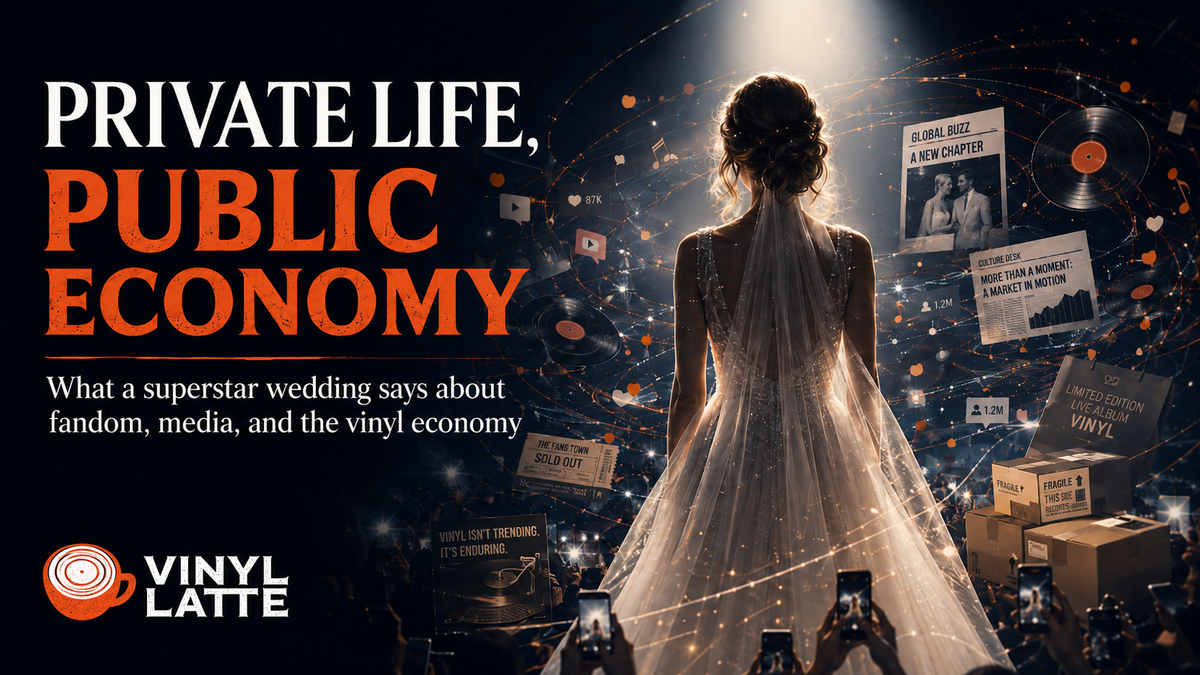
Taylor Swift’s wedding may not be a vinyl story on the surface, but the reaction around it says a lot about modern music fandom. When an artist becomes this big, even a private life event can turn into a public economy of media, branding, fan attention, and collectible culture.
Taylor Swift’s wedding to Travis Kelce was not a vinyl story.
At least not directly.
It was not about a record pressing, a deluxe edition, a limited color variant, or a surprise drop. It was not about mastering choices, sound quality, or whether the packaging justified the price.
And yet, the reaction around it says a lot about where modern music culture is headed.
Swift and Kelce reportedly married on July 3 at Madison Square Garden, turning what would normally be one of the most personal events in someone’s life into a global entertainment story almost instantly. Major outlets covered the ceremony, the guest list, the venue, the fashion, the performances, and the details that leaked out around it. Reuters even framed Dior dressing the couple as a major luxury fashion win, which tells you everything you need to know about the scale of the moment. This was not just a wedding. It was a cultural event, a media event, and a brand event all at once.
That is the part worth talking about.
Not the dress. Not the guest list. Not the celebrity spectacle.
The story is what happens when an artist becomes so large that even a private life event creates a public economy around it.
Taylor Swift is one of the defining artists of the physical media era we are living through now. She did not singlehandedly bring vinyl back, but she absolutely helped prove that physical music could still matter at massive scale. Her fans buy records not just as playback formats, but as objects, memories, artifacts, and pieces of identity. Alternate covers, colored vinyl, exclusive editions, signed inserts, bonus tracks, and limited windows have become part of the modern album experience.
That is not unique to Swift anymore. In fact, it is one of the most important ways the music industry has learned to sell physical media again.
But Swift is the clearest example of how powerful that system can become.
For years, the vinyl community has celebrated the comeback of physical music. I still do. I love that younger fans care about owning albums. I love that records have become cultural objects again. I love that people want music to exist somewhere beyond a phone screen and a monthly subscription.
But there is another side to this.
At what point does collecting stop feeling like participation and start feeling like pressure?
That question matters, especially when an artist reaches the level of Taylor Swift.
A fan buying one copy of an album because they love the music is easy to understand. A fan buying several versions because each one has a different cover, color, bonus track, or piece of packaging is also understandable. Collecting can be fun. It can be personal. It can be part of how people connect with an artist.
But when the scale gets this large, the relationship between fan and artist becomes harder to separate from the machine around them.
The artist makes the work. The label packages the work. Retailers create exclusive versions. Media outlets amplify every update. Social platforms reward urgency. Fans compare collections. Algorithms push reaction videos. Rumors become content. Content becomes commerce. Commerce becomes culture.
And eventually, even a wedding becomes part of the orbit.
That does not mean Swift is doing something wrong by getting married. It does not mean fans are wrong for caring. It does not mean every limited edition is cynical or every collector is being manipulated.
But it does raise a fair question.
Can an artist become so big that everything around them turns into a consumer event, whether they intended it or not?
That may be the real Taylor Swift story for a vinyl and music culture site.
Because the modern music industry is no longer just selling albums. It is selling proximity. It is selling participation. It is selling the feeling that you are part of the moment.
Sometimes that feeling is beautiful. Sometimes it builds community. Sometimes it gets people into record stores, onto turntables, and back into the habit of listening to full albums.
But sometimes it can also become exhausting.
Swift’s wedding coverage shows the scale of the ecosystem around her. Before official details were even widely available, fans and media were already chasing fragments. Reports circulated. Images spread. Some supposed wedding photos were later called out as AI generated fakes by people connected to the event.
That is where celebrity, fandom, and technology start to collide in a way that feels bigger than one artist.
The public wants access. The media wants attention. Platforms want engagement. Brands want association. AI tools can manufacture images faster than reality can confirm them. Fans are left sorting through all of it, trying to figure out what is real, what is marketing, what is rumor, and what they are supposed to care about.
That is a strange place for music fandom to be.
And yet, it feels like the natural endpoint of the modern superstar economy.
The same forces that make a surprise vinyl variant sell out can also turn a wedding into a global content cycle. The same fan devotion that fuels record sales can also create a sense that every moment must be witnessed, documented, decoded, and consumed. The same emotional connection that makes physical music meaningful can also become the thing the industry monetizes most effectively.
That is the tension.
Taylor Swift has done something remarkable. She has made albums feel like events again. She has helped keep physical music at the center of pop culture. She has shown that the right artist, with the right fan base, can make records feel essential in an era when music itself is more accessible than ever.
But the industry around her has also learned a lesson.
If fans will show up for the music, they may also show up for everything around the music.
That is where I think the conversation gets interesting.
Not because Taylor Swift is uniquely guilty of anything. She is not the only artist releasing multiple editions. She is not the only artist with intense fan demand. She is not the only artist whose personal life becomes part of the public narrative.
She is simply the biggest example.
And when the biggest example moves, the rest of the industry watches.
For vinyl collectors, this matters because the format is increasingly being shaped by pop’s biggest commercial strategies. The album is no longer just the album. It is the standard edition, the Target edition, the webstore edition, the signed edition, the bonus track edition, the alternate cover edition, the color variant, the deluxe reissue, the anniversary pressing, and the version that disappears before you have time to decide whether you actually wanted it.
That is not always bad.
But it does change the emotional relationship between fan and record.
A record should feel like a deeper connection to the music. It should not feel like a loyalty test.
That is the line worth defending.
Taylor Swift’s wedding will pass through the news cycle quickly. The photos, the fashion coverage, the celebrity reactions, and the social media posts will all have their moment. Then the machine will move on to the next event.
But the bigger question will remain.
How much of modern music fandom is still about the music, and how much is about keeping up with the world built around it?
For me, that is the real story.
Not whether Taylor Swift had a massive wedding.
But whether the scale of modern superstardom has made it nearly impossible for anything around the artist to remain small, private, or separate from commerce.
That is not just a Taylor Swift story.
That is a music industry story.
And for anyone who cares about records, collecting, and the future of physical media, it is worth paying attention to.

Comments ()