
I Sat Down With Supersense to Talk Mastercuts, Tape, and the Questions Collectors Are Asking
A companion piece to my full Supersense interview, exploring Mastercuts, tape sources, lacquer durability, and why this unusual analog format has sparked so much conversation among collectors.
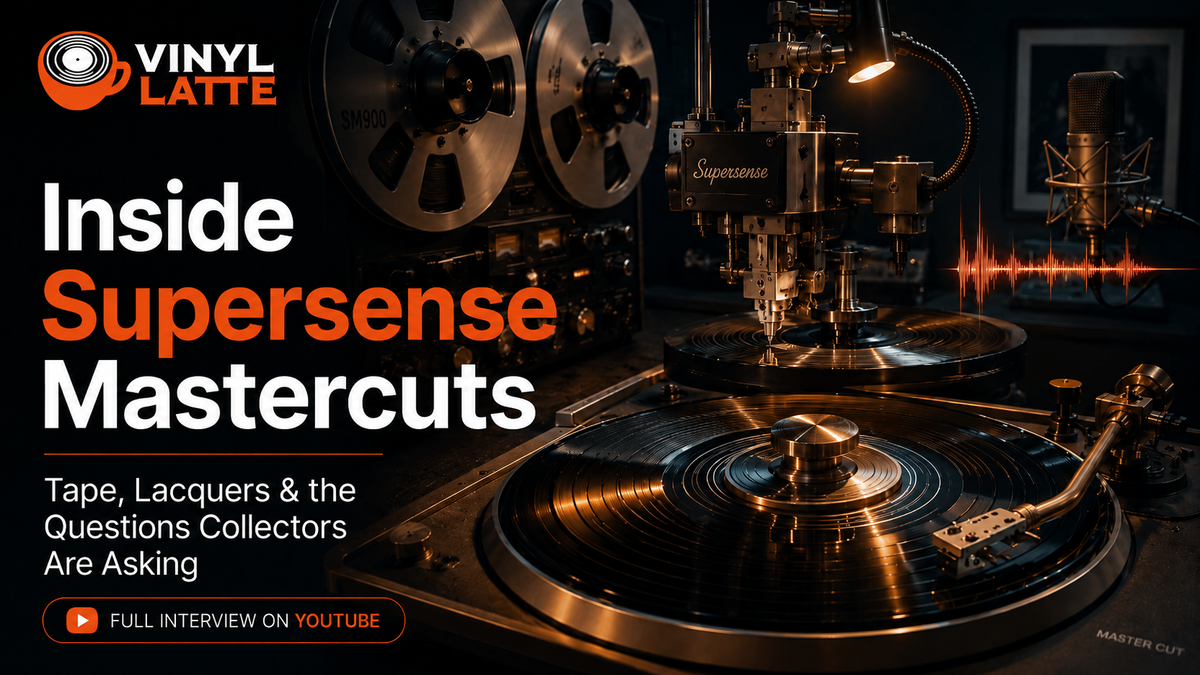
Over the last several weeks, there has been a lot of conversation around Supersense and its Mastercuts series.
Some of it has been curiosity. Some of it has been excitement. Some of it has been skepticism. That is probably inevitable when a product sits this far outside the normal vinyl conversation. Supersense Mastercuts are not traditional records. They are playback lacquers, or acetates, cut directly from tape copies sourced through major record labels and presented as a premium listening experience.
They are expensive. They are limited. They are fragile compared to a standard vinyl record. And for many collectors, they raise a very fair set of questions.
Where do the tapes come from?
How many times can a lacquer be played?
How close is this really to the source?
Why does this exist at all?
Rather than speculate, I wanted to go directly to the people behind the product. I recently sat down with Cornelius and Doc from Supersense for a long-form conversation about Mastercuts, the company’s philosophy, the production process, and the questions many collectors have been asking.
You can watch the full interview on YouTube here:
Why Mastercuts Are So Different
Most audiophile record conversations tend to orbit around familiar topics. We talk about mastering engineers, pressing plants, vinyl formulations, source material, jackets, quality control, and whether a release was cut AAA or involved a digital step somewhere in the chain.
Supersense is operating in a different lane.
The basic idea behind a Mastercut is to stop the record making process before the lacquer is used to create metal parts, stampers, and ultimately pressed vinyl. Instead of treating the lacquer as a production step, Supersense treats it as the final playback medium.
That means each copy is individually cut. It also means the listener is hearing something that has not gone through the traditional record manufacturing chain.
In the interview, Doc described one of the immediate differences as the silence of the surface. A lacquer does not behave exactly like vinyl. When the stylus hits the groove, the sense of background quiet can be striking, especially on intimate recordings where space, air, and decay are part of the emotional experience.
That does not automatically mean every collector needs one. But it does mean this is not simply another premium reissue series with fancier packaging. Supersense is asking a different question: what happens when the lacquer itself becomes the listening experience?
The Tape Question
One of the biggest areas of curiosity around Mastercuts is source material.
In the interview, Cornelius explained that Supersense works through licensing relationships with major record companies and receives one-to-one tape copies, or clones, made from approved source material. Those tapes are then brought into the Supersense cutting room in Vienna, where the lacquers are cut using their tape machines and custom-built cutting system.
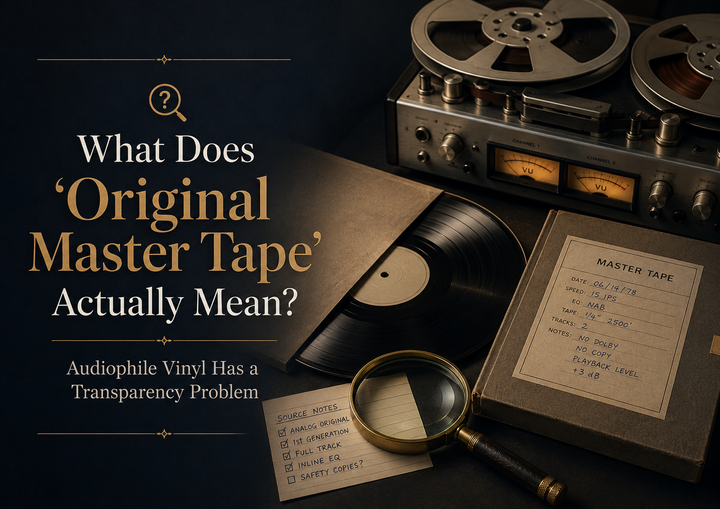
This is one of the more important distinctions in the conversation. Supersense is not claiming to have original master tapes sitting casually in the shop. The process, as explained in the interview, involves licensed tape copies that are created and supplied through proper channels.
That may not satisfy every skeptic, and that is fine. This is an expensive product, and expensive products deserve scrutiny. But one of the reasons I wanted to have this conversation was to let Supersense explain the process in its own words.
Cornelius also addressed documentation. While licensing agreements themselves are confidential, he said Supersense has communication records, logistics documentation, and relationships with the studios involved in creating the tape copies. His position was not that people should simply take everything on faith, but that the process is real, traceable, and rooted in professional relationships.
Inside the Cutting Room
One of the most interesting parts of the interview was seeing how much of the operation is built around doing things in-house.
Doc walked through the cutting room and showed the tape machine feeding multiple lathes, including custom cutting machines that Supersense developed itself. The goal is to cut multiple lacquers from a single tape playback while maintaining consistency and quality.
This matters because the economics and logistics of the product are very different from pressing records. A normal vinyl record is cut once, plated, and then replicated through the pressing process. With Mastercuts, every copy is effectively its own original cut.
That is also part of what makes the product unusual. It is not mass production in the normal sense. It is closer to a studio object, produced one at a time, with each copy existing as an individual cut from the tape playback.
Supersense also brings that analog philosophy into the packaging. Rather than reproducing original album jackets through a modern digital print workflow, they create their own artwork and packaging in-house using analog print methods. That includes letterpress and handmade presentation elements, which gives each release a distinct identity.
This will not appeal to everyone. Some collectors want original artwork, original jackets, and a release that feels as close to the historical album presentation as possible. Supersense is doing something else. The company is treating each Mastercut as an object built around the listening experience, not as a conventional reissue.
Are They Durable?
The other major concern is durability.
A lacquer is softer than vinyl. Anyone familiar with the record manufacturing process knows that acetates are not typically treated as long-term consumer playback media. So the obvious question is simple: how many times can you actually play one?
Cornelius addressed this directly in the interview. He referenced testing by Korfaudio, where one of Supersense’s lacquers was reportedly played more than 100 times and then analyzed for measurable degradation. According to Supersense, the test showed very little difference, with only slight changes in the highest frequencies.
That does not mean a Mastercut should be treated casually. Supersense recommends careful handling, a properly set up tonearm and cartridge, correct tracking force, and avoiding oils or residue from fingers. This is not a record you toss around while flipping through a pile next to the turntable.
But the interview did make one point clear: Supersense does not view these as disposable objects meant to be played once or twice and retired. Their position is that, when handled properly, a Mastercut can be played and enjoyed many times.
That is important, because the price only makes sense if this is something you can actually live with as a listening format.
Price, Value, and Who This Is For
There is no getting around the price.
In the U.S., many Supersense Mastercuts can cost well over $500 per title. For a lot of collectors, that will be a nonstarter. And honestly, that is completely reasonable. No format, no matter how interesting, is required ownership.
But I do think it is worth separating “expensive” from “pointless.”
For me, part of the appeal is that Mastercuts offer a way to get closer to the tape experience without building a tape playback system. I do not have a reel-to-reel setup in my listening room. Many collectors do not. A proper tape machine, maintenance, calibration, and access to high-quality tape copies can quickly become a very expensive and specialized path.
Mastercuts offer a different route. They allow someone deeply invested in vinyl playback to experience something closer to the tape, through a system they already own.
That does not make them a replacement for great records. It does not make them better than every audiophile pressing. And it certainly does not make them a sensible purchase for everyone.
But it does make them interesting.
The more I have listened to the Mastercuts I own, the more I understand the emotional pull. There is a directness to the presentation that can be startling, especially on recordings that have often been remastered, re-EQed, or reshaped over the years. Hearing music in a more raw, immediate form can change the way you respond to it.
Why I Wanted to Have This Conversation
What I appreciated most about the interview was that it gave space for a slower, more thoughtful discussion.
This was not a quick product pitch. It was not a surface-level overview. We talked about sourcing, cutting, packaging, durability, philosophy, analog preservation, and the role of physical media in a world where music is increasingly consumed as background content.
Cornelius spoke about Mastercuts as a way to bring focus back to individual recordings. Doc spoke about the magic of analog processes and his long-standing interest in preserving tactile, physical media. Whether you agree with every claim or not, it is clear that Supersense is not approaching this as just another luxury collectible.
They believe in the format.
And after spending time with them, I better understand why.
Final Thoughts
Supersense Mastercuts will remain polarizing. That is part of what makes them interesting.
For some collectors, they will be too expensive, too delicate, too unconventional, or too far removed from what they want out of record collecting. For others, they may represent one of the most direct and emotionally engaging ways to experience certain recordings on a turntable.
I do not think the takeaway is that everyone needs to buy one.
The takeaway is that Supersense is doing something different enough to deserve a real conversation.
That is what this interview was about. Not hype. Not defense. Not trying to convince every skeptic. Just a thoughtful discussion with the people behind one of the most unusual products in the audiophile world right now.
Watch the full interview on YouTube here:


Comments ()