
Qobuz Finally Comes to Apple TV. Can It Replace a Dedicated Hi-Fi Streamer?
Qobuz finally arrives on Apple TV with lossless streaming, Qobuz Connect, and high-resolution audio support. We explore compatibility, audio resolution limits, and whether Apple TV can truly replace a dedicated hi-fi streamer.
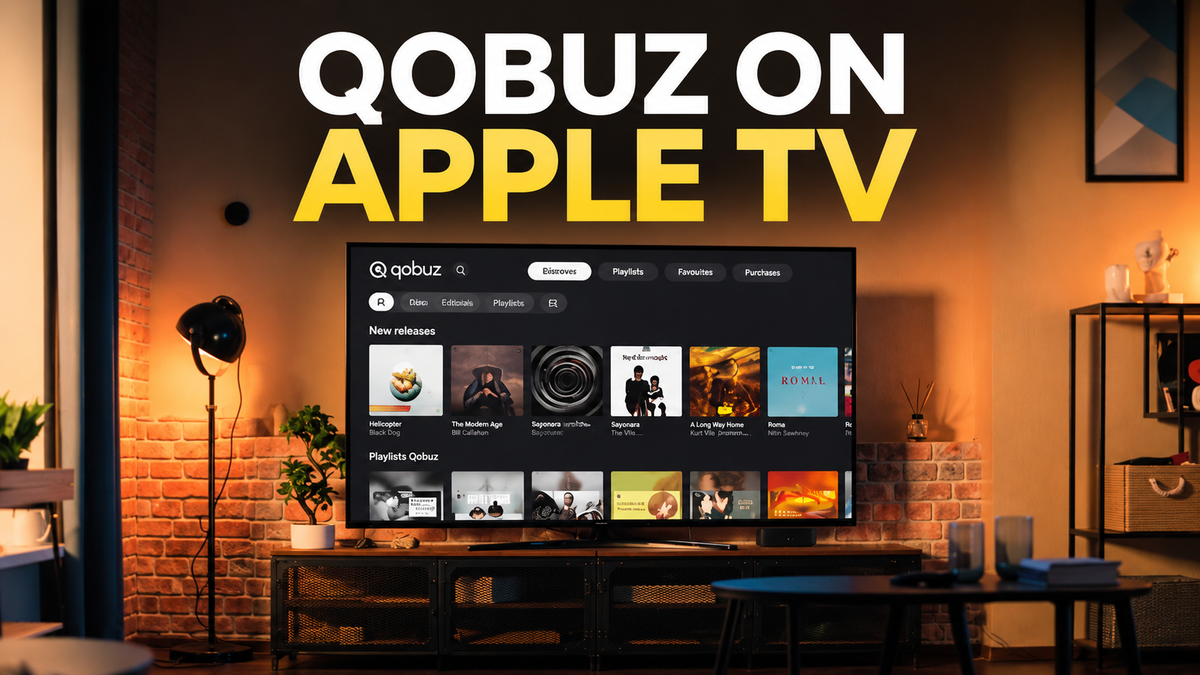
Qobuz has finally brought lossless and high-resolution music to Apple TV with a dedicated app, Qobuz Connect, and support for up to 24-bit/192 kHz audio. But the resolution depends on which Apple TV you own, and replacing a dedicated music streamer is a more complicated question.
For years, Apple TV has been one of the most convenient ways to bring movies, television, and streaming entertainment into the living room. Yet for listeners who prefer Qobuz, one important feature has been missing: a native application.
That changed on November 18, 2026, when Qobuz officially launched its Apple TV app, giving subscribers direct access to its lossless music catalog, editorial recommendations, and high-resolution recordings without relying on AirPlay or another streaming device.
The announcement is significant for anyone who has built a music system around Apple TV and an A/V receiver. It also arrives shortly after Apple's introduction of high-resolution lossless playback through tvOS 27, which has expanded the audio capabilities of compatible Apple TV hardware.
With Qobuz now advertising playback up to 24-bit/192 kHz, an interesting question emerges.
If an Apple TV can deliver high-resolution music to your audio system, do you still need a dedicated hi-fi streamer?
The answer depends on considerably more than the numbers displayed on the screen.
Qobuz Brings Its Complete Music Experience to Apple TV
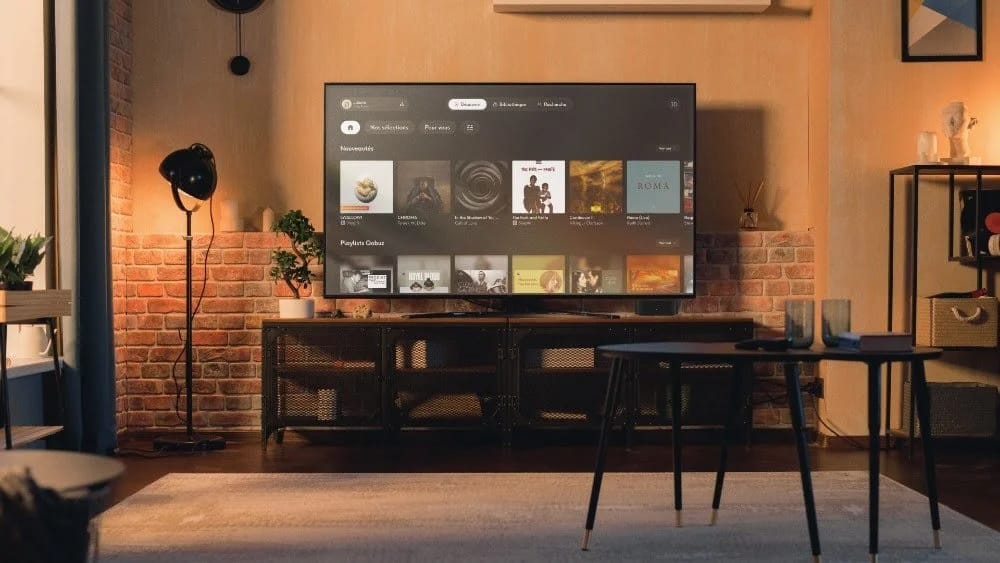
Qobuz has designed its new application around listening in the living room rather than simply displaying a mobile interface on a television.
Subscribers can browse the service's music catalog, explore new releases, revisit saved albums, and access the editorial recommendations that have become an important part of the Qobuz experience.
The application includes:
- Lossless music streaming, from CD quality to high-resolution audio on compatible hardware.
- Qobuz Connect for controlling playback from a smartphone or tablet.
- Synchronized lyrics, including translations where available.
- Album information, track listings, and recording credits.
- Editorial selections, including Albums of the Week, Qobuzissimes, and Ideal Discography recommendations.
- Personalized recommendations, playlists, and mixes.
- Synchronization of saved albums, artists, playlists, and favorites across devices.
The inclusion of recording credits deserves particular attention.
For listeners interested in mastering engineers, producers, musicians, and the people responsible for creating an album, those details can be just as valuable as another playlist recommendation.
Bringing them onto a large television screen makes music discovery feel more like an activity in its own right rather than something confined to a smartphone.
Still, the interface is only part of the story.
The Important Detail: Not Every Apple TV Supports 24-bit/192 kHz
Qobuz advertises playback resolutions of up to 24-bit/192 kHz with its new Apple TV application.
However, that figure is not universal.
According to Qobuz's official November 18 announcement, the application supports Apple TV models beginning with the fourth-generation Apple TV, now commonly called Apple TV HD, provided they run tvOS 26 or later.
The company also explicitly states that the second-generation Apple TV 4K, released in 2021, is limited to a maximum sample rate of 48 kHz.
That distinction is important because Apple's Apple TV product naming can be confusing.
Apple TV Compatibility and Audio Resolution
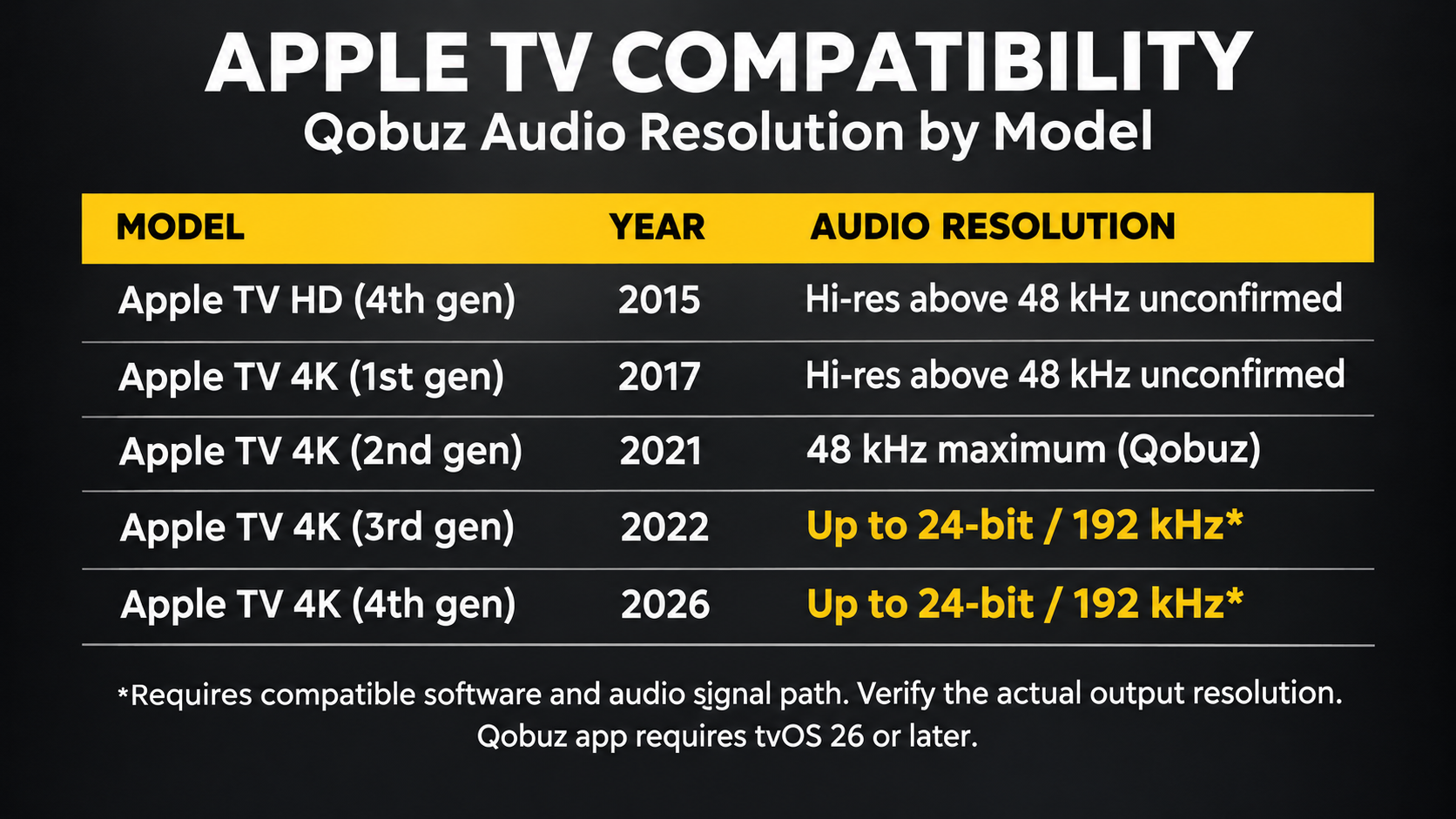
An important qualification: Qobuz's announcement establishes a maximum supported resolution for the application and explicitly identifies the 2021 model's limitation. It does not provide a complete, independently measured output specification for every Apple TV generation.
Apple separately confirms that Hi-Res Lossless playback in Apple Music is available on third-generation Apple TV 4K hardware and newer. That supports the capabilities attributed to the 2022 and 2026 devices, but it does not independently verify how the new Qobuz application handles every audio format.
Why tvOS 27 Matters
For years, Apple TV's 48 kHz audio limitation was a recurring criticism among audiophiles.
Apple addressed that limitation in September 2026 when it introduced high-resolution lossless support for Apple Music through tvOS 27.
Compatible hardware can now support resolutions as high as 24-bit/192 kHz.
Qobuz requires tvOS 26 or later to install its application, but the minimum requirement for running the app should not be confused with the requirements for obtaining its highest advertised audio resolution.
Apple's high-resolution improvements arrived with tvOS 27. Owners of compatible Apple TV 4K models should therefore update their operating system before evaluating high-resolution playback.
What remains to be independently confirmed is whether Qobuz consistently delivers each recording's native resolution through the complete HDMI audio path.
That question is more interesting than it might initially appear.
Does 24-bit/192 kHz Actually Reach Your DAC?
A streaming service offering a 24-bit/192 kHz recording and an audio system receiving that exact digital signal are two different things.
Consider the playback chain.
With a dedicated network streamer, the path might look like this:
Qobuz → Network Streamer → USB or Digital Audio Output → DAC → Amplifier
With Apple TV, the arrangement is different:
Qobuz → Apple TV → HDMI → A/V Receiver or Processor → Amplifier
Both arrangements can deliver excellent audio. However, they involve different hardware, interfaces, and potentially different processing stages.
Apple TV uses HDMI for external digital audio output rather than the dedicated USB audio, coaxial, or optical outputs offered by many purpose-built music streamers.
That matters if your preferred DAC does not have an HDMI input.
It also matters when an A/V receiver or television sits between the Apple TV and the final digital-to-analog conversion.
Depending on the equipment and configuration, the signal could encounter sample-rate conversion, volume processing, bass management, room correction, or other processing before reaching the speakers.
None of those operations automatically means the result will sound worse.
But they make it important to establish what the system is actually doing.
For example, a Qobuz recording identified as 24-bit/192 kHz could be played through an Apple TV connected to a receiver whose input display reports 48 kHz.
In that scenario, the receiver is not receiving the recording at its advertised native sample rate, regardless of what the Qobuz interface displays.
Even a receiver reporting 192 kHz does not, by itself, establish bit-perfect playback. It confirms the incoming sample rate, not necessarily that every sample is unchanged.
Lossless streaming, high-resolution compatibility, and bit-perfect output are related concepts, but they are not interchangeable.
Until the new application is independently measured across different Apple TV models, describing every compatible setup as bit-perfect would be premature.
Qobuz Connect Might Be the Most Useful Feature
While high-resolution support will attract attention, Qobuz Connect could have the greatest impact on everyday listening.
The feature allows listeners to select Apple TV as a playback destination from the Qobuz application on a smartphone or tablet.
The Apple TV then handles the stream while the mobile device provides playback control.
That is an important distinction from using AirPlay to send audio from a phone.
With Qobuz Connect, the mobile device functions primarily as a controller rather than the source relaying the music stream.
Listeners can search for albums, build a queue, skip tracks, and manage playback from the familiar Qobuz interface without navigating menus using the Apple TV remote.
For anyone who already uses Qobuz Connect with dedicated hardware, the experience should feel familiar.
It also makes Apple TV a more practical music source when the television itself is not the focus of the listening session.
There is something appealing about having access to the same music library throughout the house without having to learn an entirely different interface for every room.
Can Apple TV Replace a Dedicated Network Streamer?
For some listeners, absolutely.
Imagine a living room system consisting of an Apple TV 4K, a capable A/V receiver, and a good pair of speakers.
If the receiver supports the desired audio format, the Apple TV is running appropriate software, and the system provides a straightforward signal path, adding a separate network streamer solely to access Qobuz becomes harder to justify.
That is particularly true for listeners who value simplicity and already use Apple TV for most of their entertainment.
But dedicated music streamers still have advantages that extend beyond streaming resolution.
The Case for a Dedicated Streamer
A purpose-built network player might offer USB audio output, coaxial or optical digital connections, analog outputs, native sample-rate switching, local music library integration, and more specialized playback controls.
Those capabilities can be important in a system built around a standalone DAC and two-channel amplification.
They can also provide greater flexibility when a listener wants to avoid routing stereo music through a home theater processor.
Then there is the question of signal processing.
Some listeners deliberately use a streamer to convert PCM recordings into higher-resolution PCM or DSD before sending the signal to a compatible DAC.
Others prefer to preserve the original format with as little intervention as possible.
Neither philosophy is inherently correct, but both require control over the playback chain.
Dedicated devices from manufacturers such as Lumin, Auralic, Aurender, and others serve an audience interested in precisely those capabilities.
An Apple TV is not automatically a replacement for them simply because it supports the same maximum sample rate.
It is also worth remembering that high-resolution specifications alone do not determine sound quality.
A well-mastered 16-bit/44.1 kHz recording can be more satisfying than a poorly mastered 24-bit/192 kHz release.
The recording, mastering, DAC implementation, and acoustic performance of the listening room remain essential considerations.
What Would a Proper Listening Comparison Reveal?
At Vinyl Latte, we believe comparisons should begin by controlling the variables rather than assuming that a more expensive component must sound better.
Our reference digital playback system uses a Lumin U2X network transport feeding a T+A DAC 200, while our home theater system includes an Apple TV and Anthem AVM 90 processor.
Those components provide two different approaches to digital playback, but comparing their outputs without accounting for the differences in DACs, processing, and signal paths would not isolate the performance of the streaming devices.
A meaningful evaluation of the new Qobuz application would need to answer several questions.
First, does the Apple TV output the expected sample rate when playing known 44.1, 48, 96, and 192 kHz recordings?
Second, does the output change correctly when switching between those recordings, or does the system apply sample-rate conversion?
Third, can a comparison be conducted using equivalent downstream conversion, processing, and carefully matched playback levels?
Finally, if audible differences are identified, can they be reproduced consistently under controlled listening conditions?
Measuring the received format would be an important starting point. Establishing bit-perfect transmission would require additional verification, and a defensible listening comparison would need to account for differences in the complete signal chain.
Vinyl Latte has not yet performed these tests on the newly released Qobuz Apple TV application. Accordingly, we are not claiming that it sounds better, worse, or identical to a dedicated network streamer.
Those conclusions require evidence, not assumptions based on product categories or price tags.
The Bigger Picture: High-Resolution Music Is Becoming More Accessible
The arrival of Qobuz on Apple TV is another sign that high-resolution streaming is becoming less dependent on specialized audio hardware.
For years, enjoying lossless music was relatively straightforward, but getting high-resolution recordings to play through a television-based system could involve unexpected restrictions and compromises.
Apple's recent improvements and Qobuz's new application make that process considerably more approachable.
This is good news for music listeners.
There will always be enthusiasts who prefer carefully selected dedicated components, just as there are vinyl collectors who continue investing in better cartridges, tonearms, and phono stages.
But enjoying high-quality music should not require buying specialized hardware simply to overcome an application compatibility problem.
Removing that barrier is a meaningful improvement.
And if more people begin exploring album credits, discovering unfamiliar artists, and spending time listening to complete recordings because Qobuz is available on their television, that is a welcome development.
Vinyl Latte's Verdict
Qobuz arriving on Apple TV is an overdue addition to an already capable entertainment platform.
The native interface, synchronized lyrics, recording credits, and Qobuz Connect integration offer genuine convenience. Support for high-resolution audio on compatible hardware makes the announcement even more interesting.
However, the hardware limitations deserve attention.
Owners of the second-generation Apple TV 4K should understand its stated 48 kHz ceiling. Owners of newer models should verify their software versions and the actual audio format reaching their receiving equipment before assuming every recording is being reproduced at its native resolution.
For a living room system already built around Apple TV and a capable A/V receiver, the new Qobuz app may eliminate the need for another streaming component.
For a dedicated two-channel system built around a standalone DAC, specialized digital outputs, and carefully chosen playback settings, a purpose-built network streamer continues to offer meaningful advantages.
Ultimately, the question is not whether a dedicated streamer is more expensive or whether Apple TV can display 24-bit/192 kHz.
It is whether the two approaches deliver the same signal, through comparable playback chains, and whether any differences can be demonstrated under controlled conditions.
Until those questions are answered, replacing a dedicated streamer is a decision best made around the needs of the system rather than the specifications alone.
And perhaps that is the most encouraging aspect of this announcement.
Listeners now have another way to enjoy their music without necessarily purchasing more equipment.
For those who care about the music first, that is a very good thing.
Sources and Further Reading
Qobuz: Official Apple TV Launch Announcement (November 18, 2026)
https://community.qobuz.com/press-en/qobuz-is-now-available-on-apple-tv
Apple: About Lossless Audio in Apple Music
https://support.apple.com/en-us/118295
Apple: Major Software Updates, Including tvOS 27 (September 14, 2026)
Qobuz Connect
https://www.qobuz.com/us-en/connect
Editorial note: This article reports announced features and documented compatibility information. No hands-on testing of the newly released Qobuz Apple TV application was performed for this article.

Comments ()