
Schiit's $149 Mani 3 Fixes the Most Annoying Thing About Affordable Phono Preamps
Schiit's new $149 Mani 3 phono preamp adds front-panel controls, improved circuitry, and flexible MM/MC cartridge support. But is it worth upgrading from the Mani 2?

The new Mani 3 brings front-panel controls, improved circuitry, and greater cartridge flexibility without raising the price. But is it worth upgrading if you already own a Mani 2?
There's a particular kind of frustration that only hi-fi enthusiasts understand.
You buy a component designed to help you fine-tune your system. It offers adjustable gain, cartridge loading, and other useful settings. Then you discover that making those adjustments requires disconnecting cables, turning the component upside down, and consulting a manual.
Welcome to the occasionally absurd world of affordable phono preamplifiers.
Schiit Audio has apparently decided enough is enough.
On October 21, the Texas-based manufacturer introduced the Mani 3, the latest version of its popular entry-level phono stage. It costs $149, exactly the same as the Mani 2 it replaces.
There's revised circuitry, improved measured performance, and a new control system. But the most meaningful change might be something considerably less glamorous.
You can finally adjust the important settings without turning the thing over.
And for anyone who enjoys experimenting with different cartridges, that could be worth more than another impressive specification.
The Best Upgrade Isn't Hidden Inside
The Mani 2 was already an unusually flexible phono stage for its price.
It supported moving-magnet (MM) and moving-coil (MC) cartridges, offered multiple gain settings, and included adjustable loading and low-frequency filtering.
The problem was accessing those features.
Its configuration switches were located underneath the chassis. Once the unit was connected to a turntable, amplifier, power supply, and ground wire, changing a setting could become an unnecessarily awkward exercise.
The Mani 3 takes a more sensible approach.
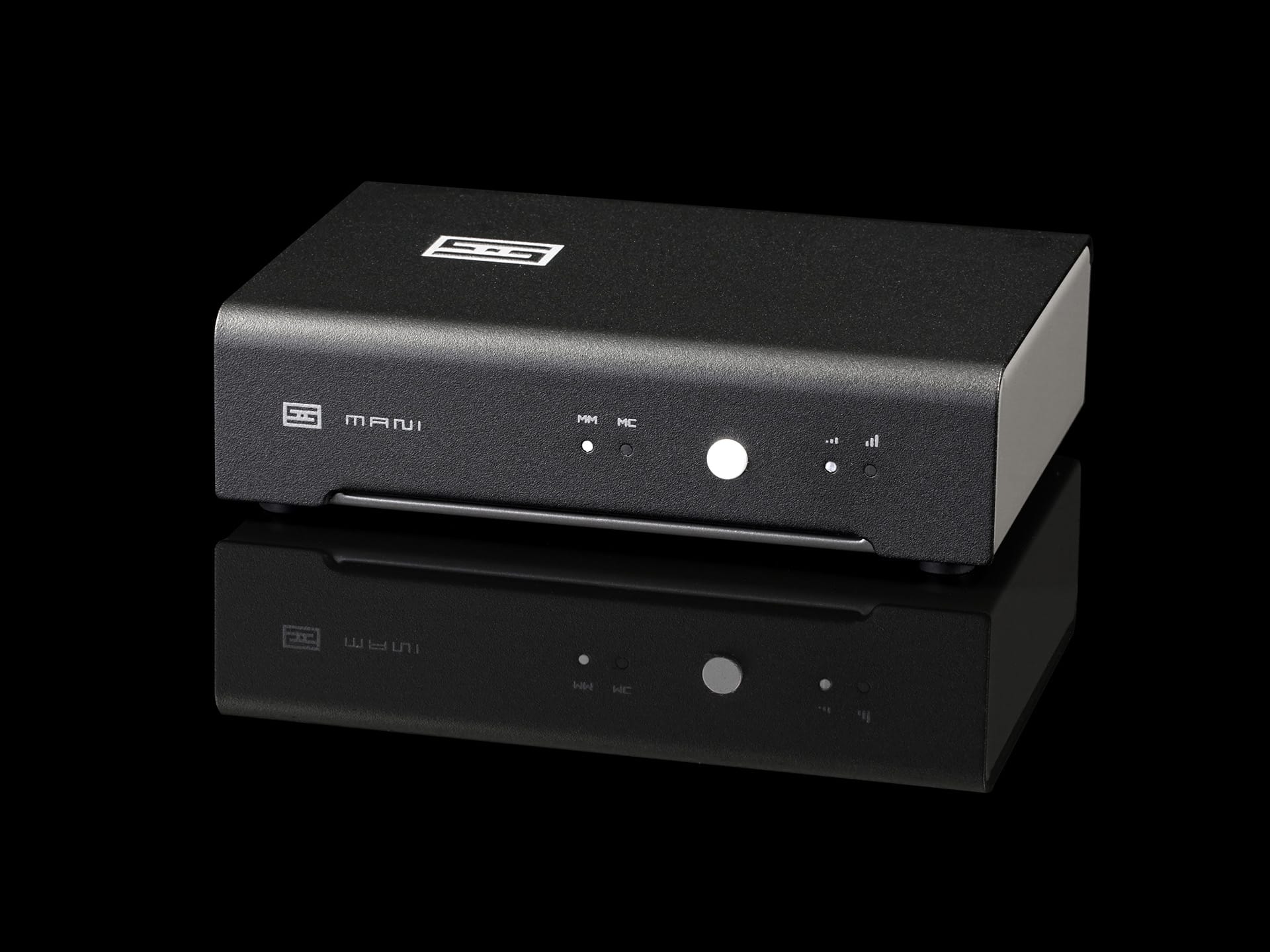
A button on the front panel now controls gain and the basic MM/MC loading selection. Indicator LEDs show the selected configuration.
Four gain settings are available: 30, 40, 50, and 60dB.
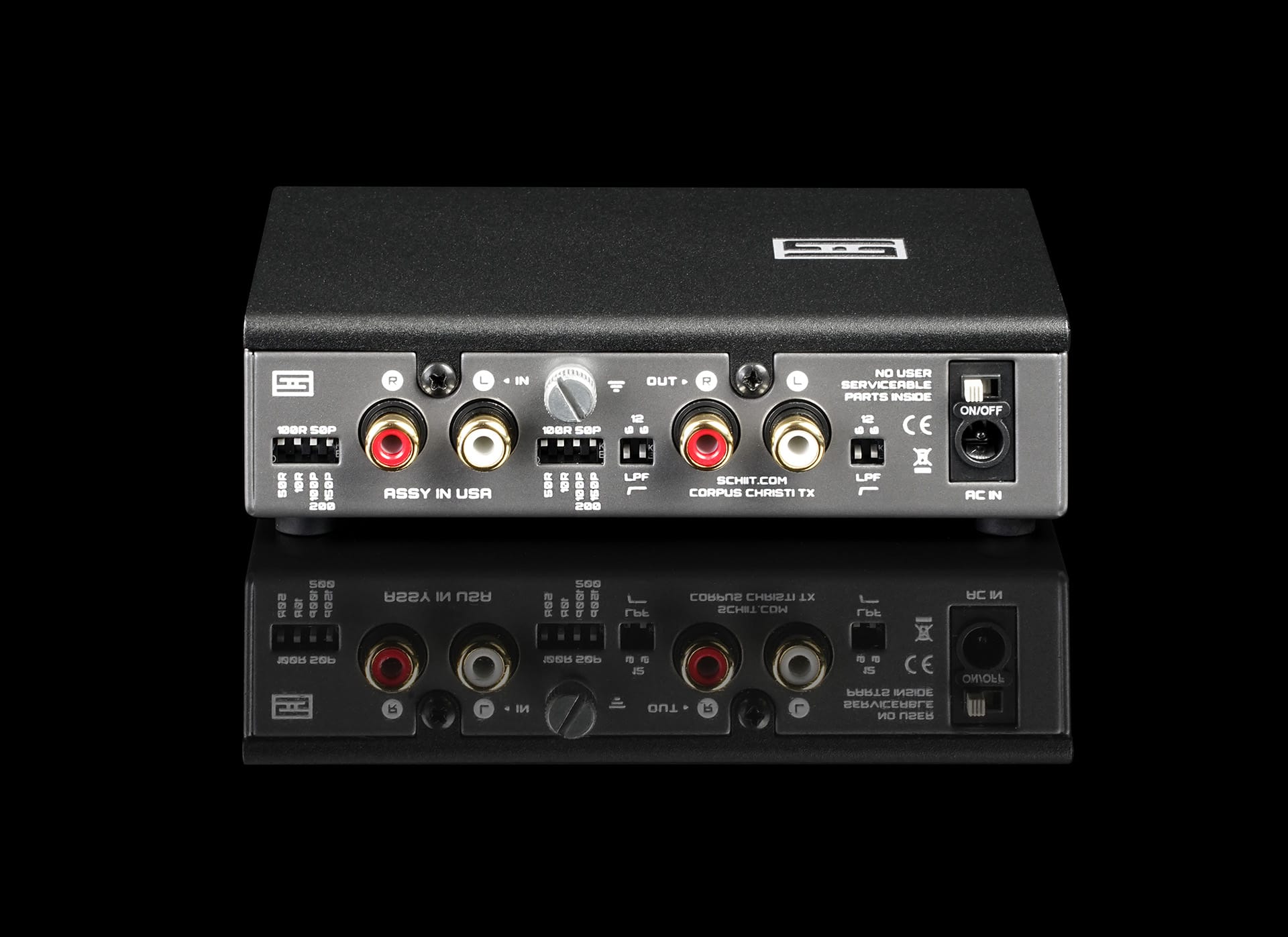
The more specialized cartridge-loading adjustments and low-frequency filter controls remain on the rear panel.
It's a practical compromise. Most listeners won't need to change those secondary settings frequently, but anyone experimenting with cartridges or gain levels will appreciate having the primary controls within reach.
Schiit has also introduced microprocessor-supervised switching and precision sealed relays. The system briefly mutes the output when gain settings change, allowing the circuitry to stabilize and reducing switching disturbances.
You should still turn down your amplifier before making substantial gain changes. Moving from 30dB to 60dB represents a significant increase in amplification.
But the overall experience should be considerably more convenient.
Sometimes good engineering means recognizing that people actually have to use the equipment.
What's Actually Changed Inside the Mani 3?
Schiit didn't simply move a few switches and call it a new generation.
The Mani 3 also receives several circuit-level changes intended to improve noise performance, accuracy, and headroom.
The previous Mani 2 used Texas Instruments OPA1612 operational amplifiers. The Mani 3 replaces those with Analog Devices AD4898 devices.
The new design retains a passive RIAA equalization network, precision resistors and capacitors, and a DC-coupled signal path supported by a revised DC servo.
For anyone unfamiliar with RIAA equalization, it's a fundamental part of vinyl playback.
Records are cut using a standardized frequency curve that reduces bass and emphasizes treble. A phono preamplifier applies the complementary playback curve, restoring the intended tonal balance while amplifying the cartridge's very small output signal.
The accuracy of that process matters.
Schiit specifies RIAA accuracy of ±0.15dB from 20Hz to 20kHz for the Mani 3, compared with the Mani 2's published ±0.2dB specification.
The power supply has also been revised. The regulated supply rails increase from ±16V to ±17.5V, providing additional voltage headroom.
The Mani 3 uses a linear power supply with an external 16VAC transformer rather than a conventional switching power adapter.
These are worthwhile engineering refinements, particularly in a product selling for $149.
But they shouldn't be mistaken for proof of a dramatic audible transformation.
A change in op-amp, for example, doesn't automatically produce better sound. Its performance depends on the surrounding circuit, operating conditions, power supply, and implementation.
Similarly, a modest improvement in RIAA accuracy is measurable, but whether it produces an audible difference under normal listening conditions is another question.
Schiit itself acknowledges that the overall performance improvement over the Mani 2 is incremental.
That's an important distinction, especially for anyone considering replacing a perfectly functional older model.
Mani 2 vs. Mani 3: What Do You Actually Gain?
Here's how the two generations compare using their published specifications and features.
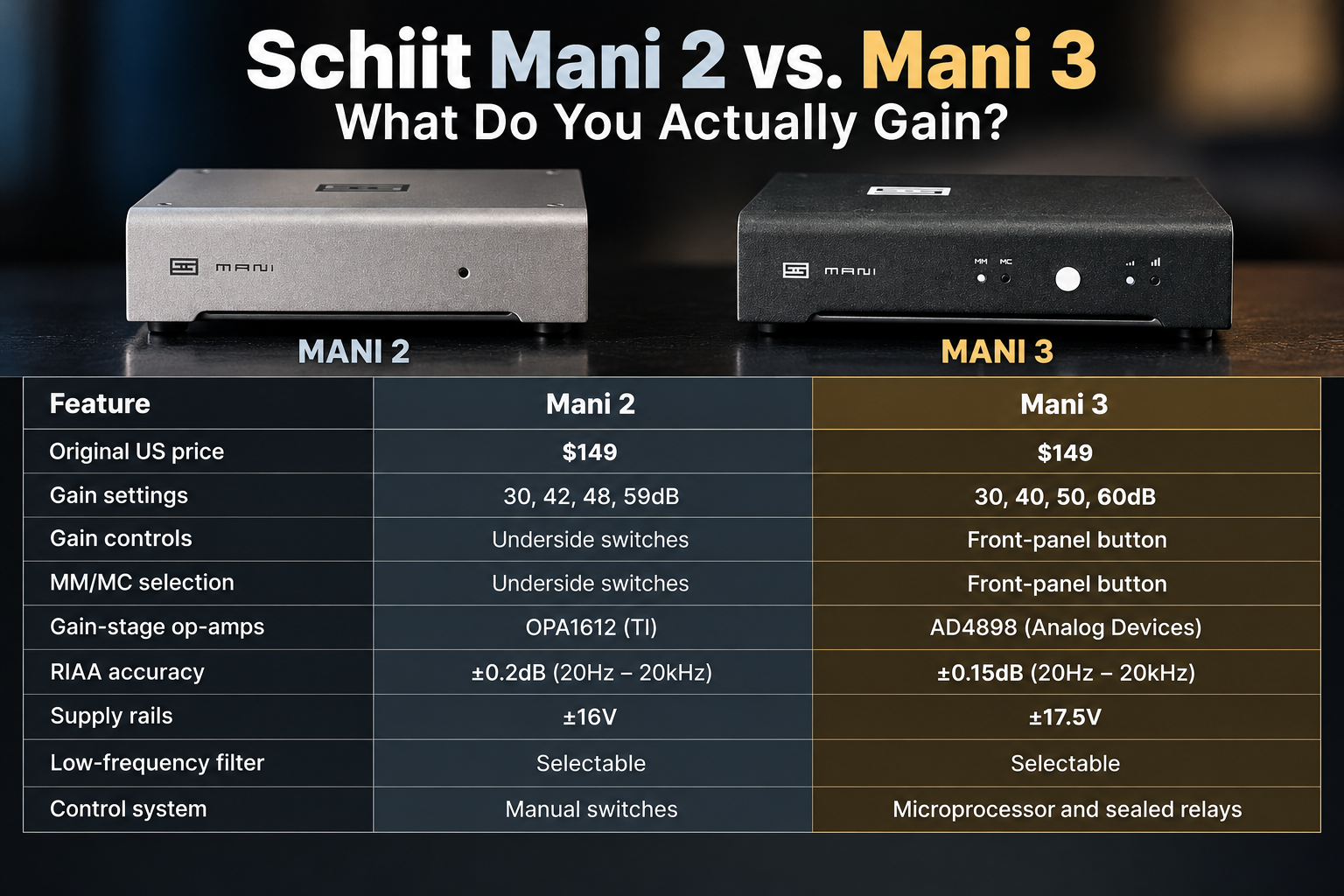
The biggest change is usability.
The internal refinements are welcome, but the Mani 2 was already designed around low noise, substantial headroom, and flexible cartridge support.
If you own a Mani 2, use one cartridge, and rarely change its settings, the Mani 3 probably isn't an urgent upgrade.
If you're constantly experimenting with cartridges or gain levels, the improved controls become much more compelling.
And if you're buying your first external phono preamp, there's little reason to seek out the older generation at the same price.
One Phono Preamp for MM, MC, and Moving-Iron Cartridges?
One of the Mani 3's strongest selling points is its flexibility.
Many affordable phono stages are designed primarily for moving-magnet cartridges. Some support moving-coil designs, but offer limited options for matching them properly.
The Mani 3 provides four gain settings spanning 30 to 60dB, along with selectable input loading.
Its standard MM setting is 47kΩ with 50pF input capacitance. The standard MC setting is 100Ω with 50pF.
Additional resistive loading options include 10Ω and 50Ω, while capacitance settings can be adjusted to 100, 150, or 200pF.
This makes the Mani 3 a potential match for a wide range of moving-magnet, moving-coil, and moving-iron cartridges.
However, flexibility doesn't mean every cartridge should use the same settings.
A high-output moving-magnet cartridge might be perfectly comfortable at 40dB of gain. A low-output moving-coil design may require 60dB.
The correct setting depends on cartridge output, recommended loading, downstream amplifier sensitivity, and available system gain.
More gain isn't automatically better.
Excessive gain can overload a phono stage or downstream component, introducing distortion and reducing usable volume-control range.
Too little gain may require considerably more amplification later in the system, potentially making noise more noticeable.
The best starting point is always the cartridge manufacturer's recommendation, followed by careful listening and, where practical, level-matched comparisons.
And that brings us to something frequently overlooked in discussions of phono preamplifiers.
Why Gain and Loading Matter More Than Price
It's tempting to assume that a more expensive phono stage must automatically deliver better sound.
But a poorly matched cartridge and phono stage can undermine even an otherwise excellent analog system.
Consider a moving-coil cartridge.
Its output voltage may be a fraction of what a typical moving-magnet cartridge produces. That makes appropriate gain particularly important.
Loading introduces another variable.
With moving-magnet cartridges, total capacitance—including tonearm wiring and interconnects—can influence the cartridge's high-frequency response.
With moving-coil cartridges, resistive loading interacts with the cartridge's electrical characteristics and the phono stage's input behavior.
These relationships aren't identical across cartridge types, and loading changes shouldn't be treated as a universal tone control.
The point is that proper electrical matching matters.
A $149 phono stage with suitable gain and loading may be a better practical match for a particular cartridge than a more expensive component configured incorrectly.
That doesn't establish that the less expensive unit sounds better. It simply means price is not a substitute for compatibility.
The Mani 3's appeal is that it gives owners useful adjustment options without requiring a major investment.
For someone starting with a modest moving-magnet cartridge and considering a moving-coil upgrade later, that flexibility could extend the useful life of the component.
A Useful Feature for Records That Aren't Perfect
The Mani 3 also retains a selectable passive low-frequency filter.
This feature doesn't receive much attention in product announcements, but it can be valuable in real-world vinyl systems.
Warped records, tonearm-cartridge resonance, and mechanical vibration can generate extremely low-frequency energy that isn't part of the musical performance.
Sometimes the effect is visible before it's audible.
You might notice a speaker's woofer moving dramatically during quiet passages, even though the music contains little deep bass.
That unnecessary movement consumes amplifier power and can increase distortion.
The Mani 3 offers selectable 6dB-per-octave and 12dB-per-octave low-frequency filtering centered at 15Hz.
The filter can also be bypassed.
For listeners with well-behaved turntables and flat records, bypassing it may be the preferred starting point.
For systems experiencing excessive woofer movement or subsonic energy, the filter provides a practical option.
It won't repair a warped record or solve every mechanical resonance problem.
But it can help manage unwanted energy before it reaches the amplifier.
And that's a useful feature to have available, particularly at this price.
Is the Mani 3 Better Than the iFi ZEN Air Phono 2?
This is where things get especially interesting for Vinyl Latte readers.
The iFi ZEN Air Phono 2 is another affordable phono stage designed to make moving-magnet and moving-coil playback accessible without spending hundreds or thousands of dollars.
Both products aim to solve the same fundamental problem: extracting a very small cartridge signal, applying accurate equalization, and amplifying it without introducing excessive noise or distortion.
But their approaches to flexibility and user interaction are different.
The Mani 3 emphasizes multiple gain settings, adjustable cartridge loading, and user-selectable low-frequency filtering.
The iFi offers its own approach to MM/MC compatibility and subsonic filtering.
That makes them natural candidates for a direct comparison.
But specifications alone won't settle the question.
A meaningful test would require both units to operate with the same turntable, cartridge, amplifier, and listening conditions.
Output levels would need to be matched carefully, because even small differences in volume can influence perceived clarity, dynamics, and tonal balance.
It would also be worth evaluating both moving-magnet and moving-coil operation rather than assuming performance in one mode predicts performance in the other.
Noise, overload behavior, low-frequency filtering, and cartridge compatibility could all influence the result.
Vinyl Latte has previously explored the iFi ZEN Air Phono 2, making the Mani 3 a particularly interesting candidate for a future hands-on comparison.
For now, we can identify the differences in features and design.
We can't responsibly declare a sonic winner without listening and testing.
Should Mani 2 Owners Upgrade?
For most existing Mani 2 owners, the answer is probably no.
At least, not solely for the promise of better sound.
The Mani 2 already offers low-noise circuitry, multiple gain settings, adjustable loading, and a useful subsonic filter.
The Mani 3 refines those capabilities, but Schiit isn't claiming a revolutionary leap in audio performance.
Its strongest improvement is convenience.
If your Mani 2 sits behind your turntable and you've never touched its switches since installation, upgrading may accomplish very little.
On the other hand, if you frequently change cartridges, compare gain settings, or experiment with different loading configurations, the front-panel controls could make your system considerably easier to use.
There's also a practical argument for buyers choosing between the two generations.
At an identical $149 price, the Mani 3 offers the more convenient interface, revised circuitry, and updated specifications.
Unless an older Mani 2 is available at a meaningful discount, the new model is the obvious starting point.
Made in Texas, With a Three-Year Warranty
Schiit continues to emphasize domestic manufacturing.
The company says Mani 3 circuit boards are assembled on its own surface-mount production line in Corpus Christi, Texas. The chassis comes from a California manufacturer, and final assembly, testing, and shipping take place in Corpus Christi.
The unit measures approximately 5 × 3.5 × 1.25 inches and weighs around one pound.
It also comes with a three-year limited warranty.
Schiit's published return policy allows returns within 15 days, subject to a 15% restocking fee.
At the time of writing, the Mani 3 is listed at $149 on Schiit's website, with the black finish available and the silver version temporarily out of stock.
The Vinyl Latte Take: A Sensible Upgrade, Not a Revolution
The Schiit Mani 3 is interesting precisely because it doesn't try to reinvent vinyl playback.
It takes a capable, affordable phono stage and addresses some of the things that made the previous version inconvenient.
The controls are easier to reach. The circuitry has been refined. Cartridge compatibility remains broad. And the price hasn't increased.
Those are meaningful improvements.
But we should be careful not to confuse a promising specification sheet with an established listening result.
We haven't conducted a hands-on evaluation of the Mani 3, and there is no basis yet for claiming that it dramatically outperforms the Mani 2 or similarly priced alternatives.
For new buyers, however, the value proposition is straightforward.
At $149, the Mani 3 offers features that can remain useful as a vinyl system evolves, particularly for listeners interested in experimenting with different cartridges.
For existing Mani 2 owners, the upgrade decision is less compelling unless the improved interface solves a genuine frustration.
And for anyone considering their first dedicated phono preamplifier, the Mani 3 deserves a place on the shortlist.
Not because it promises to make a modest turntable sound like a reference system.
But because it appears to deliver something more practical: sensible engineering, meaningful flexibility, and fewer obstacles between the listener and the music.
Sometimes that's exactly what a good hi-fi product should do.
Sources and Further Reading
Schiit Audio: Mani 3 Official Product Page
Schiit Audio: Mani 3 Launch Announcement, October 21, 2026
Schiit Audio: Mani 2 Product Information and Specifications
Vinyl Latte's iFi ZEN Air Phono 2 Review
What do you think? Would easier access to gain and cartridge-loading controls make you consider the Mani 3, or are you perfectly happy with a phono stage you configure once and leave alone?
Let us know in the comments.



Comments ()