
How Much Phono Stage Do You Really Need? I Compared $129 to $11,000
I compared the $129 iFi ZEN Air Phono 2 with my $11,000 Sutherland Dos Locos reference. The differences were real, but the results raise a bigger question: how much phono stage do you actually need?
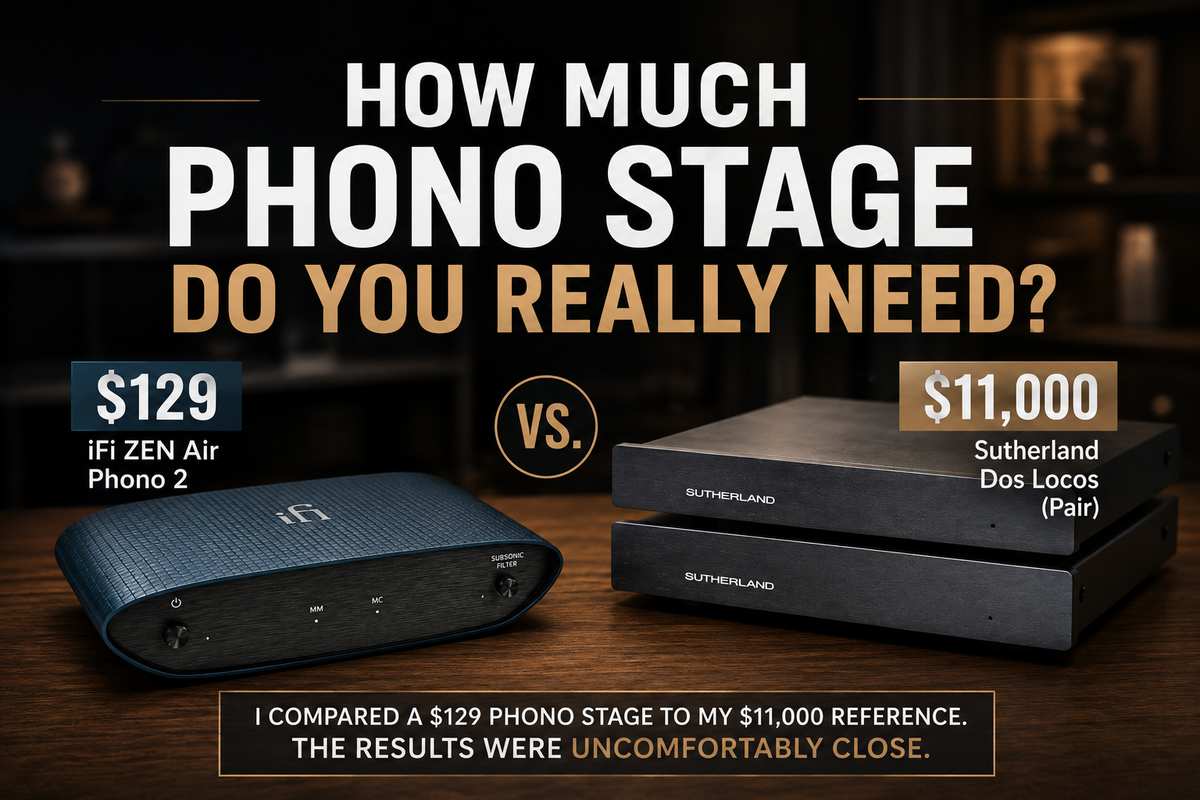
There is a $10,871 difference between the two phono stages sitting in front of me.
One costs $129.
The other costs $11,000.
Common sense says this shouldn't be much of a contest.
The $129 iFi ZEN Air Phono 2 is an entry-level phono preamp designed to make moving magnet and moving coil cartridges accessible without spending much money. My Sutherland Dos Locos is a pair of dedicated transimpedance monoblocks designed specifically for low-output moving coil cartridges. A pair currently sells for $11,000.
These products aren't really competitors.
That's precisely why I wanted to compare them.
I recently reviewed the ZEN Air Phono 2 for the Vinyl Latte YouTube channel, and instead of comparing it with another $200 or $300 phono stage, I connected it to the same system in which I use the Dos Locos as my reference.
The question wasn't whether the iFi could beat the Sutherland.
It was something much more useful:
How much performance do you actually give up when you spend $129 instead of $11,000?
The answer surprised me.
This Wasn't Supposed to Be a Fair Fight
It's important to understand how different these two products are.
The iFi is tiny, inexpensive, supports both moving magnet and moving coil cartridges, and includes iFi's intelligent subsonic filter. Its MC setting provides 64dB of gain.
The Sutherland is considerably more specialized.
The Dos Locos is a transimpedance design intended for low-output moving coil cartridges with an internal resistance below 20 ohms. Instead of the conventional voltage amplification used by most phono stages, a transimpedance design responds to the current produced by a compatible moving coil cartridge.
And there are two of them.
A stereo Dos Locos consists of two completely independent chassis, one for each channel.
This is reference-level analog equipment being compared with a little box that costs less than many audiophile record-cleaning accessories.
I wasn't expecting them to sound the same.
They didn't.
But that's where things became interesting.
I Used the Same Cartridge and the Same System
For this comparison, I used my Rega P10 equipped with a Lyra Kleos moving coil cartridge.
That matters.
This wasn't a comparison involving an inexpensive cartridge that might prevent either phono stage from showing what it could do. The Kleos is good enough that I was comfortable putting both products under the microscope.
I recorded samples from both phono stages using my Tascam DA-3000SD and then level matched the recordings before comparing them.
Level matching is extremely important in a test like this. Even a small difference in volume can make one component appear more dynamic, detailed, or impressive than another.
Once the recordings were matched, the differences became much smaller than the prices might lead you to expect.
And that's the point where this stopped being an iFi review and became a much larger hi-fi question.
$11,000 Was Better. But Not in the Way You Might Expect.
I preferred the Dos Locos.
Let's get that out of the way.
In my system, the Sutherland gave me more of the sensation that the music was happening in the room.
That's difficult to communicate through frequency-response graphs or specifications. It's that feeling of the listening room disappearing a little more and the performance becoming more physically present.
The iFi presented things differently.
What surprised me was how much information it delivered between the speakers. There was space around instruments, good separation, and considerably more refinement than I expected from a $129 phono stage.
Switching to the Dos Locos didn't suddenly reveal half of the recording that had disappeared through the iFi.
That's important.
The differences were there.
But they existed in areas audiophiles often spend enormous amounts of money pursuing: dimensionality, spatial presentation, involvement, texture, and that elusive sense of realism.
Those differences can matter enormously in the right system.
But they aren't proportional to price.
Does the Dos Locos Sound 85 Times Better?
No.
And that's also a somewhat ridiculous question.
Audio performance doesn't scale linearly with price.
An $11,000 phono stage doesn't need to produce 85 times as much bass, 85 times as much detail, or an 85-times-larger soundstage to justify its existence.
That's not how high-end audio works.
What happens as you move further up the performance ladder is that increasingly small improvements can become increasingly expensive.
The first few hundred dollars might transform a system.
The next few thousand may refine it.
And eventually you're spending substantial amounts of money pursuing improvements that may only become meaningful after everything else in the system is capable of revealing them.
That's where I think this comparison becomes useful.
Because the question shouldn't be:
Which one sounds better?
It should be:
Which one makes sense in your system?
For Most Systems, $129 May Be Enough
If you have a modest turntable, an entry-level or midrange cartridge, an integrated amplifier, and reasonably priced speakers, I would have a difficult time telling you that an $11,000 phono stage should be anywhere near the top of your upgrade list.
That's not an insult to the Dos Locos.
It's system matching.
Put the $129 iFi into a sensible budget or mid-fi system, and I suspect many listeners would be shocked by how little they feel they're missing.
The ZEN Air Phono 2 supports both MM and MC cartridges, has selectable gain for each, and includes a subsonic filter designed to address record warp without simply rolling off low bass.
That is a remarkable amount of functionality for $129.
More importantly, based on what I heard, it isn't merely inexpensive.
It is good.
Those are not necessarily the same thing.
But That Doesn't Make Expensive Phono Stages Snake Oil
This is where discussions like this tend to go off the rails.
If a $129 component performs surprisingly close to something costing $11,000, one reaction is:
See? High-end audio is a scam.
I don't agree.
I could hear differences between these products, and I preferred the Sutherland.
The question is whether those differences matter enough to you, in your system, to justify the expense.
That's very different from claiming the differences don't exist.
My reference system is built specifically to expose small changes. The Rega P10, Lyra Kleos, amplification, KEF Reference 3 Meta speakers, dual JL Audio subwoofers, room treatment, isolation, and setup have all been refined over time.
In that environment, smaller improvements become easier to appreciate.
Move the same comparison into a $2,000 system, and I'd expect the value equation to change dramatically.
That is one of the biggest mistakes we make when talking about hi-fi.
We discuss components as though they exist independently of the systems surrounding them.
They don't.
The Measurements Were Interesting Too
I also looked at the recordings rather than relying exclusively on listening impressions.
Across the musical information from roughly 20Hz to 15kHz, the level-matched recordings tracked remarkably closely, with differences within approximately 0.12dB in my analysis.
The crest-factor measurements were similarly close: approximately 16.88dB for the iFi and 16.85dB for the Dos Locos.
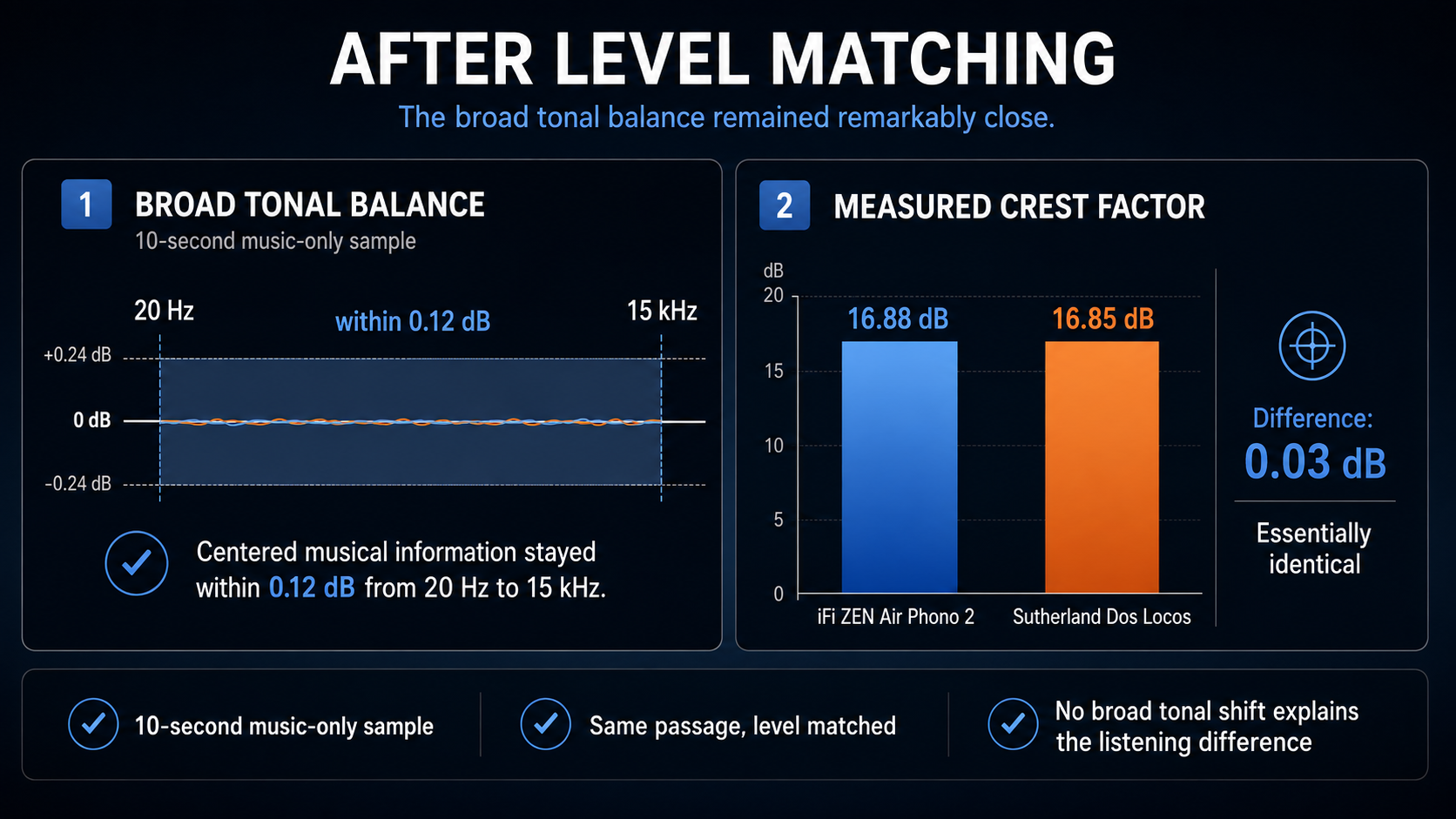
Those numbers do not prove the phono stages sound identical.
They don't.
Frequency response and crest factor can't fully describe spatial presentation, noise behavior, harmonic characteristics, transient reproduction, or how our ears perceive a component in a listening room.
But the measurements reinforce something I heard during the comparison:
The iFi wasn't doing something obviously wrong.
For $129, that's impressive.
If you want to hear the comparison yourself, the video includes the level-matched samples so you can listen before seeing which phono stage is which.
There's One Specification I Still Can't Explain
There is another part of the ZEN Air Phono 2 story that deserves attention.
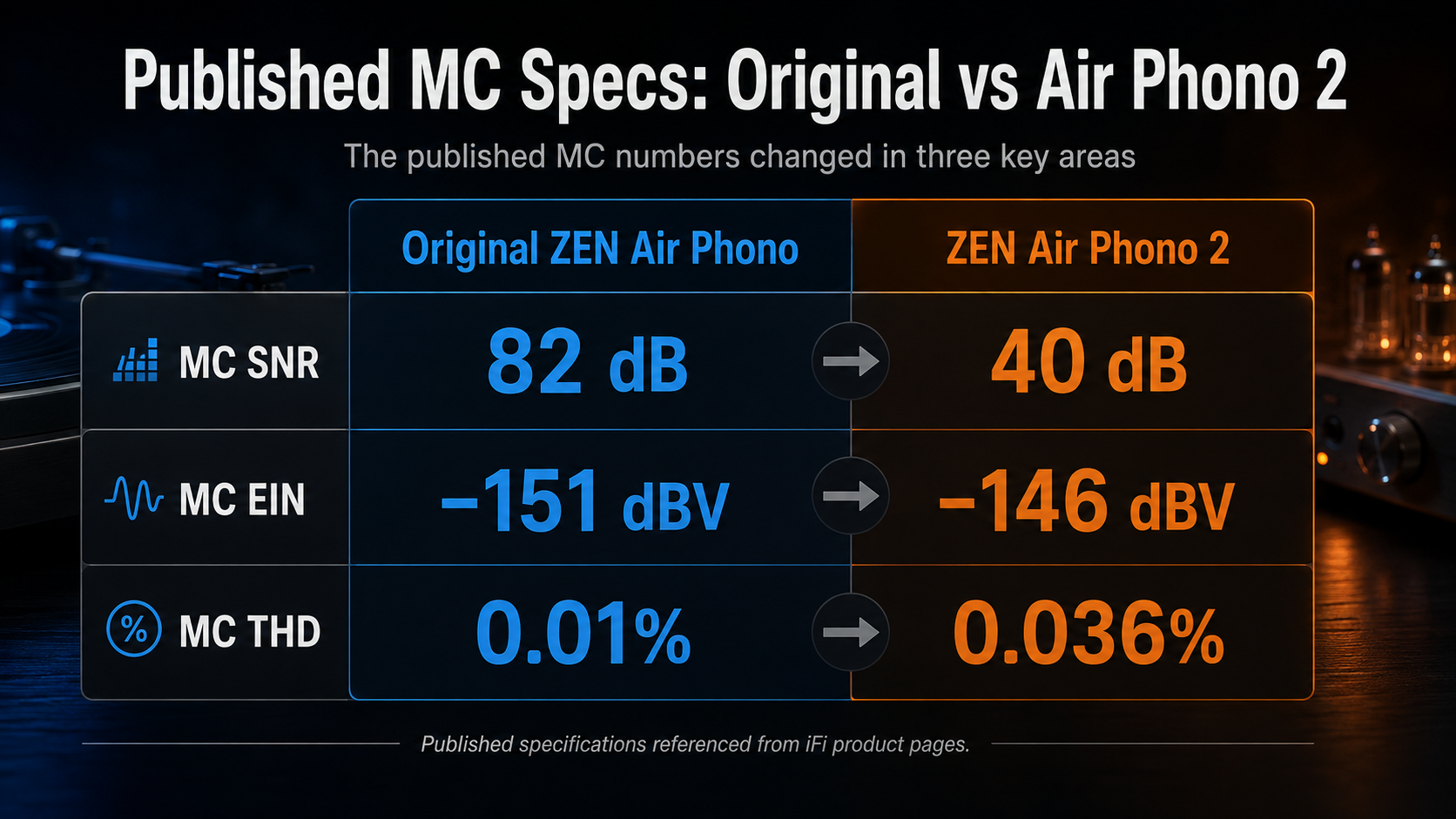
Some of the published MC specifications for the new model appear worse than those of the original ZEN Air Phono.
The original model lists an MC signal-to-noise ratio of 82dB, equivalent input noise of -151dBV, and MC total harmonic distortion of 0.01%.
The current ZEN Air Phono 2 specification table lists 40dB SNR for MC, -146dBV equivalent input noise, and 0.036% THD+N.
Here's where it gets stranger.
On the same ZEN Air Phono 2 product page, iFi promotes an ultra-low EIN of -151dBV, while the specification table farther down the page lists -146dBV for MC.
I reached out to iFi for clarification on these differences but, as of publication, have not received an explanation.
I don't know whether this represents a change in measurement methodology, an error in the published specifications, an actual change in performance, or something else entirely. Without clarification from iFi, I don't think it would be responsible to speculate.
What I can tell you is what I actually heard.
Whatever is happening with those published numbers, the ZEN Air Phono 2 performed remarkably well in my system.
It is also a useful reminder that specifications are only one part of evaluating audio equipment.
So, How Much Phono Stage Do You Actually Need?
Probably less than you think.
That's my biggest takeaway from this experiment.
If you're building a budget or midrange vinyl system, something like the iFi ZEN Air Phono 2 may get you much further than its $129 price suggests.
That doesn't mean there isn't more performance available.
There absolutely is.
As the rest of the system improves, those differences in dimensionality, realism, space, texture, and involvement can become increasingly important. That's the territory where products like the Dos Locos begin to make sense.
But high-end audio has a nasty habit of convincing us that because something better exists, we somehow need it.
We don't.
The goal isn't to own the best phono stage you can possibly afford.
It's to build a system in which the components make sense together.
My $11,000 Dos Locos sounded better to me.
The $129 iFi ZEN Air Phono 2 made me question just how much you need to spend before good enough becomes genuinely good.
And that may have been the more interesting result.

Comments ()