
Dolly Parton Got Out of Bed to Record One Last Song. Now We’re About to Hear It.
Dolly Parton got out of bed while seriously ill to record “Torn” with U2. She heard and approved the finished mix before her death. Now her final recorded vocal is about to be released.
There is something different about hearing an artist's final recording when nobody in the studio necessarily knows it will be the last one.
Dolly Parton recorded thousands of songs across a career that stretched more than seven decades. Her voice became so familiar that it's difficult to imagine there ever being a final performance.
But now we know what that performance was.
It's called “Torn.”
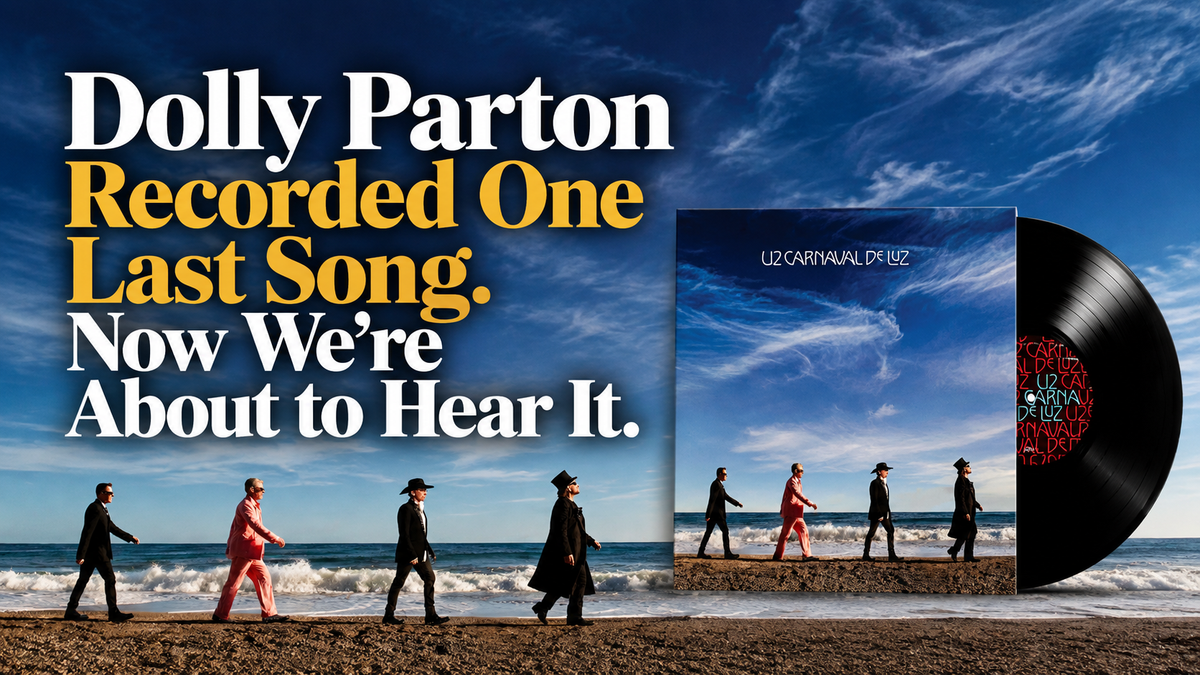
The song closes U2's upcoming album Carnaval De Luz, arriving November 13, and features Parton singing alongside Bono. U2 describes it as Parton's final recorded vocal performance.
The circumstances surrounding the recording make it considerably more poignant.
Parton recorded her vocal in June, while she was ill. Bono told Rolling Stone that she “got out of her bed to sing this song.”
She died two months later.
Now a recording that began as a collaboration has unexpectedly become something else.
It's the last time Dolly Parton walked into a recording process and left her voice behind.
This Wasn't Originally Supposed to Be a U2 Song
The story behind “Torn” didn't begin with Carnaval De Luz.
Bono had approached Parton about participating in an unreleased side project influenced by Irish folk music.
Apparently, Dolly wasn't convinced.
According to Bono, after hearing some of the material, Parton told him it was a little too Irish for her.
But she had another idea.
Parton brought Bono a song called “Torn.”
Bono and Snow Patrol's Johnny McDaid subsequently worked on the lyrics, developing the song into a story involving a mother watching her family fracture.
The finished composition is credited to Parton, U2, and McDaid. U2 describes it as a tender country song about broken family relationships with broader implications.
Then Parton became ill.
And she still wanted to record it.
“She Sang Her Heart Out”
Parton's vocal was recorded in June.
Bono's description of the session is difficult to separate from what happened afterward.
“She sang her heart out.”
He also expressed disbelief at the strength of the performance coming from an 80-year-old woman.
Parton's contribution wasn't simply dropped onto the record after her death, either.
Producer Garret “Jacknife” Lee says she heard the finished mix.
More importantly, she approved it.
Lee said Parton was proud of both her performance and the recording.
That detail matters.
Posthumous music can become complicated very quickly.
We've seen unfinished vocals reconstructed, demos turned into finished productions, abandoned recordings released decades later, and artists paired with musicians they never actually worked with.
Vinyl Latte recently explored exactly that question with Prince: who should be allowed to finish music an artist left behind?
“Torn” isn't really that story.
Parton participated in the creation of the song.
She recorded the vocal.
She heard the completed mix.
And she approved what we're going to hear.
This isn't someone trying to determine what Dolly Parton might have wanted.
She told them.
Daniel Lanois Is on the Recording Too
There's another interesting musical connection.
Daniel Lanois plays pedal steel guitar on “Torn.”
That's particularly fitting considering Lanois' long history with U2, including his production work on albums such as The Unforgettable Fire, The Joshua Tree, and Achtung Baby.
Larry Mullen Jr. also reportedly based his drum approach on Bob Dylan's “Most of the Time,” another recording produced by Lanois.
That gives “Torn” an unusual collection of musical DNA.
Dolly Parton.
U2.
Johnny McDaid.
Daniel Lanois.
And a rhythmic reference reaching back to Bob Dylan.
Yet none of those names will be the reason most people listen to the song for the first time.
We'll be listening because we know something Dolly couldn't have known with certainty when she recorded it.
There wouldn't be another one.
Final Recordings Are Strange Things
An artist's final recording isn't necessarily their greatest recording.
It isn't necessarily their final composition.
It might not even be the last music released under their name.
Archives can contain decades of unreleased performances, alternate takes, demos, live recordings, and unfinished songs.
But there is something uniquely powerful about a final studio performance.
Recording is fundamentally an act of preservation.
Someone stands in front of a microphone.
Air moves.
A diaphragm captures it.
And suddenly something that existed for a few seconds can outlive everyone who was in the room.
For most of an artist's career, we don't think about that.
It's simply another recording.
Then one day it becomes the last recording.
Nothing about the sound itself has changed.
Our understanding of it has.
We've Already Started Hearing Dolly Differently
When Parton died in August at 80, I found myself doing what I'm sure many other music fans did.
I pulled out one of her records.
For me, it was Jolene.
I've played that album plenty of times before. But listening to someone's voice immediately after they're gone inevitably changes the experience.
The recording hasn't changed.
You have.
That may be even stronger with “Torn.”
We haven't heard it yet.
For most of us, the first time we hear Dolly Parton sing this song, we'll already know we're hearing her final recorded vocal.
There's no opportunity to hear it innocently first and learn its significance later.
Its history will arrive before the first note.
U2 Is Returning Too
It's easy for Dolly's involvement to overshadow the album around it, but Carnaval De Luz is itself significant.
It is U2's 16th studio album and their first album of entirely new material in nine years. It arrives during the band's 50th year, tracing its history back to Larry Mullen Jr.'s 1976 notice looking for musicians at Mount Temple Comprehensive School in Dublin.
Jacknife Lee produced the record, with Duncan Stewart credited as engineer.
Brian Eno contributes songwriting and synthesizers to several tracks. Martin Garrix co-wrote “Glorify,” Ryan Tedder contributed additional production to “Silencio,” and Lanois appears on “Torn.”
The album grew from the same creative period that produced U2's two earlier 2026 EPs, Days of Ash and Easter Lily.
It's available in several physical configurations, including vinyl, which naturally makes the release interesting from a Vinyl Latte perspective.
But I'm not sure any format detail is going to matter very much the first time “Torn” starts playing.
There Is One Detail I Keep Coming Back To
Dolly Parton heard it.
That's the part of this story that makes me most comfortable with the song being released after her death.
She didn't leave behind an unfinished vocal that somebody decided to build into a record.
She wasn't unknowingly pulled into a collaboration through archival material.
She participated.
She listened.
She approved it.
That doesn't make “Torn” a farewell song. It wasn't written as one.
And perhaps that's better.
There's something almost too neat about imagining that great artists somehow know when they're recording their final performance and produce an intentional goodbye.
Life rarely works that way.
Dolly Parton apparently got out of bed while seriously ill because there was still a song she wanted to sing.
She sang it.
She heard the finished recording.
She liked it.
And then she left it for us.
The Last Recording Isn't the Last Word
Calling “Torn” Dolly Parton's final recording sounds definitive.
In one sense, it is.
There won't be another studio session.
But recordings have a peculiar relationship with time.
Someone who is gone can still walk into your listening room whenever you lower a stylus, load a disc, or press play.
That's one reason physical music has always meant so much to me.
The object survives.
The performance survives.
And occasionally, knowing the circumstances behind a recording makes listening to it feel less like playing a piece of media and more like encountering a moment that was somehow preserved.
When Carnaval De Luz arrives on November 13, I'm interested in hearing U2's first new album in nine years.
But there's one track I'm going to approach differently.
It's the last one.
“Torn.”
Not because it's being marketed as Dolly Parton's final recording.
Because when she was ill, there was apparently still enough music left in her that she got out of bed to make it.
And now we get to hear what she wanted to leave behind.
Pre-Order
Carnaval De Luz on vinyl, compact disc, or MP3.



Comments ()