
Should Anyone Be Allowed to Finish Prince’s Unreleased Music?
Prince’s Timeless adds newly recorded parts to music he left behind, raising a difficult question for collectors: when does preserving an artist’s archive become finishing their work for them?
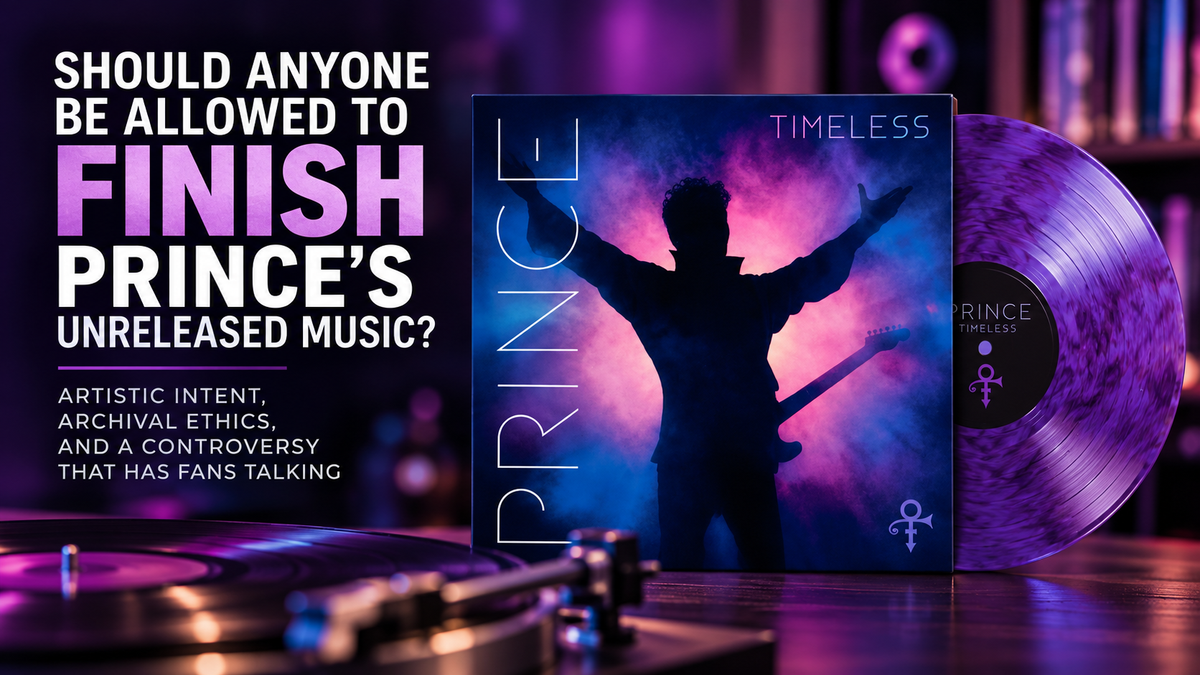
There is an important difference between releasing unfinished music and finishing it for someone who is no longer here.
Prince’s new posthumous album, Timeless, has suddenly forced that distinction into the open.
Released August 28, Timeless collects 10 rare and previously unreleased recordings from Prince’s vault, spanning an extraordinary period from 1977 through 2016. The Prince Estate and Legacy Recordings describe it as the first Prince release curated to represent every major era of his career. It is available digitally, on CD, on standard black vinyl, and as a limited purple marble pressing.
On paper, that sounds exactly like the kind of archival release Prince collectors have been waiting for.
Then fans discovered that at least some of what they were hearing wasn’t entirely what Prince left behind.
And that changes the conversation.
What Happened to “Calabama”?
At the center of the controversy is “Calabama,” a Prince recording dating to 2003.
Trombonist Greg Boyer revealed that he recorded a new horn part for the song in 2026, a decade after Prince died.
Charles F. Spicer Jr., coprincipal of Prince Legacy LLC and one of the compilation producers credited on Timeless, initially said nothing had been added to the recording. He subsequently corrected that statement after confirming that the released version did contain additional horns.
The Estate has since explained that Prince can be heard calling for horns during the bridge of the original recording, while the archived multitrack instead contained a synthesizer filling that space. Horn players who had worked with Prince were later brought in to overdub that section for the version released on Timeless.
That context is important.
This doesn’t appear to be a case of someone arbitrarily deciding that an old Prince song would sound better with a horn section.
There was evidence within Prince’s own recording that he wanted horns.
But there’s still one enormous difference.
Prince wasn’t there to approve them.
That’s Where This Gets Complicated
Archival releases require decisions.
Someone has to locate the tapes.
Someone has to decide which version of a song to use.
Someone has to mix it.
Someone has to master it.
Someone may need to repair damaged tape, correct technical problems, or assemble material that exists across multiple sources.
None of that bothers me.
In fact, without skilled archivists, engineers, and producers doing that work, enormous amounts of historically important music might never be heard.
Timeless itself was mastered by Chris James, an engineer and producer who actually worked with Prince and is credited on projects including HITnRUN Phase Two, Art Official Age, and Plectrumelectrum. James is also credited with mixing, engineering, and compilation production on the new album.
But recording a new musical performance is different from restoring an old one.
That’s the line I keep coming back to.
Is This Still a Prince Recording?
Suppose Prince recorded a guitar part in 2003.
Nobody would question whether it belonged on a Prince archival release in 2026.
Suppose one of Prince’s musicians recorded a horn part during that same 2003 session under Prince’s direction.
Again, no problem.
But what happens when a musician walks into a studio in 2026 and adds something to that 2003 recording?
The musician may have worked with Prince.
The arrangement may be completely consistent with Prince’s intentions.
Prince may even have verbally indicated what he wanted.
But Prince never heard that performance.
He never said, “That’s the take.”
He never changed the arrangement after hearing it.
He never decided the horns were too loud, too soft, too busy, or unnecessary.
He never approved the final mix.
At that point, we aren’t simply uncovering something from Prince’s vault.
We’re participating in it.
And I think collectors deserve to know the difference.
The Problem Isn’t Necessarily That It Was Changed
This is where I think the discussion needs some nuance.
I’m not convinced that nobody should ever complete unfinished music after an artist dies.
There may be circumstances where doing so is defensible.
Imagine an artist leaves behind an almost completed album with detailed notes about exactly what remains to be recorded. The musicians involved in the sessions understand the artist’s intentions. The family approves. The producer who worked on the original recordings supervises the completion.
Would finishing that album automatically be wrong?
I’m not sure it would.
Music history is filled with posthumous releases assembled from material artists left behind.
The problem is transparency.
Sony’s description of Timeless presents it as a collection of 10 rare and previously unreleased recordings from Prince’s vault. The album is marketed as providing a window into Prince’s creative process and musical evolution.
If contemporary performances have been added to archival recordings, that seems like information listeners should have before they buy the record.
Not because the resulting music is necessarily bad.
Because provenance matters.
Especially with archival music.
Record Collectors Already Understand This
Vinyl collectors obsess over provenance all the time.
Was the record cut from the original master tape?
Was a digital step involved?
Is this the original mix?
Who mastered it?
Where was it pressed?
Is this actually the same mastering as an earlier pressing?
We care because the history of a recording is part of the object we’re buying.
An archival release should be treated the same way.
If I buy a previously unreleased Prince recording from 1985, there is a reasonable expectation that I’m hearing Prince’s 1985 recording.
If I’m actually hearing Prince’s 1985 recording with overdubs recorded by someone else in 2026, I want to know that.
It doesn’t automatically make the record illegitimate.
It makes it something different.
And No, This Doesn’t Need to Become Another AI Story
Predictably, some of the discussion around Timeless has expanded into questions about whether artificial intelligence was involved.
I think that’s almost a distraction.
The controversy is interesting precisely because we don’t need AI to reach the difficult ethical question.
Real musicians adding real instruments to an old recording can create exactly the same problem.
Technology isn’t the fundamental issue.
Consent is.
Prince cannot hear the finished recording.
He cannot approve it.
So somebody else must decide what Prince would have wanted.
That’s an enormous responsibility.
And the further an archival producer moves from preservation toward creation, the more important transparency becomes.
There May Be More to Learn About
Timeless
“Calabama” may not be the end of the discussion.
Reporting by the Minnesota Star Tribune says Chris James contacted musicians about adding overdubs to older Prince recordings, while saxophonist Adrian Crutchfield said he had been approached in recent years to contribute to previous material. Trombonist Michael B. Nelson said he declined an invitation to add new material, although he confirmed that he had originally performed on another Timeless track, “Bestest Friend,” in 2012.
That doesn’t tell us that every track on Timeless has been altered.
We shouldn’t make that leap.
But it makes a complete accounting of the album’s production history even more important.
Tell us what was on the original tapes.
Tell us what was restored.
Tell us what was mixed differently.
And tell us what was added after Prince died.
Then let listeners decide how they feel about it.
The Vault Makes This Question Bigger Than One Album
Prince left behind one of the most famous musical archives in popular music.
That makes this issue much larger than Timeless.
There will almost certainly be demand for Prince archival releases for decades.
And every release creates choices.
Do you release a brilliant demo exactly as Prince left it?
Do you finish an incomplete arrangement when his intentions appear obvious?
Do you bring back musicians who actually worked with him?
Do you create a polished album that sounds finished?
Or do you preserve the imperfections because those imperfections are part of the historical document?
There isn’t necessarily one correct answer.
But I think there should be one guiding principle:
Don’t blur the line between what Prince created and what others created on his behalf.
I Want to Hear the Vault, Not Someone’s Interpretation of It
I’m fascinated by unreleased recordings precisely because they aren’t finished albums.
They let us hear decisions being made.
Sometimes they’re rough.
Sometimes something is missing.
Sometimes you immediately understand why the artist abandoned the song.
And occasionally you hear something extraordinary and wonder how it possibly remained unreleased.
That’s the appeal.
I don’t necessarily need someone to make an archival recording sound like Prince finished it yesterday.
I’d rather hear what Prince actually left behind.
If there are multiple versions, give us the versions.
If there’s an unfinished take, tell us it’s unfinished.
If new musicians are brought in to complete it, tell us exactly what they added.
Collectors can handle that complexity.
What becomes uncomfortable is presenting a posthumously completed recording as though someone simply opened the vault and found it waiting there.
Because at some point, preservation becomes production.
And once that happens, we’re no longer asking what Prince recorded.
We’re asking what someone believes Prince would have recorded.
Those are two very different things.


Comments ()