
He Spent 30 Years Building a Record Collection. A Brooklyn Building Collapse Took It Away.
Brooklyn DJ Omari Jack survived a devastating building collapse but lost his $100,000 vinyl collection, assembled over 30 years. His story reveals why some records are truly irreplaceable and what collectors can do to protect their collections.
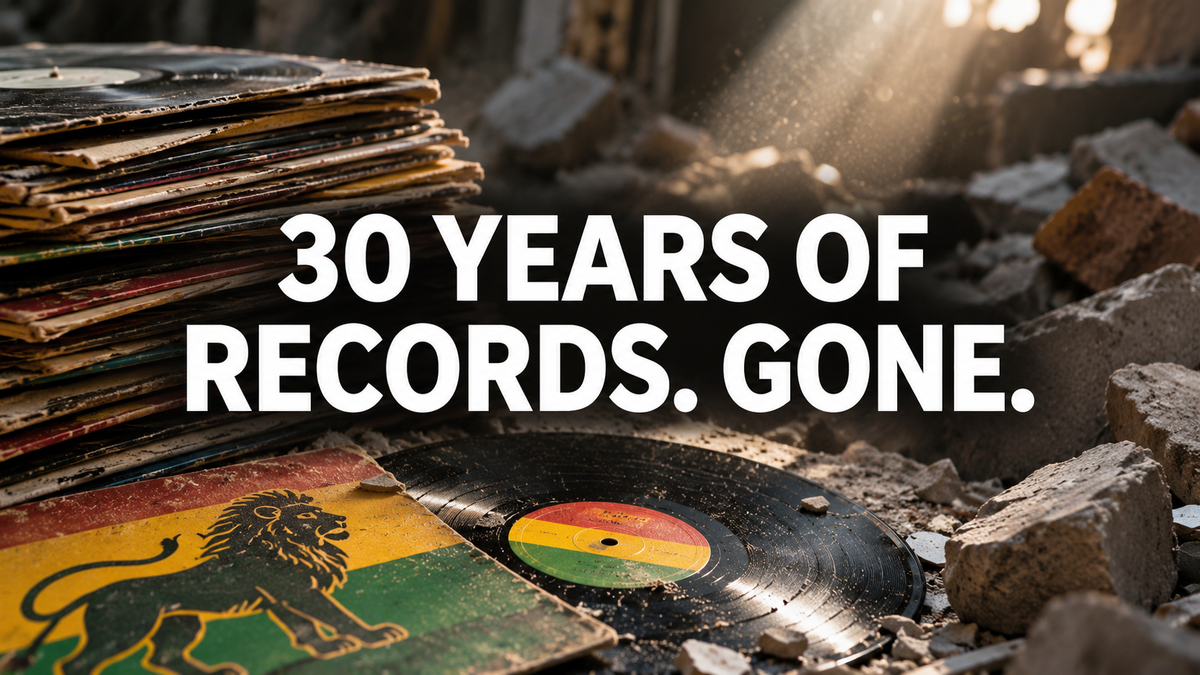
Brooklyn DJ Omari Jack survived a devastating building collapse that killed eight people. Among the possessions he lost were thousands of records representing three decades of music, memories, and cultural history.
On the morning of November 11, Omari Jack left his Brooklyn apartment for work.
He had been preparing for an upcoming DJ performance. His records were organized, his equipment was ready, and he had already selected the clothes he planned to wear.
It was supposed to be an ordinary Wednesday.
By the time he returned, his home was gone.
Shortly after 4 p.m., a three-story building at 1321 Flatbush Avenue collapsed into a neighboring construction site. Eight people, including two children, were killed, and 18 others were injured, according to New York City authorities.
Jack survived because he wasn't home.
But the disaster destroyed much of what he had spent his adult life building, including a record collection assembled over approximately 30 years.
Thousands of vinyl records. Rare reggae recordings. Concert performances dating back decades. CDs, cassettes, music books, and memorabilia.
Jack estimates that his record collection alone was worth more than $100,000.
Yet for anyone who has spent years collecting music, the most devastating part of this story isn't the dollar amount.
It's the realization that some collections simply cannot be rebuilt.
A Lifetime of Music, Reduced to Rubble
Omari Jack is originally from Saint Vincent and the Grenadines.
For three decades, he has collected records and performed as a vinyl DJ under the name Roots Outernational.
His musical interests extend across reggae, disco, soul, hip-hop, jazz, calypso, gospel, and other genres, but reggae has remained central to his collection and identity.
Artists such as Johnny Clarke, Garnet Silk, Jacob Miller, Prince Lincoln Thompson, and Barry Brown have been part of the musical world he shares with audiences.
His DJ performances have taken him from New York to Canada, Barbados, and his native Saint Vincent.
And much of that musical journey was documented in the records he brought home.
According to an interview with Gothamist, Jack had lived on the top floor of the Flatbush Avenue building for approximately five years.
His apartment wasn't simply somewhere he stored records.
It was effectively his musical headquarters.
One room was dedicated to music, while additional records occupied closets and other parts of the apartment.
For a serious collector, that arrangement probably sounds familiar.
A collection begins with a shelf.
Then another.
Eventually, records become part of the physical environment of everyday life.
But Jack's collection was also a working archive.
These weren't simply albums displayed on shelves.
They were recordings he selected, studied, transported, and played for audiences.
His collection was both a personal passion and an essential part of his work.
The Records That Cannot Simply Be Reordered
When news footage began showing the aftermath of the collapse, vinyl records were visible among the debris.
Some were scattered across the rubble.
Others remained inside damaged boxes.
Jack later saw footage of rescue workers removing what appeared to be some of his records, but he told Gothamist that he had not received confirmation about where those belongings had been taken or whether anything was recoverable.
The uncertainty adds another painful dimension to an already devastating situation.
A collector can replace a common album.
An original pressing of a widely available record might be expensive, but another copy can sometimes be found.
Other recordings are considerably more difficult.
Jack reportedly owned rare concert recordings dating back to the 1970s, alongside decades of reggae releases and other music.
Those records represent more than a collection of commercially available albums.
They reflect a particular person's musical discoveries, interests, and relationships.
Reggae collecting, especially, can involve records that were produced in relatively small quantities, distributed through specialized shops, or released by independent labels with limited documentation.
Some recordings may never have received a substantial reissue.
Others may exist in multiple mixes, versions, or regional pressings.
For a working DJ, those differences can be essential.
Two records with similar titles may contain noticeably different performances or mixes.
A particular pressing might feature a version that isn't available through mainstream streaming services.
And a rare record discovered years ago may be nearly impossible to locate again.
That's why a collection assembled over 30 years cannot necessarily be reconstructed with an insurance payment or an online shopping spree.
The records themselves are only part of what has been lost. The history of finding them matters, too.
Why This Loss Goes Beyond Vinyl
For collectors, records can become markers of personal history.
You remember where you bought a particular album.
You remember the person who introduced you to an artist.
You remember the record store you visited while traveling, the unexpected discovery in a bargain bin, or the pressing you spent years searching for.
Some records become associated with friendships, relationships, celebrations, or difficult periods in life.
Others are important simply because they changed the way you hear music.
Over time, a collection becomes something deeply personal.
It's a record of your listening life.
That idea has always resonated with me.
At Vinyl Latte, I've previously explored the emotional significance of records that remain with us through different stages of life.
The records we keep aren't always the rarest, most valuable, or best-sounding editions.
Sometimes, they're the ones that remind us of who we were when we first heard them.
Jack's situation is an extreme and heartbreaking example of what happens when that physical history disappears.
But his loss also carries a broader cultural dimension.
As a reggae DJ with roots in the Caribbean, Jack has spent decades sharing music that connects communities, generations, and traditions.
His records weren't just possessions.
They were part of the way he preserved and shared that music.
And while recordings may survive elsewhere, the particular archive he assembled reflected his own knowledge and experience.
That combination is difficult to duplicate.
A Small Piece of Good Fortune Amid the Devastation
There is one encouraging detail in Jack's account.
In the days leading up to the collapse, he had been backing up the digital files in his music collection.
He happened to have his laptop and a hard drive containing approximately six terabytes of music with him when he left for work.
Those files survived.
Some of his physical records were also being stored with a friend on Long Island.
That means not everything was lost.
For someone who has spent decades building a musical archive, those surviving recordings may eventually provide a starting point.
But digital backups cannot replace every aspect of a physical collection.
A file may preserve the music.
It doesn't preserve the original sleeve, handwritten notes, pressing details, or the personal history associated with a particular copy.
Nor does it automatically replace rare records that were never digitized.
Still, the survival of his digital archive offers an important reminder.
Backing up the music we own is worthwhile, even when our primary passion is physical media.
For Jack, that precaution preserved at least part of his life's work.
The Collection Was Reportedly Uninsured
Another difficult detail has emerged from the reporting.
Jack's record collection was reportedly uninsured.
His friend Kelly Uman, a fellow collector and DJ based in Montreal, explained to Gothamist that insuring a large collection can be complicated.
Unlike jewelry or other assets with relatively straightforward appraisal processes, records can vary dramatically in value depending on pressing, condition, rarity, and demand.
For collectors with thousands of records, maintaining an accurate inventory can be an enormous undertaking.
And there's an important distinction between having renters or homeowners insurance and having adequate coverage for a valuable record collection.
A standard policy may cover certain personal belongings, but coverage limits, exclusions, valuation methods, and documentation requirements can affect how much a collector actually receives after a loss.
Someone with a substantial collection shouldn't assume every record is automatically covered at its current market value.
That's particularly important for rare pressings, promotional releases, unusual regional editions, and other collectible recordings.
Four Things Record Collectors Can Learn From This Tragedy
Nothing can undo what happened in Brooklyn.
And these precautions are not a substitute for addressing building safety or protecting the people who live and work in our communities.
But Jack's experience is a reminder that collectors should consider how they protect the things they've spent years acquiring.
1. Document your collection.
Maintain an inventory that identifies the artist, title, pressing, condition, and approximate replacement value of significant records.
For especially valuable editions, include photographs of the sleeves, labels, and runout markings.
Discogs or another collection database can provide a useful starting point, although market estimates shouldn't be treated as guaranteed insurance valuations.
2. Confirm your actual insurance coverage.
Ask your insurance provider whether your records are covered under your existing policy, whether collectible property limits apply, and whether additional scheduled coverage is available.
Don't assume a collection valued at tens of thousands of dollars will be fully reimbursed.
3. Keep a backup outside your home.
Store copies of your inventory, photographs, purchase records, and important digital music files somewhere physically separate from the collection.
An offsite backup or reputable cloud storage service can help preserve documentation even if the original records are damaged or destroyed.
4. Identify the records that are genuinely irreplaceable.
Some albums can be purchased again without much difficulty.
Others may be rare, historically important, or personally meaningful.
Knowing which records fall into those categories can help you prioritize documentation and protection.
None of these steps guarantees that a collection can be recovered.
But they may make a difficult situation less complicated.
A Community Is Trying to Help
In the aftermath of the collapse, Jack has been staying in temporary accommodation arranged by the city.
His immediate priority is not rebuilding his record collection.
It's rebuilding his life.
A fundraising campaign has been organized by his friend Kelly Uman to help him recover from the disaster.
A benefit event is also planned for November 28 at E-K's Hideaway, a Brooklyn venue where Jack has performed.
Those efforts reflect something important about the music community.
Collectors and DJs often build relationships through shared musical interests.
A rare record might bring two strangers into conversation.
A performance might introduce an audience to an artist they would never otherwise discover.
And over time, those connections can become a genuine support network.
In a moment like this, that community matters far more than the value of any individual record.
Jack has indicated that he doesn't know when he will return to DJing or whether he will ever attempt to rebuild his collection on the same scale.
Given everything he has experienced, that's understandable.
The records can wait.
His safety, stability, and recovery come first.
The Bigger Tragedy Must Not Be Forgotten
It's important to keep this story in perspective.
Eight people lost their lives in the November 11 collapse.
Two were children.
Families have been devastated, residents have been displaced, and others are recovering from injuries.
Questions have also emerged about the building's condition and construction activity at the neighboring property.
City authorities are investigating the cause.
Records obtained by local news organizations indicate that the building had a history of documented problems, but the precise circumstances and responsibility for the collapse remain under investigation.
Those questions deserve answers.
Jack's experience is one story among many emerging from the disaster.
And while his lost collection is particularly relevant to a publication devoted to music and vinyl, it should never overshadow the people whose lives were lost.
The human cost of this tragedy is immeasurably greater than the value of any record collection.
Final Thoughts: Some Collections Are More Than Collections
I've often thought about what makes a record truly valuable.
Sometimes, it's the mastering.
Sometimes, it's a particular pressing, a rare sleeve, or an unusual piece of music history.
But the records that mean the most to us aren't always the ones worth the most money.
They're the records that become part of our lives.
For Omari Jack, 30 years of collecting created something that was both personal and cultural.
His records supported his work as a DJ, connected him to his Caribbean heritage, and helped him share music with audiences across different communities.
That history cannot be measured simply by adding up estimated resale prices.
And it cannot necessarily be recreated by purchasing replacement copies.
The loss of his collection is heartbreaking.
But the most important part of his story is that he survived.
There may eventually be opportunities to replace some of the records, recover surviving belongings, and return to performing.
For now, his focus is where it should be: getting back on his feet.
And perhaps the most meaningful thing the music community can do is help him reach that point.
Because the records matter.
But the people who bring them to life matter infinitely more.
Our thoughts are with the families of those killed, the injured, and everyone displaced by the Brooklyn building collapse.
Sources and Further Reading
Gothamist, November 15, 2026: A DJ survived the Brooklyn building collapse: His prized record collection did not.
New York Post, November 16, 2026: DJ's $100K 'impossible to duplicate' record collection destroyed in Brooklyn building collapse.
CBS News New York: Brooklyn building collapse coverage and investigation.
https://www.cbsnews.com/newyork/live-updates/brooklyn-building-collapse-search-survivors/
NYC311: Official Brooklyn building collapse assistance and relief information.
https://portal.311.nyc.gov/article/?kanumber=KA-03753
Editorial note: This article is based on reporting by Gothamist, the New York Post, and local New York news organizations, alongside official city information. Vinyl Latte has not independently interviewed Omari Jack. The collection's estimated value and the extent of its loss are based on his reported statements. Casualty figures and investigation details reflect information available as of November 17, 2026.
Comments ()