Deadwax.io Might Be the Most Useful Vinyl App You're Not Using
Finding the best sounding vinyl pressing isn't easy. Discover how I use Deadwax.io to research mastering differences, compare editions, and make smarter record buying decisions.
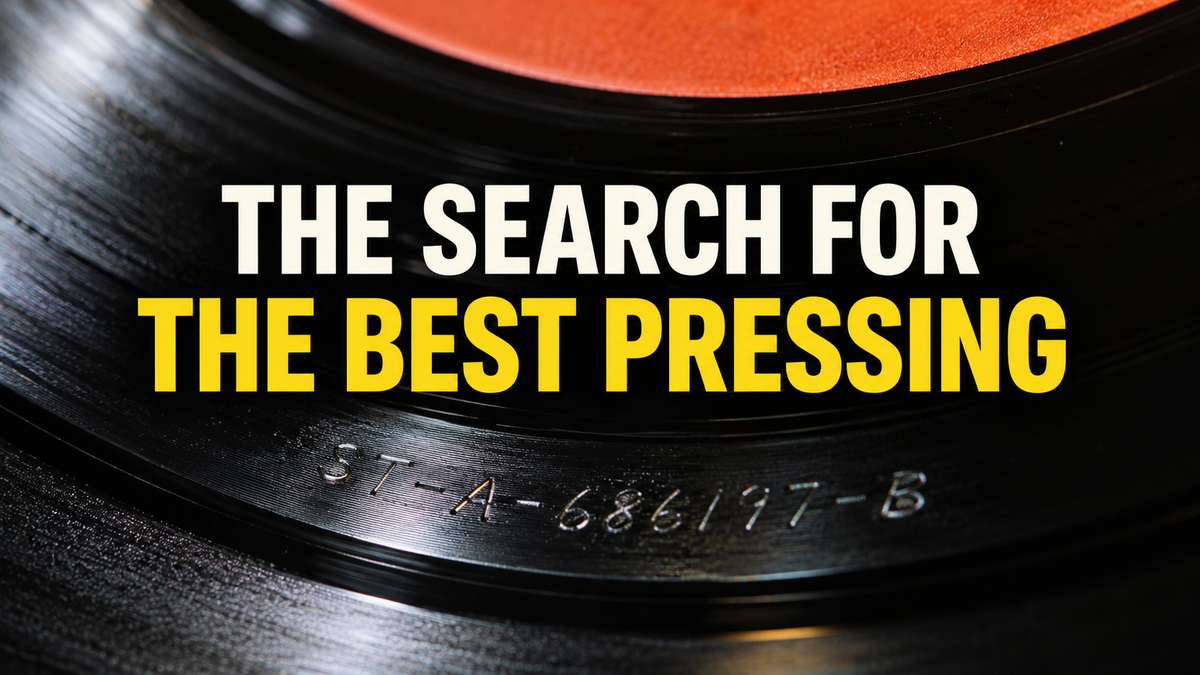
Finding the definitive pressing of an album has never been easy. Deadwax.io is making that research considerably more accessible, and I think every serious record collector should have it on their radar.
If you've been collecting vinyl long enough, you've probably asked yourself a familiar question: Do I own the best sounding pressing of this album?
It's a question that can lead you down a rabbit hole of mastering engineers, matrix numbers, pressing plants, obscure forum discussions, and sometimes expensive mistakes.
I've spent plenty of time researching records, trying to determine which versions are worth owning. Sometimes it's an original pressing. Other times, a later reissue or audiophile remaster delivers something entirely different.
And here's the frustrating part: there isn't always a straightforward answer.
That's why I've become interested in Deadwax.io, a relatively new application designed to help vinyl collectors research and identify desirable pressings.
Rather than simply telling you which records you own, Deadwax attempts to answer a more interesting question: Which version should you be looking for, and why?
What Is Deadwax.io?
Deadwax is a vinyl research and collection application developed by a small team of enthusiasts in Seattle, Washington.
The platform launched on the web in March 2026, followed by an iOS application in May and an Android release in August.
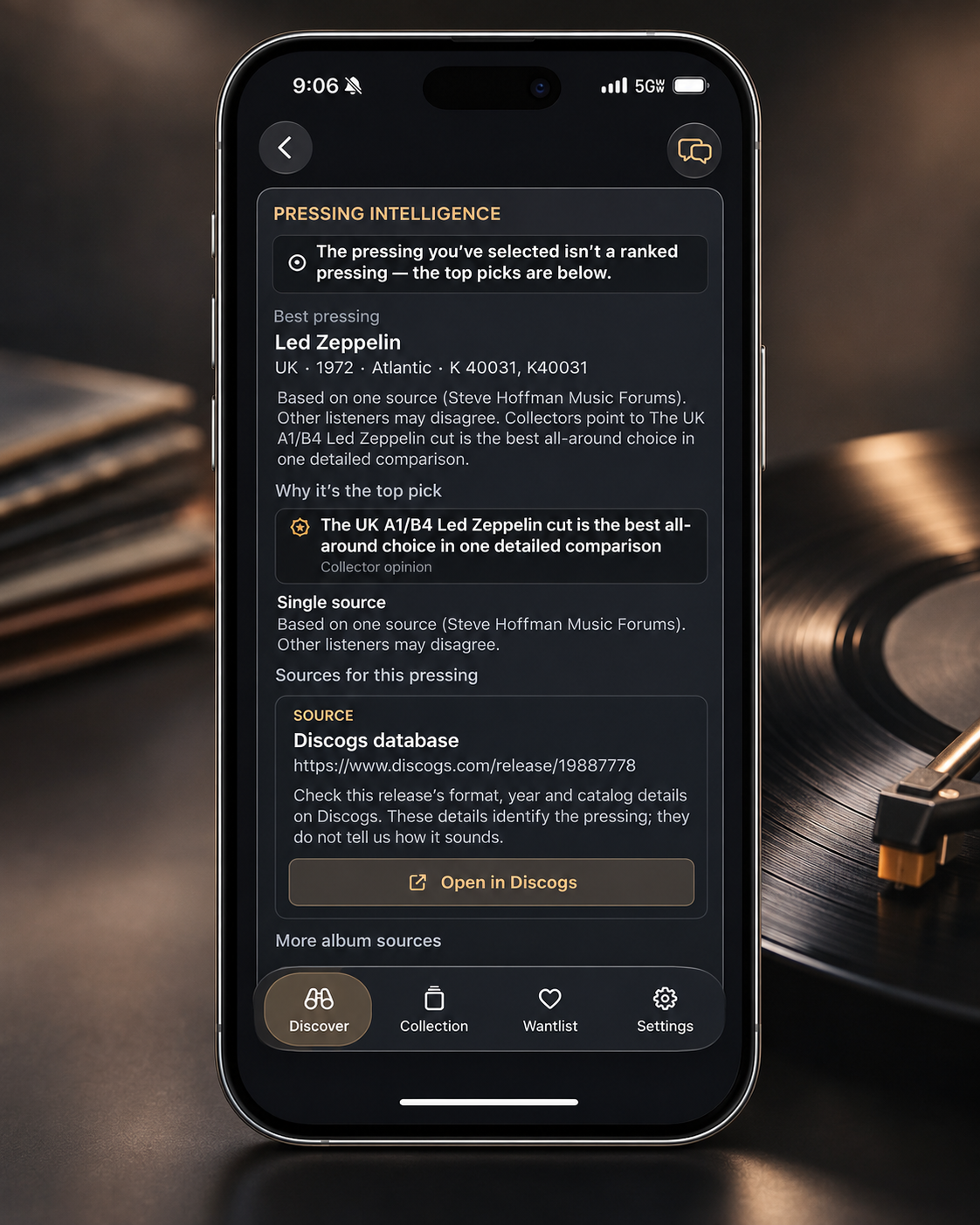
At its core is something the developers call Pressing Intelligence.
The idea is straightforward. Instead of requiring collectors to search through dozens of websites, forum threads, and videos, Deadwax brings relevant pressing information together in one place.
It can highlight:
- Notable mastering engineers associated with specific releases.
- Audiophile pressings and recognized specialty labels.
- Pressings recommended by collectors and online communities.
- References to listening comparisons and pressing shootouts.
- Information about original releases, pressing variations, and mastering provenance.
- Links to supporting sources, allowing collectors to investigate the recommendations themselves.
That last point is particularly important.
A recommendation is much more valuable when you can understand where it came from.
Why Discogs Alone Isn't Always Enough
Let me make something clear: I consider Discogs an essential resource for vinyl collecting.
Its database is extraordinary. I regularly rely on pressing information, runout inscriptions, release history, and other details when investigating records.
But Discogs is primarily designed to document releases and facilitate buying, selling, and collection management.
It doesn't necessarily tell you which pressing sounds best.
Imagine looking for a copy of an album that has been released dozens, or even hundreds, of times.
Discogs might show different countries of manufacture, label variations, pressing plants, catalog numbers, and matrix inscriptions.
That's useful information. But it doesn't automatically explain why one particular pressing has developed a reputation among audiophiles.
Traditionally, finding that answer means opening additional browser tabs, reading discussions on the Steve Hoffman Music Forums, searching for mastering information, and watching comparison videos.
Deadwax attempts to connect those pieces.
And that's where I see its real value.
How I Use Deadwax to Research Pressings
My interest in Deadwax isn't simply about organizing my collection.
It's about making more informed purchasing decisions.
When I'm investigating a record, I'm generally interested in three things.
1. Understanding which pressings are worth investigating
Before spending money on another copy of an album, I want to know which editions have earned a reputation for excellent sound.
That doesn't necessarily mean buying the most expensive pressing.
Sometimes an affordable domestic release shares desirable mastering characteristics with a much more collectible version.
Other times, a highly regarded audiophile edition offers a compelling alternative to an expensive original.
Deadwax helps bring those possibilities into focus by highlighting notable pressings and connecting them to supporting research.
For me, it's a starting point, not an automatic purchasing recommendation.
2. Identifying the actual pressing
This is where things become particularly interesting.
Two copies of an album can have nearly identical jackets and labels while containing different mastering cuts.
The clues are often found in the runout area, commonly called the deadwax, between the final groove and the center label.
Those tiny inscriptions can reveal mastering information, lacquer identifiers, pressing plant details, and other manufacturing clues.
Deadwax includes tools for barcode scanning, label recognition, and searching using matrix information.
On supported iOS devices, you can even speak the runout markings into the application rather than attempting to type a difficult inscription.
That could be particularly useful when standing in a record store, trying to determine whether a copy is the desirable version you've been researching.
Of course, an apparent match still deserves verification. Similar markings can appear across related releases, and not every identification will be definitive.
3. Deciding whether an upgrade is worthwhile
One of the challenges of collecting records is knowing when to stop upgrading.
It's remarkably easy to convince yourself that another pressing might sound better.
And sometimes it does.
But just because a particular edition is considered desirable doesn't mean the copy already sitting on your shelf is inferior.
I see Deadwax as a tool for narrowing down meaningful comparisons.
If I already own a well-regarded mastering, that information might encourage me to spend my money on something else.
If another pressing has a substantially different mastering history or consistently strong listening reports, it might justify further investigation.
Either way, the goal is the same: make better decisions rather than simply accumulating more copies.
The Feature That Makes Deadwax Especially Interesting
One of the application's smartest features is its integration with Discogs.
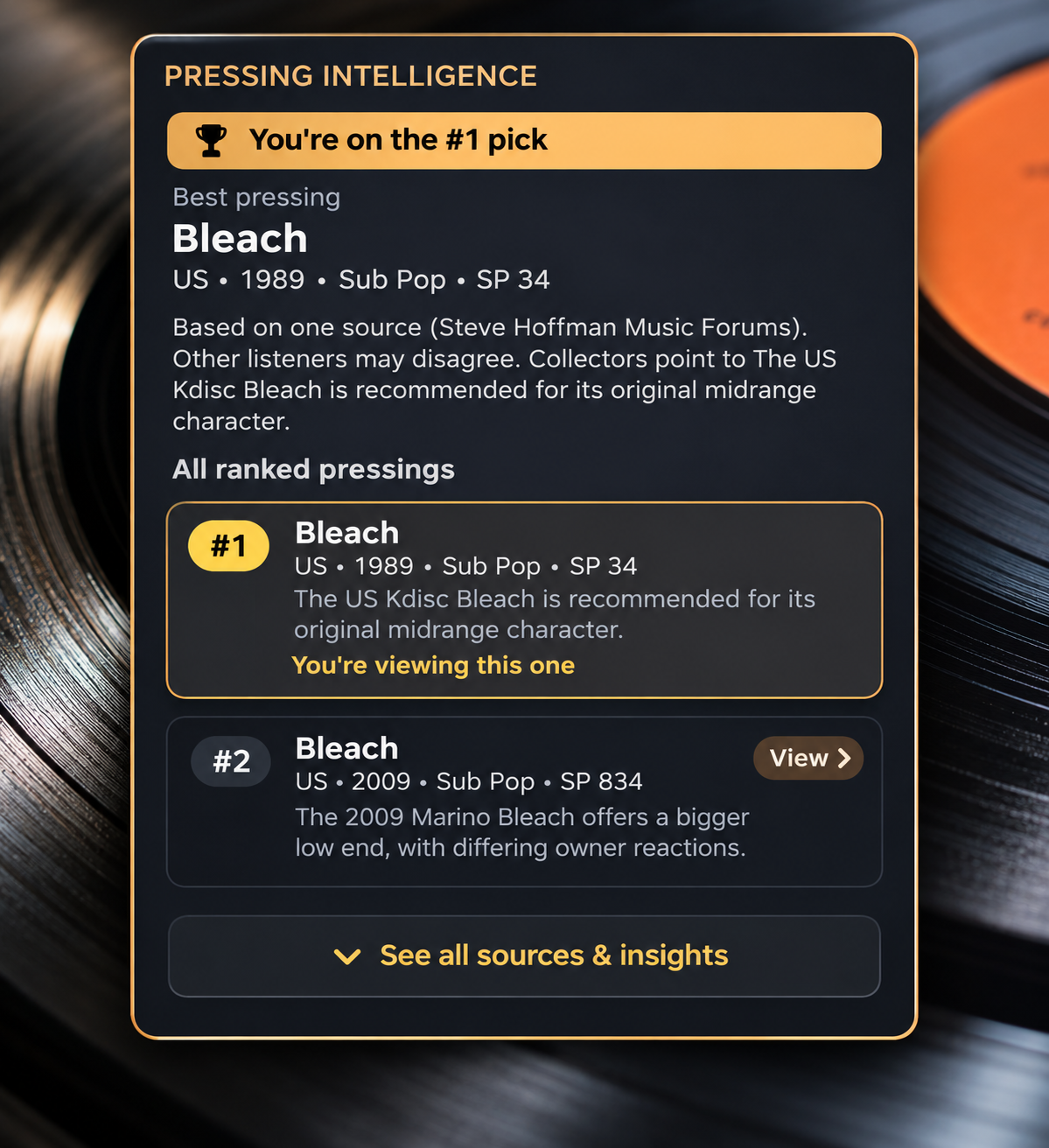
After connecting your account, Deadwax can display your existing collection and identify releases with additional Pressing Intelligence information.
It uses badges to help distinguish releases with notable pressing research, audiophile associations, and other relevant characteristics.
The application also supports a wantlist connected to Discogs.
That means you can focus on specific editions rather than simply adding an album title to a shopping list.
For collectors with hundreds or thousands of records, this approach has obvious appeal.
Instead of starting every search from scratch, you can explore your existing collection and investigate whether particular editions deserve a closer look.
Recent updates have expanded the application beyond pressing comparisons, adding features such as album stories, curated discovery collections, record values, and indicators for first pressings and documented all-analog releases.
The latter is especially relevant to collectors who care about mastering provenance, although an all-analog production chain is not, by itself, a guarantee of superior sound.
Can an App Really Identify the Definitive Pressing?
Here's where I think it's important to maintain some perspective.
There is no universally definitive pressing of every album.
I've heard expensive records that failed to impress me and relatively inexpensive copies that delivered exceptional sound.
There are also countless variables that influence what we hear.
A particular mastering might have more pronounced bass, a brighter tonal balance, greater apparent detail, or a more relaxed presentation.
One listener might prefer the original mastering. Another might favor a modern reissue.
Neither opinion necessarily makes the other wrong.
The condition of the individual record matters, too. A noisy, damaged copy of a celebrated pressing might be less enjoyable than a clean example of a supposedly lesser edition.
This is why I wouldn't treat any application, forum recommendation, or online shootout as the final authority.
Deadwax aggregates useful information. It does not replace careful listening.
And its coverage is still evolving. Some albums have extensive pressing research, while others have much less information available. User-contributed release data and external opinions can also contain mistakes.
I actually appreciate that Deadwax provides links to its sources.
It gives collectors an opportunity to evaluate the evidence instead of accepting a recommendation without question.
Why This Matters to Audiophiles
There's a tendency in high-end audio to focus on the equipment.
Cartridges, tonearms, phono stages, amplifiers, and speakers can all influence playback quality.
But the record itself remains fundamental.
A different mastering can produce a meaningful change in tonal balance, dynamics, and presentation before the signal ever reaches your cartridge.
That doesn't mean every pressing difference is dramatic, or that every expensive audiophile release is an improvement.
It does mean pressing research deserves a place alongside the attention we give our playback systems.
For someone investing considerable time and money into a revealing vinyl setup, knowing the provenance of the records being played makes sense.
And unlike another piece of hardware, researching a better pressing doesn't require changing anything in your system.
What I'd Like to See Improve
Deadwax is still a relatively young application, and I wouldn't expect it to have comprehensive research on every release.
Its long-term usefulness will depend heavily on the accuracy, depth, and transparency of its pressing information.
I'd particularly like to see continued emphasis on distinguishing between verified mastering information, general collector consensus, and subjective listening opinions.
Those are three different types of evidence, and they shouldn't carry identical weight.
I'd also love to see even deeper comparisons between pressings, particularly when there are conflicting opinions about popular audiophile releases.
For example, knowing that two editions use different mastering cuts is useful.
Understanding the reported sonic differences between them, along with the evidence supporting those reports, is even more valuable.
Deadwax already moves in that direction with source links, pressing commentary, and references to listening comparisons.
I'm interested to see how that develops.
Why I Think Every Record Collector Should Know About Deadwax
I don't believe collecting vinyl should become an endless exercise in chasing expensive records.
The point is to enjoy the music.
But I also believe there's tremendous satisfaction in discovering an exceptional pressing, particularly when it comes from careful research rather than simply paying the highest asking price.
That's what appeals to me about Deadwax.
It gives collectors another way to explore the history behind their records, investigate mastering differences, and potentially avoid disappointing purchases.
It also makes some of the specialized research that experienced collectors have accumulated over decades more accessible to people who are still learning.
Is it going to settle every debate about the best sounding copy of Led Zeppelin II, Kind of Blue, or The Dark Side of the Moon?
Of course not.
Those discussions will probably continue as long as people are playing records.
But having the relevant information organized in one place is a meaningful step forward.
For me, Deadwax is not about being told which records to buy. It's about having better information before making that decision.
And that's why I think it deserves a place on every serious collector's radar.
You can explore the application at Deadwax.io. It's available through the web, Apple's App Store, and Google Play.
What's your favorite tool for researching vinyl pressings? And is there an album you've bought multiple times while searching for the version that sounds best? I'd love to hear about it.
Vinyl Latte is an independent publication covering vinyl records, music, and high-fidelity audio. If you enjoy thoughtful, independent coverage, consider subscribing to support our work.

Comments ()