
Dolly Parton Dies at 80: The Songs Are Her Legacy
Dolly Parton has died at 80. We look beyond the headlines at the songs, records, and songwriting legacy that made her one of music’s most enduring voices.
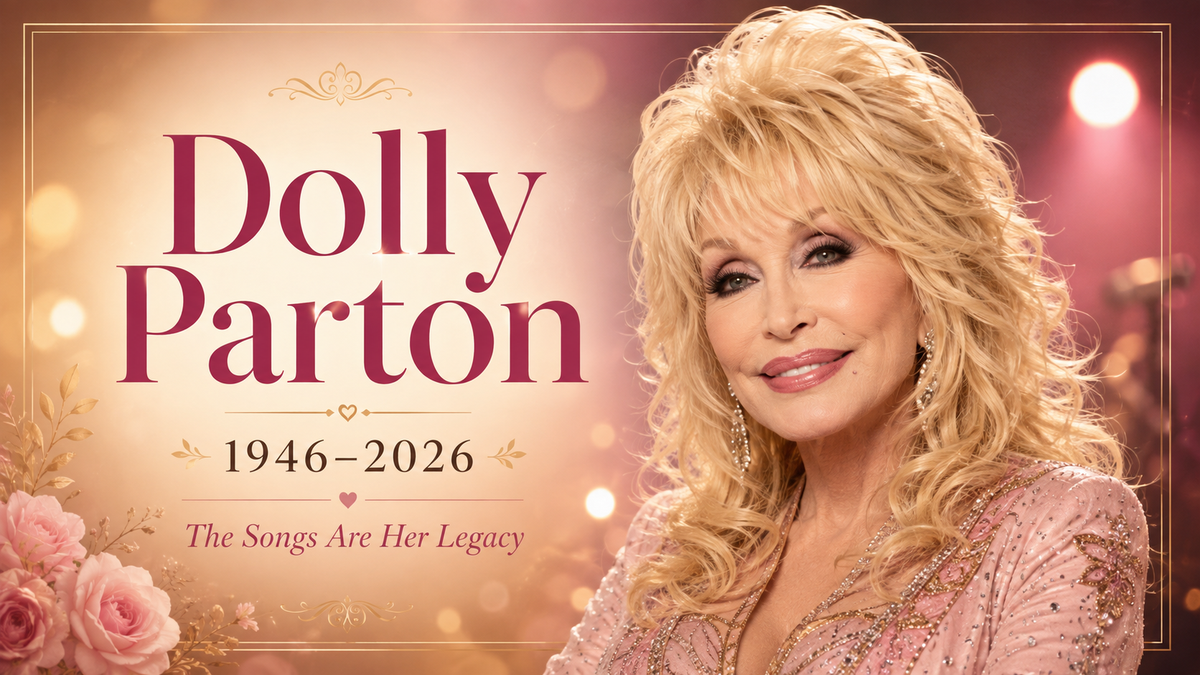
Dolly Parton has died at 80.
The country music legend, songwriter, actress, and cultural icon died peacefully Tuesday in Nashville, according to her publicist. Her family also confirmed her death.
There will be plenty written today about the extraordinary size of Dolly Parton's career. The awards. The movies. Dollywood. The unmistakable blonde hair, rhinestones, humor, and personality that made her recognizable far beyond country music.
But Dolly once explained how she actually wanted to be remembered.
“The songs are my legacy.”
And maybe that is where we should start.
Before There Was Dolly, There Were the Songs
Long before Dolly Parton became an institution, she was a songwriter.
She was writing songs as a child growing up in rural Tennessee. By her teens, she was performing at the Grand Ole Opry. After high school, she headed to Nashville carrying what may have been her most valuable possession: songs.
That distinction matters.
There are enormously successful singers who become celebrities. There are celebrities who learn how to build businesses around their fame.
Dolly Parton did all of that, but underneath it was someone who could write a song.
And she did it over and over again.
Reuters estimates that Parton wrote roughly 3,000 songs during her lifetime, recording only a fraction of them herself.
Think about some of the titles that emerged from that catalog.
“Jolene.”
“9 to 5.”
These aren't simply country hits from another era. They became part of the larger vocabulary of popular music.
“I Will Always Love You” Says Almost Everything
If you wanted one song to explain Dolly Parton as a songwriter, “I Will Always Love You” might be it.
Parton wrote it when she decided to leave The Porter Wagoner Show and establish herself independently. It wasn't originally the enormous Whitney Houston power ballad that many listeners would later associate with the title.
It was a goodbye.
Tender, grateful, sad, and remarkably direct.
Parton's original recording reached No. 1 on the country chart, and then did it again when she rerecorded the song years later. Whitney Houston transformed it into a global pop phenomenon in 1992.
But underneath both versions was Dolly's song.
There is also the famous story of Elvis Presley wanting to record it. Parton declined after Presley's management required a share of the publishing rights.
Imagine having Elvis Presley interested in your song and still being willing to walk away.
That decision looks brilliant today, but it also reveals something important about Parton. She understood very early that songs had value, and she understood that ownership mattered.
Her Songs Never Stayed Inside Country Music
One reason Dolly Parton's music will continue to survive is that it never really belonged to one generation or even one genre.
Whitney Houston turned “I Will Always Love You” into one of the defining pop recordings of the 1990s.
The White Stripes turned “Jolene” into something raw and almost desperate.
Miley Cyrus brought Parton's music to another generation.
Beyoncé revisited “Jolene” through an entirely different musical and cultural lens.
Every interpretation sounds different because the artists are different.
But the songs survive the transformation.
That's usually the test of great songwriting.
Strip away the production, the era, the format, and sometimes even the genre, and something remains.
With Dolly Parton, something almost always remained.
It Is Easy to Let the Persona Overshadow the Artist
Parton understood image better than nearly anyone.
The hair was bigger. The clothes were brighter. The jokes frequently arrived at her own expense.
She understood exactly what people saw when she entered a room, and she was often the first person willing to laugh about it.
But there was something clever about that persona.
You could underestimate Dolly Parton exactly once.
Behind the rhinestones was a songwriter who controlled much of her work, a businesswoman who built an entertainment empire, and an artist who managed to move between country, pop, television, film, and eventually rock without completely abandoning who she was.
When she was inducted into the Rock and Roll Hall of Fame in 2022, Parton initially resisted the honor because she didn't believe she had earned the right to be considered a rock artist.
So what did she do?
She made a rock album.
Rockstar, released in 2023, featured everyone from Paul McCartney and Ringo Starr to Stevie Nicks, Debbie Harry, Elton John, and Rob Halford.
Even in her late seventies, Dolly was still curious.
Still recording.
Still trying something new.
More Than Nostalgia
This is where Dolly Parton's legacy becomes especially interesting for music fans and record collectors.
It would be very easy to reduce her catalog to a handful of famous songs and a greatest hits collection.
Don't.
Go back to records like Coat of Many Colors, Jolene, and New Harvest...First Gathering. Listen to Trio, the remarkable 1987 collaboration with Linda Ronstadt and Emmylou Harris.
What becomes apparent is just how much of Parton's appeal existed before the mythology surrounding Dolly became larger than life.
There is an intimacy to many of those recordings.
Stories about poverty, family, jealousy, independence, heartbreak, faith, and ambition.
They came from someone who understood that a complicated idea doesn't necessarily require a complicated song.
That may be one of the hardest things in songwriting to accomplish.
Put On a Dolly Parton Record Tonight
There will be statistics attached to Dolly Parton's name today.
More than 100 million records sold.
Decades of hits.
Hall of Fame inductions, Grammy Awards, movies, television appearances, businesses, and an enormous philanthropic legacy that included her Imagination Library literacy program.
All of it matters.
But I'm not sure any number adequately explains why this loss feels significant.
Maybe the better tribute is simpler.
Pull a Dolly Parton record from the shelf.
Put down the stylus.
And listen.
Listen to the vulnerability in “Jolene.”
Listen to the childhood memories inside “Coat of Many Colors.”
Listen to Dolly sing “I Will Always Love You” before that song belonged, at least in the minds of millions of people, to someone else.
Because long after the headlines disappear, the records will still be there.
Dolly Parton once said that at the end of her life, she hoped people would remember her as a good songwriter.
“The songs are my legacy.”
She got her wish.

Comments ()