
Eminem's Unreleased Music Was Sold for $50,000. Then It Reached 8 Million Streams.
Eminem's unreleased recordings were sold by a former employee for $50,000 and reached over 8 million streams. The guilty plea exposes a troubling side of music leaks, studio security, and artistic control.
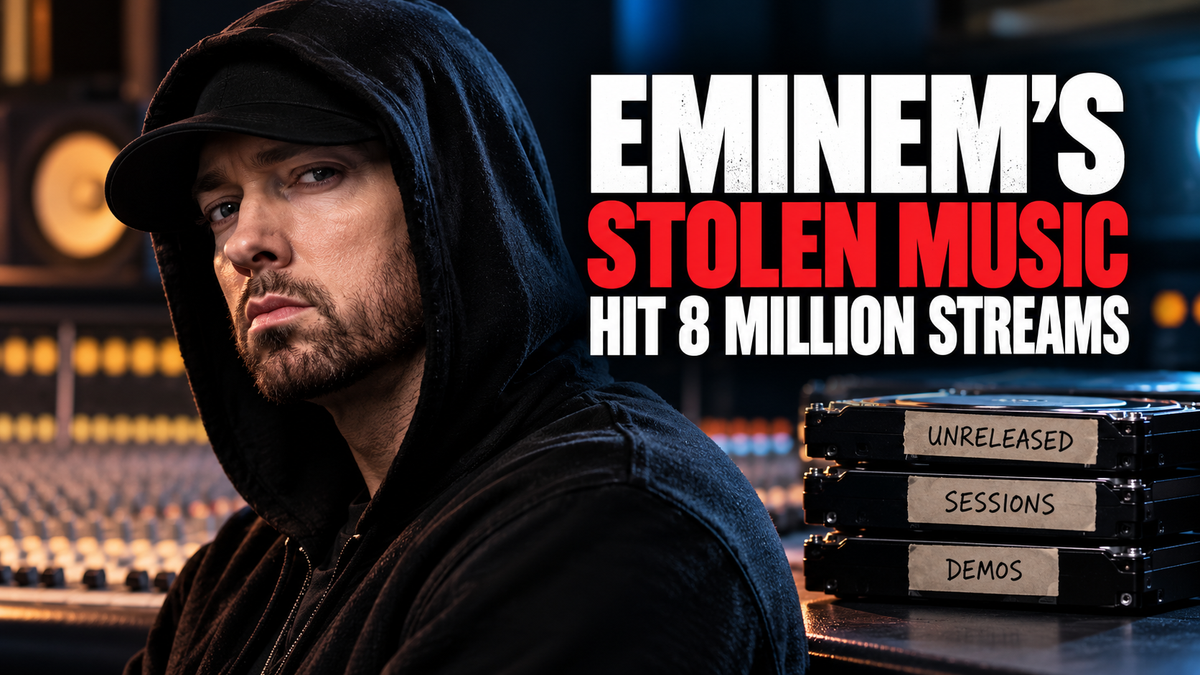
An employee trusted with Eminem's studio recordings admitted selling unreleased music without permission. The case raises a troubling question: who gets to decide when an unfinished recording becomes public?
Imagine spending years writing, recording, revising, and occasionally abandoning songs, only to discover that someone you once trusted has been selling them to strangers.
Not finished albums. Not songs you've approved for release. Recordings that may never have been intended for the public.
For Eminem, that scenario became reality.
On October 22, 2026, Joseph Strange, a former employee who worked at the rapper's Michigan recording studio, pleaded guilty to criminal copyright infringement after selling unreleased music without authorization.
According to the U.S. Department of Justice, Strange sold at least 10 audio files for approximately $50,000. The recordings eventually appeared online, where the government-identified infringing files accumulated more than eight million accesses across streaming platforms.
Federal prosecutors estimated the infringement amount at no less than $750,000.
But the most disturbing aspect of this case isn't necessarily the money.
It's what happens when an artist loses control of recordings that were never meant to leave the studio.
The Man Who Had Access to Eminem's Musical Archives
Joseph Strange wasn't an anonymous hacker breaking into a computer system from thousands of miles away.
He was someone who had worked inside Eminem's recording operation for years.
According to federal court documents, Strange was employed by Marshall Mathers, better known as Eminem, from approximately 2007 until 2021.
He worked at a studio in Ferndale, Michigan, where he helped establish and operate the computer system used to store the rapper's recordings.
That position gave him access to password-protected hard drives containing music in various stages of development.
Some files represented works in progress. Others had undergone additional production, including professional mastering.
But access to those recordings didn't mean they were authorized for release.
The distinction became central to the case.
Prosecutors said Strange copied at least 10 audio files without permission. Between July and August 2024, he sold and transmitted those files to online purchasers for approximately $50,000.
The buyers weren't purchasing music from Eminem, his record label, or an authorized distributor.
They were acquiring recordings that the artist had not approved for public distribution.
And once those files left the studio's control, their circulation became much harder to contain.
From Private Recordings to Millions of Streams
The unauthorized files eventually reached public streaming platforms.
According to the Justice Department, data supplied by several streaming providers showed that the identified infringing recordings had been accessed more than eight million times as of November 2025.
That's an extraordinary audience for music that was never officially released.
But there's an important distinction between eight million accesses and eight million legitimate, paid streams.
The government's figure describes the activity associated with the infringing recordings. It doesn't establish how much money those plays generated, how many unique listeners heard the music, or how much revenue Eminem would have earned through an authorized release.
Likewise, the government's estimated infringement amount of at least $750,000 shouldn't be interpreted as a verified loss of album sales or streaming royalties.
It is an estimate used in the copyright infringement case.
Still, the scale of the circulation illustrates how quickly unauthorized recordings can escape their original context.
A song can spend years sitting on a private studio drive, unheard by anyone outside a small circle of collaborators.
Once a digital copy begins circulating, however, it can spread to an audience of millions without the artist having any meaningful say in how it is presented.
And that creates a problem that goes well beyond piracy.
Some of the Music Had Already Been Mastered. That Doesn't Mean It Was Finished.
One detail in the Justice Department's announcement deserves particular attention.
Some of the stolen material had undergone professional preparation for possible commercial release, including studio mastering.
For music collectors and audiophiles, that might sound like evidence that the recordings were effectively finished.
After all, mastering is commonly associated with the final stage of preparing an album or song for distribution.
But that's not always how the creative process works.
Artists and producers may master alternative mixes, prepare reference versions, revisit previously completed sessions, or evaluate material that ultimately never receives an official release.
A recording can be technically polished without being artistically approved.
That distinction is especially relevant in Eminem's case.
Over a career spanning multiple decades, an artist can accumulate an enormous archive of unused verses, alternative arrangements, abandoned collaborations, and recordings that simply didn't fit a particular album.
Some may be excellent. Others may represent experiments, unfinished ideas, or directions the artist deliberately chose not to pursue.
Professional mastering doesn't erase those distinctions.
Federal prosecutors explicitly stated that commercial release of the material was neither imminent nor certain.
In other words, the existence of a mastered recording did not mean Eminem had decided the public should hear it.
And that's what makes unauthorized leaks so complicated.
They can turn a private creative decision into a public event before the artist has made that decision.
What Investigators Found
The case began attracting federal attention after Eminem's studio staff discovered unreleased recordings circulating online in January 2025.
According to reporting on the original criminal complaint, investigators traced the material to files associated with the Ferndale studio.
A federal search of Strange's home uncovered additional materials, including handwritten lyrics and notes attributed to Eminem, storage devices containing audio files, and an unreleased video.
Investigators also identified purchasers who helped establish how the recordings had been sold.
One buyer reportedly told authorities that a group of Eminem fans had helped raise money to acquire unreleased songs.
That detail introduces an uncomfortable dimension to the story.
The people seeking the recordings may have considered themselves devoted fans.
But enthusiasm for an artist's music doesn't create permission to purchase or distribute material obtained without authorization.
There's a meaningful difference between discovering a rare, legitimately issued recording and participating in the circulation of music taken from an artist's private archive.
One celebrates the artist's work.
The other can undermine the artist's ability to decide what that work should become.

The Collector's Dilemma: Is Unreleased Music Always Worth Hearing?
Anyone who collects records knows the appeal of discovering something unusual.
An abandoned album. A forgotten session. An alternate take that reveals how a familiar song evolved.
Some of the most fascinating music releases involve recordings that remained hidden for decades.
Think about how much collectors have learned from official archival projects, expanded album editions, and carefully restored studio material.
Those releases can provide extraordinary insight into an artist's creative process.
But there's a critical difference between an authorized archival release and a recording obtained through theft or unauthorized copying.
With an official release, the artist or authorized rights holder can participate in decisions about which recordings are suitable for publication, how they're presented, and what context accompanies them.
With a leak, those decisions may be made by whoever possesses the files.
That person may have little interest in the artist's intentions, the condition of the recording, or the circumstances under which it was created.
The result can be music stripped of its history.
A rough demo might be mistaken for a finished song. An experimental mix might circulate as the definitive version. An abandoned collaboration could be presented without explaining why it was never released.
For listeners, that can be fascinating.
For the artist, it can be deeply frustrating.
And once those recordings become widely available, the artist may never be able to restore the original sense of privacy around them.
Eminem's Case Is Different From the Typical Music Leak
Stories about stolen music frequently involve hacked cloud accounts, compromised passwords, or unauthorized access to remote servers.
This case involved something more personal.
Strange had legitimate access to the studio's systems because of his employment.
The alleged breach wasn't simply a failure to protect a password from an outsider. It involved the misuse of access entrusted to someone working within the artist's recording environment.
That makes the case particularly troubling for musicians, producers, engineers, and studios.
Modern recording projects often involve numerous collaborators who need access to digital files.
Producers exchange sessions with mixing engineers. Mastering engineers receive reference recordings. Managers, label representatives, and creative teams may review unreleased material before a release date is even announced.
The entire process depends on trust.
Security measures can reduce risk, but they cannot completely eliminate the human element.
Someone who legitimately needs access to a recording may also have the technical ability to copy it.
The Eminem case illustrates how serious the consequences can become when that trust is violated.
It's also a reminder that protecting music isn't exclusively about stopping illegal downloads after an album is released.
Sometimes, the greater challenge is protecting recordings before anyone has decided whether they should be released at all.
What Happens Next?
Strange pleaded guilty to criminal copyright infringement in federal court in Michigan on October 22.
He is scheduled to be sentenced on January 27, 2027.
The charge carries a maximum potential penalty of five years in prison, although the actual sentence will be determined by a federal judge after considering the applicable sentencing guidelines and other legal factors.
The guilty plea resolves an important part of the criminal case, but it doesn't undo the circulation of the recordings.
Once music has been copied, purchased, downloaded, and redistributed, eliminating every unauthorized version can be extraordinarily difficult.
And the damage isn't necessarily limited to financial considerations.
In statements following the investigation, Eminem's representatives emphasized concerns about the artist's creative integrity and legacy, as well as the interests of collaborators whose work may have been involved.
Those concerns are understandable.
A recording archive represents more than a collection of potentially valuable audio files.
It contains creative decisions, abandoned experiments, collaborations, and unfinished ideas that collectively document an artist's development.
Not every one of those ideas was intended to become part of the public record.
Who Owns the Right to an Unreleased Song?
This case also connects to a broader question that has become increasingly relevant as rare recordings, archival tapes, and private collections attract attention.
Who has the right to decide when unreleased music becomes public?
Vinyl Latte recently explored a related issue involving more than 100 hours of unheard Oasis recordings that the band sought to prevent from being sold.
The circumstances are different.
The Oasis story concerned the proposed sale and ownership of archival recordings. Eminem's case involves unauthorized copying and distribution of digital studio files by a former employee.
But both raise a similar artistic question.
Does the existence of an unreleased recording automatically make it something the public is entitled to hear?
From a collector's perspective, the temptation is understandable.
Previously unheard music can offer a glimpse into the creative process that finished albums rarely provide.
But an artist's archive isn't necessarily a collection of future releases waiting to be discovered.
Sometimes, it's a record of decisions that were deliberately left behind.
And those decisions deserve consideration, even when the music itself might be fascinating.
The Real Cost of an Unreleased Recording
It's easy to focus on the numbers in this story.
Approximately $50,000 in unauthorized sales.
More than eight million accesses across streaming platforms.
An estimated infringement amount of at least $750,000.
And a former employee now facing the possibility of federal imprisonment.
Those figures are substantial, but they don't fully explain why this case matters.
The more important issue is artistic control.
Every recording involves choices about what to keep, what to change, and what to leave unheard.
Those decisions are part of making music.
When unfinished or unreleased recordings are distributed without permission, the artist loses the ability to make those choices privately.
For someone with Eminem's extensive catalog, the recordings may eventually have become part of an authorized archival project.
Or they might have remained in the studio forever.
Either outcome should have been determined through the appropriate creative and legal channels, not by someone selling unauthorized copies.
As listeners and collectors, we naturally want to hear more from the artists we admire.
But wanting to hear a recording isn't the same as having the right to it.
And perhaps that's the most important lesson from this case.
The value of an unreleased song isn't measured only by what someone is willing to pay for it.
Sometimes, its greatest value lies in the artist's right to decide whether it should ever be heard.
What do you think? Should artists have complete control over whether their unreleased recordings ever become public, or do historically important recordings eventually deserve to be heard?
Share your thoughts in the comments.
Sources and Further Reading
Reuters: Former Eminem Employee Pleads Guilty to Criminal Copyright Infringement
Music Business Worldwide: Former Eminem Employee Pleads Guilty to Selling Unreleased Tracks
Vinyl Latte: Oasis Stopped More Than 100 Hours of Unheard Recordings From Being Sold



Comments ()