
Oasis Stopped More Than 100 Hours of Unheard Recordings From Being Sold. Who Actually Owns Them?
Oasis stopped the auction of nearly 300 tapes containing more than 100 hours of concerts, rehearsals, soundchecks, and conversations. The dispute raises a fascinating question for collectors: if you own the physical tape, do you actually own what's recorded on it?
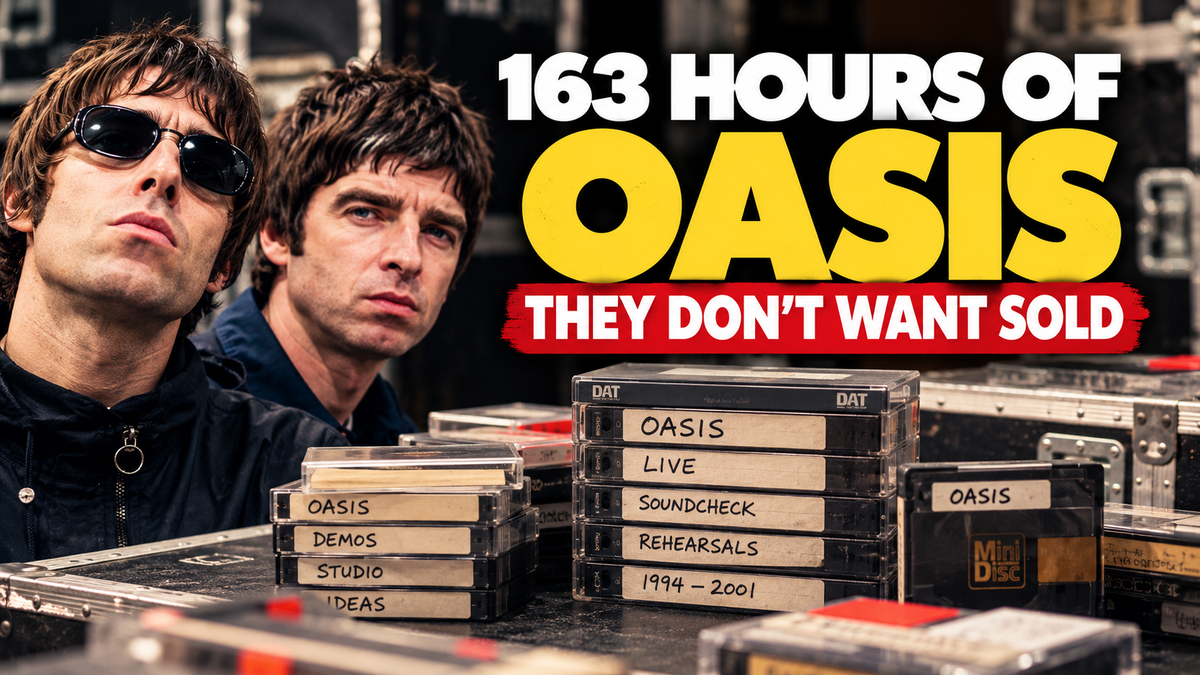
A collection of nearly 300 tapes documenting Oasis at the height of their fame was supposed to go under the hammer on October 3.
It never made it to the auction.
The archive, known as The Desk Tapes, contains 209 DAT tapes, 73 analog cassettes, and three MiniDiscs assembled by former Oasis sound engineer Huw Richards. Inside are recordings of 63 concerts, soundchecks, rehearsals, and candid conversations involving Noel and Liam Gallagher. The collection carried an estimate of £1.2 million to £1.6 million.
Then Oasis went to court.
The band launched legal action against Richards, his son Owain, and Littleton Auctions. The auction house subsequently agreed to postpone the sale while the dispute is resolved.
At first, this sounds like a fairly straightforward story about a famous band trying to stop private recordings from being sold.
It isn't.
Because Huw Richards apparently possessed the physical tapes. Oasis controls rights connected to the recordings on those tapes.
And those aren't necessarily the same thing.
Nearly 300 Pieces of Oasis History
Richards worked with Oasis from around the release of Definitely Maybe in 1994 through 2001, an extraordinary period that included Definitely Maybe, (What's the Story) Morning Glory?, Be Here Now, and Standing on the Shoulder of Giants.
While working with the band, he accumulated what became a remarkable audio archive.
The formats alone tell you something about the period.
There are 209 DAT tapes, the digital tape format that became ubiquitous in professional recording during the 1990s. There are 73 analog cassettes. There are even three MiniDiscs.
The recordings reportedly include 63 concerts as well as soundchecks, rehearsals, and conversations between members of the band. One particularly significant recording is believed to document Oasis' 1996 Loch Lomond performance.
This isn't somebody's collection of commercially released Oasis albums.
It's a working archive.
And that's what makes the dispute so interesting.
If You Own the Tape, Do You Own the Music?
Record collectors are accustomed to a simple idea of ownership.
I buy a record. The record belongs to me.
If I buy a rare acetate, test pressing, master tape, or cassette, the physical object belongs to me as well.
But owning an object containing a recording doesn't automatically give you the right to commercially exploit the recording itself.
That distinction was already clear before the auction was stopped.
When the archive was initially announced, Littleton Auctions acknowledged that a buyer wouldn't simply be able to purchase the tapes and start releasing unheard Oasis albums. Oasis retained intellectual property rights, and commercial exploitation of the material would require the band's approval.
Think about how strange that makes this particular collectible.
Someone was potentially going to spend more than £1 million to own hundreds of historically significant recordings while still being unable to commercially release what was on them.
You could own the tapes.
You could own the boxes.
You could own the physical media on which those performances were captured.
But that doesn't necessarily mean you own the music.
So What Was Worth £1.6 Million?
That's where this becomes more than a legal argument.
If the recordings can't simply be released, what exactly was the buyer purchasing?
Part of the answer is provenance.
These aren't copies of Oasis bootlegs circulating among collectors. They are recordings assembled by someone who was actually working with the band during one of the most important periods of its career.
The archive was recorded directly from the mixing desk, and the collection was even being offered with the Panasonic SV3700 DAT recorder Richards used to make recordings.
For the right collector, that's an extraordinary historical object.
But its value also comes from something harder to quantify.
What's on the tapes?
We know broadly what they contain, but an archive of this size can hold things nobody remembers existing.
Different performances. Rehearsal arrangements. Soundchecks. Unfinished ideas. Conversations. Alternate versions. Moments that seemed completely insignificant in 1995 but look very different three decades later.
That's one of the fascinating things about recorded music archives.
Nobody knows what's important until enough time has passed to understand it.
The Recordings We Almost Didn't Keep
There's another reason this story interests me.
Today, recording everything is effortless.
Phones document concerts from virtually every angle. Studio sessions can generate enormous numbers of digital files. Cloud storage makes keeping material comparatively inexpensive.
That wasn't the world in which these tapes were created.
DAT was a professional format. Tape cost money. Someone had to decide to record something, label it, store it, and then keep it.
And Richards apparently kept doing that for years.
His son Owain described the collection as a piece of history, noting that his father had preserved the recordings during an era before audiences could document performances constantly with smartphones.
Three decades later, those decisions created an archive potentially worth more than £1 million.
There is an irony here.
If Richards hadn't kept the tapes, some of this material might no longer exist.
But because he did keep them, we now have to ask who should control them.
Should Historically Important Recordings Be Private Collectibles?
This is where I think the story gets particularly interesting for collectors.
Imagine the auction had proceeded.
A private collector buys the archive for £1.5 million.
Then what?
Perhaps it remains intact and carefully preserved.
Perhaps Oasis eventually negotiates access.
Perhaps it is donated to an institution.
Or perhaps hundreds of recordings documenting one of Britain's biggest bands simply disappear into a private collection for another generation.
Collectors preserve an enormous amount of musical history. Rare acetates, test pressings, transcription discs, demos, and tapes frequently survive precisely because someone recognized their importance and kept them.
But private ownership can also make historical material inaccessible.
There isn't an easy answer.
The person who preserved an artifact may have a legitimate claim to the physical object. The artist may have an equally legitimate interest in controlling recordings of their own performances, particularly unreleased ones never intended for public consumption.
And the public may eventually see those recordings as part of cultural history.
All three interests can exist simultaneously.
The Auction Is Over. The Question Isn't.
Littleton Auctions agreed to postpone the sale so the legal dispute can be resolved. The rest of its October 3 auction was unaffected.
For now, The Desk Tapes remain in limbo.
Perhaps Oasis ultimately acquires them. Perhaps Richards retains them. Perhaps a settlement eventually allows them to be sold under different conditions.
But I keep coming back to the physical tapes themselves.
There are 209 DATs, 73 cassettes, and three MiniDiscs sitting somewhere, containing performances and moments from a band at the height of its cultural importance.
Someone owns those objects.
Someone else controls important rights associated with what's recorded on them.
And potentially millions of Oasis fans would love to hear what's inside.
For record collectors, that's a fascinating reminder that owning a recording and owning the music recorded on it can be two very different things.


Comments ()