
Your Mac Is Making More Audio Decisions Than You Think
My Bluetooth test revealed how much the transmitter matters. Now a bit perfect Mac player raises a bigger question: how many audio decisions is your computer making before the music ever reaches your DAC?
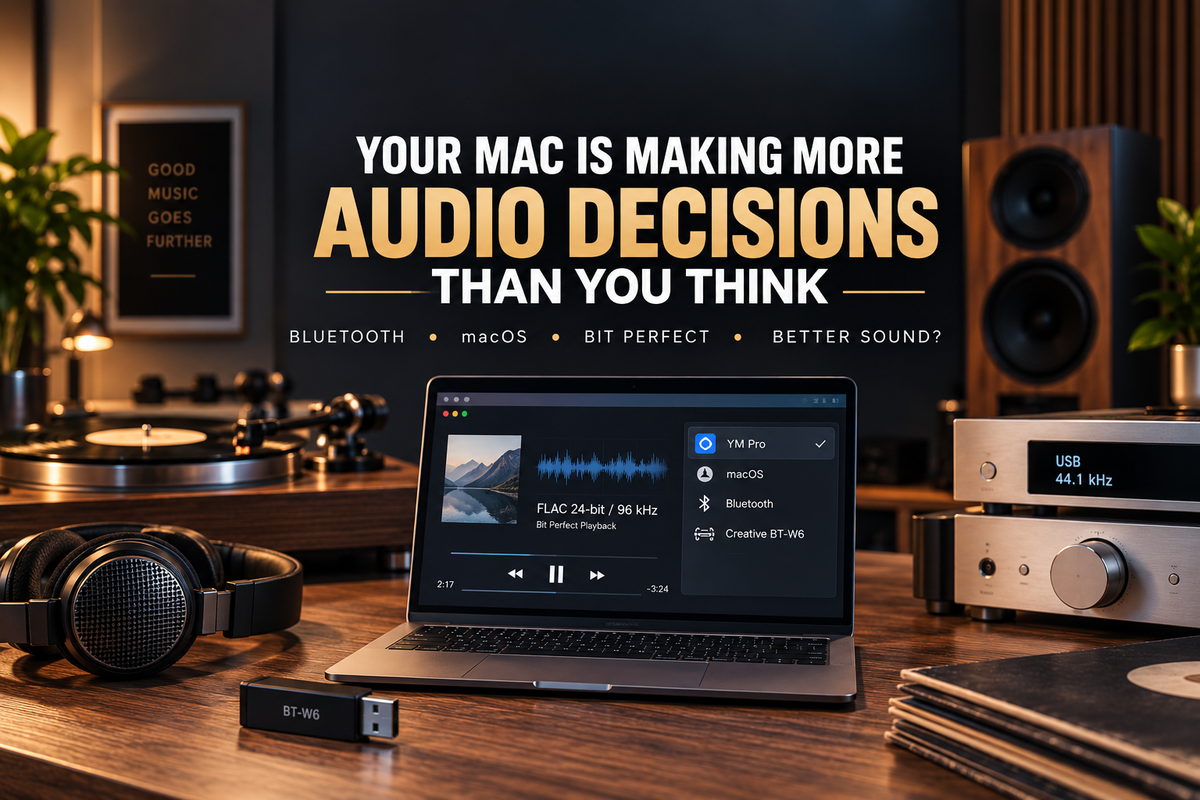
I recently spent a lot of time trying to answer what sounded like a simple question:
How close can modern Bluetooth get to a serious digital audio system?
I expected the answer to be fairly obvious.
My reference digital chain uses Roon, a dedicated Lumin U2X network transport, DSD256 upsampling, network isolation, and a T+A DAC 200. For the Bluetooth comparison, I used the $129 iFi ZEN Air Blue 2.
Those two approaches shouldn't have been close.
But they were.
Not identical. Not interchangeable. But much closer than I expected.
And the more interesting part of the experiment turned out to be something I hadn't originally set out to investigate.
The Bluetooth receiver wasn't the whole story. The device sending the music mattered too.
That led me to the Creative BT-W6 USB Bluetooth adapter, and now, just days after releasing that video, I've come across another piece of software called YM Pro that approaches digital audio from a completely different direction.
The two products don't compete with each other.
But they raise exactly the same question:
Who is actually controlling your digital audio before it reaches your DAC?
Bluetooth Wasn't the Weak Link I Expected
For years, I treated Bluetooth as convenient audio.
Useful in the car. Useful with headphones. Useful when sound quality wasn't the priority.
Not something I would compare seriously against my reference digital front end.
Modern Bluetooth forced me to reconsider some of that.
For my recent experiment, I compared several playback paths, including my Roon and Lumin reference, an iPhone feeding the iFi ZEN Air Blue 2, and a Mac using Creative's BT-W6 USB transmitter into the same iFi receiver.
The results surprised me.
The Roon and Lumin system still won my blind headphone comparison. It was smoother, more natural, and more spacious.
But the Mac with the Creative adapter was remarkably competitive.
And several listeners struggled to reliably distinguish the Bluetooth version from the reference.
That's when the experiment became more interesting than simply asking whether Bluetooth “sounds good.”
Because not all Bluetooth was behaving the same way.
The Transmitter Matters More Than I Expected
The Creative BT-W6 plugs into USB rather than relying on the Mac's built in Bluetooth audio connection.
From the computer's perspective, it behaves as a USB audio device. The adapter then handles the Bluetooth transmission itself.
Creative says the BT-W6 supports both Bluetooth Classic and LE Audio, along with codecs including aptX Lossless, aptX Adaptive, aptX HD, and others. It can transmit audio up to 24 bit/96 kHz when paired with compatible hardware.
That doesn't mean Bluetooth suddenly becomes identical to a wired 24/96 connection.
Codec support, actual codec negotiation, implementation, and the receiving device still matter.
But it changes something fundamental.
Instead of simply telling the Mac, “send this over Bluetooth,” I was giving a dedicated device responsibility for an important part of the audio chain.
And in my testing, that mattered.
The Creative adapter path performed noticeably better than the iPhone Bluetooth path, especially at the extreme high end.
That got me thinking about something further upstream.
What else is the computer deciding for us?
Your Mac Has Its Own Ideas About Audio
Connect an external DAC to a Mac and open Apple's Audio MIDI Setup utility.
You'll find that macOS lets you select the audio device's format, including its sample rate and bit depth. Apple explicitly provides controls for setting those parameters.
That creates an issue audiophiles sometimes overlook.
Imagine your DAC is currently configured for 96 kHz output.
Then you play a 44.1 kHz recording.
Something has to reconcile that difference.
Depending on the playback software and audio path, the computer may convert the audio to the currently configured output rate rather than automatically changing the DAC every time the source changes.
That isn't automatically disastrous.
Modern sample rate conversion can be extremely good.
It also doesn't mean your Mac is “ruining” your music.
But if your goal is to know exactly what is reaching the DAC, it matters.
A 44.1 kHz recording converted to 96 kHz is no longer being delivered to the DAC in its original sample rate.
That brings us to YM Pro.
YM Pro Takes a Completely Different Approach
YM Pro is a new Mac application designed specifically around bit perfect FLAC playback.
It is free, currently Mac only, and the developer describes it as a player that takes exclusive control of the audio hardware rather than using the normal shared macOS playback path.
According to its App Store listing, YM Pro automatically switches the hardware sample rate to match the music being played and uses an exclusive “Hog Mode” intende
The developer says the app supports automatic sample rate switching and bit perfect FLAC playback, with support extending into high resolution PCM.
That's an interesting approach.
But this is where I want to make an important distinction.
YM Pro and the Creative BT-W6 are not competitors.
They're solving different problems.
Creative Controls the Wireless Stage. YM Pro Controls the Computer Stage.
Think about the digital chain as a series of handoffs.
Your music starts in an application.
Then the operating system handles it.
Then perhaps a USB interface or Bluetooth transmitter receives it.
Then there may be a Bluetooth codec.
Then a receiver decodes it.
Then the DAC finally converts the digital audio to analog.
The Creative BT-W6 intervenes later in that process.
Instead of using the computer's native Bluetooth transmission, the Mac sends audio over USB to a dedicated Bluetooth transmitter. The BT-W6 handles codec selection and wireless transmission from there.
YM Pro works farther upstream.
Its goal is to control what happens before the audio leaves the computer at all.
One product is effectively saying:
Let me handle Bluetooth.
The other is saying:
Let me handle the Mac's audio output.
Different problems.
Same philosophy.
Don't leave important audio decisions to a generic system when a dedicated audio tool can make them deliberately.
That Might Explain Why My Bluetooth Test Was So Interesting
Before doing the Bluetooth experiment, I was focused primarily on the obvious part of the chain:
Bluetooth.
Lossy versus lossless.
Codec versus codec.
Wireless versus wired.
But digital audio doesn't work in such neat categories.
When I used the Creative adapter, I didn't simply change a codec.
I changed which device was responsible for part of the playback process.
That distinction may matter as much as the logo printed on the codec specification.
And YM Pro raises a similar question.
If two applications play the same FLAC file but one allows the operating system to work within a fixed output configuration while another takes exclusive control of the DAC and switches the hardware rate to match each file, are those genuinely identical playback paths?
Technically, no.
The more difficult question is:
Can we hear the difference?
That's the part I'm interested in.
Bit Perfect Doesn't Automatically Mean Better Sound
“Bit perfect” is one of those phrases that sounds like the argument is already over.
Perfect is right there in the name.
But we should be careful.
If one playback method sends the original PCM samples to a DAC unchanged and another performs high quality sample rate conversion first, that doesn't automatically mean the second one will sound obviously worse.
It may.
It may not.
The difference could be extremely small.
It might even be inaudible under controlled conditions.
That's why I'd rather test it than argue about it.
We've seen the same problem repeatedly in audio.
A technical difference becomes a marketing claim.
The marketing claim becomes conventional wisdom.
And eventually people stop asking whether anyone can actually hear it.
My Bluetooth experiment was useful precisely because it challenged one of my own assumptions.
I expected the differences to be much larger than they were.
YM Pro now gives me another assumption worth testing.
So I'm Going to Test It
The experiment I want to run is fairly simple.
Use the same Mac.
Use the same T+A DAC 200.
Use the same tracks.
Keep the downstream system unchanged.
Then compare a normal Mac playback path against YM Pro's exclusive, sample rate matched output.
I'll verify what sample rate the DAC is actually receiving.
I'll use files with different native sample rates so I can confirm that YM Pro is switching the hardware correctly.
Then I'll level match the outputs if necessary and perform the same sort of blind listening I used for the Bluetooth experiment.
And I'll compare both against the dedicated Roon and Lumin path.
That gives us three very different philosophies:
Normal Mac playback: let macOS and the playback software manage the output.
YM Pro: let dedicated playback software take exclusive control and match the DAC to the source.
Roon + Lumin: move playback away from normal computer system audio entirely and hand it to a dedicated network endpoint.
I don't know yet which differences will be audible.
That's the point.
This Is Bigger Than Bluetooth
My takeaway from the Bluetooth experiment isn't that expensive digital front ends are pointless.
It's also not that Bluetooth has caught up completely.
My reference system still performed better in my blind comparison.
The more useful lesson was that the gap between playback methods can be much smaller than the price difference suggests, especially when the less expensive system is implemented well.
And implementation keeps becoming the recurring theme.
The receiver matters.
The transmitter matters.
The codec matters.
The operating system matters.
The player matters.
The DAC matters.
And sometimes the component we think we're comparing isn't actually the component responsible for the difference we're hearing.
Maybe We Need to Stop Asking “Digital or Analog?”
Audiophile discussions frequently reduce playback to simple categories.
Analog versus digital.
Wired versus wireless.
Lossless versus lossy.
Computer versus streamer.
But those labels hide an enormous amount of what actually happens inside the chain.
My $129 Bluetooth receiver didn't suddenly become equivalent to my Roon and Lumin front end.
But it got close enough to make me start questioning where the remaining differences actually originate.
The Creative BT-W6 showed me that changing the transmitter could materially change the result.
YM Pro now gives me a way to investigate another stage entirely.
Not the Bluetooth connection.
Not the DAC.
The computer itself.
And if a free piece of software can change how the Mac hands music to a DAC, that's worth understanding whether we hear a difference or not.
Because the most interesting question in digital audio may no longer be:
What format are you listening to?
It may be:
What happened to the music before it reached your DAC?
Comments ()