
When Records Become Objects of Obsession: Living With ERC and Supersense
A closer look at ERC and Supersense, two ultra-premium vinyl labels pursuing different paths toward analog obsession. This review explores whether these rare, expensive records are truly worth it or if their real value lies in how they change our listening experience.
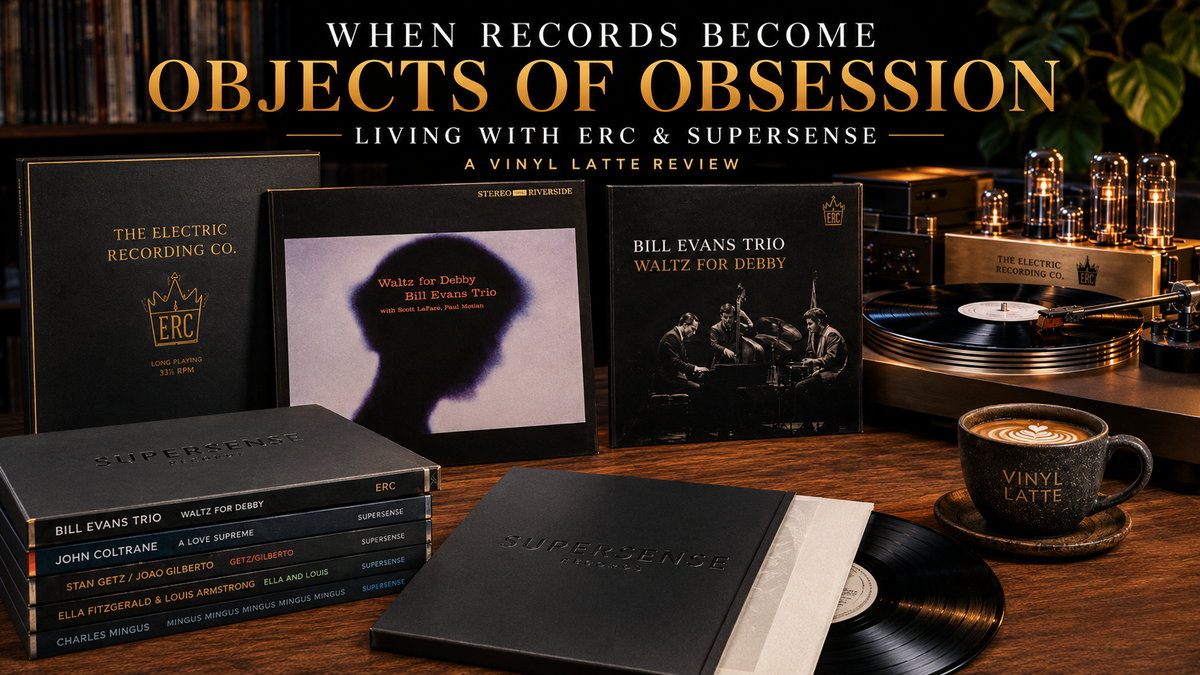
There is a point in record collecting where the conversation changes.
At first, it is about finding clean copies. Then it becomes about mastering, pressing quality, source material, plating, jackets, labels, deadwax, and whether a new reissue gets you closer to the intent of the recording. Eventually, you arrive at the far end of the hobby, where records are no longer just records. They become handmade objects, preservation projects, luxury goods, and in some cases, arguments.
That is where labels like The Electric Recording Company and Supersense live.
I have spent time with both. My Supersense collection includes John Coltrane’s A Love Supreme, Getz/Gilberto, Ella and Louis, and Mingus Mingus Mingus Mingus Mingus. I have also recently ordered Supersense’s Archival Tape Edition of The Velvet Underground & Nico. On the ERC side, I recently received the Bill Evans Trio’s Waltz for Debby, which joins my other ERC releases including Lightnin’ Hopkins’ Goin’ Away, Chet Baker’s It Could Happen to You, Rostropovich and Britten performing Schubert and Bridge, The Stooges’ Fun House, and Kenny Burrell’s self-titled Blue Note title. I have also ordered ERC’s upcoming edition of The Doors’ L.A. Woman.
That is not a casual stack of records. It is an investment. It is also the kind of collection that forces a bigger question.
Are these ultra-premium records actually worth it?
The answer is complicated. It depends on what you think a record is supposed to do.
ERC and Supersense Are Not Chasing the Same Goal
It is tempting to group ERC and Supersense together because both sit at the extreme end of the vinyl market. Both are expensive. Both are limited. Both appeal to collectors who care about process, source, presentation, and scarcity.
But after living with them, I do not think they are trying to accomplish the same thing.
ERC feels like an attempt to recreate a historically important record as a finished artifact. The jacket, labels, typography, mastering approach, and overall presentation are all part of the experience. It is not just about sound. It is about preservation through recreation.
Supersense feels different. Their Archival Tape Editions do not feel like conventional reissues. They feel more like an invitation into the cutting room. The object itself carries a sense of immediacy, fragility, and ceremony. It is less about recreating the original commercial record and more about owning something closer to the act of transferring music from tape to disc.
That distinction matters.
ERC gives you the fantasy of buying a perfect, newly made, vintage record.
Supersense gives you the feeling that you are handling something that was never really meant to be mass consumed in the first place.
The ERC Experience: Luxury Through Restraint
My newest ERC arrival is Waltz for Debby, and this is the kind of title that makes sense for the label.
Bill Evans is not music that benefits from being forced into hi-fi spectacle. The beauty of Waltz for Debby is not explosive dynamics or room-shaking bass. It is the intimacy. The air. The way Scott LaFaro’s bass moves around Evans’ piano. The way Paul Motian never feels like he is merely keeping time. The Village Vanguard atmosphere is not background noise. It is part of the recording’s identity.
This is where ERC’s approach can be incredibly effective.
The presentation does not feel hyped. It does not sound like someone tried to modernize the record or make it bigger than it is. The best ERC releases I own tend to have a natural, unforced quality. They do not always jump out of the speakers in the way some audiophile reissues do. Instead, they ask you to settle into the recording.
That can either be magical or slightly underwhelming depending on your expectations.
If you are spending ERC money and expecting fireworks, you may miss the point. ERC does not usually strike me as a label chasing maximum “wow” factor. It is more about tone, texture, scale, and preserving the emotional temperature of the recording.
With Waltz for Debby, that makes sense. The record should not sound like a hi-fi demo. It should sound like three musicians communicating in a room, with all the small human details intact.
That is where ERC can be special.
The Supersense Experience: Closer, Stranger, More Immediate
Supersense is harder to describe because the format itself changes the listening relationship.
These are not records I pull out casually while making coffee. They feel more ceremonial. With titles like A Love Supreme, Getz/Gilberto, Ella and Louis, and Mingus Mingus Mingus Mingus Mingus, there is an unavoidable sense that you are interacting with something unusual.
That is both the appeal and the problem.
Supersense can make familiar music feel newly exposed. There is a directness to the experience that can be startling. It does not feel like a normal pressing, and I do not mean that as automatic praise. It simply has a different emotional weight. You are aware of the process. You are aware of the object. You are aware that this is not something you are likely to replace easily if mishandled.
That changes how you listen.
On the best Supersense titles, the music feels less polished in the commercial sense and more immediate in the archival sense. There is a feeling of being closer to the source, or at least closer to the event of the transfer. With Ella and Louis, that can make the voices feel almost disarmingly human. With Getz/Gilberto, it can intensify the intimacy of the performance. With Mingus, the format matches the music’s density and urgency in a way that feels appropriate.
But Supersense also asks more from the listener. These are not plug-and-play luxury records in the normal sense. They require care. They require context. They require a willingness to accept that the value is not only in sonic perfection, but in the experience of the object itself.
That is important because I do not think Supersense should be judged exactly like a standard audiophile reissue. It is doing something else.
Sound Quality Is Not the Whole Story
This is where the conversation around ultra-premium records often becomes too simplistic.
People ask, “Does it sound better?”
Better than what?
Better than an original? Better than an Analogue Productions 45 RPM? Better than a Blue Note Tone Poet? Better than a clean Japanese pressing? Better than streaming through a great DAC? Better than your emotional memory of the record?
At this level, “better” becomes an inadequate word.
A great ERC or Supersense release can absolutely deliver a remarkable listening experience. But these records are not magic. They do not make every recording perfect. They do not automatically defeat every other version. They do not erase the reality that mastering choices, tape condition, playback equipment, pressing quality, and listener preference all matter.
What they can do is change your relationship with the music.
That is the real value.
When I play an ERC, I am often listening to the record as a completed historical object. I notice the restraint. I notice the artwork. I notice the absence of modern intervention. I notice the quiet confidence of the presentation.
When I play a Supersense, I am listening with a different kind of attention. I am aware of the cut. I am aware of the fragility. I am aware that the object itself feels closer to a studio artifact than a conventional consumer product.
Those are different pleasures.
Neither replaces a great standard pressing. Neither should be the only way someone hears this music. But both can deepen the experience for the right listener.
The Price Problem
We have to talk about price.
There is no way around it. ERC and Supersense records are expensive enough that they create discomfort, even among serious collectors. At these prices, the purchase is not only about sound. It becomes about scarcity, trust, presentation, and belief in the process.
That is where people divide.
Some collectors see these releases as the purest expression of analog culture. Others see them as luxury products that push vinyl into absurd territory. Both reactions are understandable.
I do not think every expensive record is automatically cynical. I also do not think every handmade, limited, all-analog project deserves blind praise just because it is rare.
The real question is whether the object has integrity.
With ERC, the integrity comes from the consistency of the vision. These releases are not cheap because they are not trying to be cheap. The entire proposition is built around recreating records with old-world craft, vintage equipment, and painstaking presentation. You may or may not value that, but the concept is clear.
With Supersense, the integrity comes from the uniqueness of the format. These records feel less like premium reissues and more like physical documents of a transfer process. Again, that may not appeal to everyone, but it is not the same thing as simply charging more for colored vinyl and a nicer jacket.
That distinction matters.
Luxury in vinyl is not automatically bad. Empty luxury is the problem.
Why Waltz for Debby Works as an ERC Title
Of all the ERC titles I own, Waltz for Debby may be one of the easiest to understand philosophically.
This is not a record that needs to be reinvented. It needs to be protected. It needs space, restraint, and respect. It needs a mastering approach that does not try to impress at the expense of the performance.
That is where ERC’s strength shows.
The album’s atmosphere is central to its identity. You are not listening to a sterile studio document. You are listening to a living room inside a jazz club, where small sounds, audience noise, and musical conversation all occupy the same space. The best versions of this record make you feel like you are sitting close enough to hear the room without losing the music.
The ERC does not make Waltz for Debby feel new. It makes it feel cared for.
That may sound like a small difference, but for this album, it is everything.
The Collector’s Dilemma
Here is the uncomfortable truth.
Most people do not need these records.
A great standard pressing, a well-mastered audiophile reissue, or even a good digital version will be more than enough for most listeners. The music is what matters, and Bill Evans, Coltrane, Ella, Louis, Mingus, Chet Baker, Kenny Burrell, The Stooges, The Doors, and The Velvet Underground do not require luxury packaging to be meaningful.
But collecting has never been only about need.
It is about connection. It is about curiosity. It is about the search for a version of a record that makes you stop multitasking and pay attention. It is about the ritual of lowering the stylus and feeling like the object in front of you matters.
That is where ERC and Supersense succeed for me.
Not because every release is automatically definitive.
Not because the price is easy to justify.
Not because owning them makes someone a better listener.
They succeed because they make the act of listening feel intentional.
Final Thoughts
After living with both ERC and Supersense, I do not view them as competitors as much as two different answers to the same obsession.
ERC asks: what if we could recreate the original record with obsessive historical care?
Supersense asks: what if we could bring the listener closer to the source artifact itself?
Both approaches are imperfect. Both are expensive. Both are easy to criticize. But both are also more interesting than the endless flood of mass-market variants that often dominate the vinyl conversation today.
For me, that is the reason these records matter.
They are not everyday purchases. They are not casual recommendations. They are not the first pressings I would tell a new collector to chase. But in a market where vinyl is increasingly treated as merch, ERC and Supersense remind us that records can still be objects of serious craft.
Are they worth it?
For most people, probably not.
For the right collector, on the right title, with the right system, and the right relationship to the music, yes.
But the better question may be this:
Does the record make you listen differently?
With the best ERC and Supersense releases in my collection, the answer is yes.



Comments ()