When an Artist’s Record Collection Becomes the Story
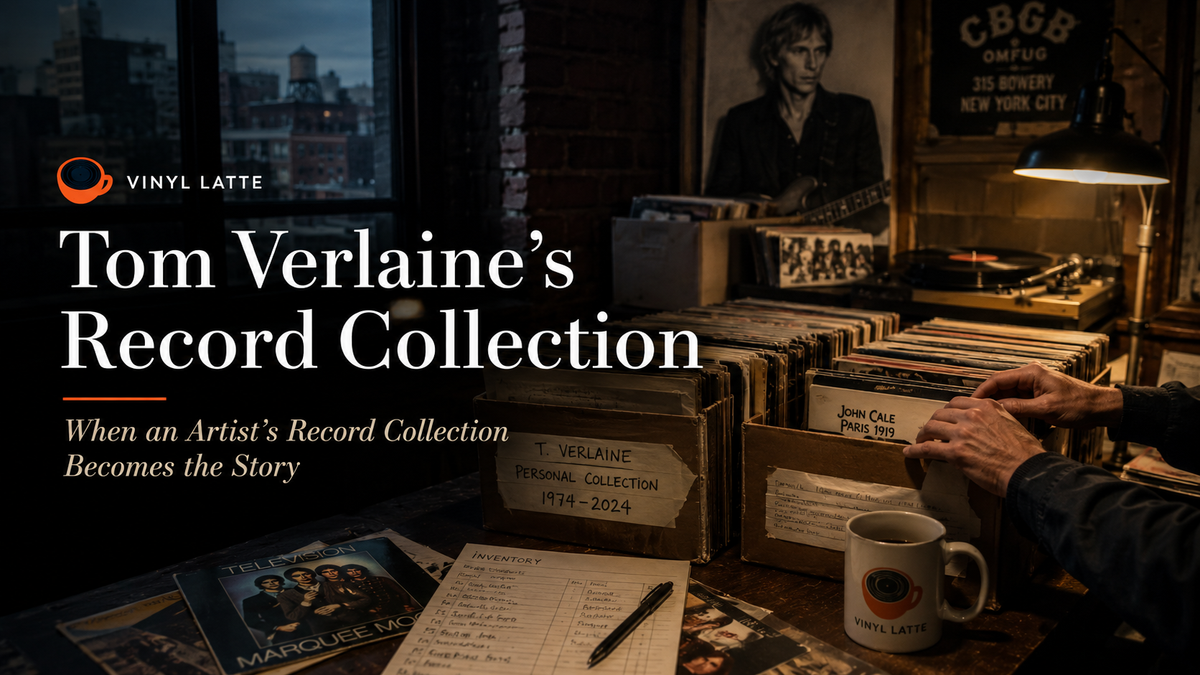
Tom Verlaine’s personal record collection is more than a sale of rare vinyl. It is a glimpse into the listening life of an artist whose influence still echoes through New York rock, record culture, and the collectors who continue chasing the stories behind the music.
There are plenty of ways to remember Tom Verlaine.
You can start with Marquee Moon, the 1977 Television album that still feels impossible to neatly categorize. It was punk adjacent, but too elegant to be reduced to punk. It was guitar driven, but not in the usual rock hero sense. It was literate, wiry, strange, precise, and full of tension. Verlaine’s playing did not simply fill space. It seemed to search through it.
Now, more than three years after his passing, another part of his story is being made public: his record collection.
Discogs and Academy Records have announced that roughly 4,000 records from Tom Verlaine’s personal vinyl archive are being offered for sale. The first online drop began on June 26 through Discogs, followed by an in person sale at Academy Records in Brooklyn on July 10 and 11. Remaining titles are expected to be listed through Discogs beginning July 31.
For most collectors, this is the kind of sale that immediately gets attention. It has the familiar ingredients: rare pressings, deep cuts, jazz, avant garde, psych, rock, international records, and personal copies tied to an artist with serious cultural weight. Among the titles mentioned are Verlaine’s own copies of Television’s Marquee Moon and “Little Johnny Jewel,” along with records by Nico, the 13th Floor Elevators, Albert Ayler, and Slint.
But the more interesting question is not simply what is in the collection.
It is what a collection like this says about the person who built it.
Record collections are strange biographies. They are rarely clean, linear, or fully explainable. They include phases, obsessions, accidents, recommendations from friends, blind buys, inherited taste, guilty pleasures, and records that made sense at one moment in life but maybe not another. Unlike a formal archive, a personal collection does not always present the version of someone they might have chosen for a museum wall.
That is what makes it compelling.
A record shelf can show curiosity in motion. It can show what someone returned to, what they chased, what they kept, and what they allowed to sit beside everything else. In Verlaine’s case, that may be especially fitting. His music never felt like it belonged to one clean lane. Television could be discussed alongside the New York punk scene, but the sound reached far beyond that. There was jazz phrasing in the guitar language, a literary sensibility in the writing, and a restless quality that made the music feel like it was still unfolding while you were listening to it.
So when you hear that Verlaine’s collection includes jazz, avant garde, psychedelic music, rock, and international records, it does not feel like a random assortment. It feels like a map.
Not a perfect map. Not a decoder ring. But a map of a listener who kept searching.
That is where the collector side of this story becomes complicated. Once a record is connected to a famous owner, its value changes. A copy of Marquee Moon is already desirable. A copy of Marquee Moon that belonged to Tom Verlaine is something else entirely. At that point, you are not only buying the record. You are buying proximity.
That can be beautiful, and it can also feel odd.
On one hand, there is something powerful about owning a record that sat in the personal collection of an artist you admire. It turns an object into a piece of history. It gives the record a story that cannot be replicated by condition grading or matrix numbers. For the right collector, that provenance matters. It becomes part of the emotional value.
On the other hand, there is a fair question about whether we sometimes over romanticize ownership. Does a record become more meaningful because Tom Verlaine owned it, or because of the music in the grooves? Is the object now more important than the listening experience? And if the record simply sits sealed away as a collectible, has it lost the very purpose that likely put it on Verlaine’s shelf in the first place?
That tension is part of what makes vinyl culture so interesting right now.
Records have always been both music carriers and physical artifacts. Today, that balance is even more pronounced. We talk about mastering chains, pressing plants, jacket quality, rarity, variants, resale value, and provenance. Those details matter, especially to collectors. But stories like this remind us that the deepest value of a record is often personal before it is financial.
A great collection is not just expensive. It is revealing.
Tom Verlaine’s record collection matters because it points back to listening as an active practice. It suggests a musician still looking outward. Not just toward records that sounded like his own work, but toward records that might have challenged him, surprised him, or opened another door.
That is the part worth holding onto.
Because every serious collector eventually has to face the same truth: the records we own are not just inventory. They become a record of our attention. They show what we cared enough to bring home. They show what we made room for.
In that sense, Verlaine’s collection is not simply going up for sale.
A portion of his listening life is being scattered into the world.
And maybe that is the most fitting ending for a collection like this. Not locked away. Not reduced to a single institution. But returned to listeners, one record at a time, where the cycle of discovery can continue.



Comments ()