
What Does “Original Master Tape” Actually Mean? Audiophile Vinyl Has a Transparency Problem
What does “original master tape” really mean? As audiophile vinyl gets more expensive, collectors deserve clearer sourcing information. The best sounding source should win, but labels should tell us exactly what they used.
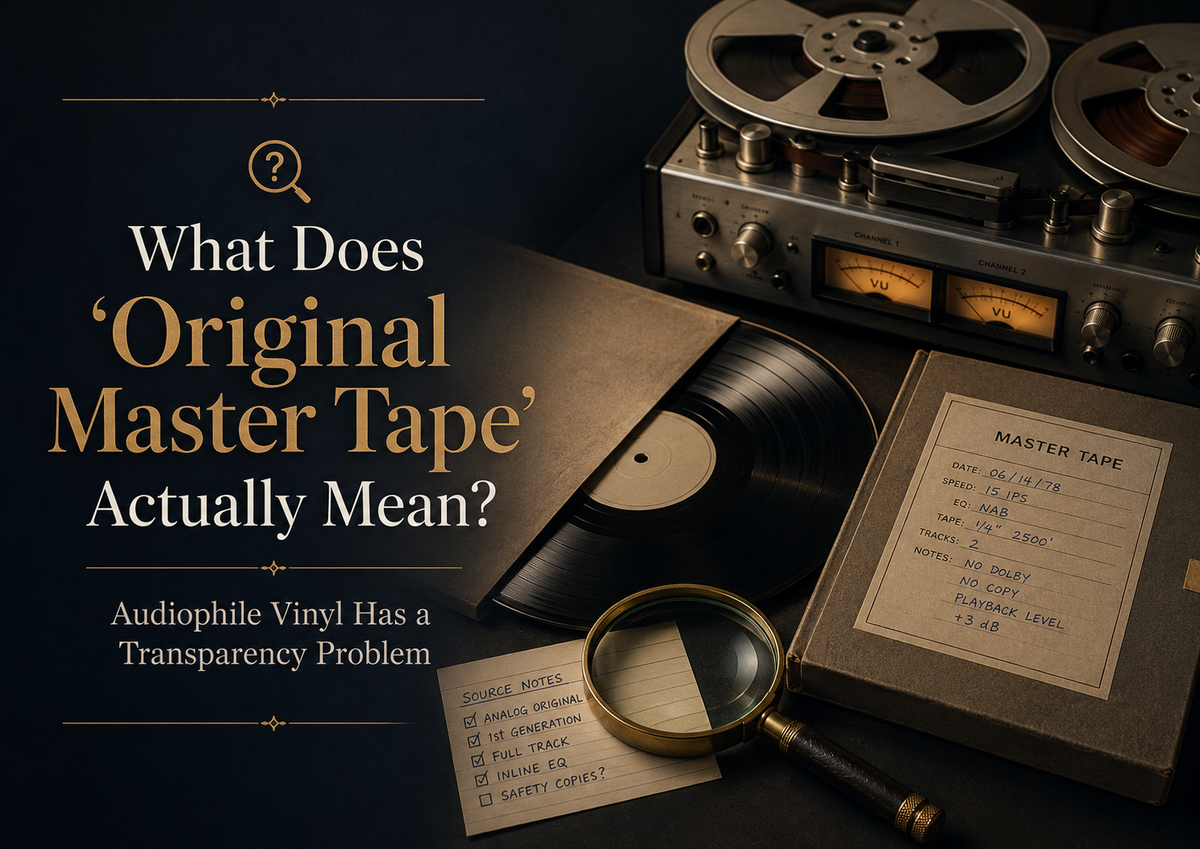
There are few phrases in record collecting more powerful than “cut from the original master tapes.”
Put those words on a hype sticker, add “AAA,” name a respected mastering engineer, press the record on 180 gram vinyl, and audiophiles immediately understand the promise being made.
Or do we?
Over the past few days, an interesting debate has been spreading through the audiophile community, and underneath some of the usual internet drama is a legitimate question that I think the record industry needs to address:
When a label says a record was cut from the original master tape, what exactly does that mean?
And perhaps more importantly, does it even need to be the original master tape to produce the best sounding record?
The Debate That Started the Conversation
Over the weekend, Steve Westman hosted a lengthy Live Audiophile Roundtable featuring Michael Fremer of The Tracking Angle, Scott Wilson of The Pressing Matters, and YouTube influencer, Mazzy.
The subject was essentially the question above: what really constitutes an original master tape, and how much should consumers care?
Then, on Monday, Mazzy continued the discussion in his own editorial video, arguing that some of the outrage over terminology may be getting out of hand.
I found myself agreeing with parts of both arguments.
Because I don't think this is fundamentally an analog versus digital debate.
I don't think this is a reason to accuse record companies of intentionally misleading customers every time the terminology isn't perfect.
And I certainly don't believe that a record automatically sounds better simply because somebody found the oldest tape in a vault.
But I do think the audiophile industry has a transparency problem.
“The Master Tape” Is More Complicated Than It Sounds
For many collectors, the phrase creates a simple mental picture.
An artist finishes recording an album. The final tape gets placed in a box. Decades later, Kevin Gray, Bernie Grundman, Ryan K. Smith, Chris Bellman, or another mastering engineer retrieves that same tape, threads it onto a machine, and cuts our new record directly from it.
Sometimes that might happen.
Record production historically was much more complicated.
There could be an original stereo mix master, an EQ'd production master, a cutting master, safety copies, copies prepared for foreign territories, and additional tapes created for different pressing facilities.
That becomes particularly important when discussing albums recorded in one country but originally distributed by another label elsewhere.
An American pressing of a British album, for example, wasn't necessarily being cut from the same physical tape used to manufacture the original UK pressing.
That doesn't automatically make the American record inferior.
In fact, some records collectors have cherished for decades were made from production or cutting masters rather than what we would now describe as “the original master tape.”
Which brings us to the real problem.
“Original master tape” sounds like a precise technical description, but in audiophile marketing it can sometimes function more like a category.
Those aren't necessarily the same thing.
Super Fly Shows Why This Matters
Rhino's recent High Fidelity edition of Curtis Mayfield's Super Fly makes this discussion particularly interesting.
Rhino markets the $39.98 vinyl edition as “AAA Cut From The Original Stereo Master Tapes By Kevin Gray.” Rhino's High Fidelity series pairs Kevin Gray's mastering with 180 gram vinyl pressed at Optimal, limited packaging, and runs of 5,000 copies for many titles.
Rhino also released Super Fly on reel to reel tape. That edition is described as being duplicated in real time from “a 1:1 copy of the original analog master tape.”
So far, that sounds straightforward.
Then things become more interesting.
In his detailed review of the Rhino release, Dave Denyer of The Reel to Reel Rambler reports that the source documentation supplied with Super Fly identifies a 1979 Kendun Recorders tape prepared by engineer Joe Gastwirt, describing it as an NAB, Dolby A, EQ'd copy master.
That doesn't mean the record sounds bad.
Quite the opposite.
Denyer praises the Kevin Gray vinyl extensively, calling it the best version of the album he has heard.
And that, to me, is exactly why this debate matters.
The Best Source Should Win
Suppose we have two tapes.
Tape A is technically the original stereo master, but after more than 50 years it has deterioration, damage, dropouts, or other problems.
Tape B is a pristine first generation safety copy made when Tape A was in perfect condition.
Which one should the mastering engineer use?
I'd choose Tape B.
Every time.
Now imagine that a carefully created high resolution digital transfer was made from Tape A before the original deteriorated.
Should we reject that source simply because using it would break the AAA chain?
Again, I wouldn't.
My priority is making the best sounding record possible.
The source matters, but the condition of that source matters. The mastering engineer matters. The mastering equipment matters. The lacquer cutting system matters. The pressing quality matters.
AAA isn't magic.
And digital isn't poison.
We've reached a strange point in the audiophile market where three letters on a hype sticker can sometimes influence how people perceive a record before the stylus ever touches the groove.
That's backwards.
The record should ultimately be judged by how it sounds.
But Sound Quality and Transparency Are Two Different Questions
This is where I separate myself from the argument that none of this matters as long as the record sounds good.
It does matter.
Not because a copy tape automatically produces an inferior record.
It matters because provenance has become part of what audiophile labels are selling.
If a label is charging a premium for an audiophile edition and specifically promoting the mastering source, then collectors should be able to understand what that source actually is.
This becomes even more important as prices climb.
A standard catalog reissue might cost $25 or $30.
Premium audiophile releases commonly cost $40, $60, $100, or considerably more. Rhino's Super Fly reel to reel edition, for example, costs $299.98 and is limited to 350 copies.
At that point, provenance isn't trivia.
It's part of the product.
AAA Doesn't Tell Us Enough Anymore
For years, collectors wanted a simple answer:
AAA or digital?
That made sense following controversies surrounding undisclosed digital steps in supposedly analog audiophile releases.
But I think the market has evolved beyond that question.
AAA tells us something useful about the signal chain.
It doesn't necessarily tell us enough about the source.
A record can be completely AAA while being cut from a second generation tape.
Another record could involve a high resolution digital stage sourced directly from the original master.
Which one sounds better?
We don't know until we hear them.
That's why I think the industry needs to separate these two ideas.
Signal chain and source provenance are not the same thing.
We Don't Need Another Complicated Audiophile Code
The solution doesn't need to involve another incomprehensible acronym.
Labels could simply tell us what they used.
Something like:
Source: Original stereo mix master
Source: Original cutting master
Source: First generation safety copy
Source: EQ'd production master
Source: Best available analog tape
Source: High resolution transfer of original master, 192kHz/24 bit
Source: Original digital master, 96kHz/24 bit
Then tell us:
Mastering: Kevin Gray at Cohearent Audio
Signal chain: AAA
Pressing: Optimal Media
Done.
Collectors know exactly what they're buying.
And here's the part I think record companies underestimate:
The story behind the source can actually make the record more interesting.
Imagine discovering that the original master was unusable, but engineers located a pristine 1972 safety copy sitting untouched in an archive for half a century.
That's not something to hide.
That's something I'd want to read about.
Audiophiles love this stuff.
Tell us the story.
This Isn't an Attack on Rhino
I also think it's important not to turn this into “Rhino is lying to collectors.”
That's too simplistic.
Rhino deserves considerable credit for what it has been doing with High Fidelity.
The company has committed to premium analog releases, respected mastering engineers, high quality pressing, archival packaging, and relatively reasonable pricing compared with much of the audiophile market. Rhino itself describes High Fidelity as a premium series intended to represent the pinnacle of its sound and packaging.
If anything, Rhino's success may be one of the reasons we're having this conversation.
The audiophile vinyl market has become more sophisticated.
Collectors know who mastered their records.
We examine dead wax.
We compare pressing plants.
We discuss tape generations.
We know the difference between a remix and a remaster.
We compare different mastering engineers using the same recording.
The vocabulary used to market these records hasn't necessarily kept pace with the knowledge of the customers buying them.
Maybe “Original Master Tape” Has Outlived Its Usefulness
This might ultimately be the bigger story.
For decades, “Original Master Recording” was almost shorthand for quality.
It told consumers that this wasn't simply another mass market reissue.
Today, that's no longer enough.
Not because collectors need to obsess over whether a particular tape is exactly one generation removed from another.
But because the information exists.
If the mastering engineer knows which tape was used, and the label knows which tape was supplied, why not tell us?
We shouldn't need forum investigations, YouTube debates, photographs of tape boxes, and detective work to reconstruct the history afterward.
Put it in the liner notes.
Better yet, put it on the product page before we buy the record.
My Standard Is Pretty Simple
I don't need every record to be AAA.
I don't need every reissue to use the original master tape.
And I don't want mastering engineers forced to use a deteriorating original simply so a marketing department can put the right words on a hype sticker.
I want them to use the best available source.
Then tell me what it was.
If that's the original master tape, fantastic.
If it's the original cutting master, tell me.
If it's a safety copy, tell me.
If the master no longer exists and somebody discovered an extraordinary production copy, tell me that story.
If the best surviving representation of the master is a high resolution digital transfer, tell me that too.
Then let the record stand or fall based on what ultimately matters:
How does it sound?
That's a standard I think collectors, mastering engineers, and record labels could all live with.
And perhaps that's the most useful thing to come out of this week's audiophile “drama.”
The question isn't whether analog is better than digital.
It isn't even whether the original master tape always matters.
The question is much simpler:
If provenance is part of what you're selling us, shouldn't we know exactly what we're buying?
What do you think? Is “AAA from the original master tapes” enough information, or should audiophile labels start providing the complete source provenance for every premium release?

Comments ()