
They Played an Album in Complete Darkness. Does Removing Your Eyes Change What You Hear?
A listening session played Caribou’s Andorra in complete darkness. Could removing visual distractions change how we perceive sound? There’s a simple hi-fi experiment you can try at home for free.
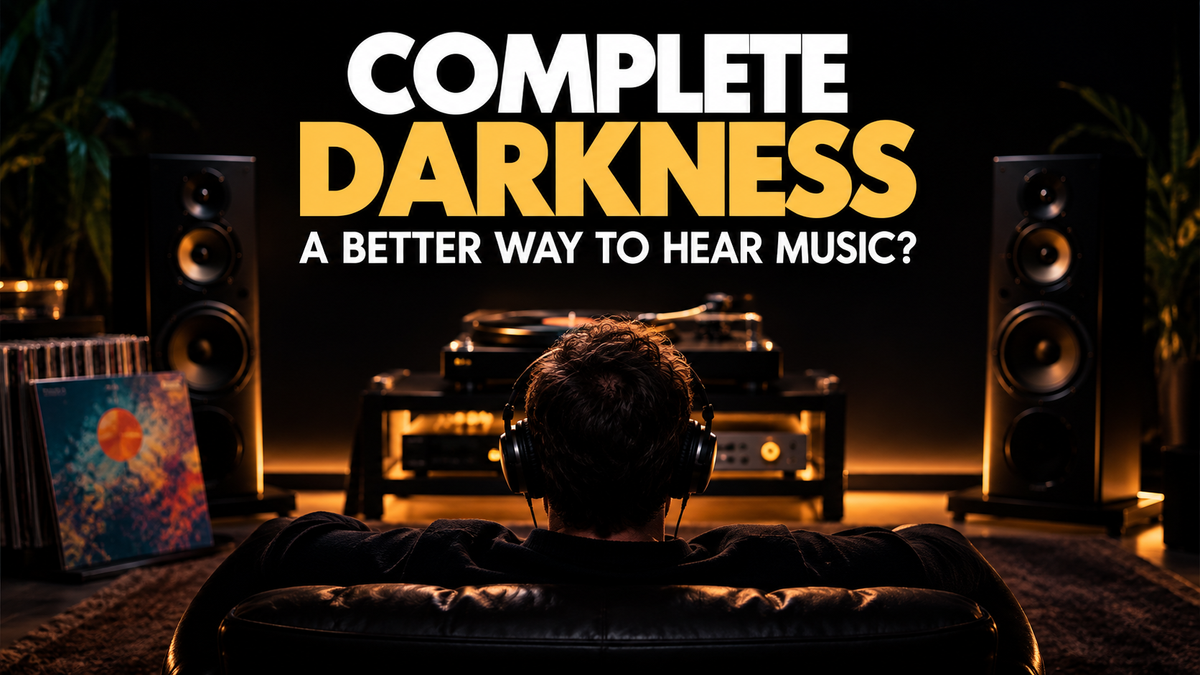
Most hi-fi demonstrations are designed to give your eyes plenty to do.
There are enormous speakers. Glowing amplifiers. Turntables spinning under carefully positioned lights. Cables thick enough to look like industrial equipment.
Then there was the listening session built around Caribou's Andorra.
The idea was almost the opposite.
Take away the stage.
Take away the performers.
And eventually, take away the light.
At Toronto's Polaris Festival, a dedicated listening event presented Andorra as an immersive hi-fi experience in complete darkness.
It's an intriguing concept because it asks a question that matters well beyond one album:
Do we listen differently when there's nothing to look at?
The Album Was the Performance
Caribou's Andorra is a particularly interesting record for this experiment.
Released in 2007, Dan Snaith's album layers psychedelic pop, electronic production, samples, percussion, vocals, and dense arrangements into recordings that can initially sound deceptively simple.
There is a lot happening inside them.
Instead of presenting that music through a conventional concert, the Polaris Festival event made the recording itself the focus.
The audience gathered specifically to listen.
No band onstage demanding attention. No phones pointed at performers. No light show competing with the music.
And, once the room went dark, very little visual information at all.
That's an unusual experience in 2026.
We rarely just listen anymore.
Your Eyes Are Part of Your Hi-Fi System
That sounds ridiculous.
It isn't.
What we see can affect what we think we hear.
Researchers have demonstrated variations of this effect for years. Expectations created by visual information can influence our perception of sound, just as expectations created by price, brand, reputation, and appearance can influence our evaluation of audio equipment.
Anyone who has spent time comparing hi-fi equipment should recognize the problem.
You know which amplifier costs more.
You know which cable was just changed.
You know which record is supposed to be the audiophile pressing.
You know you're listening to the expensive cartridge.
Even when we're trying to concentrate entirely on sound, our brains aren't operating in isolation from that information.
It's one reason I value level matching and blind comparisons when I'm evaluating equipment.
Remove information that isn't relevant to the sound, and sometimes the result becomes much less obvious than expected.
Darkness takes that idea further.
It doesn't hide which component you're listening to.
It removes nearly everything else competing for your attention.
Try Closing Your Eyes
There's a very simple version of this experiment you can perform at home.
Put on a recording you know well.
Sit in your normal listening position.
Then close your eyes.
Don't do anything else.
I've found that the apparent soundstage can become easier to visualize when I'm no longer staring at two speakers.
The speakers themselves disappear visually, which can make it easier to concentrate on where instruments appear to exist between and beyond them.
Small details can become more apparent.
Room ambience.
A breath before a vocal.
The decay of a cymbal.
The position of a backing singer.
A quiet studio sound buried behind the music.
Nothing about the system has changed.
Your attention has.
That's an important distinction.
Audiophiles Spend a Lot of Money Trying to Make Speakers Disappear
We use that phrase constantly.
“The speakers disappeared.”
Usually we're describing imaging.
A good stereo recording played through a properly positioned system can create the illusion that sound isn't coming directly from two boxes. A vocalist appears between them. Instruments occupy different positions. The recording extends beyond the physical boundaries of the speakers.
It's one of my favorite things about a good two-channel system.
But there's an amusing contradiction.
We're asking our ears to believe the speakers have disappeared while our eyes are staring directly at them.
Turn the lights off and that conflict disappears too.
You can't see the left speaker.
You can't see the right speaker.
The visual reference points defining the physical dimensions of your system are gone.
What's left is the soundstage your brain constructs from the recording.
That doesn't improve the equipment.
But it may change how you experience what the equipment is already doing.
This Isn't Proof That Darkness Sounds Better
There's an important distinction here.
A dark room doesn't improve frequency response.
It doesn't lower distortion.
It doesn't change the noise floor of your amplifier.
It doesn't fix room modes.
And it certainly doesn't turn an average recording into a great one.
What darkness can change is attention.
That's harder to measure, but it matters.
Modern listening environments are filled with distractions.
Your phone lights up.
A television is nearby.
Album information is displayed on a tablet.
The streamer shows artwork.
Meters move.
Components glow.
You start wondering whether the subwoofer needs another degree of phase adjustment.
Suddenly you're evaluating everything except the song.
Taking away the visual environment can make listening unusually deliberate.
Vinyl Already Forces Some of This Behavior
This may be part of why I find records so engaging.
Vinyl creates a small ritual around listening.
Choose the record.
Remove it from the jacket.
Clean it if necessary.
Place it on the turntable.
Lower the stylus.
Then you have roughly 20 minutes during which doing nothing is actually the intended activity.
Of course, vinyl also gives your eyes plenty to explore.
Artwork.
Liner notes.
Labels.
The spinning record itself.
But once I've looked at those things, there's often a point where I put the jacket down and simply listen.
The Caribou experiment essentially removes the first half.
There isn't anything left to inspect.
Only the recording.
There's a Free Hi-Fi Experiment Hidden Here
Audiophiles are exceptionally good at finding expensive experiments.
New cables.
Isolation devices.
Power supplies.
Network switches.
Cartridges.
DACs.
Some of those changes can be worthwhile. Others can be difficult to separate from expectation.
This experiment costs nothing.
Choose three tracks you know extremely well.
Listen normally.
Then listen again in as much darkness as you can reasonably create.
Don't change the volume.
Don't change the system.
Don't change your listening position.
And don't try to prove anything.
Just pay attention to whether your perception changes.
I'd concentrate on three things:
Soundstage: Does the apparent width or depth change when you can't see the speakers?
Localization: Is it easier to identify exactly where voices and instruments appear?
Low-level detail: Do ambience, reverberation, and quieter sounds become easier to notice?
If nothing changes, that's useful too.
The point isn't to demonstrate that darkness is an audiophile upgrade.
It's to discover how much of your listening experience is actually coming from your attention.
There's Another Experiment I'd Like to Try
The more interesting test would be blind rather than merely dark.
Take two genuinely similar audio components.
Level match them.
Have someone else switch between them without telling you which one is playing.
Then perform the comparison in darkness.
Now you've removed several visual cues simultaneously.
You can't see the equipment.
You can't see someone changing cables.
You can't see indicator lights.
You can't even use the physical location of the speakers as easily when judging the soundstage.
Would differences become easier to hear because there are fewer distractions?
Or would some differences become harder to identify because visual expectations were helping create them?
Either result would be interesting.
Maybe Critical Listening Needs Less Stuff
One of the strange things about high-end audio is how much of it is visual.
We buy equipment to hear music, but manufacturers understandably spend enormous effort making that equipment beautiful.
I appreciate that.
I love well-designed audio equipment.
But the Caribou listening session points toward something refreshingly different.
Perhaps one of the most revealing things you can occasionally do with an elaborate hi-fi system is make it disappear.
Turn off the display.
Put down the phone.
Stop looking at the equipment.
Turn off the lights.
Then play a record you know.
Not because darkness makes your system sound better.
Because sometimes the easiest way to hear more isn't changing the system.
It's giving yourself less to pay attention to.



Comments ()