
The Rolling Stones Recorded Without a Click Track. Then Their Producer Added Synth Bass.
The Rolling Stones recorded without click tracks, kept the microphone bleed, and let the performances breathe. Then Andrew Watt added synth sub-bass. It’s a fascinating lesson in knowing what technology should, and shouldn’t, fix.
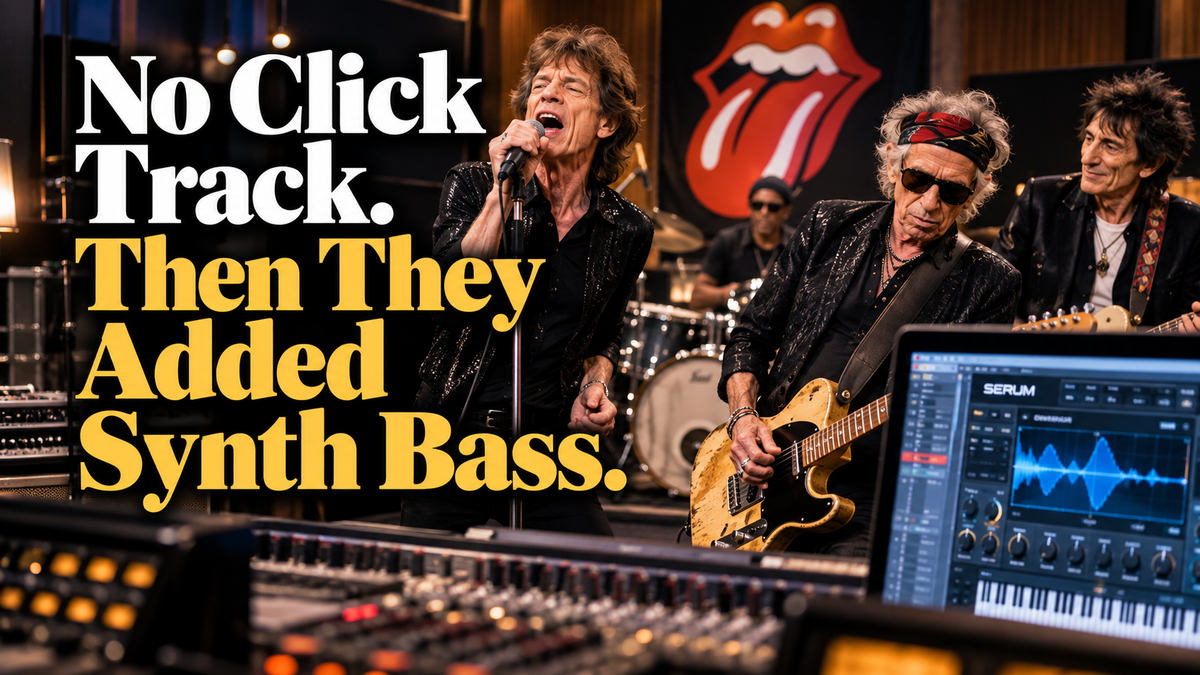
The Rolling Stones' latest album was recorded without click tracks.
The musicians played close together. Microphones picked up sounds they weren't necessarily supposed to. The tempo was allowed to move. Keith Richards and Ronnie Wood didn't always play the same guitar riff exactly the same way.
Producer Andrew Watt wanted all of that.
Then he opened a software synthesizer and added sub-bass.
That combination might sound contradictory. It's actually one of the most interesting things I've heard about modern record production lately.
Because Watt wasn't trying to make the Rolling Stones sound old.
He was trying to preserve what makes them sound human while using modern technology where it could make the recording better.
And maybe that's a much healthier way to think about recording than endlessly arguing about analog versus digital.
Don't Put the Rolling Stones on a Grid
Watt recently broke down the Stones' “In The Stars” for Mix with the Masters, revealing how he recorded the band's 2026 album Foreign Tongues.
His basic philosophy was remarkably simple.
“You just record 'em.”
The entire album was made without click tracks, according to Watt. Rather than isolating everyone, the Stones played close together in the live room so they could see, hear, and react to one another.
That's important because a click track gives musicians a fixed tempo reference.
There's nothing inherently wrong with that. Clicks are enormously useful in modern production, particularly when performances need to synchronize with programmed elements, automation, video, or extensive editing.
But musicians don't naturally behave like metronomes.
They push.
They pull.
A chorus can accelerate slightly. A phrase can hang behind the beat. A drummer can respond to what a singer is doing rather than what a grid says should happen next.
With the Stones, Watt decided that movement was part of the music.
“This is not loop-based music,” he explained. “It is performance-based music.”
That's an important distinction.
Even the Microphone Bleed Stayed
Recording musicians close together creates another problem.
Bleed.
A microphone positioned for one instrument inevitably captures some of the others.
Modern recording gives engineers countless ways to reduce that problem. Musicians can be isolated. Tracks can be cleaned. Gates can remove unwanted sound. Performances can be edited individually.
Watt went in the opposite direction.
He left the bleed.
His reasoning was that the sound spilling between microphones contributed to the energy of the performance.
That's where this gets particularly interesting to me.
We often talk about recording quality as though better separation automatically means better sound.
Technically, it can.
Musically, it isn't always that simple.
Keith Richards and Ronnie Wood are a perfect example.
Watt places Richards on the left and Wood on the right in the mix. They can play the same basic riff slightly differently, but those differences interact to create the interlocking guitar sound that has been part of the Stones for decades.
Clean all of that up too aggressively and you may end up with something more precise.
You might also end up with less Rolling Stones.
Then Andrew Watt Opened Serum
Here's the part I wasn't expecting.
After preserving the natural tempo, room sound, microphone bleed, and live interaction of the band, Watt used a software synthesizer to reinforce the low end.
Specifically, Serum.
If you spend any time around electronic music production, that name probably sounds perfectly normal. Serum is a software synthesizer commonly used to create electronic sounds and bass.
It's not something most people associate with Keith Richards.
But Watt used it to generate sub-bass on “In The Stars” and elsewhere in the production. His Mix with the Masters breakdown specifically covers bass EQ, MIDI conversion, and sub synthesis using Serum alongside a 1965 Fender Jazz Bass, an Ampeg SVT, and vintage Helios electronics.
Think about that signal philosophy for a moment.
Vintage bass.
Vintage amplifier.
Vintage microphones and preamps.
Musicians playing together without a click.
And a modern software synthesizer extending the bottom octave.
Watt wasn't choosing analog or digital.
He was choosing whatever served the recording.
That's a Better Conversation Than Analog vs. Digital
Audiophiles love provenance.
I'm one of them.
I want to know how something was recorded. I want to know what the source was, who mastered it, how the lacquer was cut, and what happened between the microphone and the record sitting on my turntable.
But provenance can become shorthand for quality when it really shouldn't.
Analog doesn't guarantee a great recording.
Digital doesn't prevent one.
We just discussed something similar with Beck's Ride Lonesome One-Step. That $110 record was cut from 24-bit/96kHz files transferred from analog masters.
The presence of that digital step tells us something important about the production chain.
It doesn't tell us whether the record sounds good.
Andrew Watt's approach to the Stones illustrates the same idea from the opposite direction.
The goal wasn't technological purity.
The goal was preserving the things technology shouldn't remove and using technology for the things it could improve.
What Technology Shouldn't Fix
This may be the most important distinction.
Not every imperfection is a defect.
A guitarist playing slightly ahead of another guitarist isn't necessarily a problem.
A singer changing phrasing from one verse to another isn't a problem.
A drummer moving the tempo isn't necessarily a problem.
Microphone bleed isn't always a problem.
Those things can be part of what makes a group of musicians sound like a band rather than a collection of individually recorded tracks.
Modern production tools make it possible to correct almost everything.
Timing can be quantized.
Pitch can be corrected.
Drums can be replaced.
Noise can be removed.
Performances can be assembled from dozens of takes.
That's extraordinary power.
The difficult part is knowing when not to use it.
Watt appears to have drawn that line around the musicians themselves.
Let the Stones be the Stones.
Then build around them.
But Modern Records Also Have to Work on Modern Systems
The sub-bass decision reveals the other half of the equation.
A Rolling Stones album released in 2026 isn't being heard exclusively through big speakers and turntables.
It's being played through headphones, cars, Bluetooth speakers, streaming systems, and modern hi-fi rigs capable of reproducing extremely deep bass.
Watt has said he was trying to balance keeping the Stones classic while making them sound current. The Mix with the Masters breakdown shows that low-frequency synthesis was one of the tools used to accomplish that.
That's not restoration.
It's production.
And I like the distinction.
He didn't make the musicians conform to modern production.
He made modern production conform to the musicians.
The Studio Gear Is Pretty Serious Too
None of this means the traditional recording chain was ignored.
The In The Stars breakdown includes a 1958 Fender High-Powered Tweed Twin, Neumann U67 microphones, an SSL E Series console, Helios Type 69 electronics, an AKG C12, an RCA 44-BX ribbon microphone, a 1965 Fender Jazz Bass, and other serious studio hardware.
Mick Jagger's vocal was recorded with a Sony C800G, according to Watt.
There's plenty here for someone who loves vintage recording equipment.
But then sitting inside that same production is a software synthesizer.
That's precisely why I find the story interesting.
It isn't nostalgia.
And it isn't technological evangelism.
It's a producer using both.
Maybe This Is What “Modern Analog” Should Mean
We tend to divide recording into camps.
Analog versus digital.
Vintage versus modern.
Live versus edited.
Purist versus processed.
Actual records rarely fit those categories as neatly as we'd like.
Foreign Tongues certainly doesn't.
The Rolling Stones were allowed to play like a band that has spent decades learning how to react to one another. Their timing wasn't forced onto a grid. Their instruments weren't completely isolated. The room wasn't scrubbed out of the recording.
Then modern tools were used deliberately around that performance.
I find that much more interesting than attempting to recreate 1972.
The Rolling Stones already made Exile on Main St.
They don't need to make it again.
The challenge is making a Rolling Stones record in 2026 that still sounds unmistakably like four musicians interacting in a room while also sounding like it belongs in 2026.
Andrew Watt's solution wasn't to choose between old and new.
It was to decide which parts shouldn't change.
That's a production philosophy I wish we talked about more.
Because maybe the best use of modern recording technology isn't making musicians more perfect.
It's knowing exactly what not to fix.



Comments ()