
The Listening Room Is Back, And It Might Be the Best Thing Happening to Hi-Fi
A dedicated listening room is becoming more than an audiophile dream. It is a response to distracted listening, giving vinyl, hi-fi, and the ritual of playing records a space that feels intentional again.
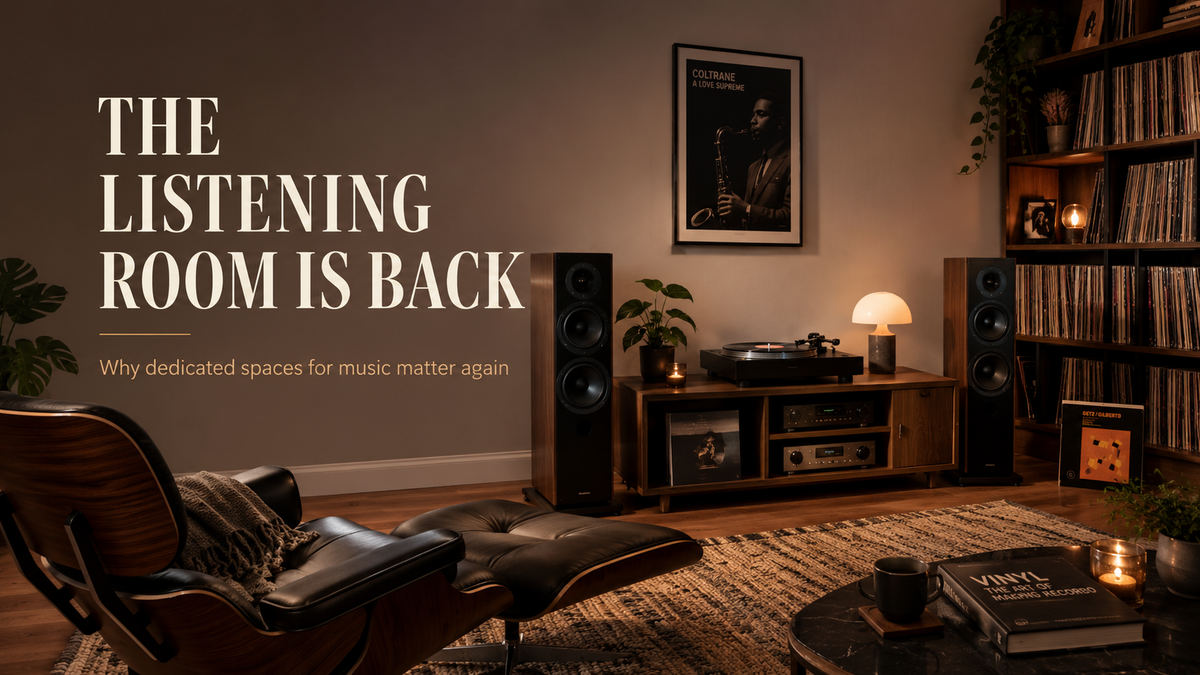
For years, the dedicated listening room felt like something reserved for a very specific kind of audiophile.
You know the image. One chair. One system. A rack full of gear that costs more than a car. Acoustic panels arranged with scientific precision. A turntable that looks like it was engineered by NASA. Maybe a glass of something expensive within reach, but only if it sits on a properly isolated surface.
That version still exists, of course. And for the people who love that level of commitment, there is nothing wrong with it.
But something interesting is happening. The listening room is starting to move beyond the hardcore audiophile world. It is becoming part of a broader lifestyle conversation. Interior designers are talking about it. Homeowners are building around it. Younger music fans are discovering it through listening bars. Vinyl collectors are realizing their records deserve more than just storage. And people who spend most of their day staring at screens are starting to crave a room that asks them to do one thing.
Listen.
That may sound simple, but in 2026, simple has become rare.
From Background Music To Intentional Listening
Most people have more access to music than ever before, yet probably spend less time truly listening to it.
Music follows us everywhere now. It plays while we cook, work, drive, clean, scroll, exercise, and answer emails. Streaming has made music impossibly convenient, but it has also made it easier to treat music like wallpaper. Always available. Always replaceable. Always competing with something else.
The listening room pushes back against that.
It says music deserves a little space. Not necessarily a mansion wing or a custom built studio, but a place where the system, the records, the lighting, the chair, and the mood all point in the same direction. It turns listening into an activity again.
That is the magic of a good listening room. It does not just improve the sound. It changes your relationship with the sound.
You walk in differently. You sit differently. You choose a record differently. You are less likely to skip songs, less likely to treat the album as disposable, and more likely to remember why you bought all this stuff in the first place.
The Japanese Listening Bar Effect
A big part of this renewed interest comes from the rise of Japanese style listening bars.
These spaces are not built around shouting over music. They are built around surrendering to it. Low lighting. Intentional seating. Carefully selected records. A system that is treated as part of the architecture, not an afterthought. The music is not background entertainment. It is the reason the room exists.
That idea has slowly made its way into homes.
People are not just asking, “What speakers should I buy?” They are asking, “What kind of space do I want to create around music?”
That is a much more interesting question.
Because once you ask it, the hobby becomes less about endlessly upgrading and more about building an experience. The turntable matters. The speakers matter. The cartridge, phono stage, amplifier, room treatment, record cleaning, and setup all matter. But the room itself becomes part of the system.
And for many people, that might be the missing piece.
The Listening Room Does Not Need To Be A Luxury Flex
There is a danger with any home design trend. It can quickly become another status symbol.
A listening room can absolutely become that. A designer sofa, hidden speakers, expensive wood slats, custom cabinetry, six figure system, and a coffee table book casually opened to a page about Blue Note records. It can become something meant to impress guests more than serve the music.
But that is not what makes the idea special.
The best listening rooms are not the most expensive. They are the ones that feel used. They have records within reach. They have a chair you actually want to sit in. They have lighting that makes you want to stay a little longer. They have a system that invites you in instead of intimidating you. They have a sense of personality.
A listening room can be a full dedicated space, but it can also be a corner of a living room. It can be a modest turntable, a pair of well placed speakers, a few shelves of records, a rug, and a comfortable seat. It can be a headphone station. It can be a small room that finally gets treated with intention.
The point is not luxury.
The point is purpose.
Hi-Fi Has Always Needed A Better Invitation
One reason I think this trend matters is because hi-fi has not always been good at inviting people in.
Too often, the hobby presents itself as a technical exam. You need to understand impedance, loading, gain, stylus profiles, room modes, cable debates, and pressing plants before you are allowed to have an opinion. That can be fun for those of us who enjoy the details, but it can also scare people away.
A listening room is easier to understand.
It is not asking someone to care about specs first. It is asking them to care about the feeling first.
Come in. Sit down. Pick a record. Hear what happens.
That is a much better gateway into the hobby than arguing about whether someone’s entry level turntable is good enough. Once people experience music in a room that is built around listening, curiosity tends to follow naturally. They start noticing imaging. They start noticing bass texture. They start noticing how different pressings sound. They start understanding why setup matters.
The room creates the emotional connection. The gear can come later.
Vinyl Belongs In This Conversation
Vinyl is a huge part of why the listening room idea works.
Records already slow the process down. You choose an album. You remove it from the jacket. You clean it. You place it on the platter. You lower the stylus. You listen to a side. Then you get up and flip it.
That ritual can be inconvenient, but it is also the point. Vinyl makes music physical again. A listening room gives that physical ritual a proper home.
This is one reason record storage has become more than just a practical problem. The records are part of the room. The jackets are artwork. The shelves tell a story. The collection becomes part of the atmosphere.
Streaming can live beautifully in a listening room too, but vinyl gives the space a visual and tactile anchor. It makes the room feel like a place for music, not just another room with speakers in it.
The Room Is Part Of The System
Audiophiles already know this, even if we sometimes forget it.
The room matters. Speaker placement matters. Seating position matters. Reflections matter. Bass behaves differently depending on the space. A modest system in a thoughtfully arranged room can often be more satisfying than an expensive system fighting a bad environment.
That does not mean every listening room needs to look like a recording studio. In fact, many people probably do not want that. The goal is not to turn your home into a lab. The goal is to create a room that sounds good and feels good.
A rug can help. Curtains can help. Bookshelves can help. Better speaker placement can help. Getting the chair out of the worst possible position can help. Subwoofer calibration can help. A little intentionality goes a long way.
The biggest upgrade might not be another component. It might be giving your system the space and setup it deserves.
Why This Trend Feels Different
The vinyl comeback has been discussed so much that it can feel exhausted. Sales numbers, pressing delays, color variants, Record Store Day, major label cash grabs. We have covered all of it.
But the listening room trend feels like the next chapter.
It is not just about buying records. It is about living with them.
It is not just about owning gear. It is about using it.
It is not just about nostalgia. It is about creating a space that feels human in a world that increasingly does not.
That may be why this idea is resonating outside the usual audiophile bubble. People are tired of everything becoming faster, smaller, more disposable, and more distracted. A listening room offers the opposite. It is slow. Physical. Personal. Focused.
It gives music back its weight.
The Real Luxury Is Attention
The listening room may be becoming a home design trend, but I hope it does not become only that.
Because the real luxury is not the room.
It is attention.
It is having a place where music is not competing with the television, the phone, the laptop, or the endless scroll. It is having a space where an album can unfold without interruption. It is having a reason to sit with a record long enough to hear the second side.
That is what makes this exciting for hi-fi.
Not because every home needs a dedicated listening room. Most do not have the space, budget, or household flexibility for that. But everyone who loves music can borrow the idea.
Create a place for listening. Make it comfortable. Make it intentional. Make it yours. Give the music a fighting chance.
Because when the room is right, the system feels more alive. The records feel more important. And listening becomes something we choose to do again, not just something happening in the background.
Maybe that is the future of hi-fi.
Not louder. Not flashier. Not more complicated.
Just a room, a record, and the willingness to listen.



Comments ()