
The Fake Vinyl Factory That Made £2.7 Million Selling Counterfeit Records
A £2.7 million counterfeit vinyl operation used vintage record presses and thousands of stampers to manufacture fake records. Here’s what the case reveals about counterfeit vinyl, and what collectors should check before buying.
You find a record you've been looking for online.
The price seems reasonable. The artwork looks right. The labels look convincing. Maybe the seller even has good feedback.
You buy it.
What you may not realize is that the record wasn't pressed by the label at all.
That possibility became considerably more real after UK authorities dismantled what they describe as the country's largest known counterfeit vinyl record operation.
The numbers are remarkable.
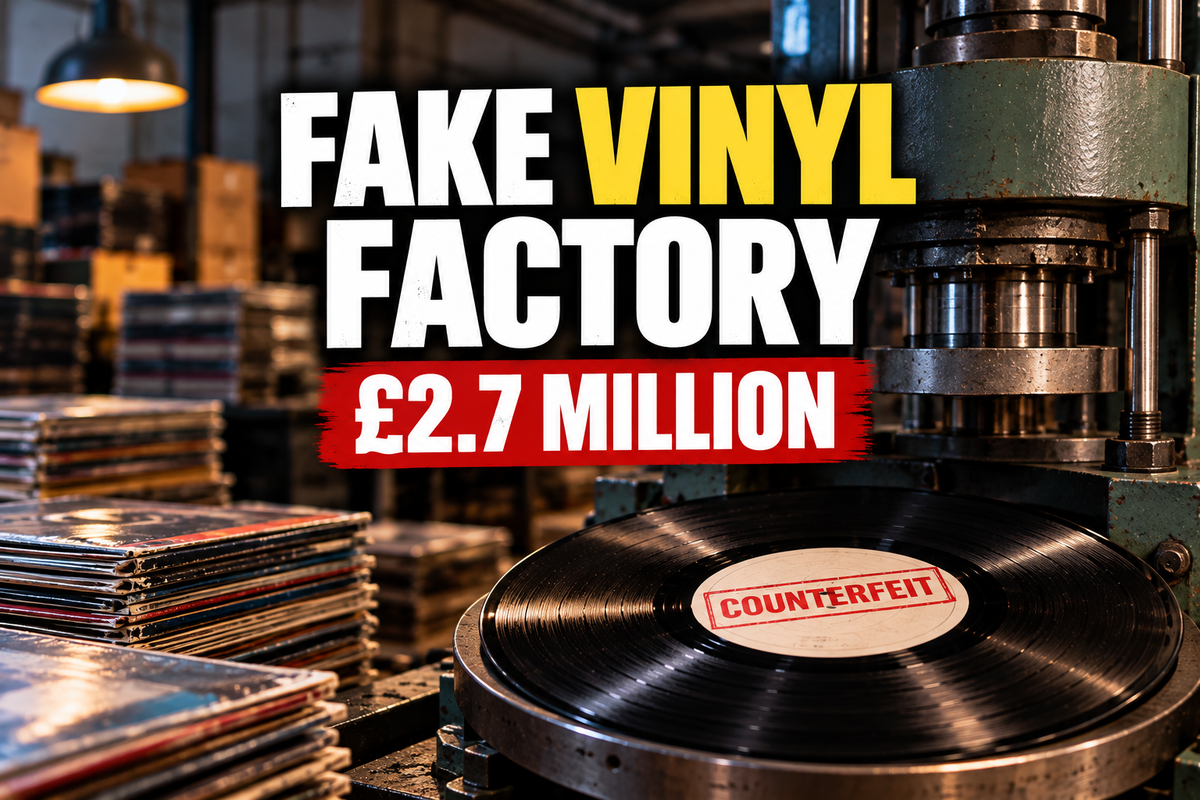
More than £2.7 million in sales. Thousands of records. Thousands of metal stampers. Four vintage record presses. More than 100 artists affected. And enough seized material to weigh approximately 18 tonnes.
On September 18, 2026, the man behind the operation, Rehan Ahmed, was sentenced to three years and six months in prison.
But for record collectors, the most interesting part of this story isn't the sentence.
It's how sophisticated counterfeit vinyl has become.
Because these weren't somebody's homemade lathe cuts being sold from the trunk of a car.
This was a record pressing operation.
And some of its products were reportedly making their way into the same marketplaces collectors use every day.
This Was Basically an Underground Record Factory
The investigation dates back several years.
According to the City of London Police's Police Intellectual Property Crime Unit, or PIPCU, Ahmed operated a business called Vinyl Groove UK Ltd.
Authorities say that between 2017 and 2024, the operation generated approximately £2.743 million from counterfeit vinyl records.
When investigators searched the operation in Acton, West London, what they found wasn't a small duplication setup.
There were four record pressing machines believed to be approximately 70 years old, along with around 3,000 metal stampers.
Police also recovered thousands of labels, sleeves, and completed records.
In total, investigators seized around 18 tonnes of evidence.
Think about the infrastructure required for that.
This wasn't simply copying an album cover and putting an unofficial recording inside.
Someone had assembled the equipment and materials necessary to manufacture records at scale.
In other words, it looked a lot like a record pressing plant.
It just wasn't pressing authorized records.
The Artist List Is Enormous
Police identified copyright infringement involving 108 different artists.
And these weren't obscure titles where nobody was likely to notice.
The list reportedly included The Beatles, Taylor Swift, Adele, Beyoncé, Rihanna, Drake, Ed Sheeran, Bad Bunny, Nirvana, and many others.
That makes the scale of the operation particularly interesting.
Counterfeit vinyl is sometimes associated with rare recordings that have never received official releases: live performances, radio broadcasts, demos, and other material collectors generally understand to be unofficial.
This was different.
The records were designed to resemble legitimate commercial products.
And that distinction matters.
A Bootleg and a Counterfeit Aren't Necessarily the Same Thing
Record collectors tend to use the word "bootleg" rather loosely.
But there is an important distinction between an unofficial release and a counterfeit.
Imagine someone presses an unauthorized live performance by a famous band. The cover is completely different from any official album, and everyone buying it understands that the record was never issued by the band's label.
It's unauthorized.
But it isn't necessarily pretending to be something else.
A counterfeit is more deceptive.
The objective is to reproduce an existing legitimate product closely enough that someone might believe they're buying the real thing.
Artwork can be copied.
Labels can be reproduced.
Catalog numbers can be duplicated.
Even the record itself can look convincing.
And that's where this case becomes particularly relevant to collectors.
These Records Didn't Stay Inside Some Secret Underground Market
According to reporting on the case, counterfeit records connected with the operation were sold through online platforms including Discogs and eBay, as well as through other channels.
That's the part that should get collectors' attention.
Because Discogs isn't some obscure corner of the internet for vinyl buyers.
For many collectors, it is the database we use to determine which pressing we own in the first place.
We examine matrix numbers. We compare labels. We look at country of origin, jacket variations, mastering credits, pressing plants, and sales history.
Then we use the marketplace to buy those records.
The existence of an industrial scale counterfeit operation demonstrates an uncomfortable reality:
A record looking legitimate doesn't necessarily make it legitimate.
Could One Be Sitting in Your Collection?
Possibly.
That doesn't mean collectors should suddenly become suspicious of every record they've purchased online.
The overwhelming majority of records changing hands are exactly what sellers claim they are.
But the sophistication of this operation makes some of the traditional warning signs more important.
One of the first things I look at with a questionable pressing is the runout area.
The dead wax can contain matrix numbers, mastering engineer initials, pressing plant identifiers, lacquer information, and other markings that help identify where a record came from.
Discogs can be extremely useful here because individual releases often document those inscriptions.
If the matrix information on your record doesn't correspond with the pressing it claims to be, that's worth investigating.
The same applies to labels.
Look closely at typography, spacing, colors, logos, and printing quality. Counterfeits can reproduce artwork surprisingly well, but small differences sometimes remain.
Jackets can offer clues too.
Poor image resolution, slightly incorrect colors, fuzzy text, unusual paper stock, or artwork that appears to have been scanned from another sleeve can all warrant a closer look.
None of those things alone proves a record is counterfeit.
Legitimate pressings vary tremendously.
But several inconsistencies together should make you curious.
The Price Can Tell You Something, Too
Collectors already know this rule, even if we occasionally choose to ignore it:
If a deal looks impossibly good, investigate before buying.
Suppose a genuinely scarce pressing routinely sells for $300 and a seller suddenly has several sealed copies for $45.
Maybe someone discovered old stock.
Maybe the seller doesn't know what they have.
Or maybe something else is happening.
Scarcity is difficult to counterfeit digitally because sales histories and pressing quantities leave clues.
The physical object, however, can be reproduced.
And when an operation has actual pressing equipment and thousands of stampers, the economics change considerably.
The Seller Matters as Much as the Record
Marketplace feedback remains useful.
But I would look beyond the percentage score.
What else is the seller offering?
Do they suddenly have multiple copies of records that should be difficult to find?
Are several supposedly rare titles available in suspicious quantities?
Do other buyers mention questionable pressings?
Does the seller provide photographs of the actual record or only stock images?
For expensive records, asking for photographs of the labels, jacket, and runout area is entirely reasonable.
You're not being difficult.
You're verifying what you're buying.
Discogs Is Incredibly Useful, but It Isn't Authentication
This case also highlights something important about record databases.
Discogs is an extraordinary resource because collectors collectively document an enormous amount of pressing information.
But finding a release in the database doesn't authenticate the physical object in your hands.
A counterfeiter can copy an existing release.
That's the point.
The database tells you what the legitimate pressing should look like.
Your job is to determine whether the record you're holding actually matches it.
For common $20 records, that level of scrutiny probably isn't necessary.
For a $500 first pressing?
I would absolutely check.
There's Another Victim Here: Independent Record Stores
Counterfeit records aren't merely a collector problem.
They're potentially a record store problem too.
A store owner purchasing used collections cannot research every record for an hour before putting it into inventory.
Experienced dealers develop an extraordinary ability to spot unusual pressings, but a sophisticated counterfeit can still create problems.
If an unauthorized record enters the used market and changes hands repeatedly, its history becomes increasingly difficult to reconstruct.
The fifth owner may have absolutely no idea where it originally came from.
That's one reason provenance matters more as prices rise.
Where did the record come from?
How long has the seller owned it?
Is there documentation?
Does the physical record match known legitimate examples?
Those questions aren't particularly exciting.
Until you're spending serious money.
Yesterday's Bootleg Story Suddenly Looks Very Different
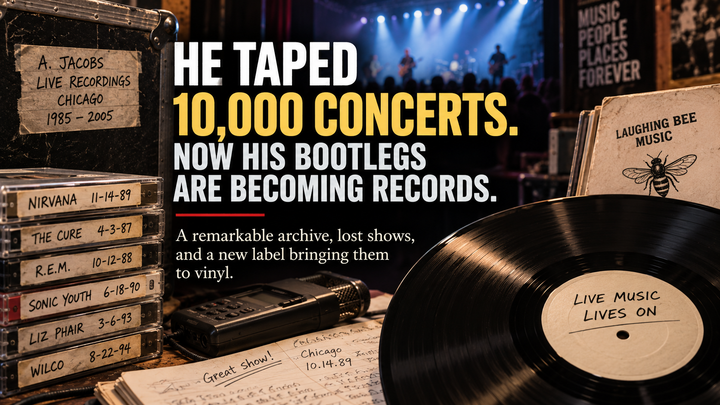
The timing of this case is fascinating because yesterday I wrote about Aadam Jacobs, who spent decades recording thousands of live performances.
His unofficial concert tapes are now being digitized as a historical archive, and selected recordings are even being legitimately released on vinyl.
At first glance, both stories involve "bootlegs."
But they couldn't be more different.
Jacobs documented performances that might otherwise have disappeared. Decades later, those recordings are being preserved as historical documents.
The UK counterfeit operation reproduced commercial records in a way authorities say infringed the rights of more than 100 artists.
One story is about preservation.
The other is about imitation.
And that distinction is worth remembering whenever we casually call every unofficial record a bootleg.
Counterfeit Vinyl Is a Strange Consequence of Records Becoming Valuable Again
There is an irony here.
For years, old records were inexpensive enough that manufacturing convincing counterfeits of many titles wouldn't have made much economic sense.
Now certain pressings sell for hundreds or thousands of dollars.
Limited editions disappear immediately.
Collectors hunt specific variants.
And vinyl has once again become a desirable physical product.
Where value goes, counterfeiting tends to follow.
The discovery of four old pressing machines and 3,000 stampers suggests just how far that incentive can go.
This wasn't someone printing fake hype stickers at home.
It was manufacturing.
What I Would Check Before Buying an Expensive Record
You don't need to turn record collecting into forensic science.
But once a purchase becomes expensive enough that getting it wrong would hurt, I would slow down.
Check the exact Discogs entry.
Compare the runout inscriptions.
Look carefully at the labels and jacket.
Research known counterfeit versions.
Examine the seller's history and inventory.
Ask for actual photographs.
And if something doesn't make sense, don't assume the seller is necessarily trying to deceive you. They may not know either.
That's perhaps the most unsettling part of counterfeit records.
Once a convincing fake enters the secondary market, it can keep circulating long after the person who originally sold it disappears.
The Record in Your Hand Still Matters
As record collecting has become increasingly expensive, we've gotten very good at tracking value.
Median price.
Highest sale.
Lowest sale.
First pressing.
Limited edition.
Variant.
Condition.
But authentication deserves a place on that list too.
The dismantling of a £2.7 million counterfeit operation doesn't mean the record collecting market is suddenly flooded with fake vinyl.
It does prove something more useful:
Counterfeit records can be manufactured at a scale and sophistication that makes them look like ordinary commercial products.
So the next time an unusually rare record appears at an unusually good price, maybe spend another five minutes looking at the dead wax.
Because somewhere out there, a 70 year old record press may have been working overtime.
Comments ()