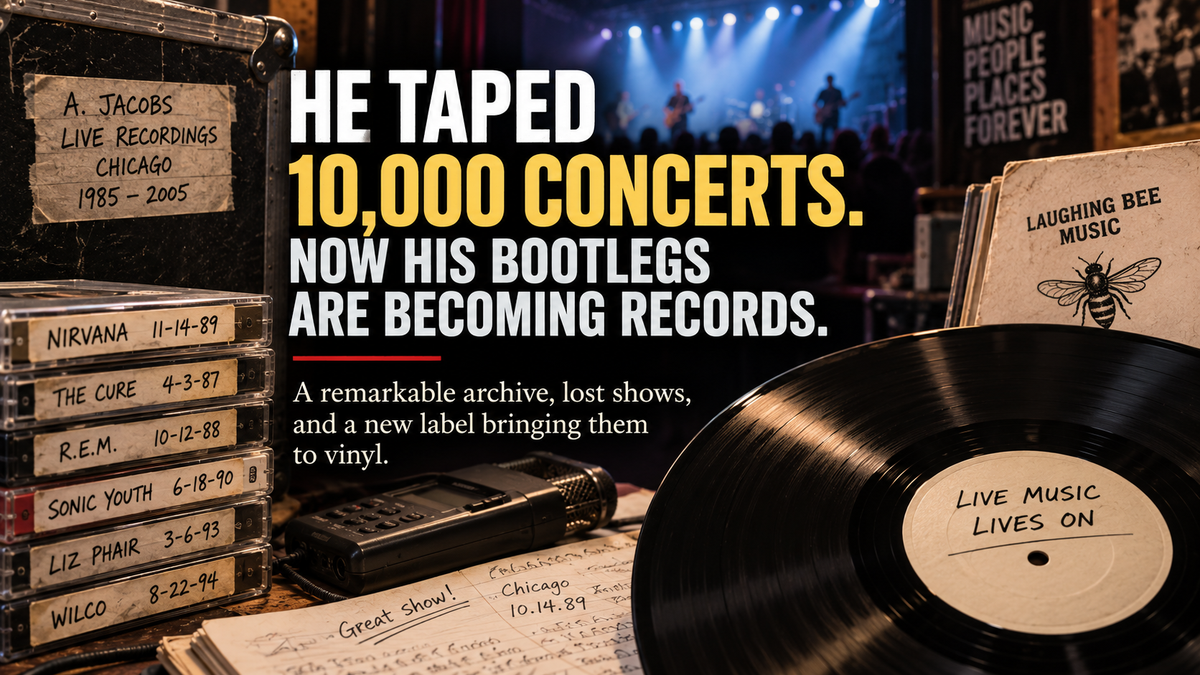
He Taped 10,000 Concerts. Now His Bootlegs Are Becoming Records.
Aadam Jacobs recorded thousands of live shows over four decades. Now his massive cassette archive is being preserved, digitized, and even pressed to vinyl, raising an intriguing question: when does a bootleg become a historical master?
Most record labels begin with a studio.
This one begins with boxes of old cassette tapes.
For decades, Chicago music fan Aadam Jacobs carried recording equipment into clubs and concert venues, documenting thousands of performances that otherwise might have disappeared the moment the house lights came back on.
Nirvana. The Cure. R.E.M. Sonic Youth. Pixies. Liz Phair. Phish. Depeche Mode. Pavement. Wilco.
And thousands of bands whose names never became nearly as famous.
Jacobs ultimately accumulated recordings from more than 10,000 concerts, creating an accidental history of several decades of live music.
Now volunteers are painstakingly digitizing those tapes and making them available through the Internet Archive. By this spring, roughly 2,500 recordings had already been uploaded. (Axios)
But something even more interesting has started happening.
Some of those tapes are becoming records.
From a Fan's Cassette to a Vinyl Record
A new record label called Laughing Bee Music has begun releasing performances from the Aadam Jacobs Collection commercially.
Its first two releases arrived September 18: Naked Raygun's This Place Used to Be a Strip Joint (Live) and Eleventh Dream Day's By The Time They Got To Lounge Ax (Live). Both originated with recordings from Jacobs' enormous archive. (BroadwayWorld)
That's an extraordinary journey for a cassette recorded by someone standing in the audience.
And it raises a question that I find much more interesting than whether we should technically call these recordings "bootlegs":
When does a fan's tape become a historical master?
Because that's essentially what is happening here.
It Started With a Small Recorder
Jacobs began recording shows in the 1980s. His collection eventually became especially valuable as a document of Chicago's independent music scene, although the artists captured on his tapes stretch far beyond local bands.
Some recordings catch major artists remarkably early.
The collection includes Nirvana performing in Chicago in 1989, two years before Nevermind transformed the band into one of the biggest acts in the world. There are recordings involving R.E.M., The Cure, Tracy Chapman, Sonic Youth, Björk, Stereolab, Phish, and countless others. (CBS News)
But the famous names may not ultimately be the archive's most important contribution.
If a major artist plays a concert, there's a reasonable chance somebody else documented it.
A small band playing to a few dozen people in a Chicago club in 1988?
Maybe Jacobs' cassette is all that's left.
The Aadam Jacobs Collection Project describes recordings ranging from early performances by internationally known artists to first and only appearances by obscure local bands.
That transforms the collection from an enormous stash of concert tapes into something closer to musical archaeology.
Saving 10,000 Concerts Isn't Easy
There is another problem.
Cassette tape doesn't last forever.
The collection spent decades growing, and Jacobs eventually recognized that preservation couldn't wait indefinitely. Volunteers associated with the Internet Archive's Live Music Archive began the enormous process of transferring, restoring, identifying, cataloging, and uploading the recordings.
This isn't simply someone connecting a cassette deck to a computer and pressing record.
Brian Emerick, one of the project's coordinators, has described collecting boxes containing dozens of tapes from Jacobs' home, transferring the analog recordings into digital files, and distributing them to volunteers who work on the audio and documentation. (WBEZ)
One published example from the archive shows just how detailed the process can become.
A 1993 Flipper recording was transferred from cassette using a Nakamichi CR-7A deck into a digital audio interface at 24-bit/48 kHz. The resulting file was then mastered, tracked, converted, tagged, and documented with information about the band, venue, recording source, transfer equipment, and people involved in its preservation. (I Just Want To Have Some Tacos)
That's archival work.
And it also leads to an interesting audiophile question.
What Does "Good Sound" Mean When the Recording Was Never Supposed to Be an Album?
We spend a lot of time in this hobby discussing master tapes.
Was the record cut from the original analog master?
Was there a digital step?
Who mastered it?
Where was it pressed?
Those are worthwhile questions when you're dealing with a professionally recorded studio album.
Jacobs' archive forces us to think differently.
Some of these recordings were made using modest equipment from somewhere inside a club. They contain crowd noise, room acoustics, imperfect microphone placement, and whatever conditions existed that night.
No mastering engineer can turn that into a pristine multitrack studio recording.
Nor should they.
The objective is different.
You want to preserve what happened.
That means restoration becomes a balancing act. Reduce enough noise and correct enough problems to make the performance enjoyable, but don't process away the thing you're trying to preserve.
In this context, fidelity isn't necessarily about producing the cleanest recording.
It's about maintaining the most truthful document.
We Just Saw the Other Side of This Problem
This story arrives at an interesting time for Vinyl Latte.
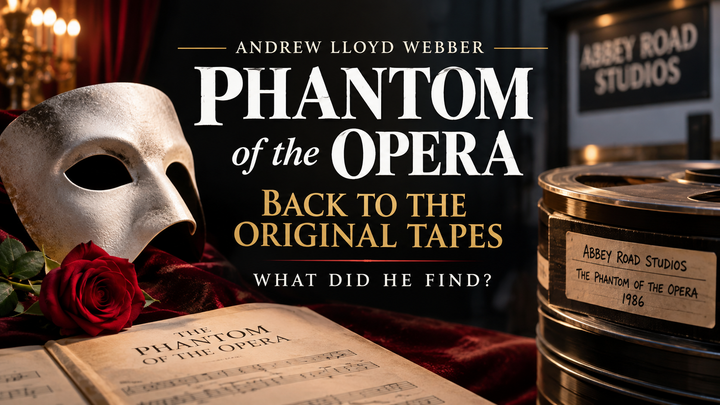
Just a few days ago, I wrote about Andrew Lloyd Webber returning to the original analog tapes for the 40th anniversary of The Phantom of the Opera.
Eight of the eleven original two-inch tape reels survived.
Three did not.
The missing material had to be reconstructed with help from an unplayed original 1986 vinyl pressing.
That story demonstrated something record collectors don't always think about: master tapes can disappear.
The Jacobs collection demonstrates the other side of the equation.
Sometimes the "master" only exists because somebody had the foresight, obsession, or perhaps insanity to press Record in the first place.
The two stories arrive at the same conclusion from completely different directions.
Recorded music survives because somebody preserves it.
Is It Still a Bootleg?
"Bootleg" carries a lot of baggage.
It can describe everything from an unauthorized audience cassette traded among fans to commercially manufactured records sold without an artist's permission.
Jacobs' collection doesn't fit neatly into the stereotypical image.
The Internet Archive project is about preservation and access. Thousands of performances are gradually being made available for people to hear, and the process involves cataloging information that might otherwise have disappeared with the recordings themselves. (CBS News)
The vinyl releases take things another step.
Now a recording originally captured by a fan can become a mastered, manufactured physical record.
There is something wonderfully circular about that.
A person goes to a concert.
He records it onto tape.
The tape sits in an archive for decades.
Volunteers rescue the recording from an aging cassette.
It gets transferred into the digital domain, restored, documented, and preserved.
And eventually, selected performances return to the analog world as vinyl records.
The Obscure Bands May Matter Most
It's tempting to browse the archive looking for recognizable names.
I understand that.
Finding an unheard Nirvana performance from 1989 is exciting. So is discovering an early Phish show or an old Liz Phair recording.
But imagine looking through this collection 30 or 40 years from now.
The performances that could prove most culturally valuable may be the bands that never became famous.
Local music scenes aren't built exclusively by the artists who eventually fill arenas.
They're built by hundreds of bands, tiny venues, opening acts, promoters, bartenders, fans, and nights that seem completely ordinary while they're happening.
Most of those moments vanish.
Jacobs kept recording them.
That's why his archive is so fascinating.
Your Record Collection Is an Archive, Too
There is a lesson here for record collectors that extends beyond 10,000 concert tapes.
We often think about collections in terms of value.
First pressing.
Rare variant.
Mint condition.
Limited edition.
But collections can also preserve things.
A record may contain a mastering that disappears from later releases. A regional pressing may preserve different artwork. A promotional copy might document how an album was originally marketed. An obscure local single might be one of the few surviving artifacts from a band that existed for six months.
Friday's Phantom story showed an original record helping reconstruct material after master tapes disappeared.
Now a fan's concert recordings are being preserved and, in some cases, pressed onto records themselves.
Maybe that's the more interesting way to think about collecting.
We're not merely accumulating objects.
Sometimes we're keeping evidence that the music happened.
And somewhere among Aadam Jacobs' thousands of tapes could be a performance nobody yet realizes is important.
That's a pretty compelling reason to keep the tape rolling.
Comments ()