
Andrew Lloyd Webber Went Back to the Original Phantom Master Tapes. What Did He Find?
Andrew Lloyd Webber returned to the original 1986 Phantom of the Opera master tapes for a new mix. But three reels were missing, forcing the team to turn to an unexpected archival source: an original vinyl pressing.
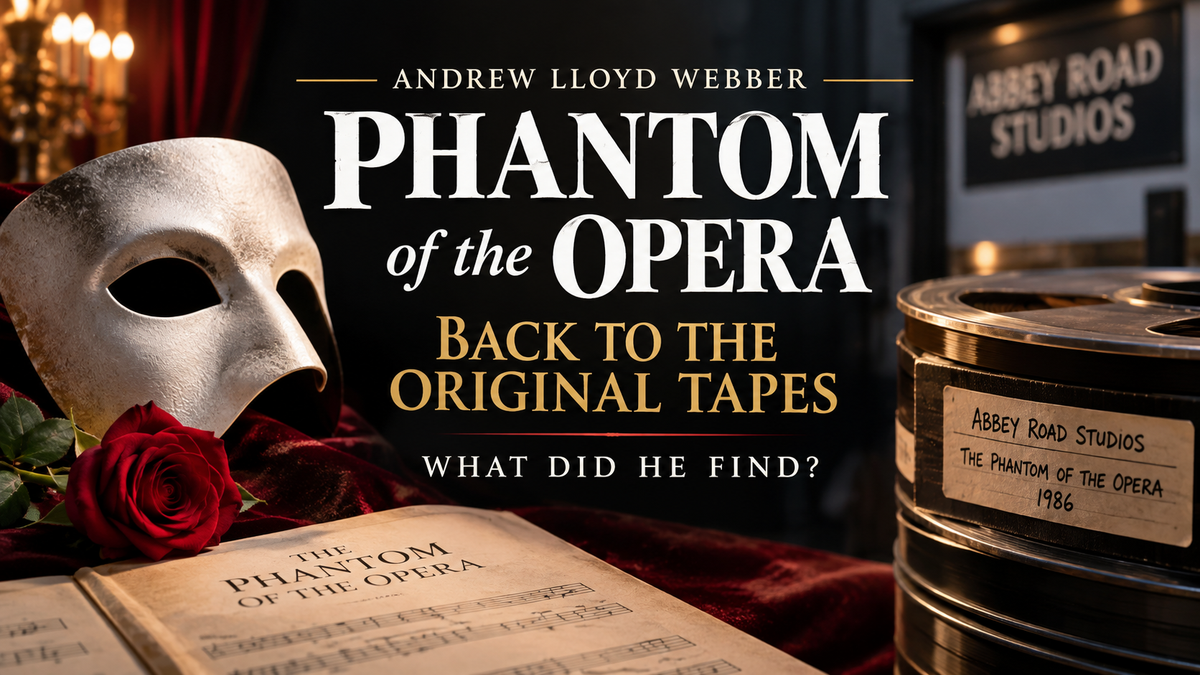
Some anniversary albums are little more than familiar music in new packaging.
The 40th anniversary of The Phantom of the Opera is turning into something considerably more interesting.
Andrew Lloyd Webber has returned to the original analog recordings of the 1986 Original London Cast Recording of The Phantom of the Opera and created a new mix of the album for the first time. But when the tapes were pulled from the archive, there was a problem.
Not all of them were there.
Of the eleven original two inch analog tape reels recorded at Abbey Road Studios in September and October 1986, only eight have survived intact. The other three are missing.
So, to reconstruct one of the most successful cast recordings ever made, the team had to turn to another source:
An unplayed copy of the original 1986 vinyl record. (Andrew Lloyd Webber)
And that makes this much more interesting than another 40th anniversary remaster.
Eight Master Tapes Survived. Three Didn't.
The original London cast album captured Michael Crawford as the Phantom, Sarah Brightman as Christine, and Steve Barton as Raoul, with Mike Reed conducting.
It was recorded at Abbey Road before the musical opened in London in October 1986. According to the official announcement, the album has since sold more than 40 million copies across its various formats and became the first musical cast recording to debut at number one on the UK chart.
Forty years later, Lloyd Webber went back to the multitrack tapes.
Eight of the eleven original two inch reels were still intact. Those tapes have now been remixed, with the announcement specifically stating that the performances are being presented without enhancement.
The voices haven't been replaced. The orchestra hasn't been rerecorded. This isn't an attempt to make a 1986 recording sound as though it were made in 2026.
The idea appears to be the opposite: go back to what was actually captured in the studio and hear more of it.
But that still left three missing reels.
The solution is something record collectors should appreciate.
The missing material was reconstructed using an unplayed 1986 vinyl pressing of the album.
Think about that for a moment.
We normally talk about vinyl as the final consumer product created from a master.
Here, the record itself has effectively become part of the archive.
That's What Makes This Story Fascinating
Master tapes are often treated as permanent objects.
They aren't.
Tapes can deteriorate. They can be misplaced. They can be mislabeled. They can disappear as studios close, catalogs change hands, and decades pass.
In this case, three reels from a hugely successful recording apparently did not survive alongside the other eight.
Yet a clean vinyl copy did.
It is a wonderful reminder that the records sitting on our shelves aren't merely playback formats. In some circumstances, they can become historical documents preserving a version of a recording that no longer exists anywhere else in exactly that form.
Of course, recovering audio from vinyl isn't the same thing as recovering the original master tape.
A record has already passed through another mastering stage. It has been cut to lacquer, plated, pressed, and ultimately played back through a mechanical system.
But if the source tape no longer exists, a pristine record can become an extraordinarily valuable reference.
In this case, apparently valuable enough to help reconstruct Phantom.
This Is a Remix, Not Just a Remaster
There's another important distinction here.
The new Phantom isn't simply being remastered.
It's being remixed.
Those words are frequently used interchangeably, but they describe very different processes.
A remaster generally works from an existing finished mix. Engineers can adjust EQ, dynamics, level, sequencing, and other characteristics, but the fundamental balance of the recording has already been established.
A remix goes further back.
When the original multitrack elements survive, the balance between vocals, orchestra, instruments, ambience, effects, and other elements can be reconsidered.
That's what makes returning to the original tapes potentially so significant.
Lloyd Webber described remixing the album as feeling as though the performers were back in the studio with him.
Whether listeners ultimately prefer the new mix is another question.
A familiar mix becomes part of the music. After decades of listening, changing the placement of a voice, the prominence of an instrument, or the amount of space surrounding an orchestra can make a recording feel surprisingly different even when every performance remains identical.
New doesn't automatically mean better.
But it can reveal things that were always on the tape.
Vinyl Created Another Limitation in 1986
The new release also addresses something else collectors regularly encounter: playing time.
The original album had to fit the physical constraints of a two record vinyl release.
For the 2026 edition, Phantom expands to three LPs, allowing portions of the score omitted because of the original album's running time restrictions to be reinstated.
That's an example of a vinyl reissue where adding another record actually has a purpose.
Instead of stretching the same album across more sides simply to create a premium edition, the additional LP allows the producers to restore music that wasn't included before.
That makes the 2026 version potentially more than an alternate sounding edition.
It becomes a more complete version of the recording.
Then There Are the Recordings We Were Never Supposed to Hear
Three previously unreleased recordings from Lloyd Webber's archive are also being included.
One is an early cassette demo of “The Phantom of the Opera,” created when the song was apparently being considered as a standalone single.
Another, “Box Five,” is an early version of the Opera Managers' “Notes” scene that was ultimately rejected by director Hal Prince and reworked into “Prima Donna.”
The third is an early demo of “Masquerade,” featuring Richard Stilgoe's original lyrics before the song was rewritten. (Andrew Lloyd Webber)
Those aren't simply bonus tracks pulled from another release.
They're snapshots of a work that hadn't finished becoming The Phantom of the Opera yet.
For anyone interested in how albums, musicals, and recordings evolve, that may be some of the most interesting material in the collection.
And Yes, There Is a Massive Vinyl Box
Naturally, there is also a collector's edition.
The standard 2026 mix will be available digitally on October 9, followed by a 3LP vinyl edition and 2CD edition on November 6. A limited 6LP box set follows November 20.
The larger set combines the new 2026 mix with the 2LP motion picture soundtrack and the Masquerade orchestral score, along with archival reproductions and other memorabilia.
For me, though, the expensive box isn't the interesting part of this release.
The tapes are.
When the Record Becomes the Master
There's something almost poetic about what happened here.
In 1986, Abbey Road recorded The Phantom of the Opera onto analog tape.
Those tapes became an album.
That album became a record.
Forty years later, some of those original tapes are gone, and the record has become part of the source used to reconstruct the album.
That's a pretty remarkable journey for recorded music.
And it is one reason I'm much more interested in this release than I normally would be in another anniversary edition of a hugely successful catalog title.
There is a legitimate archival story here.
There is also a listening question.
How different does a fresh mix made from the surviving original tapes sound compared with the Phantom millions of people have known for decades? And can you hear the transition between material sourced from surviving tape and material recovered from vinyl?
The first taste arrived today with the newly mixed title track featuring Sarah Brightman and Michael Crawford. The complete digital album arrives October 9, with the vinyl following November 6.
I'll be particularly interested in hearing the vinyl.
Not because it is another anniversary pressing.
But because, this time, an old vinyl record actually helped save part of the recording.
Sources: Andrew Lloyd Webber official announcement · The Phantom of the Opera official site

Comments ()