
The CD Isn't Dying. The Machines That Play Them Might Be.
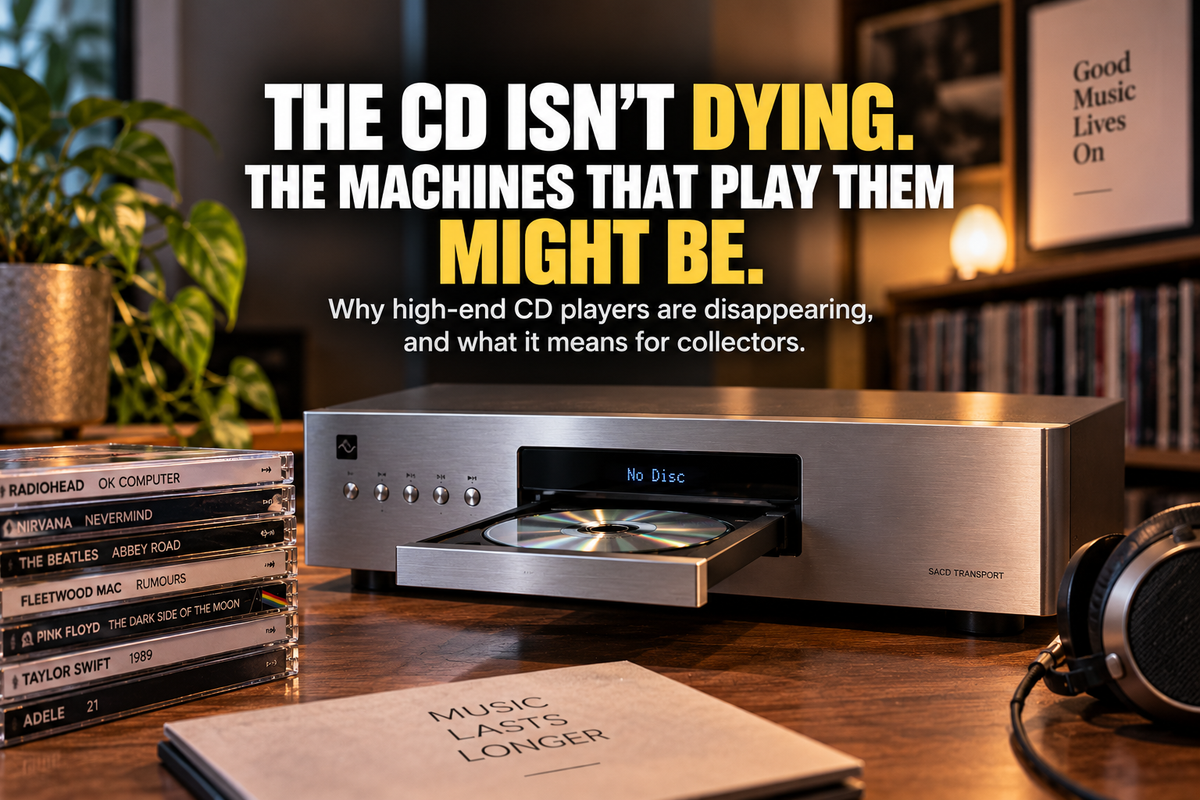
High-end CD and SACD players are disappearing, not because collectors stopped buying discs, but because the optical mechanisms needed to build them are becoming unavailable. What happens when the media survives longer than the machines that play it?
For the past few years, we've heard plenty about the return of physical music.
Vinyl is firmly established again. CDs have attracted renewed interest. Collectors want something tangible, and even listeners who primarily stream are discovering there can be value in actually owning music.
So, here's a strange problem.
What happens if people still want discs, but manufacturers can no longer get the parts needed to build high-end players for them?
That's not hypothetical.
PS Audio has discontinued production of its $8,999 PMG Signature SACD Transport. Not because the company suddenly decided nobody wants to play CDs or SACDs.
One of the fundamental components required to build it is disappearing.
The optical disc mechanism.
And PS Audio isn't alone.
This may be an early warning about a problem that has less to do with whether physical media survives and more to do with whether the hardware required to play it can still be manufactured.
An $8,999 Player Defeated by a Part It Doesn't Make
The PMG Signature SACD Transport sits near the top of PS Audio's digital lineup.
It plays CDs and SACDs, along with data discs containing high-resolution audio files, and was designed as an uncompromising disc transport rather than an inexpensive universal player.
Today, PS Audio's own website carries an unusually definitive message:
"Discontinued from new production in 2026."
The problem wasn't necessarily the electronics PS Audio designed.
It wasn't the chassis.
It wasn't the software.
It was the mechanism that physically reads the disc.
Like most audio companies, PS Audio doesn't manufacture optical drives from scratch. Those extraordinarily complicated assemblies come from specialized suppliers.
As fewer manufacturers build dedicated CD, DVD, Blu-ray, and SACD mechanisms, high-end audio companies have fewer options.
Eventually, there may be no suitable option at all.
That's apparently what happened here.
PS Audio Saw This Coming
PS Audio didn't simply wake up one morning and discover its transport mechanism was unavailable.
According to reporting on the discontinuation, when Marantz stopped producing the mechanism used in the player, PS Audio purchased the remaining supply it could obtain.
Even that became expensive.
The price of the mechanisms reportedly doubled during the final purchasing period.
That stockpile allowed production to continue.
But stockpiles eventually run out.
This creates a strange situation.
You can have customers.
You can have a product people still want.
You can have engineers capable of building it.
And you can still be forced to stop manufacturing it because one supplier no longer considers a particular component worth producing.
Why Not Just Put Another Drive Inside?
At first glance, the solution seems obvious.
Find another optical drive.
There are still inexpensive CD and DVD drives everywhere. You can buy an external USB optical drive for less than the price of a decent dinner.
Surely an $8,999 transport could use one of those.
Unfortunately, it isn't that simple.
An optical mechanism isn't merely a tray that spins a disc.
The mechanism contains the laser assembly, motors, servo systems, tracking hardware, disc control electronics, and other components responsible for physically retrieving the data.
The manufacturer then has to integrate that mechanism into its own electronics and software.
That can involve mechanical mounting, power supplies, vibration control, firmware, communication protocols, error handling, disc compatibility, and control systems.
SACD complicates matters further because it isn't simply another flavor of CD.
A mechanism suitable for an audiophile SACD transport needs to support the formats and functionality the manufacturer designed the entire product around.
Replace the mechanism, and you may effectively be redesigning a significant portion of the player.
At some point, you're no longer substituting a part.
You're developing a new product.
Naim Has Run Into the Same Problem
PS Audio isn't the only high-end manufacturer dealing with this.
Naim has stopped producing the Uniti Star, its all-in-one player that included CD playback and ripping.
Again, the issue reportedly involves the availability of optical mechanisms.
Naim has reportedly retained remaining mechanisms to support repairs for existing customers rather than consume them building additional new units.
That decision makes sense.
Imagine spending thousands of dollars on a premium player only to discover a few years later that the manufacturer used its final replacement mechanism building one more unit.
For companies serving the high-end market, supporting existing owners can become more important than squeezing a few additional products out of a disappearing component supply.
But it also exposes another issue.
What Happens When Your $9,000 Transport Needs a New Drive?
This might be the more important question for audiophiles.
We tend to think about high-end audio equipment as durable goods.
A good amplifier can last decades.
Speakers can last even longer with occasional service.
Turntables are particularly resilient because so much of their operation is mechanical. Motors, bearings, belts, cartridges, and power supplies can often be repaired or replaced.
Digital disc players are different.
They contain mechanical systems, lasers, proprietary electronics, firmware, and specialized components that may only exist while a much larger consumer electronics industry has a reason to manufacture them.
The $9,000 price tag doesn't necessarily protect you from that.
In fact, an expensive player built in relatively small quantities may be more dependent on a particular mechanism than a mass-market machine.
If that mechanism disappears, the manufacturer can't simply machine another one in its workshop.
We've Seen This Movie Before
Anyone who has collected vintage CD players knows the problem.
There are wonderful players from the 1980s, 1990s, and 2000s that still sound excellent.
Until the laser fails.
Sometimes replacement optical assemblies are readily available.
Sometimes new-old-stock parts exist.
Sometimes inexpensive substitutes can be adapted.
And sometimes a perfectly functional piece of audio equipment becomes extraordinarily difficult to repair because one tiny specialized component is unobtainable.
The electronics might be fine.
The power supply might be fine.
The DAC might be fine.
The chassis could survive another 50 years.
But if the machine can't read a disc, none of that matters.
This Isn't Really a Story About the CD Revival
That's an important distinction.
The easy headline would be that CDs are making a comeback while manufacturers stop making CD players.
But that oversimplifies what's happening.
Consumer demand and component manufacturing don't operate on the same scale.
Even if millions of people continue buying CDs, that doesn't necessarily create enough demand for a supplier to manufacture a specialized optical mechanism suitable for a relatively small number of high-end SACD transports.
The mass market moved elsewhere years ago.
Computers stopped routinely including optical drives.
Cars increasingly eliminated CD players.
DVD and Blu-ray players became less central as video streaming took over.
Game consoles remain an important optical-disc market, but their highly specialized drives aren't necessarily components a small audiophile company can buy and install in a premium music transport.
High-end audio benefited from an enormous optical-disc ecosystem it didn't create.
Now that ecosystem is shrinking.
Vinyl Has an Unexpected Advantage
There is an interesting contrast here with vinyl.
Vinyl playback looks technologically primitive compared with SACD.
That's partly why it is so durable.
A turntable needs to rotate a record at the correct speed.
A stylus traces a groove.
The cartridge converts that mechanical movement into an electrical signal.
There are obviously sophisticated implementations of every part of that process, but the fundamental technology isn't dependent on a proprietary optical mechanism or decoding platform.
If Rega disappeared tomorrow, your Rega turntable wouldn't suddenly stop playing records.
Someone can manufacture a belt.
Someone can rebuild a motor.
Another company can make a cartridge.
A machinist can manufacture mechanical components.
Standards established decades ago still allow cartridges from one manufacturer to work with tonearms from another.
Digital hardware doesn't always have that luxury.
Streaming Solves One Problem and Creates Another
There is an obvious answer to all of this.
Rip the disc.
Once the music exists as a file on a server, the optical mechanism becomes irrelevant for everyday listening.
That's essentially how I use digital music in my own reference system. A network based playback chain removes the need to physically retrieve data from a disc every time I want to hear an album.
But that doesn't make the issue meaningless.
Some people enjoy playing physical media.
SACD collectors may own discs whose high-resolution layers aren't easily transferred using ordinary computer hardware.
And a physical collection is supposed to offer something streaming cannot:
Independence.
You own the music.
No licensing agreement can remove the album from your shelf.
No streaming service can replace one master with another.
No internet outage prevents you from playing it.
But ownership only works if you maintain the ability to play what you own.
We Think About Media Longevity. Maybe We Should Think About Player Longevity.
Collectors spend enormous amounts of time worrying about the objects themselves.
Will CDs rot?
Will record PVC degrade?
How should we store them?
What temperature and humidity are safe?
Should records be stored vertically?
Those are useful questions.
But the PS Audio and Naim situations suggest another one:
Will functioning playback hardware outlive the media?
A well stored compact disc could remain perfectly playable decades from now.
That doesn't guarantee you'll have a functioning machine capable of reading it.
The same concern applies to SACD, MiniDisc, DAT, cassette, and virtually every physical format involving specialized playback hardware.
The music carrier and the machine that reads it are part of the same preservation problem.
Does This Make Me Nervous About Buying an Expensive Disc Player?
A little.
Not because I expect optical playback to disappear tomorrow.
There are millions of functioning CD players in the world, and inexpensive optical drives aren't suddenly going extinct.
But if I were considering a very expensive SACD or CD transport today, I would ask questions I might not have considered ten years ago.
What mechanism does it use?
Is that mechanism still being manufactured?
Does the company maintain replacement inventory?
How long does it expect to support the product?
Can the optical assembly be serviced or replaced?
Those questions aren't nearly as exciting as comparing DAC chips, clocks, power supplies, or jitter measurements.
They might ultimately matter more.
The Strange Future of Physical Digital Music
There is something ironic about all of this.
We spent years wondering whether physical media would survive streaming.
Maybe that's no longer the only question.
Records survived because enough people wanted them that an entire manufacturing ecosystem was rebuilt and expanded around them.
CDs never completely disappeared, and interest in collecting them has become increasingly visible again.
Yet the machines required to play optical media depend on a supply chain that was built for a much larger consumer electronics market.
Audiophiles are tiny compared with that market.
PS Audio can design an $8,999 SACD transport.
Naim can engineer an exceptional all-in-one player.
But neither company can economically become an optical-drive manufacturer just to keep those products alive.
That's the part of this story I find fascinating.
The CD may survive.
The SACD may survive.
Your collection may survive.
The question is whether the machines needed to play them will be as easy to preserve.
And for anyone building a physical music collection intended to last a lifetime, that's probably worth thinking about.


Comments ()