
The $30,000 Turntable Question: Is Luxury Audio Helping or Hurting Vinyl?
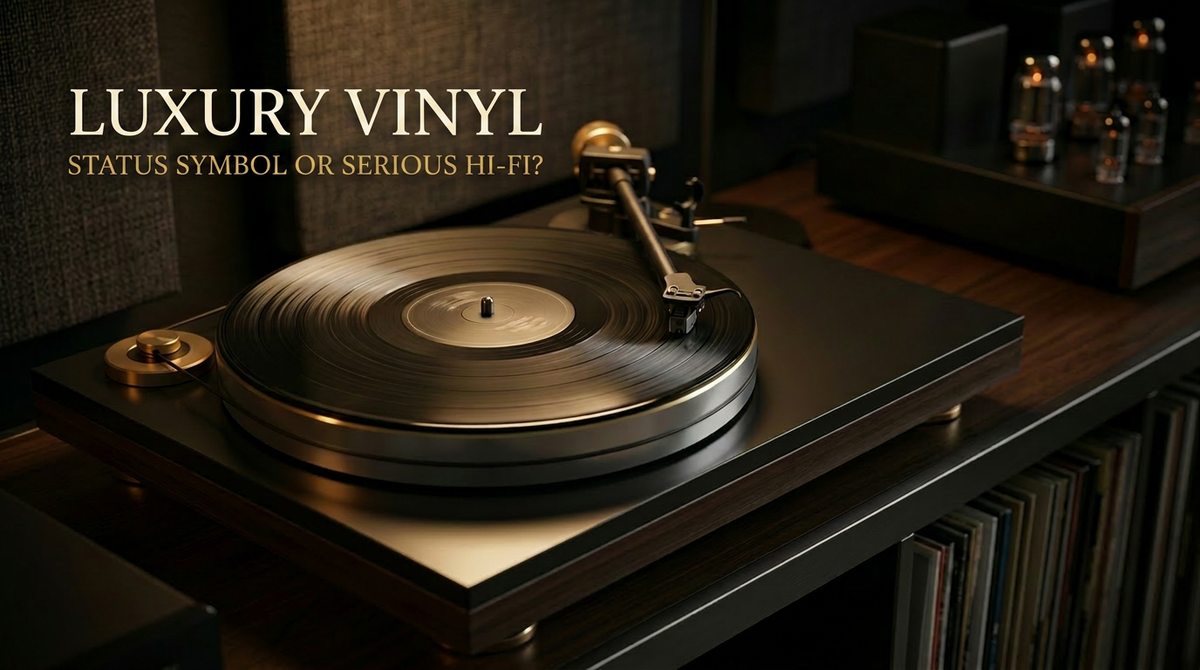
Vinyl’s luxury era is here. From restored design classics to ultra-premium turntable systems, analog playback is becoming both a serious listening pursuit and a modern status symbol. But is that helping the vinyl revival, or turning the format into something more about image than music?
Vinyl is no longer just the format that refused to die.
It is now a hobby, a culture, a design statement, a nostalgia machine, and in some cases, a luxury object. The latest reminder comes from Bang & Olufsen, which recently introduced the Beosystem 3000c Dune Grey Edition, a limited system built around a restored 1985 Beogram 3000 turntable and a pair of modern Beolab 8 wireless speakers. Only 100 units are being produced, and the price is around $30,000.
It is beautiful. It is exclusive. It is very Bang & Olufsen.
But it also raises a bigger question.
When does celebrating vinyl become using vinyl as a status symbol?
Vinyl Has Always Had a Luxury Side
Let’s be fair. High end audio has never been cheap.
There have always been expensive turntables, exotic tonearms, moving coil cartridges that cost more than some used cars, and speakers that require both a dedicated listening room and a deeply understanding spouse. Anyone who has spent time around serious hi-fi knows this is not new.
Luxury audio is part of the culture. In many ways, it has helped preserve the culture. The companies that obsess over materials, tolerances, power supplies, isolation, and analog playback are often the same companies keeping the conversation alive around what great sound can actually be.
So this is not an argument against expensive audio.
The question is different.
Is this kind of product advancing the listening experience, or is it turning vinyl into a beautifully staged lifestyle accessory?
The Difference Between Hi-Fi and Lifestyle Luxury
There is a difference between a high end audio product and a luxury lifestyle product.
A high end turntable usually tries to justify its existence through performance. Better speed stability. Lower noise. More accurate tracking. Superior isolation. Better arm geometry. Improved vibration control. These products may also look beautiful, but the design is usually in service of playback.
A lifestyle luxury system often starts from a different place. It is about the object. The room. The feeling. The heritage. The ownership experience. The exclusivity.
Bang & Olufsen has always lived in that second world, and that is not necessarily a bad thing. The brand has a long history of making audio equipment that looks like it belongs in a design museum. The Beosystem 3000c fits that tradition perfectly. It takes a vintage design, restores it, pairs it with modern wireless speakers, limits production, and turns the entire package into something collectible.
That is compelling.
But it is also different from the way most vinyl lovers experience the format.
Most of us are not buying records because we want our listening room to look like a luxury hotel lobby. We are buying records because we love the ritual. We like pulling a record from the shelf, cleaning it, cueing the stylus, reading the jacket, and hearing an album unfold as a complete piece of work.
That experience can happen on a $500 turntable or a $50,000 turntable.
The magic is not automatically tied to the price tag.
Vinyl as Furniture, Fashion, and Identity
Part of what makes the current vinyl revival so fascinating is that vinyl has become more than a music format.
For some people, it is a way to reconnect with albums. For others, it is about collecting. For younger buyers, it may be a physical connection to artists they first discovered through streaming. For design focused buyers, it can be part of the atmosphere of a home.
That last part is where things get complicated.
Vinyl looks good. Records look good on shelves. Turntables look good in rooms. Album jackets are art pieces. A spinning record creates an immediate visual cue that says something intentional is happening.
Brands know this.
That is why vinyl keeps showing up in lifestyle marketing. Coffee table books, boutique hotels, clothing stores, listening bars, luxury furniture spaces, and now ultra limited audio systems all understand that vinyl communicates taste.
But taste and listening are not always the same thing.
There is a difference between owning records because you love music and owning records because they complete a room.
The Case For Luxury Vinyl Systems
Here is the positive side.
Products like the Beosystem 3000c may bring people into vinyl who otherwise would never think about it. Someone who is design driven may discover the ritual first and the music second. That is still a win.
There is also value in restoration. Taking a classic turntable from 1985, rebuilding it, and giving it a modern role is more interesting than simply producing another disposable Bluetooth speaker. It respects history. It reminds people that great industrial design can have a second life.
And honestly, there is something refreshing about a product that treats music playback as something worthy of attention. In a world where most listening happens through tiny speakers, background playlists, and compressed convenience, a product that says “sit down and listen” deserves some credit.
Even if the price is absurd for most people.
The Case Against It
The problem is not that luxury audio exists.
The problem is when luxury audio becomes the visible face of vinyl.
Because for every $30,000 design system, there are thousands of people building systems piece by piece, saving up for a better cartridge, hunting for clean used records, or trying to get more from a modest setup. That part of vinyl culture matters too.
In fact, that might be the heart of it.
Vinyl’s comeback was not only powered by luxury buyers. It was powered by music fans. Pop fans buying variants. Jazz fans chasing Tone Poets. Rock collectors searching used bins. Younger listeners wanting something physical. Audiophiles comparing pressings. Independent stores building community.
That is the part of vinyl that feels alive.
When the format is pushed too far into luxury branding, it risks becoming something colder. Something you display more than use. Something that signals taste instead of deepening your relationship with music.
And that feels like the wrong direction.
The More Interesting Contrast
The timing is interesting because we are also seeing products like the Cambridge Audio Evo 300, a modern streaming amplifier priced around $3,999. It is still not inexpensive, but it represents a different approach: compact, powerful, connected, and designed for people who want modern convenience without completely abandoning serious hi-fi.
That contrast matters.
One product says analog heritage can be a luxury design statement.
The other says modern hi-fi can be simplified without becoming disposable.
Both are valid. Both reflect where audio is going. But they speak to very different listeners.
And that might be the bigger story. Vinyl’s future is not one lane. It is splitting into many lanes at once.
There is affordable vinyl. Audiophile vinyl. Collector vinyl. Lifestyle vinyl. Luxury vinyl. Nostalgia vinyl. Streaming integrated with vinyl. Old gear being restored. New gear pretending to be old. Old gear being made modern.
The format is not just surviving. It is being reinterpreted by everyone.
So Is Luxury Audio Helping or Hurting Vinyl?
The honest answer is both.
It helps because it keeps vinyl visible. It gives the format cultural weight. It reminds people that physical music can still feel special. It supports craftsmanship, restoration, and design.
But it can hurt when it makes vinyl look inaccessible. When the conversation becomes more about exclusivity than music. When analog playback is treated as a prop for people with expensive living rooms rather than a format for anyone who loves albums.
Vinyl does not need to be cheap to be meaningful.
But it does need to remain connected to music.
That is where the line is.
A $30,000 turntable system can be beautiful. It can be collectible. It can even be inspiring. But the soul of vinyl is still found in the act of listening. Not the price. Not the scarcity. Not the certificate of authenticity.
The record still has to matter.
The music still has to matter.
And whether your turntable costs $300 or $30,000, the real question is the same:
Are you using it to listen, or are you using it to say something about yourself?

Comments ()