
Stack Audio AUVA EQ Review: The Small Footer That Made My System Feel More Settled
Stack Audio’s AUVA EQ component isolators bring vibration control to hi-fi electronics, helping reduce mechanical noise, improve focus, and let the system sound more stable, detailed, and complete.
Component isolation is one of those areas in hi-fi that can be easy to dismiss until you experience it in the right system.
On paper, it sounds almost too simple. Place something under your equipment, reduce vibration, and the system performs better. In practice, the subject is more complicated. Some isolation products soften the sound. Some overdamp the presentation. Some bring focus but take away energy. Some are beautifully made but only seem to work under certain components, on certain racks, in certain rooms.
That is why I have become such a fan of Stack Audio’s AUVA line.
I have used and reviewed Stack Audio’s speaker isolators before, including the AUVA 50s, and they remain one of the more meaningful accessories I have added to my system. At the time I first covered them, Vinyl Latte was still a newer channel, and I was still finding my voice as a reviewer. Since then, my system has evolved, my listening priorities have sharpened, and I have spent far more time understanding where isolation matters most.
The short answer is that it matters more than many people think.
For this review, I want to focus on the Stack Audio AUVA EQ component isolators, which are designed for electronics rather than loudspeakers. These are not speaker feet. They are not subwoofer isolators. They are compact, precision-machined isolation devices intended to sit between your hi-fi component and the shelf, rack, or platform below it.
You can find them directly from Stack Audio here:
Why Component Isolation Matters
Every audio system deals with vibration.
Some of that vibration comes from outside the component. Footfall, speakers pressurizing the room, subwoofers energizing the floor, rack resonance, transformer hum, and even the general mechanical energy of the listening environment can all find their way into the equipment.
Some vibration comes from inside the component itself. Transformers, motors, disc mechanisms, circuit boards, chassis panels, and internal parts all operate within a physical structure. Even digital components are not immune to mechanical energy. A streamer, DAC, phono stage, or amplifier may not be reading a groove like a cartridge does, but it still contains circuitry that performs best when it is operating in a stable mechanical environment.
This is where isolation becomes interesting.
The goal is not to change the voicing of the system. At least, that is not what I want from a good isolation product. I do not want more treble because a footer is making things sound artificially etched. I do not want more bass because something is thickening the lower midrange. I do not want “hi-fi effects” that make the first five minutes exciting and the next hour tiring.
The best isolation products, in my experience, do something quieter and more useful. They lower mechanical noise. They reduce smearing. They allow leading edges to arrive with more confidence. They clean up decay. They make the image feel more locked in. They do not make the system sound like a different system. They make it sound more like itself.
That is exactly where the AUVA EQs make sense.
What the AUVA EQ Is
The Stack Audio AUVA EQ is a compact component isolator measuring 50 mm in diameter and 28 mm tall. Each unit uses a precision-machined aluminum shell and is designed to make direct contact with the underside of your component.
The design uses two key technologies.
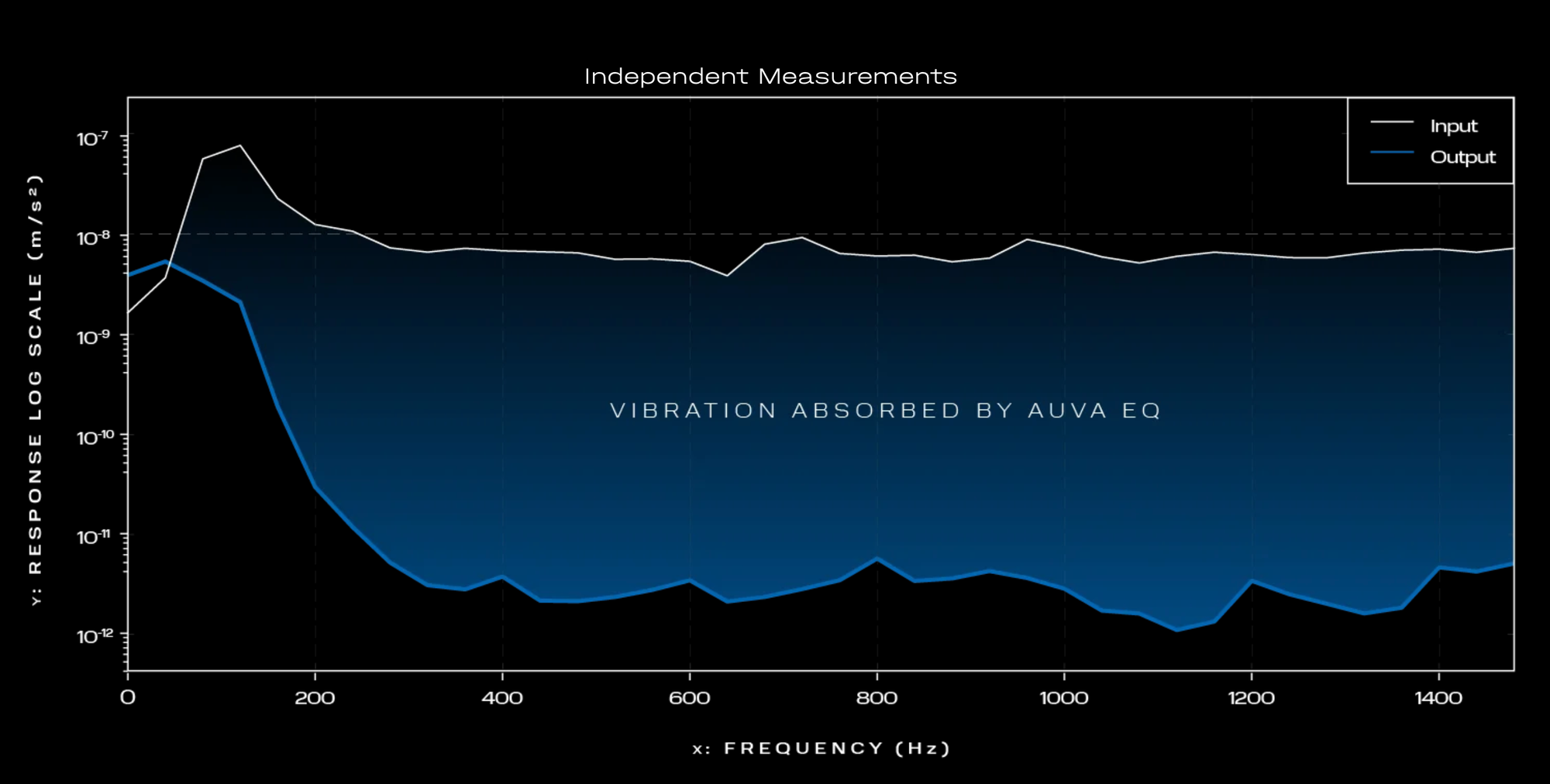
The first is Stack’s AUVA particle damping system. Inside the isolator are internal cells containing particles. When vibration enters the structure, those particles move and collide. That motion helps convert mechanical energy into heat, allowing vibration to dissipate rather than reflect back into the component.
AUVA is a technology that uses particle impact damping to absorb vibration and stop it from reflecting back into your equipment. Footage from StackAudio.co.uk
The second is Stack’s CSA, or Custom Silicone Absorber. This sits below the AUVA body and acts as a tuned decoupling system between the component and the surface below. The idea is that the AUVA section helps address vibration coming from the component, while the CSA helps manage energy coming up from the rack, shelf, or support surface.
The CSA is precisely tuned for a broad range of frequencies commonly found in real listening environments. Its air-spring design aborbs vibration and ensures rapid energy decay - preventing resonance from building up or returning. Footage from StackAudio.co.uk
That two-stage approach is important. A component does not only need to be isolated from the outside world. It also needs to stop feeding its own vibration back into itself.
ogether, AUVA and CSA create a uniquely balanced isolation system. Footage from StackAudio.co.uk
This is also why Stack offers different CSA inserts depending on equipment weight. The AUVA EQ is not a one-size-fits-all puck. CSA 1 is intended for lighter loads, CSA 2 for medium loads, and CSA 3 for heavier components. Stack rates them per isolator, so you divide the weight of your component by the number of EQs you plan to use.
That matters. An isolation product that is too soft, too stiff, or incorrectly loaded can shift the balance in the wrong direction. In my experience, proper matching is not a small detail. It is central to getting the best result.
The AUVA EQs are also height adjustable by up to 3 mm, which is useful for leveling components and making sure each footer is carrying the load evenly. Stack recommends using the same number of isolators as the original feet on your component, and placing them where the stock feet were if those feet are easily removable. If not, positioning the EQs as close to the original feet as possible is the next best approach.
That is practical advice, and it reflects something I appreciate about Stack Audio. Their products feel engineered, but they are not fussy for the sake of being fussy.
Build Quality and Design
The AUVA EQs feel like serious little pieces of engineering.
The aluminum shells are cleanly machined, the finish is excellent, and the overall presentation feels premium without being jewelry for jewelry’s sake. They are compact enough to fit under most components, but substantial enough that they feel like real mechanical devices rather than decorative accessories.
That matters to me because isolation products live in an odd space. They need to be physically well made, but they also need to disappear once installed. You should not be constantly thinking about them. You should not be worried about whether the component is stable. You should not feel like you have created a fragile tower of audiophile accessories under your DAC or phono stage.
The AUVA EQs feel stable, especially when properly matched to the component weight. I also like that Stack provides practical guidance around placement, weight selection, and the use of rubber discs for lighter components if there is any movement between the chassis and the shell.
This is not just a “put it anywhere and hope” product. It rewards proper installation, but it does not require obsessive setup.
Listening Impressions
The first thing I noticed with the AUVA EQs was not a tonal shift.
That is important.
The system did not suddenly become brighter, warmer, leaner, or more forward. Instead, the presentation felt more settled. The music had a calmer foundation. Images were more stable. The space between instruments was easier to follow. Bass notes had a little more shape and less blur around the edges.
That word, “settled,” kept coming back to me.
A good system already gives you detail. A better-isolated system makes that detail easier to absorb. You are not straining to separate instruments. You are not mentally working through a layer of haze. The music simply arrives with better organization.
On well-recorded vocals, the AUVA EQs helped the center image feel more locked in. Not exaggerated, not artificially spotlighted, just more stable. When the singer was supposed to appear in the middle of the soundstage, that placement felt more confident. The voice had a better sense of body and space around it.
On acoustic music, I heard improvements in texture and decay. Piano notes had a cleaner start and a more natural fade. Cymbals seemed less splashy and more defined. String tone carried a little more wood and less glare. These are not huge frequency response changes. They are changes in clarity, timing, and the way the system handles low-level information.
On rock records, the benefit showed up differently. Bass lines were easier to follow. Kick drum impact had better definition. Dense mixes felt less congested. When guitars, drums, bass, and vocals were all competing for space, the AUVA EQs seemed to reduce the sense of mechanical blur.
That is where isolation products can be most valuable. It is not only about audiophile demo tracks. It is about making real records easier to enjoy.
Where I Would Use Them First
If I were starting from scratch, I would not put AUVA EQs under everything on day one.
I would start with the most vibration-sensitive or most system-critical components.
For vinyl listeners, that may mean a phono stage. A phono preamp is dealing with tiny signals, and anything that improves clarity without changing tonal balance is worth exploring. I would also consider trying them under a turntable power supply, external motor controller, or non-suspended turntable, assuming the design is appropriate.
For digital listeners, I would try them under a DAC, streamer, server, or network-related component. Digital audio may not behave like analog playback, but mechanical stability still matters. A good DAC or streamer can benefit from a cleaner operating environment, especially in a highly resolving system.
For amplification, I would be more deliberate. Integrated amplifiers and power amplifiers can benefit, but they are often heavier and may require the correct CSA insert and careful placement. This is where weight matching becomes especially important.
In my own system, the AUVA EQs make the most sense under components where focus, low-level detail, and noise reduction matter most. That includes front-end electronics, digital components, and phono-related gear.
What They Do Not Do
The AUVA EQs are not tone controls.
They will not fix a bad room. They will not make a poor recording sound like an audiophile pressing. They will not transform a system that is fundamentally mismatched. They also will not replace proper speaker placement, subwoofer integration, or basic rack stability.
That is actually part of why I like them.
The best accessories should not feel like bandages. They should support the system you already have. The AUVA EQs are more about refinement than rescue. If your system is already capable of good imaging, they can make that imaging feel more precise. If your system already has good bass, they can help that bass feel better defined. If your system already has strong resolution, they can help reveal more of that information without making the presentation analytical.
That is a very different thing from making the sound more exciting in a forced way.
The Stack Audio Approach
What I appreciate about Stack Audio is that their isolation products do not feel like generic accessories with audiophile branding added later.
The AUVA speaker isolators are designed around a different problem than the AUVA EQs. Speakers need stability. They need to be held firmly while cabinet energy is dissipated. Electronics benefit from a different kind of support, one that allows controlled decoupling while also addressing internal vibration.
That distinction matters.
It tells me Stack is not simply applying one idea to every product category. They are looking at the mechanical problem first, then designing the product around the use case.
The AUVA EQ is a good example of that philosophy. It combines a rigid aluminum shell, particle damping, tuned silicone absorption, weight-matched inserts, and height adjustment into a compact component footer that is easy to use and easy to recommend.
Value
At the high end of audio, accessories can get expensive very quickly.
The AUVA EQs are not cheap in the generic sense, but in the context of serious hi-fi, they are very reasonably priced. More importantly, they are the kind of product that can move from system to system as your setup evolves. If you change a DAC, streamer, phono stage, or amplifier, the EQs can usually come along for the ride, assuming the weight range is still appropriate.
That makes them a smarter investment than many accessories that only solve one narrow problem.
I also like that they are available in sets of three or four. Some components are better supported on three points, while others make more sense with four, especially if replacing the original feet. Having that flexibility matters.
Final Thoughts
The Stack Audio AUVA EQs are one of those products that make more sense the longer you live with them.
They do not shout. They do not impose a new character on the system. They do not chase spectacular changes at the expense of musical balance. Instead, they help the system feel quieter, more organized, more stable, and more natural.
That is exactly what I want from component isolation.
As someone who has already had excellent results with Stack Audio’s speaker and subwoofer isolators, the AUVA EQs feel like the natural extension of the same design philosophy. The speaker isolators address the big mechanical energy in the room. The EQs address the smaller, subtler vibrations affecting the electronics.
Together, they make a compelling case that vibration control should not be treated as an afterthought.
For me, the AUVA EQs have become a product of choice because they deliver the kind of improvement I value most: less noise, more focus, better dimensionality, and a clearer path between the recording and the listener.
They do not make my system sound different.
They make it sound more complete.
Rating
Highly recommended.
For systems that are already resolving enough to reveal changes in support, isolation, and mechanical grounding, the Stack Audio AUVA EQs are an easy product to recommend. They are well built, thoughtfully engineered, practical to use, and musically meaningful.
More importantly, they solve a real problem without creating a new one.
For more information, or to order, visit: Stack Audio AUVA EQ
Louie V. of Vinyl Latte experiments with Stack Audio EQs under his Rega P10 turntable.



Comments ()