
Pro-Ject's $649 Debut Carbon Returns. But Is Saving $50 Worth It?
Pro-Ject brings back the Debut Carbon for $649, but the EVO 2 costs just $50 more. We compare their tonearms, cartridges, platters, and features to determine which turntable offers better value.
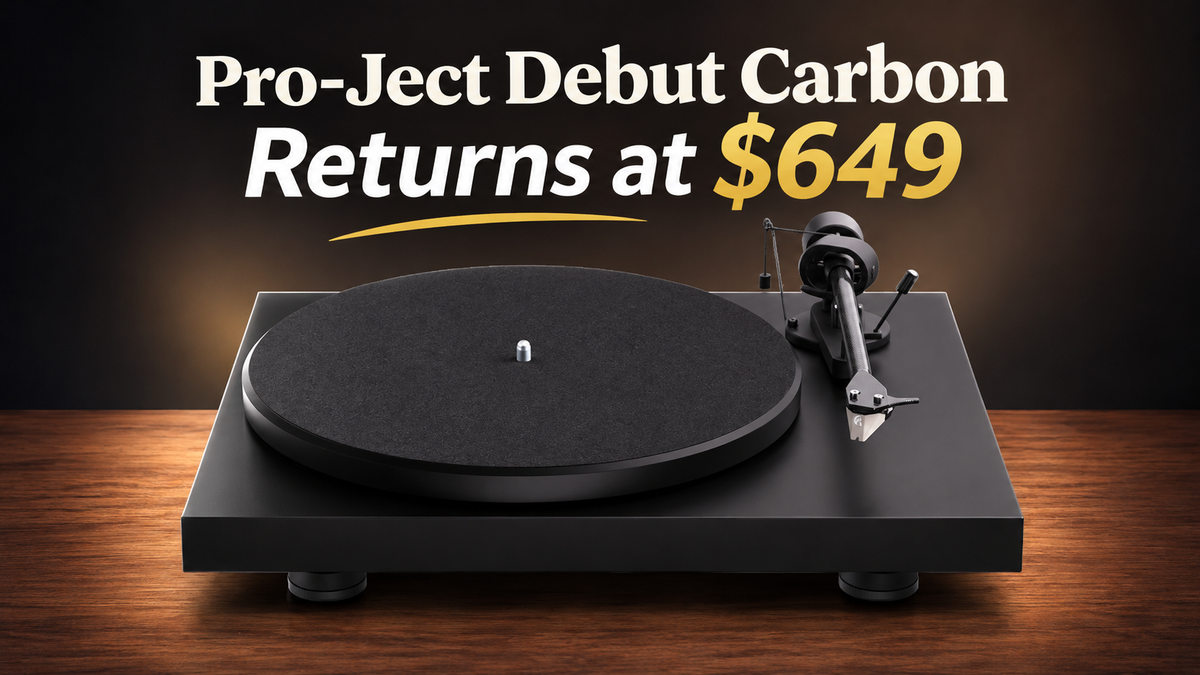
The new Debut Carbon The Original revives a popular turntable formula from 2012. With a carbon-fiber tonearm, an Ortofon-made cartridge, and a $649 price, it looks appealing. But Pro-Ject's own EVO 2 presents an interesting problem.
There's something refreshing about a turntable manufacturer deciding that the next big thing might actually be an old idea.
Pro-Ject has introduced the Debut Carbon The Original, a $649 belt-drive turntable that revisits the formula behind one of its most recognizable models.
No Bluetooth. No touchscreen. No built-in phono preamplifier.
Instead, the Austrian company has concentrated on the fundamentals: a carbon-fiber tonearm, a substantial steel platter, a mechanically isolated motor, and a factory-installed moving-magnet cartridge.
For anyone looking to build a serious vinyl playback system without spending thousands, that sounds promising.
But there's a catch.
Pro-Ject already sells the Debut EVO 2 for $699.
That means the new Original costs just $50 less than its more modern sibling.
So the question isn't simply whether Pro-Ject has built another good-looking turntable.
It's whether returning to the basics makes sense when a more advanced alternative costs only $50 more.
Why Pro-Ject Is Bringing Back a Turntable From 2012
The Debut series has been part of Pro-Ject's identity since 1998.
The concept was straightforward: build a turntable around the mechanical components that influence record playback, keep unnecessary features to a minimum, and make serious analog listening more accessible.
In 2012, the Debut Carbon became an important step in that philosophy.
Its defining feature was a one-piece carbon-fiber tonearm, an unusual inclusion at its price at the time.
Pro-Ject says the broader Debut family has since sold more than one million units worldwide.
Now, the company is revisiting that successful formula rather than introducing an entirely new design.
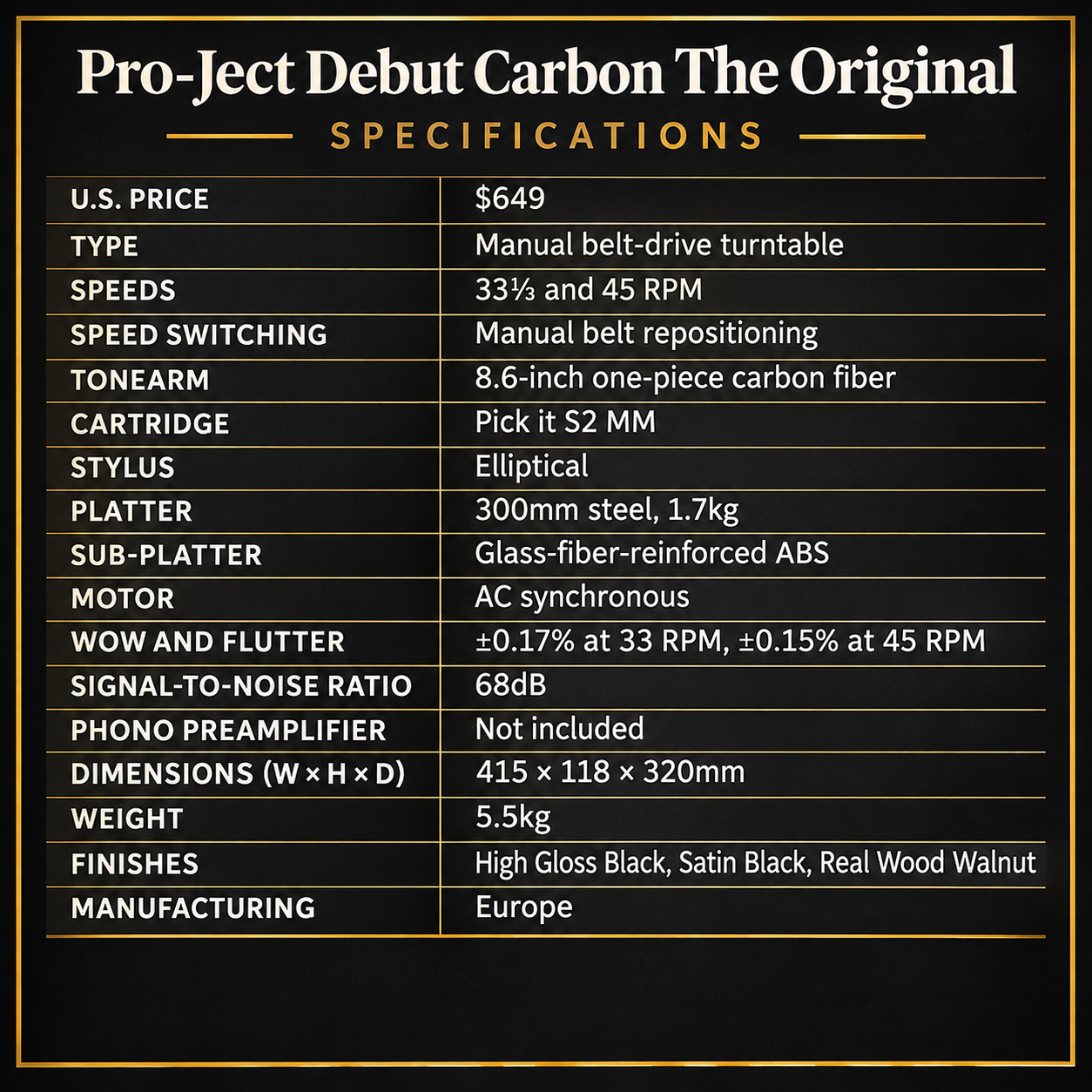
The Debut Carbon The Original is handmade in Europe, with a solid MDF plinth, a 1.7kg steel platter, and an 8.6-inch carbon-fiber tonearm.
It's an approach that prioritizes mechanical engineering over convenience features.
And there's a reasonable argument for doing exactly that.
After all, the fundamental challenge of playing a vinyl record hasn't changed. A stylus must trace a microscopic groove while the platter rotates at a consistent speed, and unwanted vibration must be kept under control.
The interesting part is how Pro-Ject has chosen to address those challenges at $649.
The Carbon-Fiber Tonearm Is Still the Main Attraction
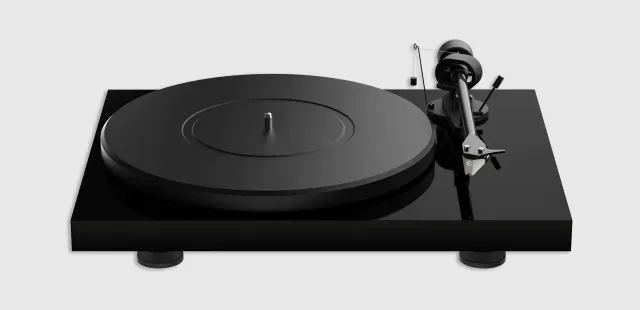
The new Original uses an 8.6-inch, one-piece carbon-fiber tonearm with an integrated headshell.
That construction matters because a tonearm must perform two jobs that can sometimes conflict.
It needs sufficient rigidity to support accurate cartridge tracking, while also keeping unwanted resonances under control.
Carbon fiber offers designers a way to achieve a lightweight, stiff structure.
But material alone doesn't determine performance.
The quality of the bearings, effective mass, cartridge compatibility, and overall resonance behavior all matter.
Pro-Ject has equipped the new model with a CNC-machined aluminum bearing block and an adaptive anti-skating mechanism.
It also includes a TPE-damped counterweight, which the company claims can reduce certain arm and cartridge resonances by up to 50%.
That's an interesting claim, although the figure should be understood as a manufacturer statement rather than an independently verified result for the complete turntable.
The more important question is whether these components work together to provide stable, accurate tracking.
A well-engineered tonearm can support future cartridge upgrades, making it particularly valuable on a turntable intended to remain in a system for years.
That may be one of the strongest arguments for choosing the Debut Carbon over an inexpensive record player built primarily around convenience.
The Cartridge: A Sensible Starting Point
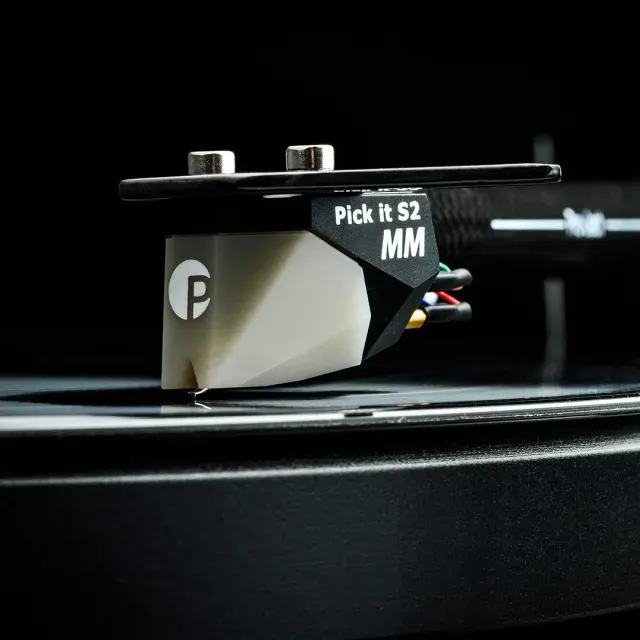
Pro-Ject supplies the Debut Carbon The Original with its Pick it S2 moving-magnet cartridge.
The cartridge is manufactured by Ortofon and tuned for Pro-Ject.
It features an elliptical stylus, a meaningful detail at this price.
Compared with a basic conical stylus, an elliptical profile can provide improved groove tracing, particularly at higher frequencies, although actual performance depends on the stylus geometry, alignment, tracking force, and record condition.
The cartridge arrives pre-adjusted.
For someone purchasing a first serious turntable, that's a practical advantage.
Cartridge alignment is important, but it's also one of the areas where newcomers can make mistakes.
A factory-installed cartridge removes much of the initial complexity, allowing the buyer to concentrate on leveling the turntable, setting it up correctly, and enjoying records.
However, pre-adjusted doesn't mean maintenance-free.
Tracking force, anti-skating, stylus condition, and correct setup remain important.
And as listeners become more experienced, the cartridge offers a natural place to investigate future improvements.
My advice would be to resist upgrading it immediately.
Start with the supplied cartridge, learn its sound, and make sure the turntable is properly installed.
Only then consider whether a cartridge change addresses something you're actually hearing.
A Heavy Platter, Belt Drive, and an Old-Fashioned Compromise
Underneath the record sits a 300mm steel platter weighing approximately 1.7kg.
The platter rests on a glass-fiber-reinforced ABS sub-platter, supported by a stainless steel axle and brass bearing.
A belt connects the sub-platter to an aluminum motor pulley.
The motor itself is mechanically isolated from the plinth using a TPE suspension system.
Pro-Ject also uses an internal DC-to-AC generator to supply the synchronous motor with a controlled electrical signal.
These design choices address two fundamental aspects of turntable performance: rotational stability and vibration control.
Consistent platter rotation is important because speed variations can affect pitch stability.
Mechanical vibration is equally relevant because unwanted energy reaching the stylus can become part of the reproduced signal.
Pro-Ject specifies wow and flutter of ±0.17% at 33 RPM and ±0.15% at 45 RPM.
Those figures provide a useful reference, but they aren't a substitute for independent measurements.
There's also a compromise that deserves attention.
Changing between 33⅓ and 45 RPM requires manually moving the belt.
For listeners who primarily play 33⅓ RPM albums, that might be a minor inconvenience.
For collectors with a substantial library of 45 RPM records, it could become irritating.
I regularly listen to 45 RPM audiophile pressings, and having to lift the platter and reposition a belt every time would be a consideration.
It's not a dealbreaker, but it is a real difference between the Original and the EVO 2.
And it's one of the reasons the $50 price gap matters.
Pro-Ject Debut Carbon The Original vs. Debut EVO 2: What Does $50 Buy?
This is where the new turntable becomes particularly interesting.
At $649, the Debut Carbon The Original is only $50 less than the $699 Debut EVO 2.
Both use carbon-fiber tonearms, belt-drive systems, mechanically isolated motors, and factory-installed moving-magnet cartridges.
But the EVO 2 includes several meaningful differences.
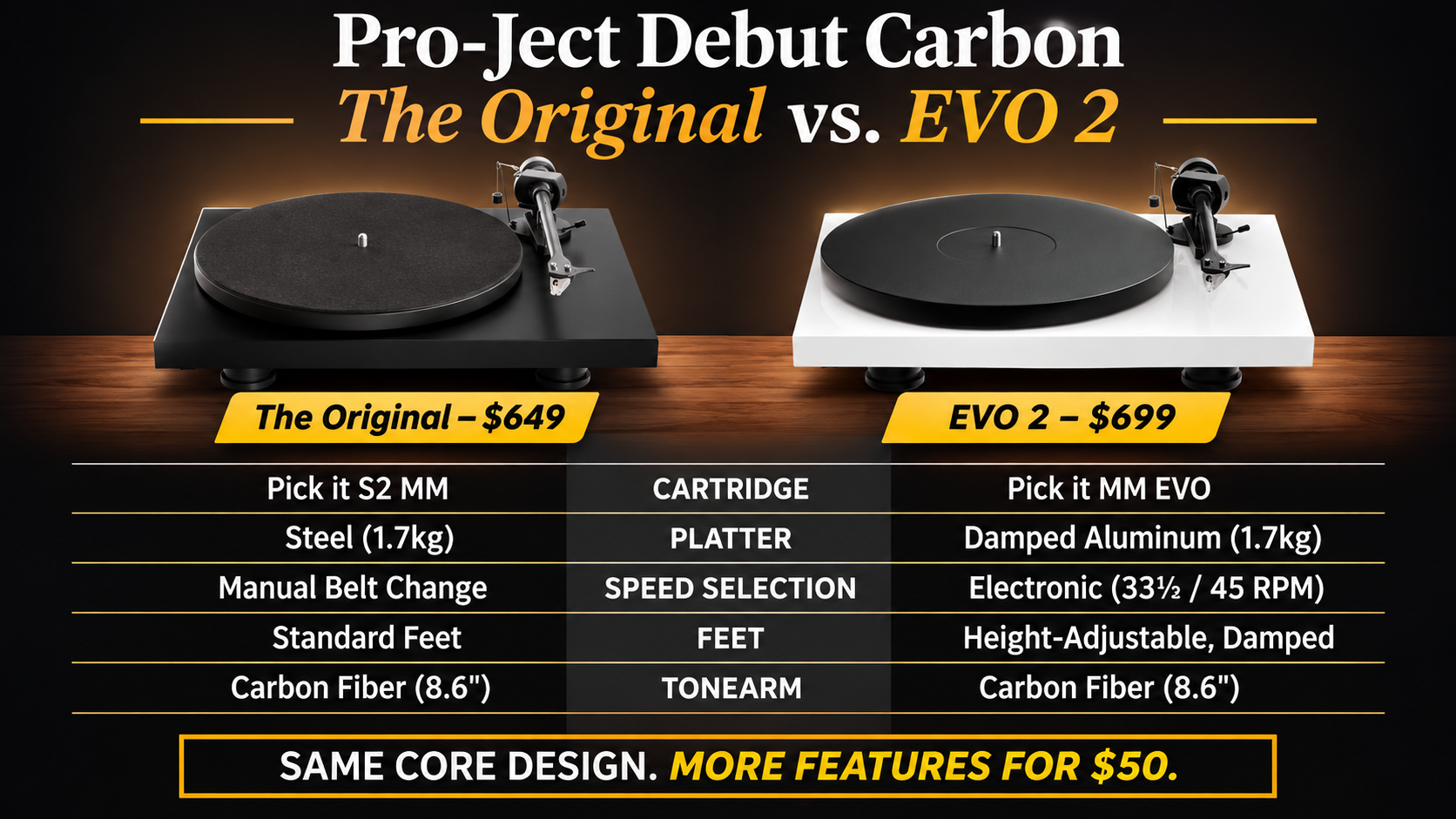
Comparison based on published manufacturer specifications and U.S. pricing. These differences do not establish an audible performance ranking.
The most obvious advantage of the EVO 2 is electronic speed switching.
Press a switch, and the turntable changes speed without requiring you to move the belt.
That's a meaningful convenience improvement for anyone regularly playing 45 RPM records.
The EVO 2 also uses a die-cast aluminum platter with integrated TPE damping.
The platter is designed to reduce unwanted resonance and is nonmagnetic, which can be useful when considering certain moving-coil cartridge upgrades.
The Original's steel platter is substantial, but the different materials and damping arrangements deserve consideration.
That doesn't mean aluminum automatically sounds better than steel.
Platter performance depends on resonance, mass distribution, bearing quality, and how the entire system is implemented.
Still, the EVO 2 offers a more developed platter arrangement on paper.
It also includes the Pick it MM EVO cartridge and height-adjustable damped feet.
These are tangible differences, not merely cosmetic changes.
Is the EVO 2 Worth the Extra $50?
Based on the published specifications, I would lean toward the EVO 2 for most buyers.
The price difference is relatively small, and electronic speed selection alone could justify it for anyone who frequently switches between 33⅓ and 45 RPM.
The damped aluminum platter and upgraded cartridge provide additional reasons to consider the newer model.
However, I wouldn't claim the EVO 2 sounds better without comparing both turntables under controlled conditions.
A proper comparison would require matched playback levels, careful setup, and attention to the differences between the supplied cartridges.
Otherwise, it's easy to attribute changes to the turntable when they may actually result from the cartridge or setup.
The Original could still be an excellent choice, particularly for someone who prefers its finish, finds it discounted, or simply wants a straightforward manual turntable.
But at their announced U.S. prices, the EVO 2 appears to offer the stronger overall value.
That's not a criticism of the Original's engineering.
It's a consequence of Pro-Ject pricing two closely related products only $50 apart.
What Does a $649 Turntable Actually Cost to Use?
There's another consideration that buyers should understand before ordering.
The Debut Carbon The Original does not include a built-in phono preamplifier.
That means it cannot simply be connected to any conventional line-level input without additional equipment.
You'll need an amplifier or receiver with a suitable moving-magnet phono input, or a separate phono stage.
The turntable includes an RCA phono cable, dust cover, felt mat, and other basic accessories.
But the phono preamplifier is an additional requirement if your existing system doesn't provide one.
For someone building a system from scratch, that changes the budget.
A $649 turntable isn't necessarily a $649 vinyl playback system.
You'll still need amplification and speakers, or a compatible powered-speaker arrangement, as well as phono amplification.
The good news is that an external phono stage isn't inherently a disadvantage.
It can provide more flexibility as the system develops.
But I wouldn't recommend buying an expensive phono stage simply because a turntable has a carbon-fiber tonearm.
At this level, sensible system matching matters more than chasing exotic components.
Where Should You Spend Your Upgrade Money?
One of the most common mistakes in vinyl playback is assuming every upgrade must involve replacing equipment.
In reality, some of the most useful improvements are less glamorous.
Start with proper setup.
Make sure the turntable is level and positioned on a stable surface.
Verify tracking force and anti-skating according to the manufacturer's instructions.
Keep the stylus clean, and make sure records are in good condition.
If the turntable is positioned near speakers, pay attention to vibration and acoustic feedback.
These fundamentals can influence playback more directly than swapping cables or adding accessories without identifying a specific problem.
The next priority should be the phono stage, particularly if the existing one is noisy, poorly matched, or otherwise limiting performance.
A cartridge upgrade may also be worthwhile eventually, but it should be approached as a deliberate comparison rather than an automatic purchase.
And before spending money on any upgrade, ask a simple question:
What problem am I trying to solve?
If the answer isn't clear, it may be worth spending more time listening before spending more money.
Pro-Ject Debut Carbon The Original: Specifications
Who Should Buy the Debut Carbon The Original?
The new Original makes the most sense for someone who wants a dedicated hi-fi turntable without unnecessary features.
It provides a credible starting point with a carbon-fiber tonearm, a factory-installed cartridge, and a traditional belt-drive system.
It also makes sense for listeners who value a straightforward mechanical design and don't mind manually changing speeds.
But there are buyers who should look carefully at the EVO 2 before making a decision.
Anyone who frequently plays 45 RPM records will appreciate electronic speed switching.
Listeners planning future cartridge upgrades may also value the EVO 2's nonmagnetic, damped aluminum platter.
And buyers looking for the strongest specification package at this price should consider whether saving $50 is worthwhile.
Neither model should be purchased on the assumption that carbon fiber, platter weight, or a particular cartridge automatically guarantees better sound.
Those features are useful starting points, not listening-test results.
Final Thoughts: Sometimes the Original Formula Isn't the Best Deal
I appreciate what Pro-Ject is trying to accomplish with the Debut Carbon The Original.
There's something appealing about a manufacturer revisiting a design that helped make serious vinyl playback more accessible.
The carbon-fiber tonearm, heavy platter, isolated motor, and supplied cartridge all suggest a turntable designed around the fundamentals.
And for $649, that's a respectable proposition.
But I keep coming back to the same question.
Why save $50 when the Debut EVO 2 offers electronic speed switching, a damped aluminum platter, and additional refinements?
On paper, I would spend the extra money.
That doesn't mean the Original won't sound excellent, and it certainly doesn't mean every listener needs the more expensive model.
It simply means the value proposition is more complicated than the name suggests.
The Debut Carbon The Original may be a return to Pro-Ject's roots.
But for most buyers, the EVO 2 looks like the smarter purchase until a direct listening comparison proves otherwise.
And perhaps that's the most useful takeaway from this release.
Buying a turntable isn't about choosing the newest model, the most expensive component, or the most impressive specification.
It's about understanding what you're paying for and whether those differences matter in your own listening system.
Would you save $50 and choose the Debut Carbon The Original, or spend a little more for the EVO 2? Let me know in the comments.
Learn More
Pro-Ject Debut Carbon The Original: https://www.project-audio.com/en/product/debut-carbon-the-original/
Pro-Ject Debut EVO 2: https://www.project-audio.com/en/product/debut-evo-2/
Editorial Note
This article is a specification-based comparison and buying analysis, not a hands-on review. Vinyl Latte has not independently tested the Debut Carbon The Original against the EVO 2. Performance claims and technical specifications are attributed to the manufacturer, and conclusions about value are based on the documented features and announced U.S. pricing.
Comments ()