
Acoustic Energy's New 500 Series Borrows From Its Flagship Speakers. But Will the Engineering Make a Difference?
Acoustic Energy's redesigned 500 Series brings flagship Corinium engineering to more affordable speakers. Explore the new carbon-fiber drivers, soft-dome tweeters, revised crossovers, and what these changes could mean for sound quality.
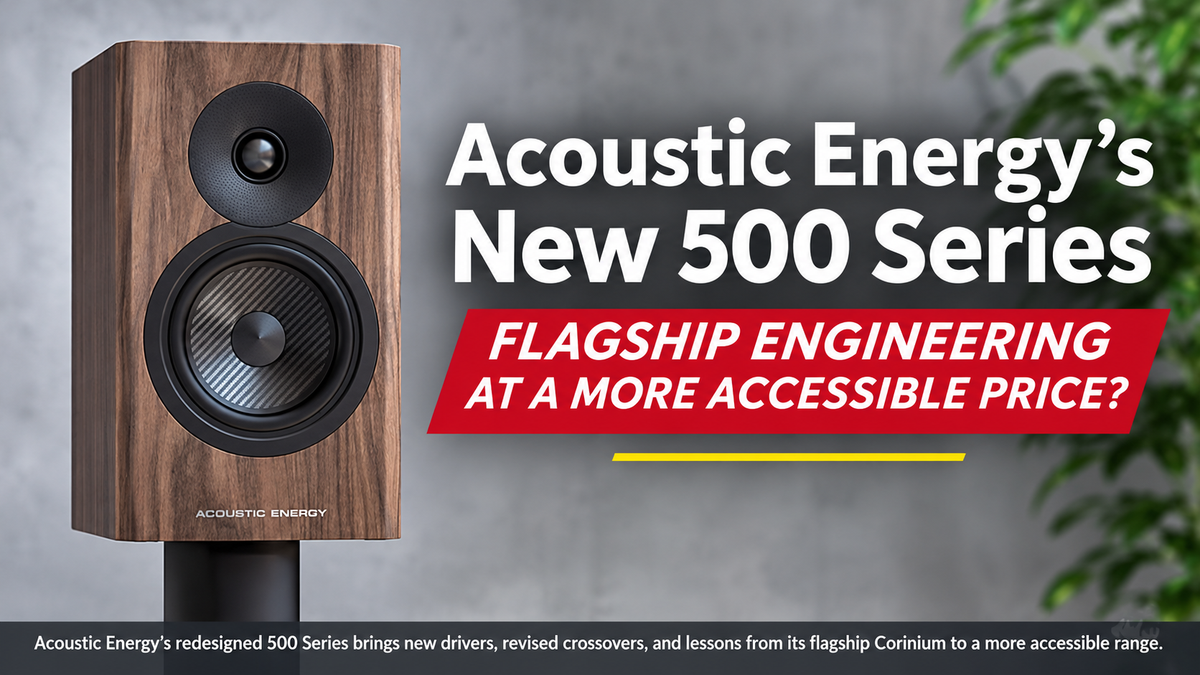
The British loudspeaker manufacturer has redesigned its 500 Series with new drivers, revised crossovers, and lessons learned from its flagship Corinium. Three models are coming, starting at £1,200 per pair.
A loudspeaker doesn't need a radical new shape or an exotic cabinet material to represent a meaningful engineering improvement.
Sometimes, the most interesting changes happen inside.
That's the approach Acoustic Energy is taking with its second-generation 500 Series, announced November 11, 2026.
The British manufacturer has introduced three redesigned loudspeakers: the compact AE500² standmount, the AE509² floorstander, and the larger AE520².
All three draw on engineering developed for the company's flagship Corinium loudspeaker.
The headline changes include newly developed carbon-fiber mid/bass drivers, 29mm soft-dome tweeters, revised crossovers, and improvements to cabinet construction.
Prices start at £1,200 per pair, with availability expected in December.
On paper, this looks like a conventional loudspeaker refresh.
But there's a more interesting story beneath the specifications.
Acoustic Energy is making a series of engineering decisions that could influence how these speakers reproduce music, particularly through the midrange and treble.
And some of those decisions challenge the idea that more expensive materials automatically produce better sound.
Three New Speakers, One Shared Design Philosophy
The second-generation 500 Series replaces Acoustic Energy's existing models while retaining a familiar approach to loudspeaker design.
Rather than introducing dramatically different products, the company has concentrated on refining the components responsible for turning an electrical signal into sound.
The lineup consists of three models.
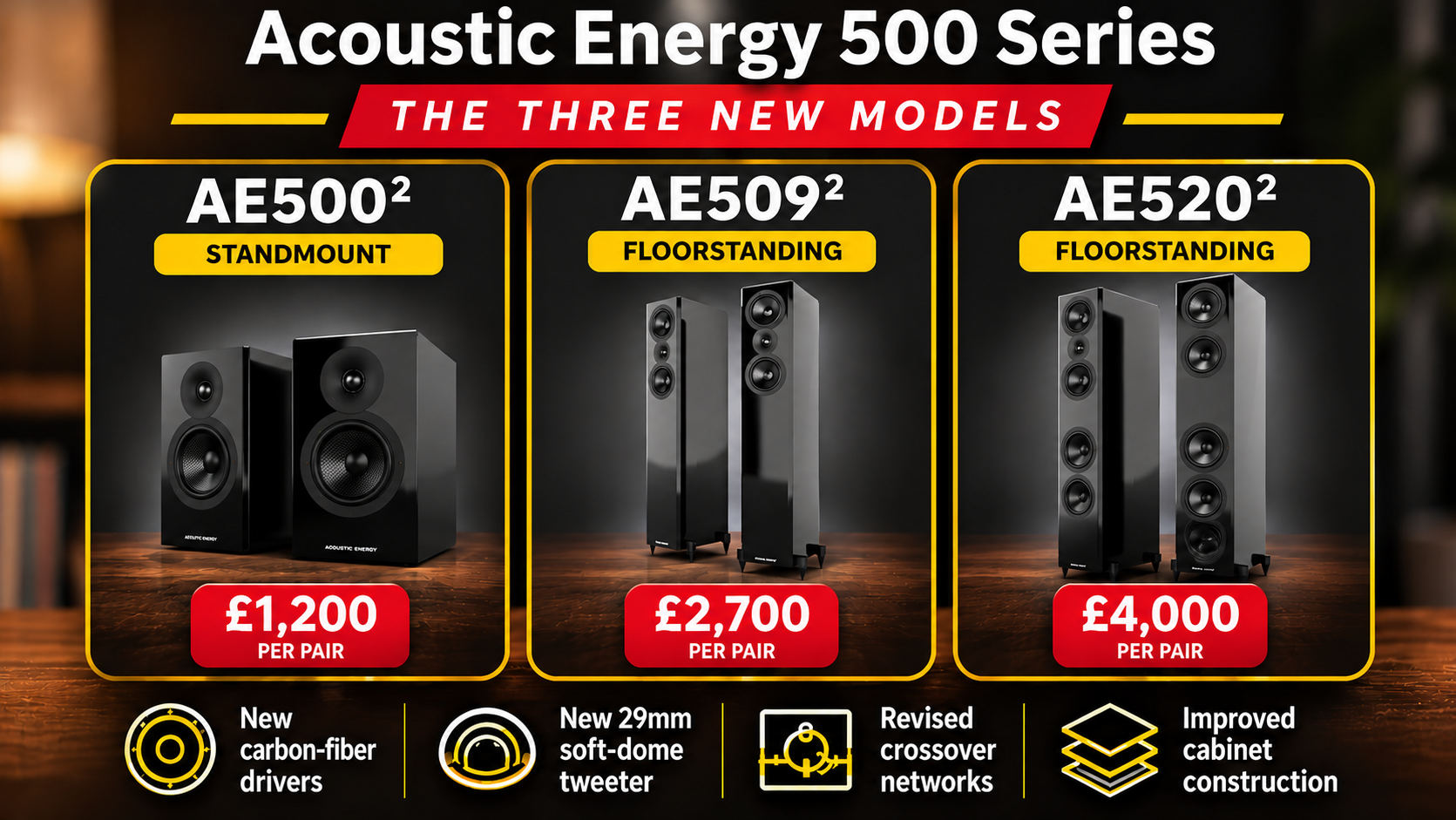
All three are expected to become available in December 2026.
The important distinction isn't simply their size or price.
It's how Acoustic Energy has applied lessons from the Corinium project across a more accessible range.
That includes reconsidering the materials used in its drivers, refining how those drivers operate together, and reducing unwanted cabinet vibration.
Those changes address several of the most important challenges in loudspeaker design.
But whether they produce audible improvements will ultimately depend on the complete implementation.
Why Acoustic Energy Changed Its Tweeter
One of the most interesting decisions involves the high-frequency driver.
The previous 500 Series used carbon-fiber dome tweeters.
For the second generation, Acoustic Energy has moved to a newly developed 29mm soft-dome design.
That might seem surprising.
Carbon fiber is frequently promoted as a premium loudspeaker material because it offers an attractive combination of stiffness and low mass.
But tweeter design isn't a contest to find the stiffest material.
A tweeter must reproduce high frequencies while controlling resonance, distortion, and unwanted vibration.
It also needs to maintain consistent behavior as sound moves away from the speaker's central listening axis.
A stiff dome can be effective when its breakup behavior is properly controlled.
A soft dome can offer different resonance characteristics, potentially allowing the designer to manage unwanted high-frequency behavior more predictably.
Neither approach is inherently superior.
What matters is the complete driver, including its diaphragm, suspension, motor system, acoustic loading, and crossover.
Acoustic Energy says the new tweeter incorporates lessons from its Corinium development program.
That makes the change particularly interesting.
Instead of retaining carbon fiber simply because it sounds impressive in a specification sheet, the company has selected a different approach for the new design.
The important question isn't whether a soft dome is better than carbon fiber. It's whether this particular tweeter integrates more effectively with the rest of the loudspeaker.
And that brings us to the midrange.
Carbon Fiber Remains Central to the Mid/Bass Drivers
Although Acoustic Energy has moved away from carbon fiber for the tweeter, the material remains important elsewhere.
The new 500 Series uses redesigned carbon-fiber mid/bass drivers developed with knowledge gained from the Corinium project.
A mid/bass driver faces a different set of challenges from a tweeter.
It must move enough air to reproduce lower frequencies while maintaining controlled behavior through the midrange.
That requires balancing diaphragm stiffness, moving mass, damping, and the behavior of the driver's motor and suspension.
Carbon fiber can be useful because it allows engineers to create a relatively lightweight, rigid diaphragm.
But the material alone doesn't guarantee accuracy.
Every cone has resonances, and its behavior becomes more complicated as frequency increases.
At some point, the diaphragm may stop moving as a single rigid surface.
Different regions can begin vibrating independently, producing what engineers call cone breakup.
If that behavior occurs within the driver's operating range, it can introduce unwanted coloration.
A successful design must manage those resonances through the cone's construction, damping, driver geometry, and crossover.
This is where Acoustic Energy's redesign could matter.
By refining the mid/bass drivers and their integration with the tweeters, the company may be able to improve the transition between the drivers.
That transition is particularly important because it occurs in a frequency region containing significant musical information.
Vocals, guitars, piano, and many acoustic instruments depend on consistent reproduction through the midrange.
A loudspeaker that handles this region well can sound natural and coherent without needing exaggerated bass or treble.
However, we'll need measurements and listening evaluations before determining how much the new drivers improve performance over the previous generation.
The Crossover May Be More Important Than Either Driver
It's easy to focus on driver materials because they're visible and relatively easy to explain.
But one of the most important parts of a loudspeaker is usually hidden inside the cabinet.
The crossover.
Acoustic Energy has revised the crossover networks for the second-generation 500 Series.
That could prove to be one of the most consequential changes.
A crossover determines how the audio signal is divided between the drivers.
But its role extends beyond deciding which frequencies each driver reproduces.
It also influences the acoustic relationship between the drivers, including their output levels, phase behavior, and combined response.
Two excellent drivers can produce disappointing results if they're poorly integrated.
Conversely, a carefully designed crossover can help relatively conventional drivers work together exceptionally well.
One area worth examining is the transition between the mid/bass driver and tweeter.
Ideally, their combined output should remain smooth through the crossover region.
There should also be reasonably consistent dispersion as the listener moves away from the speaker's central axis.
This matters because we don't hear only the sound traveling directly from the loudspeaker to our ears.
We also hear sound reflected from the floor, ceiling, and walls.
If a speaker's off-axis response changes dramatically around the crossover frequency, those reflections may have a different tonal balance from the direct sound.
The result can affect how natural the speaker sounds in a room.
It's one reason loudspeaker measurements should include more than a single on-axis frequency-response graph.
Acoustic Energy's revised crossovers are therefore worth investigating.
But until independent measurements become available, it's impossible to know whether the new networks deliver measurably smoother response, improved directivity, or lower distortion.
Those are questions a proper review should answer.

Cabinet Resonance: The Problem You Don't Want to Hear
The other major area of development is the cabinet.
A loudspeaker cabinet should provide a stable structure for its drivers while minimizing unwanted acoustic output from its panels.
In practice, no cabinet is completely inert.
As the drivers operate, mechanical energy enters the enclosure.
Some of that energy can cause cabinet panels to vibrate.
If those vibrations become sufficiently strong, the cabinet can contribute audible sound that wasn't part of the original recording.
The result may be coloration, particularly in the lower midrange.
Manufacturers address this through combinations of cabinet thickness, internal bracing, damping materials, and structural design.
Acoustic Energy says it has refined the cabinet construction of the new 500 Series to help suppress unwanted resonance.
That's a worthwhile goal.
But cabinet engineering is more complicated than simply making an enclosure heavier.
Adding mass can change resonance behavior, while strategic bracing can increase stiffness and move resonances to different frequencies.
Damping materials can reduce the amplitude of certain vibrations.
The effectiveness depends on how these approaches work together.
A well-designed cabinet doesn't necessarily need to be extraordinarily heavy.
It needs to control unwanted energy sufficiently that cabinet vibration doesn't meaningfully interfere with the intended sound.
For the new Acoustic Energy models, I'd be interested in seeing cabinet vibration measurements alongside conventional frequency-response and distortion data.
Those results would provide a better indication of the improvements than construction claims alone.
What Does This Mean for Actual Listening?
This is where specifications become less useful than careful evaluation.
A manufacturer can describe a new driver, crossover, or cabinet design in considerable detail.
But listeners ultimately experience the complete loudspeaker operating in a room.
The individual components don't exist in isolation.
A redesigned tweeter might offer lower distortion, but that improvement could be difficult to appreciate if the crossover introduces an uneven response.
A better-controlled mid/bass driver might improve clarity, but cabinet resonances could still influence the result.
And even a well-engineered loudspeaker can sound disappointing if it's poorly positioned or used in an unsuitable room.
For that reason, I would want to evaluate several things before drawing conclusions about the new 500 Series.
Vocal reproduction
Voices are particularly useful for identifying tonal coloration.
I would listen for natural vocal weight, consistent presence, and whether the speaker adds an artificial emphasis to certain frequencies.
Midrange clarity
Complex recordings can reveal whether instruments remain distinct without sounding unnaturally separated.
I'd pay attention to piano, acoustic guitar, and densely layered arrangements.
Treble behavior
The new soft-dome tweeter deserves careful attention.
I'd listen for detail, but also for smoothness and the absence of excessive brightness.
A speaker can initially sound impressive because its treble is emphasized.
That doesn't necessarily make it more accurate.
Bass control
Bass extension is only part of the equation.
I'd also want to hear whether low frequencies remain controlled and whether the transition into the midrange sounds natural.
Performance away from the sweet spot
A loudspeaker's dispersion characteristics influence how it interacts with a room.
I'd listen from several positions rather than judging the entire design from one carefully selected seat.
None of these observations would replace measurements.
But together, they could help establish whether Acoustic Energy's engineering changes translate into meaningful listening improvements.
There's Also a Fourth Model for Home Theater
The new 500 Series includes a fourth speaker that deserves attention: the AE507².
Priced at £650 each, it's designed for left, center, or right channel use, including wall-mounted installations.
Its shallow cabinet measures approximately 125mm deep and incorporates two 125mm carbon-fiber drivers, a 29mm soft-dome tweeter, and a passive radiator.
That makes it particularly interesting for listeners who want consistent speaker voicing across a multichannel system.
It's also a reminder that the technologies developed for traditional two-channel listening can have applications beyond stereo.
The complete lineup is:
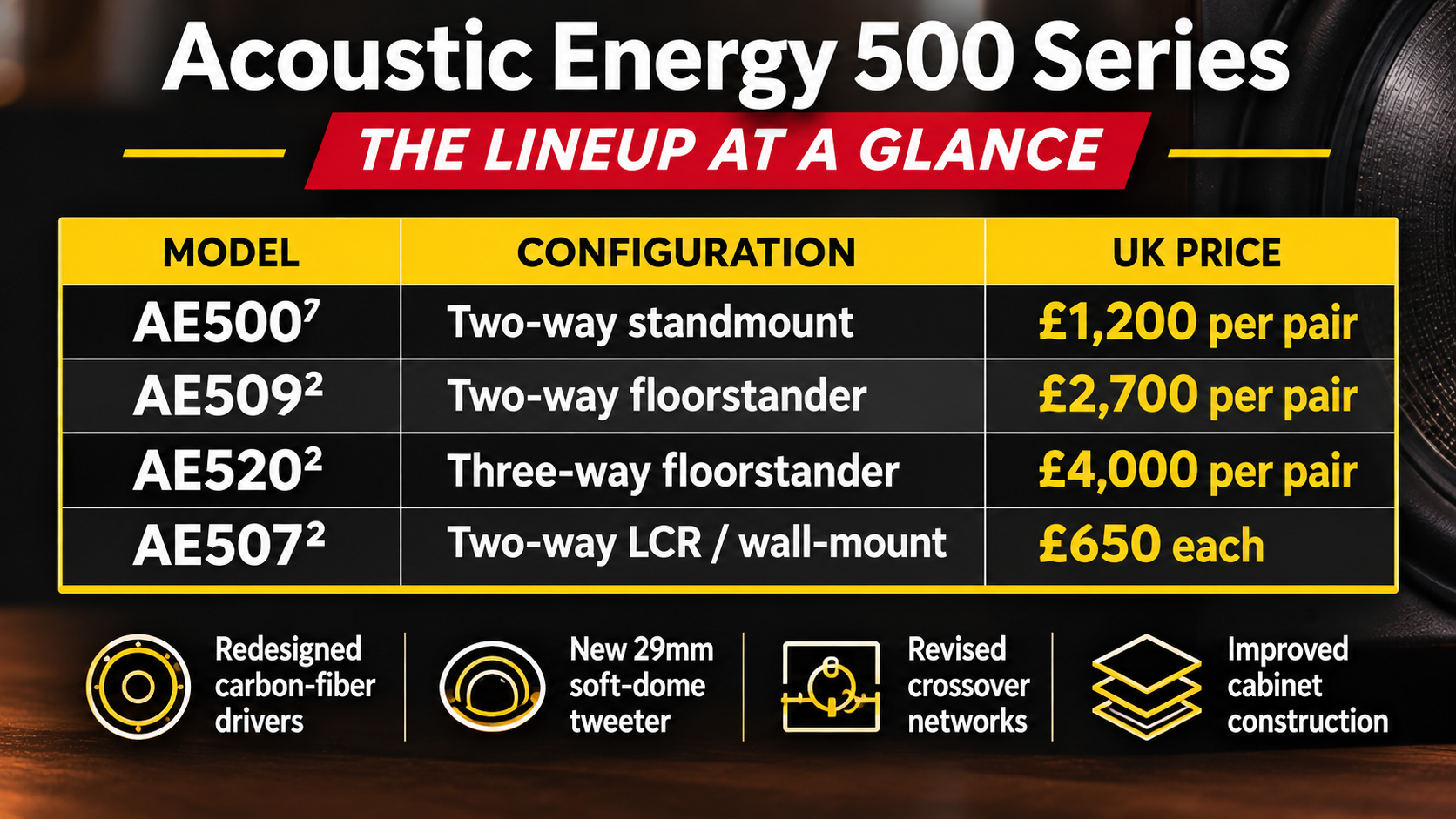
All four models are scheduled to become available in December 2026, in Piano Gloss Black, Piano Gloss White, and American Walnut finishes. U.S. pricing has not yet been confirmed.
Which Acoustic Energy 500 Series Speaker Is Most Interesting?
The AE500² could be particularly appealing for listeners working with smaller rooms.
A compact standmount speaker can offer excellent imaging and tonal accuracy when properly positioned, although its low-frequency extension and maximum output will generally be more limited than those of a larger floorstander.
The AE509² occupies an interesting middle ground.
With two 125mm carbon-fiber drivers in a slim floorstanding enclosure, it could appeal to listeners who want additional bass capability without moving to a particularly large cabinet.
But the AE520² is arguably the most interesting from an engineering perspective.
Unlike the previous model, which employed a five-driver arrangement, the redesigned AE520² uses a three-way configuration with two 165mm bass drivers, a dedicated 125mm midrange driver, and the new soft-dome tweeter.
That architecture allows the designer to optimize the bass and midrange drivers for different operating ranges.
Acoustic Energy specifies bass extension to 28Hz and sensitivity of 92dB for the AE520². Those figures suggest a speaker worth investigating for listeners who want substantial low-frequency capability without necessarily relying on a subwoofer, although room behavior and actual measurements will determine the result.
Of the four models, the AE520² would be my first choice for a detailed technical evaluation, while the AE500² may offer the most interesting value proposition.
Final Thoughts: Better Engineering Doesn't Always Mean More Exotic Materials
What interests me most about Acoustic Energy's redesigned 500 Series isn't the promise of flagship technology at a lower price.
We've heard that claim from countless manufacturers.
It's the specific engineering decisions behind the announcement.
A move from carbon-fiber to soft-dome tweeters. A redesigned carbon-fiber mid/bass driver with a shallower cone profile and revised motor system. Crossovers developed with attention to group delay and phase integration. Cabinets reshaped to better manage internal reflections.
None of these changes guarantees better sound.
But they demonstrate an approach that treats the loudspeaker as a complete acoustic system rather than a collection of impressive components.
That's important.
A loudspeaker's performance depends on how its drivers, crossover, and enclosure interact.
Improving one component without considering the others may accomplish very little.
Acoustic Energy appears to recognize that relationship.
Its chief designer, Mat Spandl, has explained that the lessons from developing Corinium involved making relatively small improvements across several areas rather than relying on one dramatic innovation.
It's a philosophy I appreciate.
Because the best audio engineering isn't necessarily the engineering that attracts the most attention.
Sometimes, it's the engineering that allows you to stop thinking about the equipment and concentrate on the music.
The new 500 Series looks promising on paper.
Now Acoustic Energy needs to demonstrate that those refinements deliver a meaningful improvement when the music starts playing.
Would you choose the compact AE500², the slim AE509², or the larger three-way AE520²? And how important is driver material when you're evaluating a loudspeaker?
Let me know in the comments.
Official Sources and Further Reading
Acoustic Energy, New 500 Series Announcement:
https://www.acoustic-energy.co.uk/acoustic-energy-unveils-the-new-500-series/
Acoustic Energy, Official Product Photography:
https://www.acoustic-energy.co.uk/press-images/
Acoustic Energy, Product Documentation:
https://www.acoustic-energy.co.uk/support/user-manuals/
Editorial note: Acoustic Energy originally announced the redesigned 500 Series on November 3, 2026, with additional media coverage appearing in the following week. This article is an engineering analysis based on published manufacturer information, not a hands-on review. Vinyl Latte has not independently tested the new models, and claims about improved sound quality remain unverified.
Comments ()