
Is the Modern Entry Level Turntable Getting Too Convenient?
Modern entry-level turntables are making vinyl easier than ever to enjoy, with built-in phono stages, Bluetooth, and automatic playback. But as the format becomes more convenient, it raises a bigger question: are we removing the very ritual that makes records feel special?
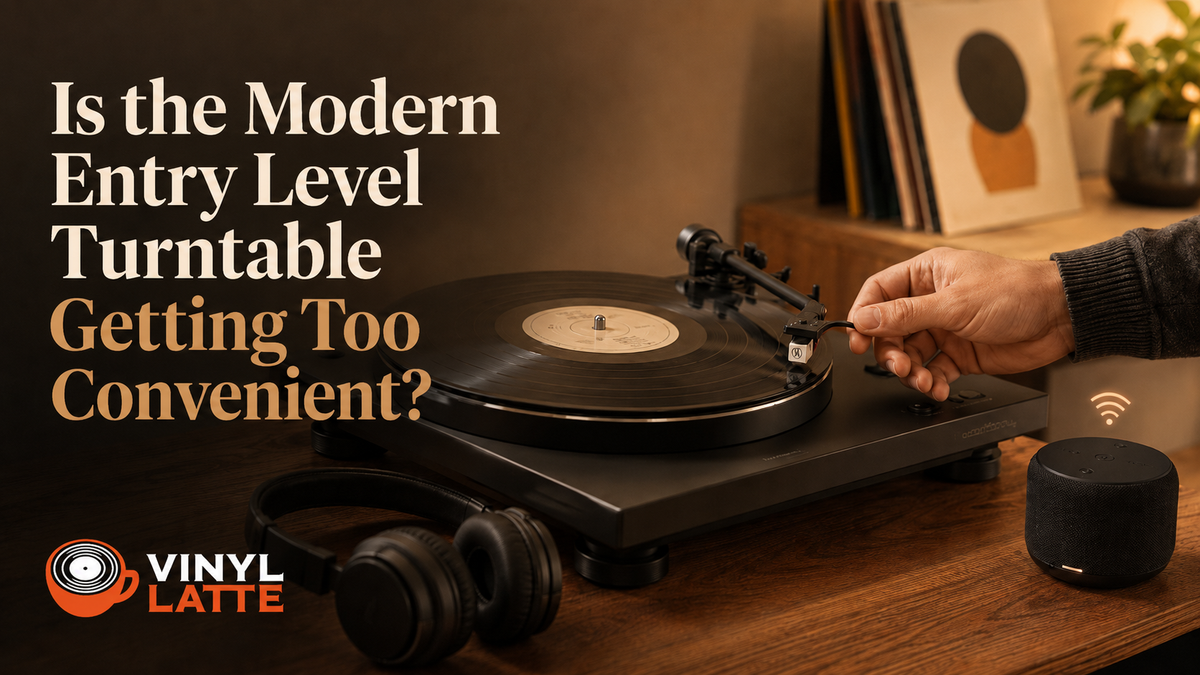
There was a time when buying your first real turntable meant accepting a little friction.
You had to think about where it would go. You had to understand what a phono stage was. You had to connect it to an amplifier or powered speakers. You had to learn how to cue the record, clean the stylus, handle the record, and maybe even balance a tonearm.
For some people, that friction was part of the barrier.
For others, it was part of the point.
Today, the entry level turntable has changed. A lot of the newest beginner friendly models are designed to remove as many obstacles as possible. Built in phono stages are common. Bluetooth output is common. Fully automatic operation is common. Some decks are marketed less like a traditional hi-fi component and more like a lifestyle product that happens to spin records.
That raises an interesting question.
Are modern entry level turntables making vinyl more accessible, or are they making it too convenient?
The Case for Convenience
Let’s start with the obvious. Convenience is not a bad thing.
The biggest challenge with getting someone into vinyl is not convincing them that records are cool. That part is already done. Records are visible in bookstores, lifestyle shops, big box retailers, record stores, and all over social media. The harder part is getting someone from “I like the idea of vinyl” to “I can actually play records at home without feeling overwhelmed.”
That is where modern entry level turntables serve a real purpose.
A deck like the Audio Technica AT LP70XBT is built around ease of use, with fully automatic operation, Bluetooth wireless playback, and a built in switchable phono preamp. Sony’s PS LX310BT follows a similar path, offering Bluetooth connectivity, a built in phono EQ, and simple playback for 33⅓ and 45 rpm records.
For a newcomer, that matters.
Not everyone wants to start with separates. Not everyone wants to research cartridges, preamps, cables, speaker matching, tracking force, isolation, and alignment before they hear their first record. Some people just want to buy a turntable, connect it to powered speakers or headphones, and play the album they picked up at the store.
That first positive experience can be the gateway.
If a convenient turntable gets someone to buy records, visit record stores, care about album sequencing, and sit down with music instead of treating it as background noise, then it has done something valuable.
The audiophile path does not have to start with complexity. Sometimes it starts with ease.
The Problem With Making Vinyl Too Easy
At the same time, vinyl is not streaming with a platter.
The format has always asked something of the listener. You have to pull the record from the sleeve. You have to handle it carefully. You have to clean it. You have to lower the stylus. You have to flip sides. You have to accept that the experience is physical, imperfect, and a little inconvenient by design.
That is part of what separates vinyl from every frictionless listening option we already have.
When entry level turntables try to remove every step, there is a risk that they also remove some of the connection. If the turntable becomes just another wireless device feeding a Bluetooth speaker across the room, the record can start to feel like a novelty input source instead of the center of the listening experience.
That does not mean Bluetooth turntables are bad. It means we should be honest about the tradeoff.
Bluetooth is convenient, but it changes the signal path. A record is an analog source. Sending it wirelessly means converting that signal into digital, compressing or transmitting it through a wireless codec, and then converting it back again at the speaker or headphone end. For casual listening, that may be perfectly acceptable. For someone trying to understand why vinyl can sound special, it can be a confusing place to start.
The same thing applies to fully automatic operation.
There is nothing wrong with pressing a button and letting the turntable cue itself. In fact, for some users, it may prevent damaged records or damaged styli. But learning how to cue a record is part of learning the medium. So is learning how the tonearm behaves. So is understanding why the stylus, cartridge, and setup matter.
If the entire experience becomes invisible, the listener may never learn what makes one turntable better than another.
Entry Level Should Not Mean Disposable
The bigger concern is not convenience itself. It is whether convenience becomes a substitute for quality.
There is a difference between an approachable turntable and a throwaway turntable. The best entry level products simplify the experience without disrespecting the record. They still have a proper tonearm. They still track records safely. They still allow the owner to connect to a real system. They still give the listener a path forward.
That is the key.
A good beginner turntable should make vinyl less intimidating, but it should not trap the listener in a dead end.
This is why some simple manual turntables still make so much sense. A deck like the Fluance RT81, for example, is frequently positioned as an affordable way to discover or rediscover vinyl without spending a fortune, while still keeping the experience closer to a traditional record playing setup.
That type of product gives a beginner enough convenience to get started, but still leaves room to understand the system.
You can connect it to powered speakers. You can use the built in phono stage. Later, you can bypass that phono stage and try something better. You can upgrade the rest of the system around it. You can learn.
That is very different from buying something that treats records like accessories.
The Ritual Is Not the Enemy
Audiophiles can sometimes be too quick to dismiss convenience. That is a mistake.
Not every beginner needs to be told to buy a separate phono preamp, separate amplifier, passive speakers, a cartridge scale, a record cleaning machine, and a stack of alignment tools. That may be where the hobby eventually leads, but it is not where everyone needs to begin.
At the same time, we should not be afraid to say that ritual matters.
The ritual is not gatekeeping. It is part of the experience.
Dropping the needle matters. Sitting with the album art matters. Flipping the record matters. Listening to a full side matters. Knowing that setup affects the sound matters. Realizing that the cartridge is not just a needle, the tonearm is not just a handle, and the phono stage is not just a checkbox matters.
Vinyl rewards attention.
The more we remove the need to pay attention, the more vinyl risks becoming another aesthetic product instead of a listening format.
The Best Entry Level Turntable Teaches Without Scaring People Away
The ideal beginner turntable should do two things at once.
It should make the first step easy.
It should also invite the second step.
That is where the balance lives. Give people a built in phono stage, but let them bypass it. Give them simple setup, but do not hide the basics. Give them a cartridge that is safe for records, but ideally allow replacement or upgrade options. Give them convenience, but not at the expense of the format itself.
The best entry level turntable should not make the owner feel like they need to become an audiophile overnight. It should make them curious enough to keep going.
That curiosity is what turns a casual buyer into a record collector. It is what turns a Bluetooth speaker setup into a proper listening space. It is what turns “I bought this album because it looked cool” into “I want to hear what this pressing actually sounds like.”
Convenience can open the door.
But the hobby begins when the listener chooses to walk through it.
So, Are Modern Entry Level Turntables Too Convenient?
Some are.
But convenience itself is not the problem. The problem is convenience without education. Convenience without quality. Convenience without a path forward.
A good entry level turntable should remove confusion, not remove engagement.
It should help someone enjoy their records on day one, while still leaving enough of the vinyl experience intact to make them understand why the format matters in the first place.
Because the magic of vinyl is not just that it plays music.
It is that it asks you to participate.


Comments ()