Is Gen Z Actually Saving Physical Music?
Gen Z may not be saving physical music in the traditional audiophile sense, but their renewed interest in vinyl, CDs, and ownership suggests something meaningful: albums still matter when they feel personal, permanent, and worth holding.
For years, the story around physical music has been told like a comeback nobody expected.
Vinyl was supposed to be dead. CDs were supposed to be landfill. Cassettes were supposed to remain a nostalgic punchline. Streaming won, ownership lost, and the future of music was supposed to live entirely inside an app.
Except that is not quite what happened.
Physical music is still a tiny piece of the overall industry compared with streaming, but it refuses to disappear. Vinyl keeps growing. CDs are suddenly cooler than they have any right to be. Cassettes, somehow, continue to find an audience. And perhaps most surprising of all, a meaningful part of that audience is not made up of people trying to relive the past.
It is Gen Z.
That raises an interesting question: is Gen Z actually saving physical music?
The answer depends on what we mean by saving.
This Is Not Your Father’s Record Collection
When older collectors talk about vinyl, the conversation often moves quickly toward pressing quality, mastering engineers, deadwax, AAA sources, original pressings, cartridge alignment, and whether the reissue sounds better than the digital version.
That is one version of physical music culture. It is an important one, and frankly, it is the version many of us live in. But it is not the only version.
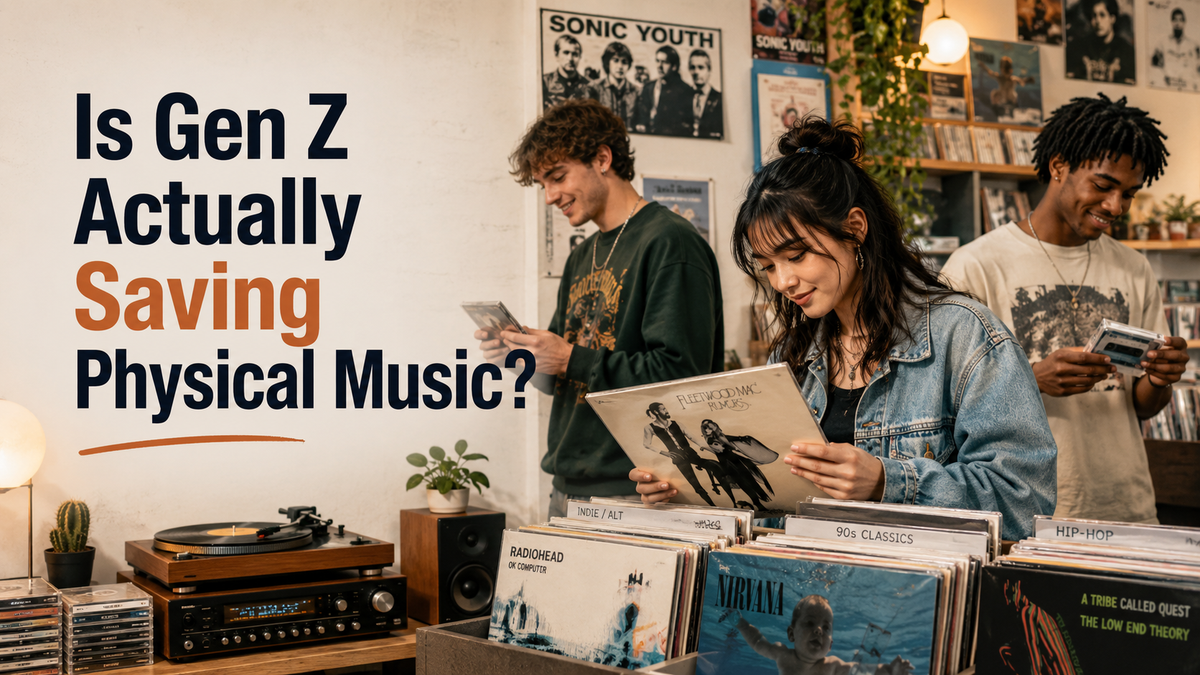
For many younger buyers, physical music is not always about building an audiophile system or chasing the best sounding copy of an album. Sometimes it is about the object. The cover art. The color variant. The lyric booklet. The ritual of opening it. The feeling that an album they love has crossed over from being something they stream into something they own.
That distinction matters.
Some older collectors look at this and say, “They are buying records but not even playing them.” And in some cases, that may be true. But I’m not sure that automatically makes the trend meaningless. A record sitting on a shelf still says something. It says this album mattered enough to exist outside the phone.
That may not be traditional record collecting, but it is still a form of music attachment.
Ownership Is Becoming Rebellious Again
Streaming made music incredibly convenient. It also made music feel temporary.
An album can be everywhere and nowhere at the same time. You can listen to almost anything, but you own almost nothing. Your library can change because of licensing, platform decisions, missing versions, altered artwork, removed bonus tracks, or simple algorithmic drift. The music is accessible, but it is not always yours in any meaningful way.
For a generation that grew up inside the streaming era, physical media offers something different. It is slower. It takes up space. It costs real money. It requires a decision.
That may be part of the appeal.
Buying a record or a CD is not just a transaction. It is a declaration that this music means something beyond background entertainment. It is also a quiet rejection of the idea that every part of culture should be rented, compressed, shuffled, skipped, and fed back through an algorithm.
That does not mean Gen Z is abandoning streaming. Of course they are not. Streaming is still the main way most people discover and consume music. But physical media gives certain albums a second life. It creates a line between music you like and music you want to keep.
That is a powerful distinction.
The Pop Star Effect Is Real
We also have to be honest about what is driving a lot of this.
Modern physical music sales are heavily influenced by major artists, fan culture, and collectible variants. Taylor Swift, Billie Eilish, Olivia Rodrigo, Sabrina Carpenter, Kendrick Lamar, Laufey, and other current artists have made vinyl and CDs feel relevant to younger fans in a way that classic rock reissues alone never could.
This is where some longtime collectors get uneasy.
When an album is released in ten different colors, with different covers, exclusive inserts, signed editions, retailer variants, and limited drops, it can start to feel less like music culture and more like merchandise culture. The record becomes part album, part collectible, part fandom badge.
That criticism is fair.
But it is also too easy to dismiss the whole movement because of it. Every generation has had its version of music as identity. Posters, shirts, picture discs, import singles, bootlegs, box sets, fan club releases, deluxe editions. None of this is entirely new. What is new is the speed and scale of it.
The question is whether these purchases lead younger listeners deeper into music, or whether they stop at the collectible object.
I think both things are happening.
Some people will buy the record because it looks good on a shelf or because it completes a fan collection. Others will buy it, play it, fall in love with the format, visit a record store, discover an older album, start asking questions about pressings, and maybe eventually care about sound quality too.
That second path is where the future gets interesting.
Record Stores Need New Blood
The independent record store cannot survive on aging collectors forever.
That may sound harsh, but it is true. Every hobby needs new people entering the room. If record stores only catered to the same group of collectors looking for Blue Note originals, classic rock reissues, and audiophile pressings, the audience would eventually shrink.
Younger buyers change the energy of a record store.
They bring different artists into the bins. They make space for current pop, indie, hip-hop, alternative, soundtracks, K-pop, and modern R&B. They buy new releases the week they come out. They make physical music feel connected to the present instead of only the past.
That is important.
A healthy record store should not feel like a museum. It should feel alive. It should have a copy of Fleetwood Mac’s Rumours in one section and the newest Billie Eilish record in another. It should serve the person looking for an original jazz pressing and the teenager buying their first CD. It should make room for the collector, the casual fan, the audiophile, and the curious newcomer.
Gen Z may not be saving physical music by preserving it exactly as older collectors remember it. They may be saving it by changing who it is for.
But Will They Stay?
This is the big question.
Is this a long-term shift, or is physical music just another aesthetic trend?
Some of it will fade. That is inevitable. Not every young person buying vinyl today is going to become a lifelong record collector. Some will buy a few favorite albums and stop. Some will lose interest. Some will decide the format is too expensive, too inconvenient, or too space-consuming.
But that has always been true.
Not everyone who bought CDs in the 90s became a serious music collector either. Not everyone who bought records in the 70s cared about mastering, pressing plants, or stylus profiles. Most people simply bought music they loved.
That is enough.
A format does not need every buyer to become an expert in order to survive. It needs enough people to care. It needs enough people to see value in the object. It needs enough people to believe that music can be more than a file, more than a playlist, and more than something that disappears into the endless scroll.
On that front, Gen Z may be doing more than we give them credit for.
Maybe They Are Saving the Feeling
So, is Gen Z saving physical music?
Not completely. Streaming still dominates. Prices are high. Pressing quality can be inconsistent. Collectible variants can feel excessive. And buying a record does not automatically mean someone is engaging deeply with the music.
But maybe that is the wrong standard.
Maybe Gen Z is not saving physical music as older collectors define it. Maybe they are saving the feeling that physical music represents.
The feeling of holding an album in your hands.
The feeling of choosing what to play instead of letting an algorithm decide.
The feeling of walking into a record store and discovering something you did not know you needed.
The feeling that music deserves space in your life, not just storage in your phone.
That matters.
As someone who loves records not only for how they sound, but for the way they force me to slow down and connect with music, I find this encouraging. The next generation may not enter the hobby the same way we did. They may not care about the same things at first. They may buy different artists, different formats, and for different reasons.
But they are buying music.
They are owning music.
They are putting albums back into bedrooms, dorm rooms, apartments, shelves, crates, and record bags.
That may not save physical music in the nostalgic sense.
It may do something better.
It may keep it alive.

Comments ()