
Do Hi-Fi Shows Still Matter If Most of Us Experience Them Online?
Do hi-fi shows still matter when most of us experience them online? HIGH END Vienna raises a bigger question about audio culture, show coverage, and why the conversation around better sound still matters.
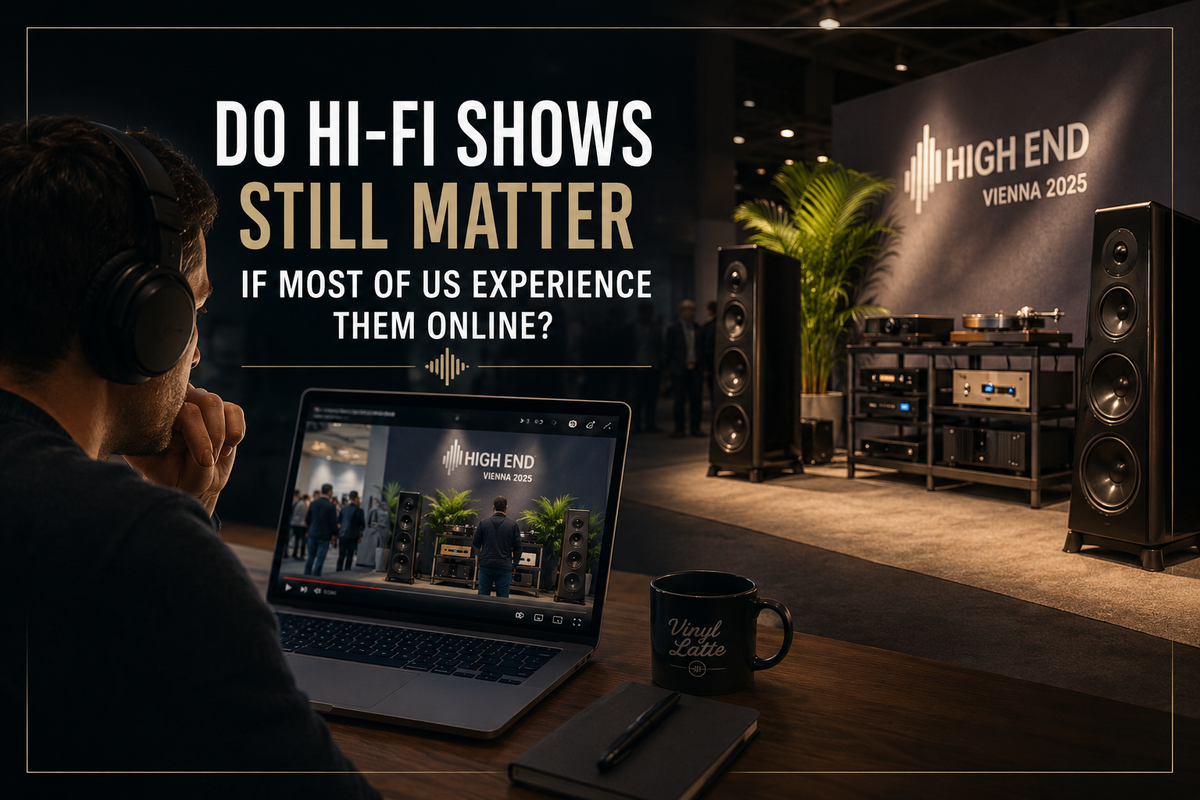
HIGH END Vienna is happening right now, and I am not there.
That may sound like a strange way to begin a piece about one of the most important audio shows in the world, but in many ways, that is exactly the point.
For European audiophiles, Vienna may be within reach. For many of us watching from the United States, it is not.
We are not sitting in the rooms. We are not walking the halls. We are not hearing the million dollar systems, the new loudspeakers, the statement turntables, the amplifiers glowing under carefully placed lighting, or the carefully selected tracks that manufacturers hope will leave a lasting impression.
And yet, we are still experiencing the show.
The Show Now Begins on a Screen
We are seeing it through YouTube walkthroughs, Instagram stories, manufacturer announcements, press photos, forum reactions, and the endless stream of first impressions that now define the modern hi-fi show experience.
Before most of us ever hear a product, we have already formed an opinion about it.
We have seen the room. We have judged the system. We have reacted to the price. We have wondered who it is for. In some cases, we may have already decided whether it is brilliant, ridiculous, beautiful, unnecessary, or all of the above.
That raises a fair question.
Do hi-fi shows still matter if most of us are experiencing them online?
I think they do.
But perhaps not for the reasons they once did.
What Hi-Fi Shows Used to Be
For decades, audio shows were the place where the industry gathered to hear what was next.
Manufacturers needed them. Dealers needed them. Reviewers needed them. Enthusiasts needed them.
They were part product launch, part listening session, part networking event, and part pilgrimage. If you wanted to hear the best systems, meet the people behind the brands, and get a sense of where the hobby was heading, you went to the show.
That still matters.
There is something meaningful about seeing this hobby exist in physical space. Rooms full of turntables, loudspeakers, amplifiers, cables, streamers, cartridges, headphones, racks, and obsessive attention to detail remind us that hi-fi is not just a set of products.
It is a culture. It is a community. It is a shared belief that music is worth caring about deeply.
But the way we consume these shows has changed.
The Modern Audio Show Is Also a Media Event
For many people, the show now begins on a screen.
A product appears in a video thumbnail before anyone has read the technical details. A room gets praised or dismissed based on a short clip recorded on a phone. A speaker design goes viral because it looks outrageous. A new amplifier becomes a talking point before anyone outside the room has actually heard it.
The show floor has become content.
And the content often travels farther than the sound ever could.
That is not necessarily a bad thing.
Online coverage allows more people to participate. Not everyone can travel to Vienna, Munich, Axpona, Capital Audiofest, or Pacific Audio Fest. Not everyone has the time, budget, or ability to attend these events in person.
For those people, online coverage is not a lesser version of the show.
It is the only version of the show they get.
And there is real value in that.
A well-made video can show scale. A good photo can capture design. A thoughtful article can explain context. A reviewer or creator can help make sense of what matters and what is simply noise.
Even a quick room walkthrough can give people a feeling for the energy of the event.
But You Cannot Hear a Hi-Fi Show Through a Phone
There is also a danger.
Hi-fi is ultimately about listening, and listening does not translate cleanly through a screen.
A phone microphone cannot tell you what a system really sounds like. A show report cannot fully capture the way a room feels when the music locks in. Even the best coverage is still filtered through someone else’s ears, someone else’s camera, someone else’s priorities, and sometimes someone else’s relationship with a brand.
That is where we need to be careful.
A hi-fi show can create excitement, but it can also create distortion.
Not audio distortion.
Perception distortion.
The biggest rooms get the most attention. The most expensive systems become the easiest to talk about. The strangest products become the easiest to share. The most visually dramatic setups often win the online conversation before anyone has asked whether they are musically convincing.
And then there is the problem of show sound itself.
Anyone who has spent time around high-end audio knows that setup matters. The room matters. Placement matters. Power matters. Time matters. Matching matters.
A system can sound underwhelming at a show and exceptional at home.
Another system can impress in a short demo but become exhausting over time.
Some rooms are carefully tuned. Others are fighting bad acoustics, rushed setup, limited space, and the impossible challenge of making unfamiliar equipment sound its best in a temporary environment.
So maybe we should stop treating hi-fi shows as final judgment.
A show is not the last word on a product. It is the first conversation.
What Shows Still Tell Us
That may be the best way to understand what events like HIGH END Vienna mean today.
They are not only about hearing the best sound.
They are about seeing where the industry wants to go.
Shows reveal what manufacturers are prioritizing. They show us what design language is changing. They show us which categories are growing, which technologies are being pushed, and which ideas are being recycled with better finishes and higher price tags.
They also remind us how strange and wonderful this hobby can be.
Where else can you find people debating cartridge alignment, room acoustics, streaming architecture, horn loading, isolation feet, reel-to-reel tape, record cleaning, power delivery, and six figure loudspeakers in the same building?
Where else can a product be both technically fascinating and emotionally absurd?
Where else can grown adults stand in silence while a track they have heard a hundred times suddenly makes them rethink what recorded music can do?
That part still matters.
The Best Shows Are About Possibility
The best hi-fi shows are not just about gear.
They are about possibility.
They make people think about their own systems differently. They inspire people to chase better sound, even if they will never own the statement products on display.
Sometimes that inspiration comes from a massive cost-no-object system.
Sometimes it comes from a modest room that simply gets the music right.
Sometimes it comes from a conversation with a designer who reminds you that behind every component is a person trying to solve a problem.
That is why I still care about these shows, even when I am not there.
I may not be in Vienna this weekend, but I will still be paying attention.
Not because every product announcement deserves excitement.
Not because every room report should be treated as gospel.
Not because the most expensive systems automatically represent the future of audio.
I will be paying attention because shows like this still tell us something about the state of the hobby.
They show us what the industry believes audiophiles want. They show us where manufacturers are placing their bets. They show us how much of high-end audio is still driven by passion, craftsmanship, spectacle, engineering, nostalgia, and sometimes pure excess.
So, Do Hi-Fi Shows Still Matter?
Yes.
But they matter differently now.
They are no longer limited to the people in the room. The room is only the beginning.
The real show continues online, where the rest of us watch, react, question, debate, and decide what actually deserves our attention.
That does not replace listening.
It never could.
But it does keep the conversation alive.
And for a hobby built around the emotional power of recorded music, that conversation still matters.
Learn more about the event at HIGH END Vienna
Comments ()