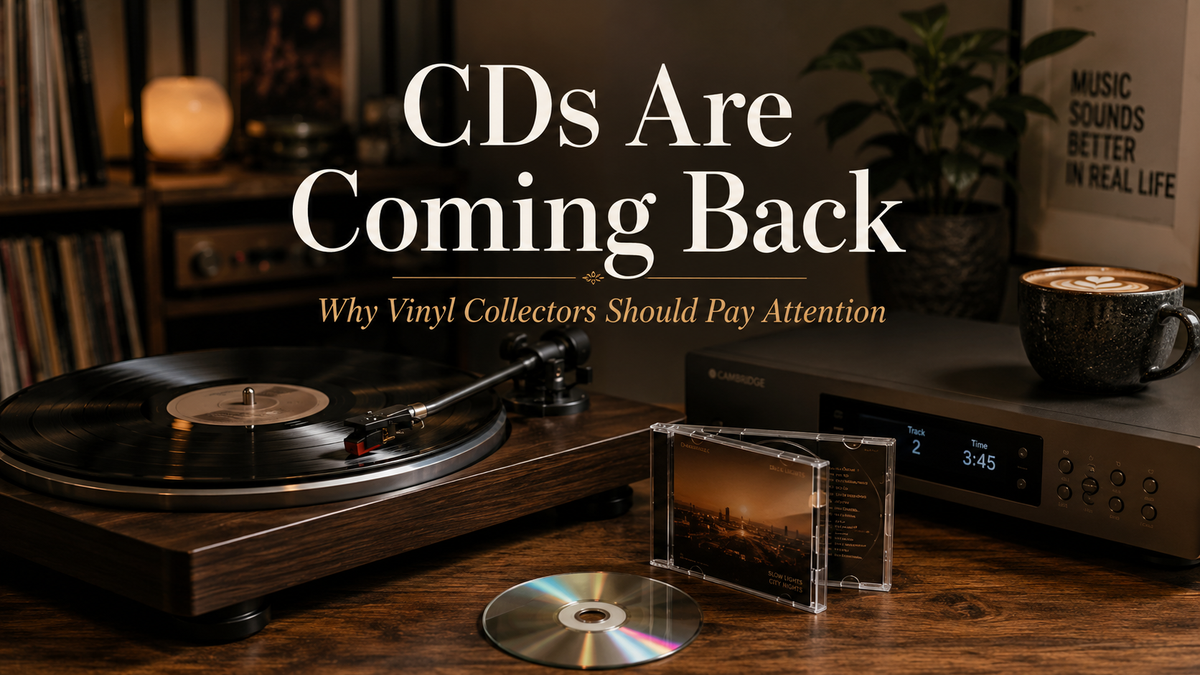
CDs Are Coming Back, and Vinyl Collectors Should Be Paying Attention
CDs are quietly reentering the conversation, but their comeback is not a threat to vinyl. It is another sign that listeners are craving ownership, ritual, and a more intentional relationship with music in a streaming-first world.
For years, vinyl has been the symbol of the physical music revival. It had the ritual, the artwork, the collectability, the sound, and the cultural momentum. It became the format people talked about when they wanted to explain why music still matters as an object and not just a file floating around in the cloud.
But something interesting is happening now.
CDs are starting to re-enter the conversation.
Not in the same way vinyl did. There is no widespread romance around jewel cases. Nobody is arguing that a scratched plastic case has the same emotional pull as a gatefold jacket, a heavy record, or the act of lowering a stylus into a groove. But the renewed interest in CDs says something important about where music culture is going.
The CD comeback is not a threat to vinyl.
It proves the same point.
Listeners are tired of music feeling disposable.
Streaming Won, But Something Was Lost
Let’s be honest. Streaming is incredible.
For a small monthly fee, we have access to more music than any generation in history. We can discover an artist in seconds, build a playlist in minutes, and jump from Miles Davis to Radiohead to Billie Eilish to Chet Baker without leaving the couch.
There is no serious argument that streaming has not changed music for the better in some ways. Discovery is easier. Access is broader. The barrier to entry is lower.
But convenience came with a cost.
Music became easier to hear, but easier to ignore.
Albums became background noise. Songs became content. Discovery became an algorithmic feed. And the more music we had available, the less any single album seemed to demand our full attention.
That is where physical media still matters.
It interrupts the scroll.
Whether it is a record, a CD, a cassette, or even a well-made box set, physical music asks something different from the listener. It asks you to choose. It asks you to handle something. It asks you to make a small commitment before the first note plays.
That tiny bit of friction may be exactly what people are missing.
Vinyl Made the Case First
Vinyl did not come back because it was convenient.
It came back because it was not convenient.
That is the part people outside the hobby still struggle to understand. Vinyl is not the fastest way to listen to music. It is not the cheapest. It is not the most portable. It requires space, setup, maintenance, cleaning, and care.
And yet, that is part of the appeal.
When you pull a record from the shelf, remove it from the jacket, clean it, place it on the platter, and lower the stylus, you are doing more than starting playback. You are creating a moment.
That moment changes the way you listen.
Vinyl collectors understand this instinctively. We are not simply buying sound. We are buying a relationship with the album. The cover art matters. The mastering matters. The pressing matters. The liner notes matter. The whole object matters.
That is why vinyl has remained the emotional center of the physical media conversation.
But CDs are now reminding us that vinyl is not the only way people can reconnect with music physically.
The CD Was Never Really the Enemy
For a long time, vinyl people treated CDs like the villain.
The CD was the format that pushed records out of the mainstream. It was marketed as cleaner, smaller, more durable, and more modern. It represented the early promise of digital perfection. No pops. No surface noise. No flipping sides. No cartridge alignment. No dust brush. No inner groove distortion.
To many vinyl lovers, the CD became shorthand for everything music lost when it moved away from analog.
But that view feels too simple now.
The CD is also a physical format. It is an album you own. It has sequencing. It has artwork. It has credits. It has a beginning, middle, and end. You can hold it, file it, lend it, collect it, and play it without being dependent on a streaming license.
That matters.
A CD may not offer the same ritual as vinyl, but it still offers something streaming does not. It gives the album back its shape.
You do not need to believe CDs are better than records to understand why they are becoming interesting again. You only need to recognize that people are looking for ways to make listening feel less passive.
The New CD Interest Is Different This Time
The original CD boom was about progress. The CD was sold as the future. Smaller. Cleaner. Digital. Modern.
The new CD interest feels different.
It is not about replacing vinyl. It is not even really about replacing streaming. It is about adding another layer to the listening experience.
For some listeners, CDs are affordable. In a world where new vinyl can easily hit $30, $40, $50, or more, used CDs can feel like a bargain. For younger collectors, that matters. Not everyone can build a vinyl collection at today’s prices.
For others, CDs are practical. They are easier to store, easier to play, and less demanding than records. You can still own the music without needing a turntable, cartridge, phono stage, record cleaning routine, and a dedicated shelf that slowly takes over your home.
And for some audiophiles, CDs never stopped making sense. A well-mastered CD played through a good DAC can sound excellent. Not “excellent for digital.” Excellent, period.
That may be the part vinyl collectors need to hear.
The format is not the whole story. The mastering, playback chain, and listener engagement all matter. A bad record pressing is not magically better than a great CD. A great CD is not automatically less musical because it is digital.
Physical media should not be a format war.
It should be a reminder to care.
Modern Hi-Fi Is Starting to Notice
One of the more interesting signs of this shift is the return of CD playback in modern lifestyle hi-fi products.
For years, many new systems seemed to assume physical media was either vinyl or nothing. If a product had physical playback, it usually meant a turntable input. CD players, meanwhile, were often treated like legacy components for people who had not moved on.
That is changing.
When a modern streaming amplifier includes a CD player, it says something about the market. It suggests manufacturers are starting to recognize that listeners do not live in one format anymore.
Many of us stream. Many of us play records. Some of us still own CDs. Some of us are buying CDs again. Some of us want one system that allows all of that without making the living room look like a laboratory.
That does not mean every product with a CD slot deserves applause. But it does show that physical media is not just a retro trend sitting in a corner of the hobby. It is being folded into the modern listening experience.
That is important.
The future of hi-fi may not be analog versus digital.
It may be convenience when you want it, ownership when you need it, and ritual when the music deserves it.
Vinyl Collectors Should Not Dismiss This
It would be easy for vinyl collectors to look at the CD comeback and shrug.
After all, vinyl has the larger cultural identity. Vinyl has the record stores. Vinyl has the premium reissue market. Vinyl has the visual presence. Vinyl has the romance.
But dismissing CDs misses the bigger picture.
The renewed interest in CDs is part of the same movement that helped bring vinyl back. It is another sign that listeners are questioning what they gave up when everything became available everywhere all the time.
People want to own things again.
They want to look at the album art. They want to read the credits. They want to know which version they have. They want to build collections that say something about their taste. They want music to take up space in their lives again.
That is good for vinyl.
It means the physical media revival is not only about one format. It is about a broader cultural correction.
For years, the industry trained listeners to think access was everything. Now some listeners are realizing access is not the same as connection.
The Best Format Is the One That Makes You Listen
I still love vinyl most.
There is nothing quite like pulling a great record from the shelf and letting the system disappear into the room. At its best, vinyl has a way of slowing me down. It keeps me with the album. It makes me less likely to skip around. It turns listening into an event instead of a reflex.
But I do not think vinyl needs to win by making everything else lose.
CDs have a place. Streaming has a place. High-resolution digital has a place. Even cassettes, for the right person and the right memory, have a place.
The real enemy is not another format.
The real enemy is disposable listening.
It is the habit of treating music like wallpaper. It is the endless playlist running in the background while we do five other things. It is the algorithm deciding what comes next before we have even processed what we just heard.
Physical media pushes back against that.
Vinyl does it beautifully. CDs can do it too.
Final Thoughts
The return of the CD does not make vinyl less special. If anything, it makes vinyl’s original argument stronger.
People are not only chasing nostalgia. They are chasing presence.
They want music they can touch. Music they can own. Music that feels chosen instead of served. Music that invites them to sit down, pay attention, and experience an album as something more than a thumbnail on a screen.
Vinyl collectors should welcome that.
Because if CDs are coming back, it does not mean the vinyl revival is weakening.
It means the desire for physical music is bigger than vinyl alone.
And for anyone who cares about albums, listening rooms, record stores, hi-fi systems, and the simple joy of choosing what to play next, that is a very good thing.

Comments ()