
Audiophile Doesn't Have to Mean Expensive. So Why Does It Feel Like It Does?
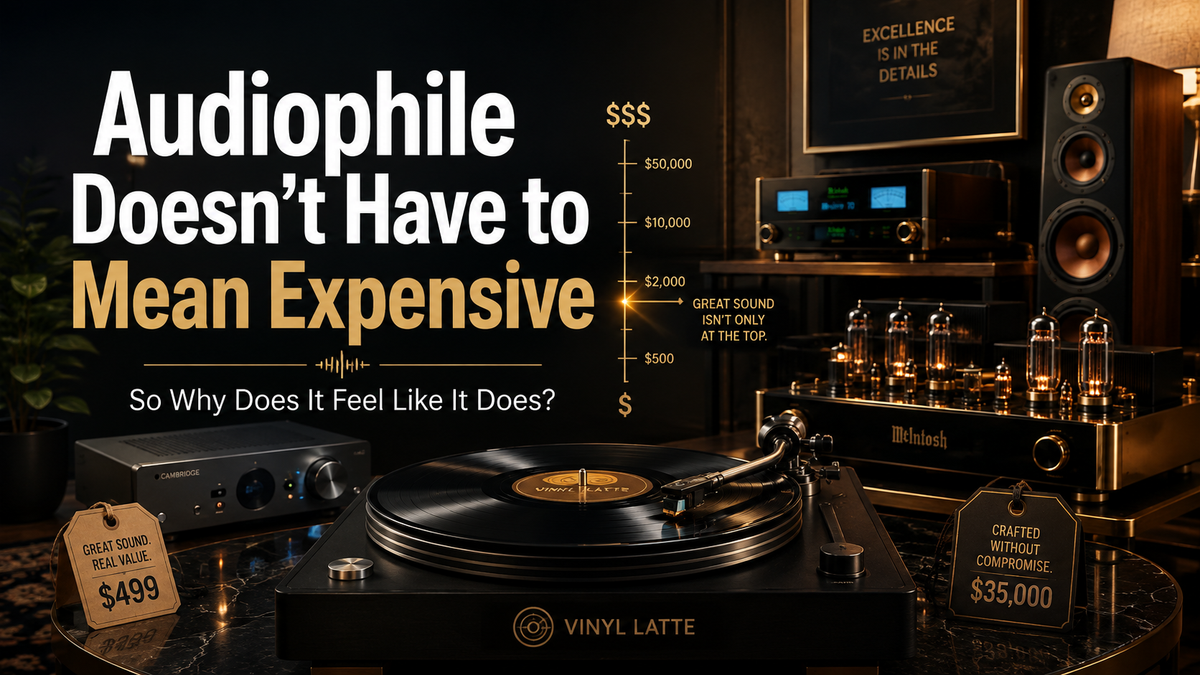
Audiophile doesn’t have to mean expensive. Great sound can come from thoughtful setup, smart choices, and well engineered gear at many price points. So why has the hobby become so closely tied to luxury?
Spend enough time around high end audio, and something strange begins to happen.
The word audiophile starts sounding less like a description of someone who cares deeply about sound and more like a price category.
Audiophile turntable.
Audiophile amplifier.
Audiophile cable.
Audiophile pressing.
And increasingly, the assumption seems to be that if something is truly audiophile, it should probably be expensive.
I am not convinced that is healthy for the hobby.
There are legitimate reasons why great audio equipment can cost a lot of money. Engineering, manufacturing, materials, small production runs, research, and support all have costs. I am also not going to pretend that a $300 amplifier and a $30,000 amplifier are interchangeable simply because both play music.
But somewhere along the way, many of us began confusing expensive with audiophile.
Those are not the same thing.
Audiophile Should Describe an Approach
At its simplest, being an audiophile means caring about reproducing recorded music as faithfully, convincingly, and enjoyably as possible.
There is no dollar amount in that definition.
Someone carefully setting up a modest pair of speakers, experimenting with placement, treating first reflection points, matching a cartridge correctly to a phono preamp, or searching for the best mastering of an album is engaging with music in an audiophile way.
Someone spending $50,000 on equipment and never bothering to position the speakers properly may actually be doing less to improve reproduction.
That does not make expensive systems pointless.
It means price alone tells us remarkably little about how thoughtfully a system has been assembled.
The same applies to records.
A $30 Record Can Be Audiophile
Yesterday, I wrote about the encouraging shift toward audiophile releases of music from the 1980s, 1990s, and 2000s.
I still think that is one of the most exciting developments happening in vinyl.
But there is another part of the story worth discussing.
Some premium vinyl releases now routinely cost more than $100. Meanwhile, excellent records mastered by people such as Kevin Gray can still be purchased for around $30.
Both can legitimately be called audiophile records.
That should tell us something.
The quality of a record is determined by far more than its price.
What source was used?
Who mastered it?
How was it cut?
Where was it pressed?
Was the mastering appropriate for the music?
How good was the original recording?
Was quality control consistent?
A $125 One Step may sound extraordinary.
It may also only sound marginally better than a $30 edition.
In some cases, a less expensive pressing may actually be preferable.
The price cannot answer that question.
Only listening can.
We Have Become Very Good at Selling Luxury
Part of the problem is that high end audio and premium vinyl have become exceptionally good at selling luxury.
Luxury is easier to market than subtle differences in sound.
Heavy boxes photograph well.
Machined aluminum feels expensive.
Numbered editions create urgency.
Limited quantities create scarcity.
Thick vinyl feels substantial.
Elaborate packaging gives us something tangible to justify the purchase.
None of those things are inherently bad.
I enjoy beautiful equipment and well produced records as much as anyone.
But packaging and presentation can quietly become substitutes for performance.
A record does not sound better because the box takes up twice as much shelf space.
An amplifier does not become more musical because its chassis weighs 80 pounds.
A cable does not automatically perform better because it arrives in a velvet lined case.
Yet the visual language surrounding audiophile products frequently encourages exactly those associations.
We begin evaluating the object before we ever hear it.
Expensive Equipment Can Still Be Worth It
There is also a danger in pushing this argument too far.
The answer is not that expensive audio is a scam.
Sometimes expensive equipment really is significantly better.
Better power supplies cost money.
Better components cost money.
Precision machining costs money.
Engineering teams cost money.
Low volume manufacturing costs money.
Excellent dealers and long term support cost money.
At a certain level, manufacturers may be chasing extremely small improvements that require disproportionately large investments.
That is the nature of diminishing returns.
The first thousand dollars spent on a system may transform the listening experience.
The next thousand may produce another substantial improvement.
Eventually, spending another $10,000 might only improve something by a few percent.
But to the person chasing that last few percent, the improvement may be worth every dollar.
There is nothing wrong with that.
The problem begins when we imply that everyone else needs to spend the same money to participate.
The Hobby Needs Better Entry Points
This matters because high end audio already has an accessibility problem.
Walk into certain audio shows, look at certain systems online, or browse premium vinyl releases, and it would be easy for someone new to the hobby to conclude that good sound requires extraordinary amounts of disposable income.
That is simply not true.
Some of the most meaningful improvements in audio cost nothing.
Speaker placement costs nothing.
Moving the listening chair costs nothing.
Learning how your room affects bass costs nothing.
Proper cartridge alignment costs very little compared with replacing the cartridge.
Comparing masterings before automatically buying the most expensive pressing can actually save money.
Buying used equipment can dramatically increase what a given budget can accomplish.
And today there is genuinely excellent affordable equipment available across nearly every category.
The industry should celebrate that more often.
A person buying a $500 amplifier today might become the person buying a $5,000 amplifier ten years from now.
More importantly, that person may simply discover a deeper relationship with music.
That should be enough.
Vinyl Has the Same Problem
Record collecting is experiencing its own version of audiophile inflation.
We now have standard editions, deluxe editions, anniversary editions, numbered editions, box sets, 45 RPM editions, One Steps, UHQRs, SuperVinyl, Clarity Vinyl, and countless variations intended to occupy increasingly premium positions.
Again, many of these records are excellent.
I buy them too.
But collectors should resist the idea that the most expensive version is automatically the version they need.
Sometimes an original pressing is better.
Sometimes a well mastered $35 reissue gets remarkably close.
Sometimes the difference between two editions is meaningful.
Sometimes it is tiny.
And sometimes we are paying primarily for scarcity, packaging, or the satisfaction of owning the supposedly definitive version.
There is nothing wrong with collecting any of those things.
We should just be honest about what we are buying.
Audiophile Is Not a Price Tier
Perhaps we need to reclaim the word.
Audiophile should not mean luxury.
It should not mean expensive.
It should not mean exclusive.
It should mean someone or something focused seriously on better sound.
A carefully designed $200 component can be audiophile.
A properly mastered $30 record can be audiophile.
A vintage amplifier can be audiophile.
A modest system installed thoughtfully in a good room can absolutely be audiophile.
And yes, a $100,000 system can be audiophile too.
The price is not what connects those things.
The pursuit is.
The Question We Should Be Asking
When a new product or record arrives, maybe the first question should not be:
How much does it cost?
Or even:
Is it audiophile?
The better question is:
Does it make the music better?
Does it reveal more of the recording?
Does it make instruments feel more believable?
Does it communicate dynamics more naturally?
Does it make you want to keep listening?
Does it move you closer to the performance?
If the answer is yes, then it has accomplished something worthwhile, regardless of whether it cost $129 or $12,900.
And if the answer is no, a bigger price tag is not going to make it more audiophile.
High end audio will always have aspirational products.
It should.
Pushing boundaries is part of what moves technology forward.
But the hobby becomes much healthier when aspiration is something enthusiasts can grow toward rather than a financial barrier they must cross before being taken seriously.
Audiophile does not have to mean expensive.
Maybe we just need to start using the word that way again.


Comments ()