
Are All-in-One Hi-Fi Systems Finally Becoming Serious?
Modern all-in-one hi-fi systems are no longer just about convenience. As streaming amps, phono stages, HDMI, and serious amplification come together, the future of hi-fi may require fewer boxes.
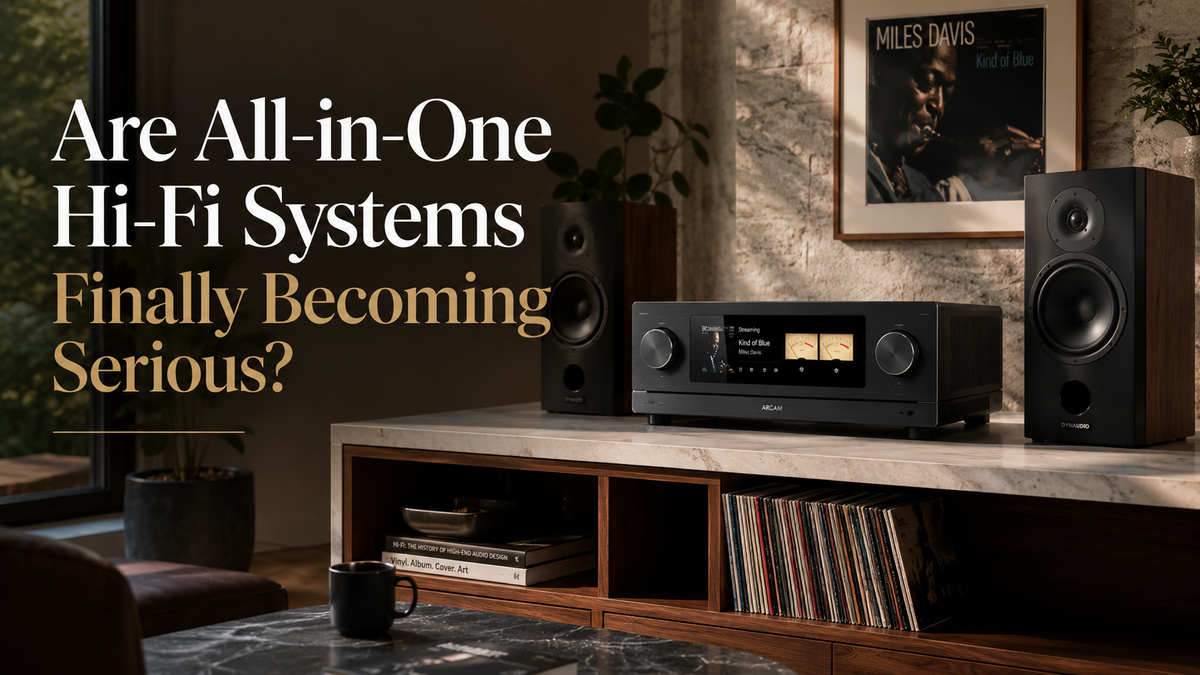
For a long time, the phrase “all-in-one hi-fi system” felt like a polite way of saying compromise.
It usually meant convenience over performance. Fewer boxes, fewer cables, fewer decisions, and often, fewer expectations. Serious audiophiles built systems the traditional way. A separate amplifier. A separate streamer. A separate DAC. Maybe a separate phono stage. A separate power supply if you really wanted to go down the rabbit hole. The more boxes you had, the more serious the system appeared.
But something has changed.
The modern all-in-one system is no longer just a lifestyle product hiding behind nice furniture-grade design. It is becoming a real category for people who care about sound but do not necessarily want their living room to look like a hi-fi dealership. And honestly, that may be one of the healthiest things happening in audio right now.
The Old Bias Against Simple Systems
Audiophiles are not always kind to simplicity.
Part of that is understandable. Separate components give you flexibility. They allow you to upgrade one piece at a time. They let you mix and match brands, sonic flavors, design philosophies, and price points. If you want a tube phono stage, a solid-state integrated amplifier, a standalone DAC, and a dedicated streamer, you can build exactly that.
That freedom is part of the hobby.
But it can also become a barrier.
For someone just getting into hi-fi, a traditional separates system can be intimidating. You need to understand impedance, gain, cartridge loading, speaker sensitivity, DAC architecture, streaming platforms, cables, grounding, room setup, and about seventeen other things before you even play a record. For the seasoned hobbyist, that complexity can be fun. For a normal music lover, it can feel like homework.
That is where the new generation of all-in-one systems starts to make sense.
Not because they replace the most ambitious separates systems. They do not. But because they remove enough friction to let more people actually enjoy music through a better stereo.
And that matters.
The New All-in-One Is Not the Old All-in-One
The reason this conversation feels different now is because the products themselves are different.
Look at something like the Cambridge Audio Evo 300. This is not a little convenience box pretending to be hi-fi. It is a serious streaming amplifier with 300 watts per channel, a proper DAC section, HDMI eARC, balanced inputs, a moving magnet phono stage, subwoofer output, Roon support, and a large display that can show album art or VU meters.
That is not a toy. That is a complete modern stereo hub.
Ruark has also been leaning into this idea with products that blend old-school music console charm with current-day functionality. Streaming, CD playback, HDMI, phono input, and proper speaker pairing all wrapped in something that looks like it belongs in a home rather than a rack full of lab equipment.
These products are not aimed at the person who wants to spend six months comparing digital transports. They are aimed at people who want a great-sounding system that works with the way they actually live.
Records. Streaming. TV sound. Maybe CDs. Maybe a subwoofer. Maybe a nice pair of bookshelf speakers. One system. One remote. One app. One place to start.
That sounds simple, but simple is not the same as unserious.
The Living Room Problem
One reason all-in-one systems are gaining ground is because the traditional hi-fi system has a living room problem.
Most people do not have a dedicated listening room. They do not have space for a wide equipment rack, multiple full-size components, thick cables, external power supplies, and large speakers pulled several feet into the room. Even if they could make space for it, they may not want to.
The hard truth is that many audiophile systems are built for audiophiles, not households.
A great stereo has to live somewhere. It has to share space with furniture, family, pets, partners, televisions, bookshelves, and real life. The more difficult a system is to integrate into a normal room, the smaller its potential audience becomes.
All-in-one systems solve some of that problem.
They do not solve room acoustics. They do not magically make speaker placement irrelevant. They do not remove the need for quality amplification or good source design. But they reduce the visual and practical burden of getting into better sound.
That could be huge for people who are vinyl-curious, streaming-first, or simply tired of soundbars.
The Soundbar Alternative
This is another part of the conversation that deserves more attention.
For many households, the default audio upgrade has become the soundbar. It is easy to understand why. Soundbars are simple, compact, and designed around TV use. They solve an obvious problem: modern televisions sound thin.
But soundbars are rarely the best answer for music.
A good all-in-one streaming amplifier with HDMI eARC and a proper pair of speakers can serve as both a music system and a TV sound upgrade. That is a much more interesting proposition. You get real stereo separation. You get better imaging. You get speakers that can be positioned properly. You get a system that does not treat music as an afterthought.
This is where modern integrated streaming systems become very compelling.
They meet people where they are. The TV is already in the room. The turntable might be nearby. Streaming is a daily habit. The system has to handle all of it without making the user feel like they need an engineering degree.
For a lot of people, that is not compromise. That is exactly the point.
Where Separates Still Win
Of course, none of this means separates are dead.
They are not.
A carefully assembled separates system still gives you more control. You can choose a better phono stage. You can upgrade your DAC. You can change amplification. You can experiment with tubes, class A, class AB, class D, external clocks, power supplies, and whatever other path your audio personality leads you down.
For the obsessive listener, that flexibility is part of the fun.
There is also a serviceability and longevity argument. If your streamer becomes outdated, you can replace only the streamer. If your DAC tastes change, you can swap the DAC. If your amplifier remains excellent for twenty years, you can keep it while everything around it evolves.
With an all-in-one, more of the system is tied together. That can be elegant, but it can also be limiting. If the app support fades, the streaming platform changes, or one internal section no longer meets your needs, you may be replacing more than you would in a separates-based system.
That is a fair concern.
But it is also fair to ask how many people actually want to upgrade piece by piece forever.
Some do. Many do not.
The Real Question: Who Is This For?
The mistake is thinking every product category has to serve the same customer.
An all-in-one system is not necessarily for the audiophile who already owns multiple tonearms, a dedicated phono stage, room treatment, and a carefully tuned subwoofer setup. That person probably already knows what they want.
The more interesting audience is the music lover who wants better sound but does not want to become consumed by the hobby.
Someone who owns records but also streams constantly.
Someone who wants their TV to sound better without giving up on music quality.
Someone who wants fewer boxes but still wants real speakers.
Someone who appreciates design but does not want audio to become furniture clutter.
Someone who is willing to spend real money, but only if the system feels complete and usable.
That person exists. In fact, that person probably represents a much larger audience than the traditional audiophile world likes to admit.
Simplicity May Be the Gateway
This is where I think the audiophile community should pay attention.
If we want hi-fi to grow, we cannot make the entry point feel like a test. We cannot tell people they need six boxes, cable risers, a wall of records, and a glossary of acronyms before they are allowed to care about sound.
A good all-in-one system can be a gateway into better listening.
It can teach people what stereo imaging sounds like. It can show them why real speakers matter. It can make records feel more alive. It can make streaming feel less disposable. It can remind people that music deserves more than a Bluetooth speaker on a kitchen counter.
Some of those people may eventually move into separates. Others may not. Both outcomes are fine.
The goal should not be to turn every music lover into an equipment obsessive. The goal should be to help more people experience music in a way that feels meaningful.
The Audiophile Ego Problem
There is also a little bit of ego involved here.
Audiophiles often like the evidence of seriousness. The racks. The components. The cables. The rituals. The visual complexity can become part of the identity. A system that does more with less can feel like it is challenging that identity.
But performance should not be judged by box count.
A poorly matched separates system is not automatically better than a well-executed integrated one. A complex system is not automatically more musical than a simple one. More expensive does not always mean more enjoyable. More complicated does not always mean more serious.
The best system is the one that makes you want to listen.
That sounds obvious, but it is easy to forget.
So, Are They Finally Serious?
Yes, I think they are.
Not all of them, of course. There will always be lifestyle products that prioritize looks over sound. There will always be feature-packed systems that try to do too much and end up doing nothing especially well.
But the category itself has changed.
The best modern all-in-one systems are no longer just convenience products. They are serious attempts to combine sound quality, design, streaming, vinyl playback, TV integration, and everyday usability into one coherent package.
That is not a threat to traditional hi-fi.
It is an expansion of it.
There will always be a place for separates. There will always be listeners who want to build, tune, upgrade, and obsess. I am one of those people. But there should also be room for systems that make high-quality listening easier, cleaner, and more approachable.
Because if hi-fi is going to reach more people, it probably needs fewer barriers.
Maybe the future is not fewer audiophiles.
Maybe it is fewer boxes.



Comments ()