
Apple Just Built a Concert Venue Around Spatial Audio. That Could Matter More Than It Sounds.
Apple’s new 600-person London venue combines live music, multitrack recording, Spatial Audio, and video production under one roof. Could the future recording studio have an audience?
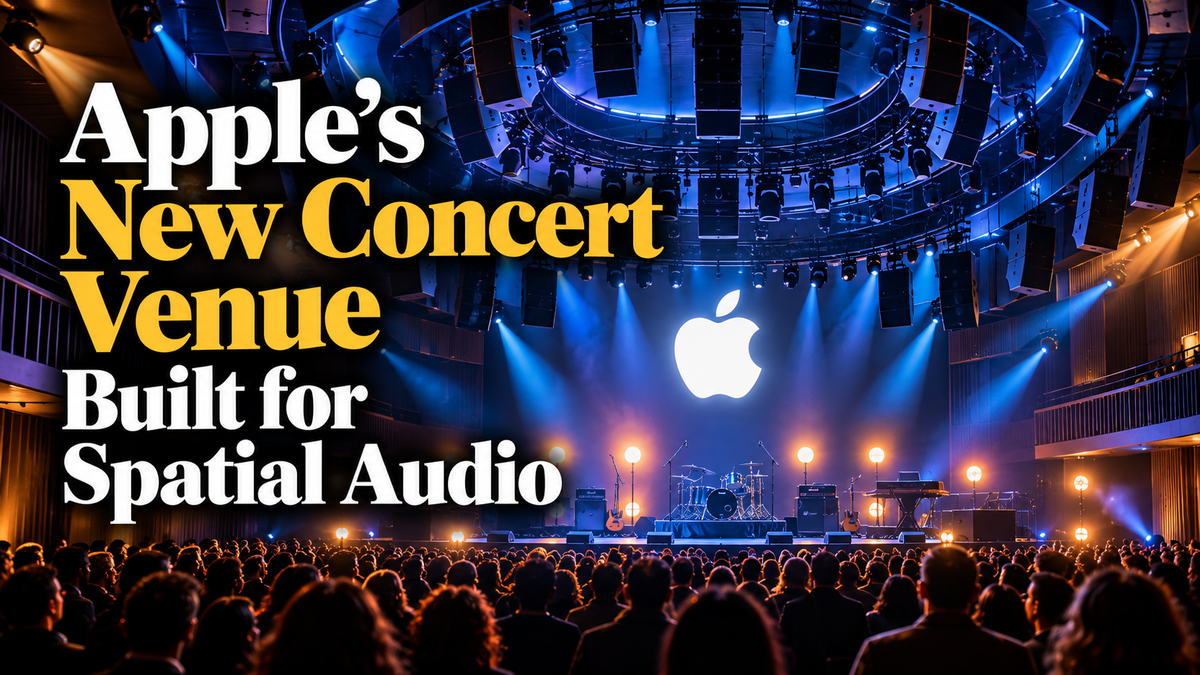
Apple has opened a new 600-capacity concert venue in London.
That alone isn't particularly interesting. London has plenty of great places to hear live music.
What's different about Apple Music Hall is what happens behind the stage.
The new venue at Battersea Power Station combines a concert hall with two professional recording and mixing studios, a 48-speaker Spatial Audio system, multitrack recording, and a dedicated video broadcast facility.
An artist can perform a concert and potentially leave with a multitrack live recording, a Spatial Audio mix, and a multicamera video production.
That raises a much more interesting question:
What happens when the concert venue and the recording studio become the same place?
Apple Music Hall Is Really a Recording Studio With an Audience
Apple Music Hall opens today, September 28, with room for approximately 600 people and a 38-foot-wide stage.
The venue's 48-speaker system surrounds the audience and allows performances to be designed specifically for immersive sound. Behind the stage are two recording and mixing studios capable of capturing the performances as multitrack recordings.
Apple has also installed infrastructure for at least 16 broadcast cameras, with iPhones able to supplement the traditional camera system. A dedicated control room handles the video production.
That's what makes this more interesting than simply putting a sophisticated sound system into a small venue.
The entire building has been designed around capturing the performance.
For an artist, that could mean playing one concert and producing the raw material for a live album, concert film, livestream, Spatial Audio release, or some combination of all four.
What If the Concert Becomes the Master?
Traditionally, the studio recording is the controlled version of the music.
The live recording documents what happened afterward.
Apple Music Hall blurs that distinction.
An artist could walk into the venue knowing from the beginning that a particular performance is being recorded for release. The room, audience, microphones, cameras, and immersive sound system could all become part of the production.
That's potentially more interesting than recording a normal tour stop and deciding later whether it was good enough for a live album.
The performance itself could be designed as the recording session.
We've certainly seen variations of this before. Some of the greatest live albums were deliberately recorded over specific nights, and studios have invited audiences into recording sessions.
What's different here is how much of that process has been integrated into the building from the beginning.
Spatial Audio Makes More Sense When Music Is Created for It
I'm particularly interested in what this could mean for Spatial Audio.
There is a fundamental difference between taking an existing stereo recording and asking how it can be expanded into an immersive mix, and creating a performance knowing from the beginning that the audience will be surrounded by 48 speakers.
The latter makes spatial placement part of the creative process.
Backing vocals could come from behind the audience. Electronic textures could move through the room. An acoustic performance could use the system much more subtly, attempting to reproduce the scale and ambience of the venue rather than creating obvious effects.
None of that guarantees better sound.
But it gives musicians and producers another tool.
And that's when new audio technology tends to become interesting.
Apple Is Trying to Fix Something Streaming Lost
Apple says it isn't trying to become a traditional concert promoter.
Apple Music executive Oliver Schusser told What Hi-Fi? that part of the goal is creating a deeper connection between artists and listeners than streaming alone provides.
I think that's the more important part of this story.
Streaming solved access to music spectacularly well.
It hasn't always been as successful at preserving the context around it.
Put on a record and you're confronted with artwork, credits, sequencing, mastering information, musicians, producers, and the physical object itself. Even deciding to turn the record over creates a deliberate break in the experience.
Streaming removes much of that friction.
That's incredibly convenient, but something can disappear with it.
Apple Music Hall appears to be one way Apple is trying to put some of that connection back.
Don't just stream the album.
Watch the artist perform it. Hear them discuss it. See the room where the performance happened. Listen to a different version of the song.
For a streaming company, that's a notable acknowledgment that simply having access to 100 million songs isn't necessarily enough to make people care deeply about them.
There's an Audiophile Question Here Too
I want to know what happens to these recordings after the audience goes home.
Apple says performances can be captured as multitrack recordings and mixed in Spatial Audio.
But there are plenty of questions left unanswered.
What converters are being used? What resolution are the multitracks recorded at? Are dedicated stereo mixes being created? How much of the acoustics heard by the audience make it into the finished recording?
And, naturally, I have another question:
Could one of these performances eventually become a record?
There's no technical reason it couldn't.
A properly captured high-resolution multitrack performance could be mixed to stereo, mastered, cut to lacquer, and pressed to vinyl.
Yes, the chain would be digital.
But that's not automatically a problem.
I recently wrote about Beck's $110 Ride Lonesome One-Step, which was cut from 24-bit/96kHz files transferred from analog masters. The more interesting question wasn't simply whether digital appeared somewhere in the chain. It was whether the transfer, mastering, cutting, and pressing produced a great record.
The same would apply here.
If Apple Music Hall produces an exceptional live recording, I'd love to hear what happens when someone takes that recording all the way to vinyl.
The Technology Isn't What Will Make This Work
Forty-eight speakers make a great headline.
They don't make a great performance.
Neither do expensive microphones, recording consoles, cameras, or Spatial Audio.
The success of Apple Music Hall will ultimately depend on whether artists do something interesting with the tools Apple has given them.
If bands simply perform the same concerts they would play anywhere else, Apple has built an exceptionally well-equipped small venue.
But imagine an artist treating a night at Apple Music Hall as something between a concert and a recording session.
A performance arranged specifically for the room.
An audience present while the definitive version is being captured.
A stereo mix for traditional listening.
An immersive mix designed from the same performance.
Perhaps even a physical release afterward.
That's much more interesting.
Maybe the Future Recording Studio Has an Audience
Great recording spaces have always become part of the music made inside them.
Abbey Road isn't simply a building. Rudy Van Gelder's studios weren't interchangeable rooms. Famous live albums are often inseparable from the venues where they were recorded.
Apple Music Hall approaches that relationship from another direction.
Apple has put the venue, recording studios, immersive playback system, video production, and global distribution platform under one roof.
The technology is impressive.
But the real test starts now.
I don't particularly care whether Apple Music Hall has 48 speakers.
I want to hear the first recording that couldn't have been made anywhere else.


Comments ()