
Another $125 Copy of Who’s Next? Audiophile Vinyl Needs a New Canon
Audiophile labels keep returning to the same classic albums, but decades of important music still lack a truly great vinyl edition. Using Analogue Productions’ new Who reissues as a starting point, this article asks whether the industry should keep perfecting the past or finally expand its canon.
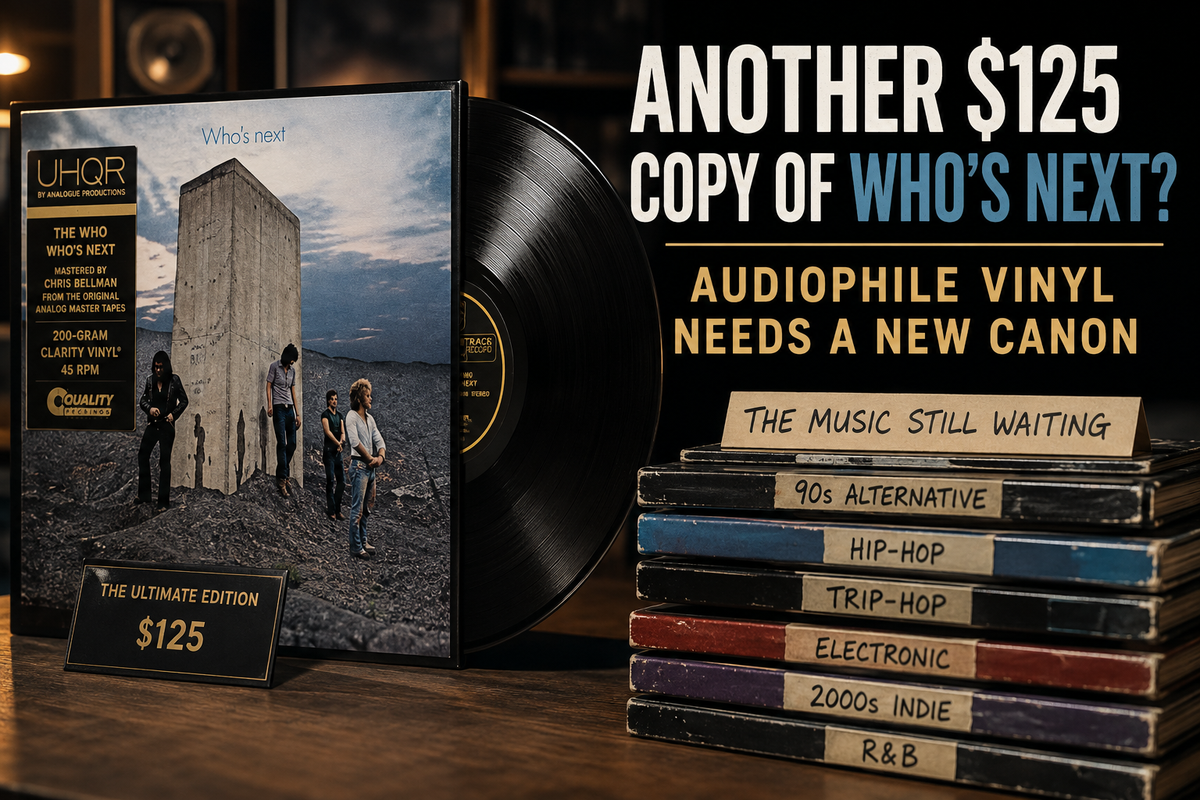
Analogue Productions recently announced a major series of audiophile reissues from The Who, including premium editions of My Generation, Tommy, Live at Leeds and Who’s Next.
On paper, there is plenty to celebrate. Who’s Next and Tommy are being mastered by Chris Bellman from the original analog master tapes. The UHQR editions will be pressed on 200-gram Clarity Vinyl at Quality Record Pressings and priced at $125. These will almost certainly be beautifully produced records, and they may become the best versions of these albums many listeners have ever heard.
But I could not help asking a slightly uncomfortable question when I saw the announcement:
Do we really need another audiophile copy of Who’s Next?
That question is not meant as an attack on The Who, Analogue Productions or Chad Kassem. The Who made some of the most important rock records of their generation, while Analogue Productions has done as much as almost anyone to preserve great recordings and demonstrate what vinyl can still achieve.
The question is not whether Who’s Next deserves to sound great.
The question is why the audiophile industry keeps returning to the same small collection of albums while decades of more recent music remain neglected.
The Safe Choice Makes Business Sense
There is an obvious business case for reissuing The Who.
These are established albums by an internationally recognized band. Their historical importance is not in dispute. Audiophile customers know the music, understand its value and may already own several versions.
That last point may be part of the appeal rather than a problem.
The person most likely to pay $125 for a premium edition of Who’s Next may not be someone who has never owned the album. It may be the collector who owns an original pressing, an earlier reissue, a deluxe box set and perhaps a high-resolution digital version, but still wants to know whether this edition gets them closer to the master tape.
That customer already exists. No education is required.
Reissuing an overlooked alternative, hip-hop, or electronic album from 1997 would be far less predictable. The label might face complicated licensing, incomplete recording archives, digital production methods or an audience that has never been asked to spend premium audiophile prices.
The Who is safer.
I understand why the decision gets made.
But when nearly every label makes the safe decision, the audiophile catalog begins to look less like a celebration of recorded music and more like an endlessly circulating list of approved classics.
The Problem Is Not Another Great Pressing
We should also be honest about what an audiophile reissue offers.
Saying that an album is “available in every record store” does not mean every copy is equally desirable. A used copy may be worn, noisy, poorly cut or sourced from an inferior tape. Different masterings can sound dramatically different, and a carefully produced reissue can reveal qualities that an ordinary pressing does not.
I have purchased premium editions of familiar albums for exactly that reason.
There is something compelling about hearing a record you know intimately suddenly open up. The bass gains definition. The room around the musicians becomes clearer. Small production choices that once blended into the background become obvious.
That experience is real.
The danger comes when the pursuit of the ultimate copy consumes so much of the market that other music never receives a credible first attempt.
For every classic album receiving its fourth or fifth “definitive” edition, there are albums from the 1990s and 2000s that were barely issued on vinyl, pressed from questionable sources or squeezed onto a single LP despite being created for a much longer CD runtime.
Some never appeared on vinyl at all.
Those albums are not obscure to the people who grew up with them. They shaped entire generations, introduced new production techniques and changed the direction of popular music. Yet they are often absent from the audiophile conversation.
Has Audiophile Music Become a Genre?
Audiophile was once a description of production quality.
Increasingly, it feels like a genre.
Mention an audiophile recording and many listeners immediately imagine jazz trios, blues singers, acoustic guitars, female vocalists and classic rock recorded between the late 1950s and the end of the 1970s.
There is nothing wrong with any of that music. Much of it sounds extraordinary.
But great sound did not end in 1979.
The 1990s produced landmark recordings in alternative rock, hip-hop, trip-hop, electronic music, metal, R&B, and pop. The 2000s introduced another generation of artists who combined analog instruments, samples, synthesizers, and digital production in ways that deserve to be taken seriously.
A recording does not need to be entirely analog to benefit from thoughtful mastering and excellent vinyl production.
Some modern albums may never provide the traditional “AAA from the original master tape” marketing story. They may have been recorded digitally, assembled across multiple studios or mixed inside a workstation.
So what?
The goal should not be to force every album into a 1970s production philosophy. The goal should be to produce the best possible edition from the best available source.
A well-recorded digital album mastered with care can still sound exceptional on vinyl. A poorly prepared analog reissue can still sound disappointing.
Source matters, but judgment matters too.
Is This Really About Age?
The easiest argument would be that the people running audiophile labels are older and simply do not appreciate newer forms of music.
That may occasionally be true, but it is too simple.
Audiophile labels know their customers. Their buyers have repeatedly shown that they will spend significant money on familiar jazz and classic rock titles. Pressing plants, mastering engineers, packaging, and licensing are expensive. A label cannot take unlimited risks on albums whose audiences may never have purchased a premium record.
The industry is responding to demand.
Collectors therefore have to accept some responsibility. We say we want labels to take risks, then many of us buy another copy of Aja, Kind of Blue, or The Dark Side of the Moon instead.
Labels notice what sells.
The larger problem is that the current system reinforces itself. Labels release titles for the established audiophile customer. Those customers buy them. The sales data then confirms that similar titles are the safest choices.
Meanwhile, younger listeners look at the catalog and reasonably conclude that the audiophile industry has little interest in their music.
This may not be deliberate exclusion. It may simply be commercial caution.
The result is the same.
What Is Being Left Behind?
Think about the number of albums from the CD era that were never properly configured for vinyl.
Many records from the 1990s and 2000s run for 55, 60 or even 70 minutes. When issued on a single LP, they can require lower cutting levels, reduced bass response or tightly packed grooves. Other releases were created as inexpensive novelties during a period when vinyl was still treated as a niche format.
Even some albums that have since been reissued received little more than colored vinyl, collectible packaging and a new barcode.
Collectors are frequently offered variants rather than improvements.
This is where audiophile labels could provide something genuinely valuable.
Instead of producing the tenth premium edition of an album that already has multiple respected pressings, imagine taking a major 1990s release that has never sounded right on vinyl and giving it the complete treatment:
Locate the best available source. Involve the original artist or producer. Give the music enough sides to breathe. Hire an experienced mastering engineer. Press it at a reliable plant. Use packaging that respects the original artwork.
That would not merely create another collectible.
It could rescue an album.
Preservation or Repetition?
Audiophile labels often describe their work as preservation, and in many cases that description is justified.
Master tapes deteriorate. Knowledge disappears. Original artwork is lost. Pressing quality varies. A carefully documented edition can preserve both the music and the story surrounding it.
But preservation should not stop with the recordings that were already canonized decades ago.
Albums from 1991 are now 35 years old. Albums from 2001 are 25 years old. Even records released in 2011 are approaching the age at which classic rock albums first began receiving serious reissue treatment.
At what point does newer music qualify as history?
If the audiophile industry only preserves what its existing customers already consider sacred, it is not building a broader musical legacy. It is maintaining a private museum for one generation.
Museums need familiar masterpieces. They also need new acquisitions.
Would I Buy the New Who’s Next?
Possibly.
That is part of what makes this discussion uncomfortable.
If the mastering is outstanding and the reviews suggest that this is truly an exceptional version, I may be tempted. I love hearing a familiar album presented at its best, and I respect the work required to create a premium pressing.
But my personal interest does not erase the larger question.
How many production slots, original-master-tape searches and premium campaigns should be devoted to albums that already have excellent options?
More importantly:
What deserving record will not receive this treatment because the safer choice was to perfect Who’s Next one more time?
Audiophile Vinyl Needs a Bigger Canon
The answer is not to stop reissuing The Who, Miles Davis, Steely Dan or the other artists who built the audiophile market.
The answer is to expand the definition of music worthy of audiophile treatment.
Give us the classics, but also show us what is possible with trip-hop, alternative rock, industrial music, hip-hop, modern R&B, electronic music, and albums created during the height of the CD era.
Take chances on records that have loyal audiences but no truly great vinyl edition.
Work with artists who are still alive and can participate in the process.
Treat digital recordings with the same seriousness traditionally reserved for analog tape.
And perhaps most importantly, stop assuming that audiophile customers only care about the music they heard in their youth.
The new Analogue Productions editions of The Who may sound spectacular. They may even become the definitive versions.
But the audiophile industry has spent decades perfecting the same past.
It is time to decide which music deserves a future.
Would you pay $125 for another premium copy of Who’s Next, or would you rather see that same effort devoted to an overlooked album from the 1990s or 2000s? Which record deserves the audiophile treatment next?

Comments ()