
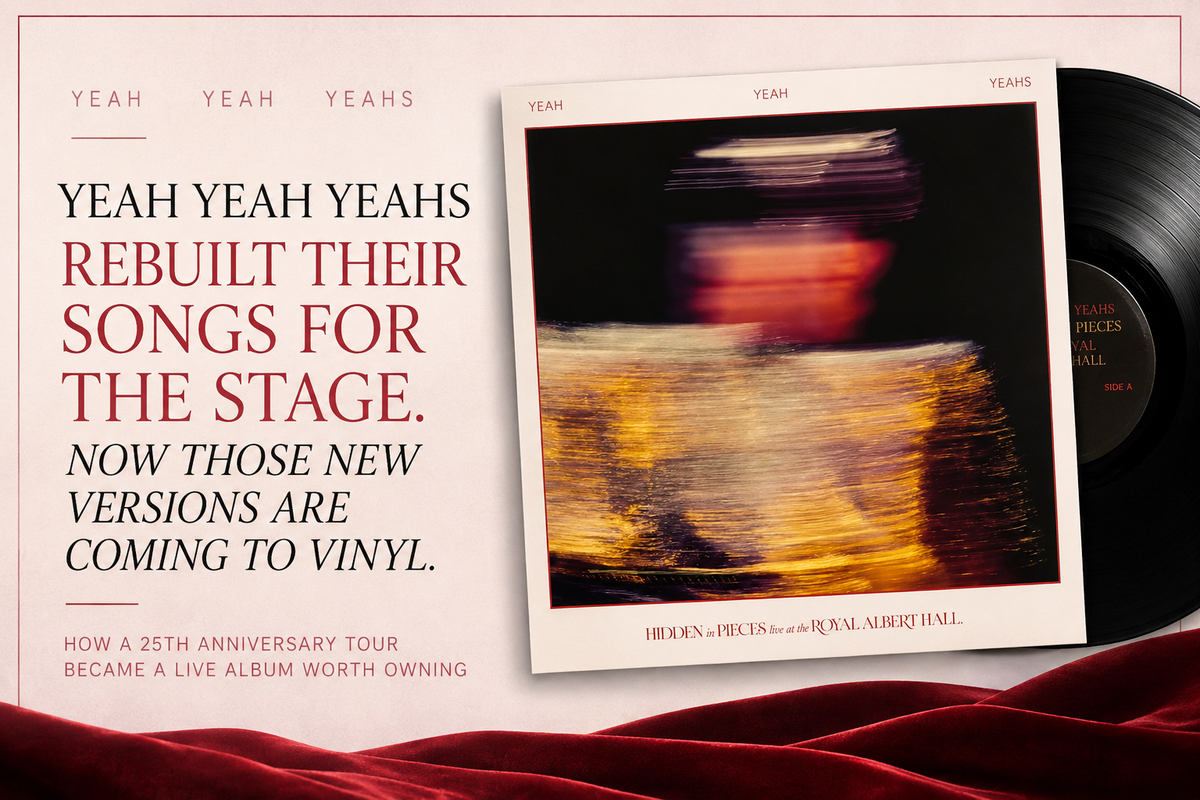
Yeah Yeah Yeahs Rebuilt Their Songs for the Stage. Now Those New Versions Are Coming to Vinyl
Yeah Yeah Yeahs reimagined their catalog for an intimate theater tour. Now those rebuilt songs are coming to vinyl with Hidden in Pieces Live at the Royal Albert Hall.
There is a problem with a lot of live albums.
You already own the songs.
Maybe the performance is a little faster. Maybe the guitar solo stretches out for another minute. Maybe the crowd sings the chorus.
But too often, the live album becomes a slightly different version of something sitting three feet away on your record shelf.
Yeah Yeah Yeahs appear to have approached that problem differently.
For their 25th anniversary, Karen O, Nick Zinner, and Brian Chase didn't simply take the familiar catalog on tour and play the songs the way we've heard them for the last two decades. They stripped them apart, rebuilt them for a more intimate setting, and allowed some of their best known music to become something different.
Now those performances are becoming a record.
Hidden in Pieces Live at the Royal Albert Hall arrives October 23, capturing the band's 2025 theater tour and offering something I increasingly want from a live album:
A reason to own it.
This Wasn't Supposed to Be a Greatest Hits Tour
Twenty five years is exactly the kind of milestone that usually produces a predictable celebration.
Play the hits. Tell a few stories. Bring out a special guest. Sell an anniversary pressing at the merchandise table.
There is nothing necessarily wrong with that.
But Yeah Yeah Yeahs chose a more interesting route.
Their 2025 theater shows were designed around intimate, reimagined arrangements of songs spanning the band's catalog. Instead of attempting to recreate the energy of their regular rock shows in smaller venues, they changed the music to fit the rooms.
That distinction matters.
Songs originally built around Nick Zinner's aggressive guitar work, Brian Chase's drums, and Karen O's enormous stage presence suddenly had more room to breathe.
The result wasn't simply quieter Yeah Yeah Yeahs.
It was another way of hearing the band.
What Makes a Live Album Worth Buying?
That's the question I kept coming back to when I saw this release.
Live albums once served a very different purpose.
Before YouTube, smartphones, and instantly available concert footage, a live record could provide access to a side of an artist you might otherwise never experience.
Put on At Fillmore East, Live at Leeds, Stop Making Sense, or any number of great concert records, and you aren't simply hearing studio recordings with applause added.
You're hearing something that exists because musicians were standing together on a particular stage at a particular moment.
That's what makes the best live records feel necessary.
Today, almost every concert exists somewhere online. Sometimes professionally filmed. Sometimes captured vertically from the 37th row by someone who apparently spent the entire evening holding a phone over their head.
That changes the value proposition of the live album.
If you're going to ask listeners to buy another physical version of songs they already own, the record should give them something they don't already have.
Hidden in Pieces appears designed to do exactly that.
"Maps" Doesn't Need to Be "Maps" Again
Take a song like "Maps."
It has followed Yeah Yeah Yeahs for more than two decades and remains one of the band's defining recordings.
There would be absolutely nothing wrong with putting a faithful live version of "Maps" on a record.
But we already have "Maps."
What becomes more interesting is hearing musicians who have lived with a song for more than 20 years reconsider what it can be.
That's one of the overlooked advantages veteran artists have.
A song doesn't stop evolving when the master recording is finished.
Musicians change. Their voices change. Their influences change. Their relationship with the material changes.
The audience changes, too.
The person listening to Fever to Tell today probably isn't the same person who heard it in 2003, even if they happen to share a name and record collection.
Why shouldn't the song change with them?
A Different Kind of Anniversary Record
The vinyl industry loves anniversaries.
Twenty years. Twenty five years. Thirty years. Fifty years.
Anniversaries have become convenient reasons to remaster albums, change the vinyl color, add another disc, redesign the packaging, and sell us music we may already own.
I've written plenty about that cycle because, as a collector, I participate in it too.
But this feels different.
Instead of asking collectors to buy the original album again, Yeah Yeah Yeahs have created a document of what those songs have become decades later.
That is a far more interesting anniversary proposition.
The physical edition of Hidden in Pieces Live at the Royal Albert Hall is scheduled for October 23 and includes a 180 gram vinyl release. The project is also accompanied by a 22 minute film directed by Barnaby Clay.
There is clearly a collectible component to the campaign as well, including signed photographs offered with an initial batch of vinyl orders.
But that's not what makes me interested in the record.
The music does.
Vinyl Might Be the Right Format for This
There is also something about this particular project that seems well suited to vinyl.
Not because vinyl magically makes live music sound better.
It doesn't.
But an album built around quieter arrangements, space, atmosphere, and an intimate theater performance invites a different kind of listening than watching another concert clip on a phone.
Put the record on. Sit down. Let the performance unfold.
That is precisely the type of experience physical media can still provide extremely well.
The format forces a little commitment from the listener.
And this particular record appears to be asking for it.
More Bands Should Do This
There is no shortage of legacy material coming to vinyl.
What I would like to see more often is artists doing something new with their legacy instead of simply repackaging it.
Rearrange the songs.
Play the deep cuts.
Change the instrumentation.
Record the version that could only exist after spending 20 years performing the original.
Give collectors a reason to put another version of a familiar song on the shelf.
Yeah Yeah Yeahs could have celebrated 25 years by reminding everyone how good these songs were.
Instead, they appear to be asking a much more interesting question:
What can these songs become now?
That's the kind of live album I want to hear.

Comments ()