
The Turntable Trick That Helped Invent Hip Hop
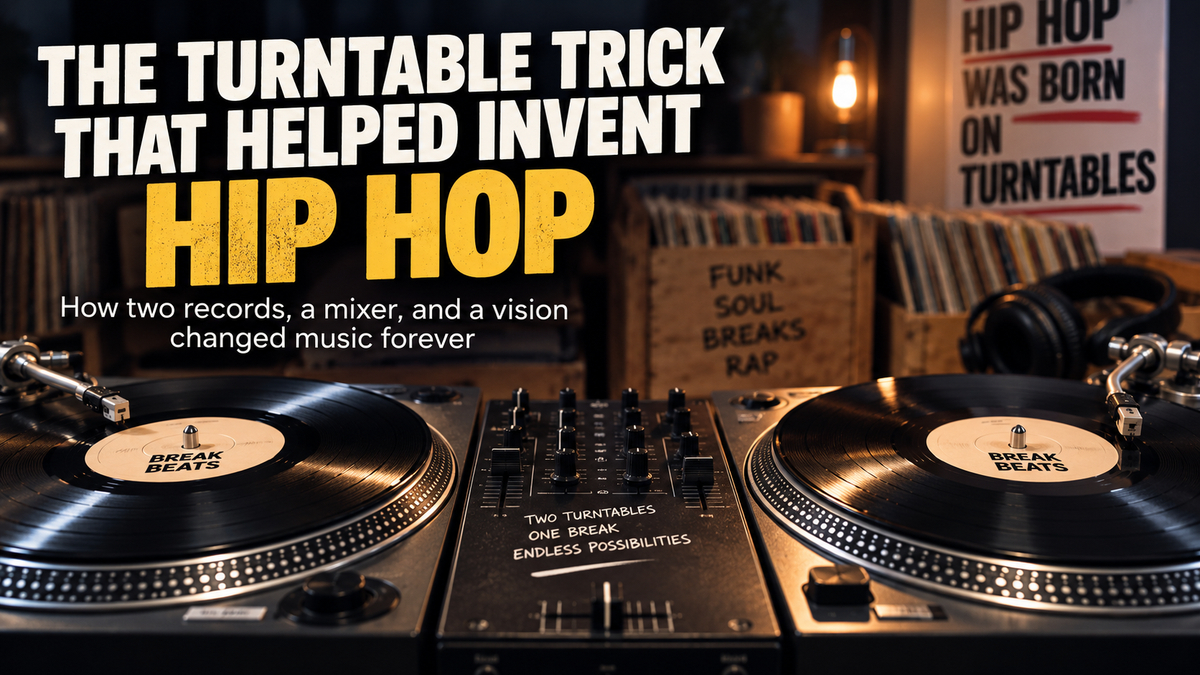
Grandmaster Flash helped transform the turntable from a playback device into an instrument, using two records, a mixer, and precise cueing to extend drum breaks and reshape music in real time.
Today, looping a drum break takes seconds.
Highlight a section of audio. Set the start and end points. Press a button, and it can repeat indefinitely.
Grandmaster Flash figured out how to accomplish essentially the same thing decades before digital samplers and music software made it easy.
His tools were two turntables, a mixer, a crayon, and two copies of the same record.
And in the process, he helped transform the turntable from something designed to play recorded music into an instrument capable of creating new music.
For record collectors, that transformation is especially fascinating.
Audiophiles spend enormous amounts of time trying to make a stylus follow a record groove as accurately as possible.
Grandmaster Flash looked at that same groove and wondered what else he could make it do.
The Problem Was the Best Part of the Record Was Too Short
Hip hop didn't begin with entire songs.
DJs such as Kool Herc had noticed that dancers responded especially strongly to the instrumental breaks buried inside funk, soul, and rock records.
For a few seconds, the vocals might disappear. The melody might drop away. What remained was often percussion, bass, or a particularly infectious groove.
Those moments could electrify a dance floor.
There was just one problem.
They ended.
Grandmaster Flash became obsessed with solving that problem.
If the dancers wanted the break, why couldn't the DJ keep giving it to them?
The obvious answer today would be to sample it.
In the 1970s, that wasn't an option.
So Flash developed a mechanical solution using the playback equipment already sitting in front of him.
Two Copies of the Same Record Changed Everything
The concept behind what became Flash's Quick Mix Theory is brilliantly simple.
Take two copies of the same record.
Put one on each turntable.
Find the break on both copies.
Play the break from the first record.
While the audience hears that record, cue the second copy to the beginning of the same break.
When the first break reaches its end, switch to the second turntable.
Then rewind the first record back to the beginning of the break.
Switch again.
Repeat.
If performed correctly, a drum break lasting only a few seconds could continue for as long as the DJ wanted.
The recording hadn't changed.
The DJ had changed its structure.
That distinction is enormous.
He Had to Find the Groove Again and Again
This wasn't as easy as dragging a waveform on a computer screen.
Vinyl doesn't provide a visual timeline telling you exactly where the snare drum starts.
Flash needed a repeatable way to locate the beginning of a break quickly enough to perform the technique live.
His solution was wonderfully physical.
He developed a system of marking the record so he could identify the precise location he needed, using visual cues on the vinyl and the label to know where to return the disc.
The turntable became a navigation system.
The record became something closer to a reel of editable material.
And the DJ was effectively performing an edit in real time.
Every transition depended on timing.
Too early and the rhythm would jump.
Too late and the break would end.
Cue the wrong point and the illusion collapsed.
There was no Undo button.
Think About How Strange This Is From an Audiophile Perspective
This is where the story becomes particularly interesting to me.
Consider how most of us who care about vinyl treat a record.
We carefully align cartridges.
We set tracking force.
We clean the stylus.
We worry about groove wear.
We debate record cleaning machines.
We replace inner sleeves.
We lower the stylus gently.
The goal is usually straightforward:
Retrieve the information stored in the groove while interfering with it as little as possible.
Grandmaster Flash approached the same technology with almost the opposite philosophy.
The record wasn't sacred.
It was raw material.
He touched it.
Stopped it.
Reversed it.
Repeated sections.
Marked it.
Dropped the stylus into specific grooves.
Then he did it again.
And again.
From a preservation standpoint, some record collectors might find the whole process horrifying.
From a musical standpoint, it was revolutionary.
The Turntable Was Never Designed to Do This
A piano is obviously a musical instrument.
So is a guitar.
A turntable originally wasn't.
Its job was reproduction.
A recording already existed, and the turntable's purpose was to reproduce that recording through a playback system.
What Flash and other pioneering DJs discovered was that reproduction itself could become performance.
Once you can decide which part of a recording plays, when it plays, and how long it plays, you're no longer simply listening to the original arrangement.
You're creating another one.
Two identical records could effectively become a primitive sampler.
The mixer became an editing console.
And the person behind the turntables became more than someone selecting records.
The DJ became a musician.
Sampling Didn't Invent the Idea. It Automated It.
When digital samplers eventually became central to hip hop production, they made this process dramatically easier.
A producer could capture a break once.
Trim it.
Loop it.
Pitch it.
Layer it.
Trigger it whenever necessary.
The physical gymnastics of switching between two records were no longer required to keep a loop running.
But conceptually, something important had already happened.
The idea that a small piece of an existing recording could become the foundation for an entirely new performance had already been demonstrated on turntables.
The sampler digitized the process.
It didn't invent the desire behind it.
That's why the history of hip hop production can't really be separated from vinyl.
The record wasn't merely the format containing the source music.
It was part of the technology used to create the new music.
It Also Changed What Records Were Valuable
There's another fascinating consequence.
Once DJs began searching for breaks, records could become desirable for reasons completely unrelated to whether the album itself had been successful.
A forgotten funk record might contain eight seconds of extraordinary drums.
An obscure soul LP might have the perfect bass line.
A record nobody cared about when it was released could suddenly become valuable because one section of one track worked on a dance floor.
That helped create an entirely different form of record collecting.
Digging.
The goal wasn't necessarily to own the best pressing of a famous album.
It was to find something nobody else had.
A rare groove wasn't valuable simply because it was scarce.
It could be valuable because it contained musical possibilities other people hadn't discovered yet.
That mentality would become deeply embedded in DJ and hip hop culture.
Record Collecting Became Part of Music Production
That's a very different relationship with a record collection.
Most collectors build libraries of music they want to hear.
DJs and producers could build libraries of sounds they might someday use.
Drums.
Bass lines.
Horn stabs.
Vocal phrases.
Percussion.
Strange noises.
The collection itself became part of the creative process.
And knowledge became enormously valuable.
Knowing that a forgotten album contained an incredible break was almost like knowing a secret.
Long before searchable sample databases could identify where a sound originated, discovering those records required listening.
Lots of listening.
The record store wasn't merely somewhere to buy music.
It was somewhere to search for ingredients.
There's Something We Lose When the Process Becomes Easier
None of this is an argument that making music was somehow better when everything was difficult.
Modern production tools are extraordinary.
A laptop can do things that would have seemed impossible when Flash was experimenting with turntables.
But limitations have a way of producing unexpected ideas.
Flash couldn't simply purchase a device that did what he wanted.
So he had to understand the mechanics of the equipment well enough to make it do something it wasn't designed to do.
That's engineering.
It's also creativity.
The same principle appears throughout recording history.
Musicians overloaded amplifiers because they liked the distortion.
Engineers pushed tape into saturation.
Producers manipulated tape speed.
Artists reversed recordings.
DJs manually looped records.
Technology provides a set of rules.
Musicians eventually discover how to break them.
A Turntable Can Do More Than Play Records
I spend a lot of time thinking about turntables in terms of fidelity.
How accurately is the cartridge tracing the groove?
How much vibration is reaching the stylus?
Is the cartridge aligned correctly?
How much information can we extract from the record?
Those questions matter.
But Grandmaster Flash's story is a reminder that the turntable has another history.
One where accuracy wasn't necessarily the objective.
The objective was possibility.
Take a piece of recorded music.
Find the moment that makes the room move.
And figure out how to make that moment last.
Two turntables and two copies of the same record were enough.
In retrospect, the technique seems almost obvious.
But that's often what great inventions look like after someone else figures them out.
Grandmaster Flash didn't just discover a clever way to extend a drum break.
He demonstrated something much bigger:
Recorded music didn't have to remain fixed.
You could touch it.
Rearrange it.
Repeat it.
Perform with it.
And ultimately create something new from something that already existed.
For a format invented to preserve performances, that's a remarkable second life.
Comments ()