
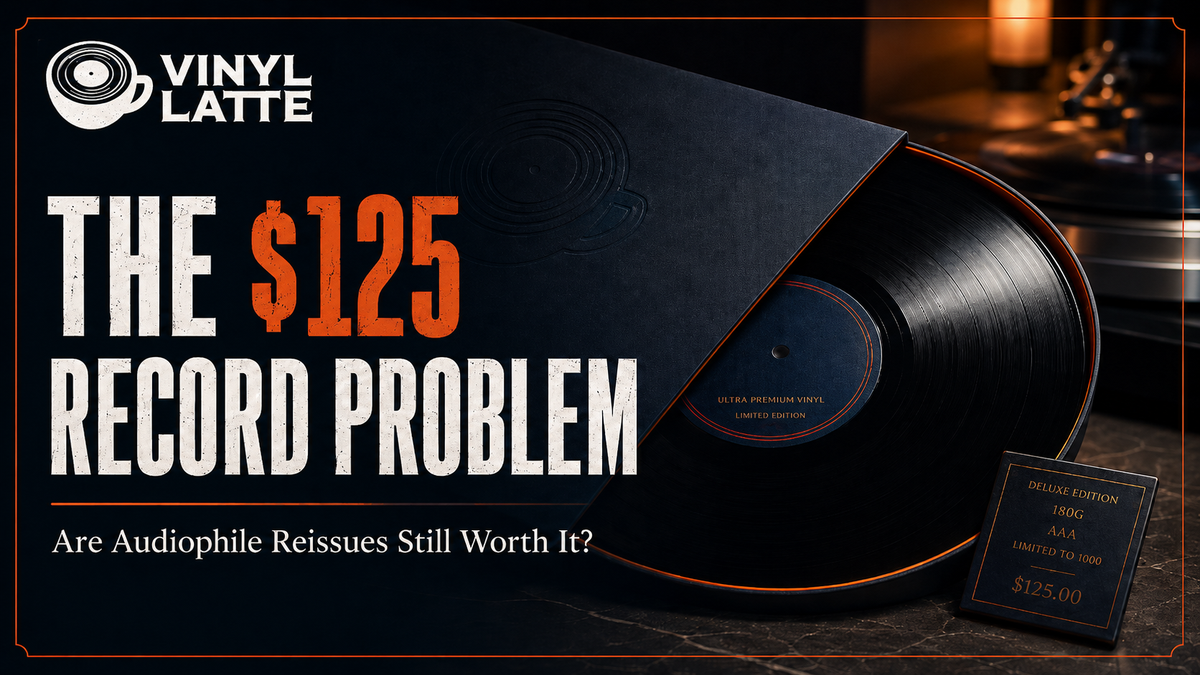
The $125 Record Problem: Are Audiophile Reissues Still Worth It?
As premium vinyl reissues climb past $100, collectors face a harder question: are they paying for better sound, luxury packaging, or fear of missing out? We examine what an expensive audiophile pressing should deliver before earning a place on the shelf.
The audiophile vinyl market has never offered collectors more choice.
Nearly every month brings another premium reissue promising quieter vinyl, better mastering, deluxe packaging, and a closer connection to the original recording. Some of these records sound spectacular. Others are beautifully manufactured objects. A select few manage to be both.
But as prices continue to climb, collectors are being asked an increasingly uncomfortable question:
How much should we pay to hear an album we may already own several times?
That question returned this week when Analogue Productions announced premium editions of four albums by The Who: My Generation, Tommy, Live at Leeds, and Who’s Next. The albums will appear in several formats, including 45 RPM vinyl, SACD, reel to reel tape, and UHQR editions. The single LP UHQR release of Who’s Next will be pressed on 200 gram Clarity Vinyl, limited to 7,500 copies, and priced at $125.
For one of rock’s most celebrated albums, this is not an entirely surprising treatment. Who’s Next contains “Baba O’Riley,” “Behind Blue Eyes,” and “Won’t Get Fooled Again.” It is the kind of title audiophile labels know collectors will purchase again, particularly when the mastering and manufacturing credentials appear promising.
But it also illustrates where the premium vinyl market currently stands.
We are no longer debating whether a new record should cost $25 or $35. We are deciding whether one album is worth $100, $125, or more.
Premium Vinyl Can Be Worth It
There is a tendency to dismiss every expensive record as overpriced. That is too simplistic.
Producing a high quality vinyl reissue costs money. Licensing an important album can be expensive. Original tapes must be located, evaluated, transported, and handled carefully. Experienced mastering engineers command higher fees. Specialty vinyl formulations, small production runs, careful plating, premium jackets, and strict quality control all add to the final cost.
When these elements come together, the improvement can be significant.
A great audiophile reissue can reveal greater depth, cleaner separation, more natural vocals, and a wider sense of space. It can reduce the glare or congestion heard on lesser editions. It can also make a familiar album feel new again.
Collectors who own revealing systems may hear improvements that are difficult to reproduce through streaming or an ordinary mass market pressing. For them, the record is not simply another copy. It is an attempt to get closer to the recording itself.
That has real value.
The problem is that price and sound quality do not always rise together.
Expensive Does Not Automatically Mean Definitive
The word “audiophile” has become one of the most powerful marketing terms in vinyl.
Put an album on heavyweight vinyl, place it inside a thick box, number the jacket, and describe it as limited. Suddenly, a familiar record can command three or four times the price of a standard edition.
None of those features guarantee better sound.
A 200 gram record is not automatically superior to a well pressed 140 gram record. A numbered jacket does not improve frequency response. A large presentation box may look impressive on a shelf, but it has no effect on what comes through the speakers.
Even the phrase “mastered from the original tapes” does not tell us everything we need to know.
Was the record cut directly from those tapes? Was a digital transfer created? Which tape was used? What condition was it in? Was the mastering performed specifically for this edition? How does it compare with previous releases?
Those details matter, especially when a record costs $125.
The higher the price, the more transparency collectors should expect.
The Fear of Missing Out Is Part of the Product
Premium vinyl is rarely sold on sound quality alone. Scarcity is often just as important.
Collectors are told that an edition is limited, individually numbered, or unlikely to be repressed. Preorders open months before the record reaches listeners. Buyers must make a decision before independent reviews or direct comparisons become available.
That creates a familiar cycle.
The announcement appears. Collectors rush to preorder. The record sells out or appears to be approaching that point. Secondary market listings follow. Only later do detailed reviews begin to establish whether the new edition is actually the best sounding version.
By then, the decision has already been made.
This does not mean labels are deliberately manipulating customers. Limited production is a reality for specialty releases. Licensing agreements, pressing capacity, and manufacturing costs can restrict how many copies are practical.
But scarcity undeniably changes buying behavior.
Collectors are no longer simply asking, “Will this sound better?”
They are also asking, “Will I regret not buying it?”
That is a very different question.
How Many Copies Do We Really Need?
Many collectors already own Who’s Next.
They may have an original pressing, an earlier audiophile edition, a recent remaster, a deluxe box set, a CD, an SACD, or a high resolution digital version. Some likely own several of them.
The new UHQR does not compete with an empty space in the collection. It competes with every previous version already sitting on the shelf.
That should change how we evaluate it.
The question is not whether the new pressing sounds good. At this price, it almost certainly needs to sound excellent.
The real question is whether it offers a meaningful improvement over the best reasonably available alternative.
A $125 record does not need to sound four times better than a $30 edition. Audio quality does not work that way. But it should offer something identifiable and worthwhile. Greater realism. Better tonal balance. More dynamic freedom. Lower noise. A presentation that clearly justifies the expense.
Collectors should not have to rely entirely on the reputation of the label or the prestige of the packaging.
A Better Checklist for Premium Reissues
Before purchasing an expensive reissue, I try to separate three different products that are often presented as one.
The first is a better sounding record.
The second is a luxury collectible.
The third is a replacement for a record I already own.
Sometimes a release satisfies all three. Often, it does not.
Before spending $100 or more, it is worth asking:
Do I already own a version that sounds excellent?
A respected original or previous audiophile pressing may already provide everything you want from the album.
Is the mastering information complete?
Collectors should know who mastered it, what source was used, where it was cut, and where it was pressed.
Am I paying for sound or presentation?
There is nothing wrong with valuing deluxe packaging. The important thing is recognizing what part of the price is actually improving playback.
Would I still buy it if it were not limited?
This may be the most revealing question of all.
If the urgency disappears when the numbered edition disappears, the purchase may be driven more by scarcity than by music.
The Market Needs Premium Records, but It Also Needs Restraint
Audiophile labels play an important role in preserving recordings and demonstrating what vinyl can achieve.
Without them, many historic albums might receive careless digital remasters, indifferent pressings, or no meaningful physical release at all. The best reissue companies treat albums with a level of attention that major labels often cannot provide at mass market prices.
We should support that work.
But supporting premium vinyl does not require buying every premium record.
At some point, collectors must decide whether they are pursuing better sound or simply responding to the next announcement. The industry has become exceptionally skilled at selling us albums we already love. It is our responsibility to determine whether the new version deepens that relationship or merely duplicates it.
The upcoming Who’s Next UHQR may turn out to be extraordinary. The source, mastering, pressing quality, and reputation of the people involved give listeners legitimate reasons to be interested.
But at $125, interest should not automatically become a preorder.
The record should earn its place.
Because once a single album costs as much as several excellent standard releases, the burden of proof changes. It is no longer enough for the edition to be limited, attractive, or technically impressive.
It must make the music more convincing.
And until someone lowers the stylus and compares it with the versions we already own, the most honest answer may be the one vinyl collectors find hardest to accept:
We do not need to buy it yet.
Would you spend $125 on a definitive edition of an album you already own, or has premium vinyl finally crossed the line?



Comments ()