
Should Vinyl Collectors Stop Preordering New Albums?
Vinyl collectors are paying more, preordering earlier, and sometimes receiving albums that differ from the final digital release. Is it time to stop preordering until we know exactly what is on the record?
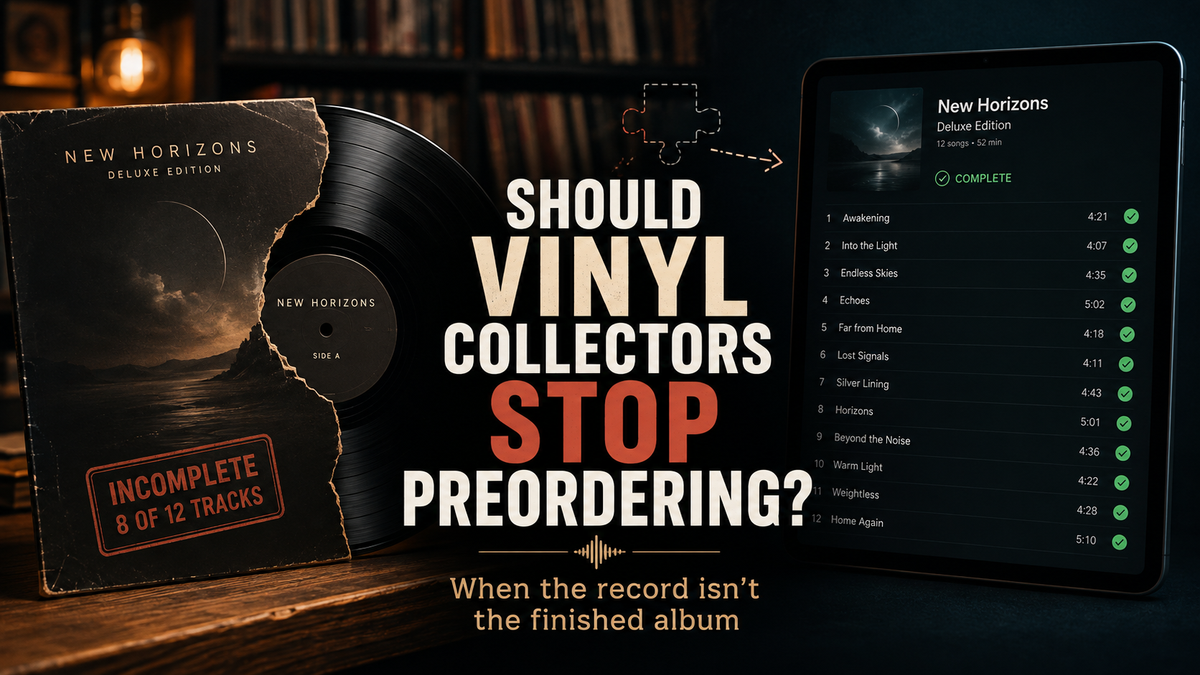
When the Most Expensive Version Isn't Always the Finished Version
For years, vinyl collectors have accepted a familiar tradeoff. Records cost more, take longer to manufacture, and are less convenient than streaming. In return, we get something tangible: artwork, liner notes, a physical connection to the music, and, hopefully, a version of the album worth owning.
But what happens when the record we paid more for isn't actually the finished album?
That question is becoming increasingly difficult to ignore.
Several major releases have recently arrived on vinyl with missing songs, earlier mixes, shortened tracks, or musical elements that appear on the digital version but not on the record. The Guardian documented examples involving Charli xcx, Olivia Rodrigo, Raye, The Weeknd, and others, while What Hi Fi revisited the issue this week.
This isn't really a debate about whether streaming sounds better than vinyl.
It's a question of whether collectors are being asked to buy an album before the album is actually finished.
And increasingly, I think that should make us reconsider the preorder.
When the Vinyl Deadline Comes Before the Album Deadline
The fundamental problem is surprisingly simple.
Vinyl takes time.
A pressing plant may need masters, artwork, packaging specifications, and other materials weeks before an album's release. The Guardian cites a minimum of roughly six weeks, while What Hi Fi reports that current production lead times can be closer to eight to ten weeks. Digital platforms can receive an album considerably closer to release.
That creates two very different deadlines.
There is the deadline for the vinyl record.
Then there is the deadline for the album.
Those aren't necessarily the same anymore.
If an artist changes a mix, rewrites a section, records another guest contribution, or even adds another song after the vinyl master has been submitted, the digital album can potentially be updated.
The records already being manufactured cannot.
Suddenly, the format we think of as the permanent version of an album can actually preserve an earlier version of it.
That's fascinating from an archival perspective.
It's considerably less charming when nobody tells you before you buy it.
Charli xcx: A Collaboration That Missed the Record
One of the more striking recent examples comes from Charli xcx's Music, Fashion, Film.
The album's closing track, "No One Lasts Forever," features filmmaker David Cronenberg on its digital release. His spoken contribution, however, isn't included on the vinyl version.
According to Charli xcx, the contribution simply wasn't completed in time for the vinyl audio deadline. The record therefore contains a different version of the song.
There is nothing inherently wrong with an alternate version.
Collectors buy alternate mixes, demos, mono versions, promotional pressings, and unreleased recordings all the time.
But there's an important distinction.
We know what we're buying.
If an album is marketed as a special alternate mix, that difference becomes part of its appeal. If I preorder what I believe is the standard version of a new album and discover afterward that a significant contribution is missing, that's something else entirely.
Olivia Rodrigo Shows How Complicated This Can Become
Olivia Rodrigo's You Seem Pretty Sad for a Girl So in Love makes the issue even more interesting.
Fans discovered differences across multiple songs on the vinyl editions, including missing bridges, outros, and other passages. According to The Guardian, tracks including "Honeybee," "Maggots for Brains," and "The Cure" are shorter on vinyl, with "The Cure" missing its violin outro. Rodrigo has also discussed writing the album's closing song shortly before everything had to be submitted for vinyl production.
At the same time, the album reportedly appeared in at least a dozen vinyl configurations, including picture discs, alternate covers, colored vinyl, signed copies, and retailer exclusives.
Think about that for a moment.
The industry had enough time to create an elaborate ecosystem of collectible versions around the album, yet the music itself was still evolving.
That feels backwards.
The record should be the product.
The color should be secondary.
Raye, The Weeknd, and Beyoncé Aren't Isolated Examples
The problem isn't limited to one artist or one label.
Vinyl copies of Raye's This Music May Contain Hope contained earlier mixes than some of the eventual digital versions. Raye acknowledged those differences and apologized, explaining that some of the digital tracks changed significantly.
The first vinyl edition of The Weeknd's Hurry Up Tomorrow contained 11 songs compared with 22 on the digital release, along with additional differences involving mixes, transitions, and guest contributions. A later complete double vinyl edition followed.
Beyoncé's Cowboy Carter created a similar controversy in 2024 when the original vinyl release omitted five songs found on the digital version.
At some point, these stop feeling like unusual exceptions.
They begin to reveal a structural problem with the way modern albums are being released.
The Preorder Economy Makes This Worse
Here's where I think collectors need to start asking harder questions.
Vinyl marketing increasingly revolves around urgency.
Limited edition.
Exclusive color.
Signed insert.
Only 5,000 copies.
Indie exclusive.
Webstore exclusive.
Preorder now.
We are encouraged to purchase the record before reviews appear, before anyone compares the pressing, and often before we have even heard the album.
That model depends heavily on FOMO.
I've certainly participated in it. Most collectors probably have.
But the incomplete album problem changes the equation.
We're no longer simply taking a chance on whether we'll like the music or whether a pressing will sound good.
We may be purchasing a physical product before the final version of the music it supposedly contains even exists.
That's a much bigger issue.
Being Different Isn't the Problem
I don't want every vinyl release to be identical to its streaming counterpart.
In fact, I love the idea of vinyl offering something unique.
Give me a different mix.
Include a vinyl exclusive song.
Use an alternate sequence designed around four sides of an LP.
Create an analog master specifically for vinyl.
Give collectors a reason to own the physical version.
But tell us.
Imagine if the Charli xcx record had been marketed clearly as containing an exclusive early version of "No One Lasts Forever."
That could be interesting.
Imagine if a record deliberately preserved an earlier album sequence and clearly identified itself as such.
Collectors might seek it out.
Transparency transforms what feels like an omission into something potentially collectible.
The issue isn't that the vinyl and digital versions are different.
The issue is discovering that difference after you've spent your money.
Maybe We Should Stop Preordering Records
I'm increasingly convinced that collectors should at least become more selective about preorders.
Wait until the album comes out.
See what people receive.
Check the track list.
Look at Discogs.
Read reviews.
Find out whether there are pressing problems.
Determine whether the supposedly limited edition is actually limited.
Most importantly, make sure the record you're buying contains the version of the album you actually want.
Yes, occasionally you'll miss a genuinely limited pressing.
But considering how many "limited" releases are followed by another color, another retailer exclusive, another anniversary edition, and eventually another repress, I'm not convinced that's the catastrophe the industry wants us to believe it is.
Vinyl Buyers Deserve Better
There's an irony here that shouldn't be overlooked.
Vinyl collectors are often among an artist's most committed customers.
We buy the physical record.
We sometimes buy multiple versions.
We buy deluxe editions.
We support record stores.
We pay substantially more for an album than it costs to stream it.
Those customers shouldn't be treated as the easiest people to sell an unfinished product to.
If production realities mean a vinyl version has to be finalized two months before the digital album, that's understandable.
Manufacturing has limitations.
Artists change their minds.
Creative work continues.
But labels and artists have two choices.
Finish the album before manufacturing begins, or clearly tell buyers that the physical edition may differ from the final digital release.
What shouldn't be acceptable is quietly letting customers find out afterward.
Because vinyl's value has never been just the plastic.
It's trust.
Trust that the record was worth buying.
Trust that someone cared about how it was mastered, manufactured, packaged, and presented.
And, at the absolute minimum, trust that when we buy an album, we're actually getting the album.
Would knowing that a vinyl release might contain an earlier or incomplete version of an album make you stop preordering records, or would the differences actually make that pressing more collectible to you?


Comments ()