
Rega's $395 Replay Looks Like a Flagship Turntable. What's the Catch?
Rega's new $395 Replay turntable borrows the skeletal design philosophy of its flagship models. But what do you gain, and what compromises come with the lower price? We examine the engineering, features, and tradeoffs.
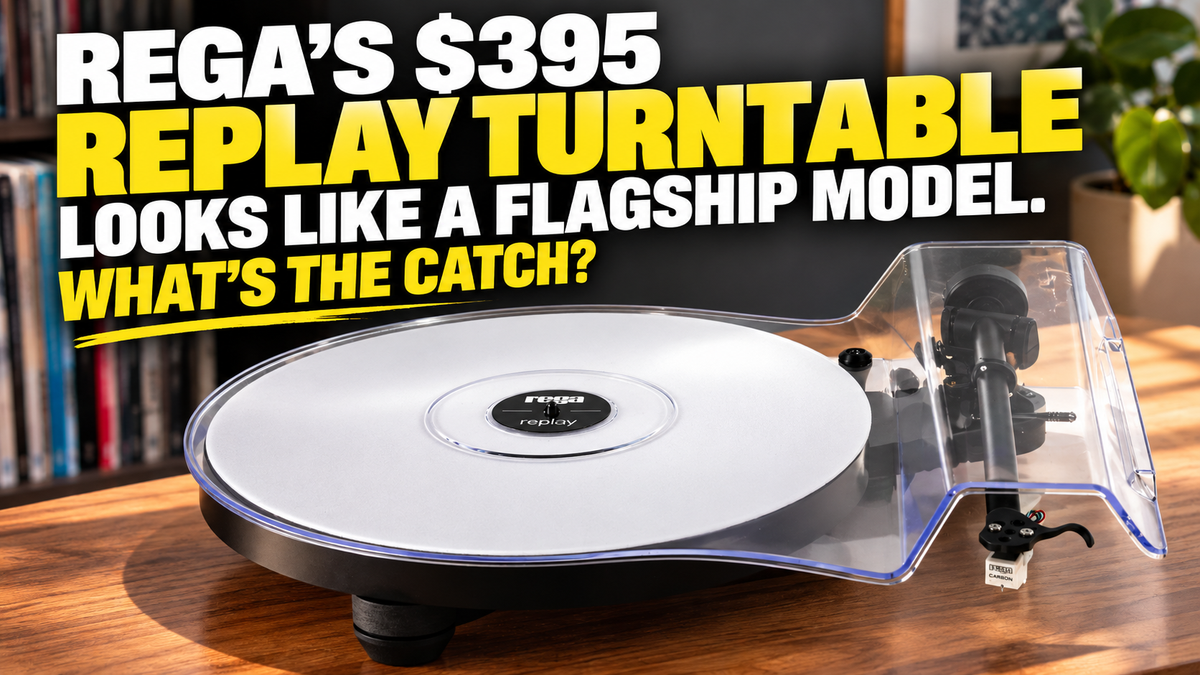
Rega has brought its distinctive skeletal turntable design to its most affordable model. But does the engineering philosophy behind its high-end turntables translate to a $395 record player?
At first glance, you might mistake Rega's new Replay for something considerably more expensive.
Its stripped-down, skeletal appearance immediately recalls the company's high-end Planar 8, Planar 10, and Naia turntables.
But there's a rather significant difference.
The Rega Replay costs just $395.
For a company whose flagship turntables can cost thousands of dollars, that's an interesting development.
Rega says it spent three years developing the Replay, with a simple objective: make genuine hi-fi vinyl playback more accessible without overwhelming newcomers with complicated adjustments.
It's an appealing proposition. But the most interesting question isn't whether Rega can manufacture a less expensive turntable.
It's whether the engineering philosophy behind its premium models can deliver meaningful benefits at this price.
And, inevitably, what compromises were necessary to get there.
A $395 Turntable With High-End Design DNA
Rega has long championed a particular approach to turntable construction.
Rather than making everything heavier, the company emphasizes rigidity, low mass, and minimizing the storage and transmission of unwanted mechanical energy.
The theory is straightforward.
A turntable's job is to rotate a record at a consistent speed while allowing the stylus to retrieve extremely small movements from the groove.
Unwanted vibration can interfere with that process.
A structure that stores mechanical energy and releases it over time can potentially contribute unwanted coloration.
Rega's approach is to create a rigid structure with relatively little mass, reducing opportunities for energy storage while maintaining precise relationships between the platter, bearing, and tonearm.
That philosophy becomes particularly visible in its skeletal designs.
Instead of a conventional rectangular plinth, the Replay uses a minimal structure that supports the essential mechanical components.
It's a design that looks remarkably similar in concept to Rega's far more expensive turntables.
But there's an important distinction.
Sharing a design philosophy doesn't mean sharing the same engineering execution.
The Planar 10 and Naia use substantially more sophisticated materials, bearings, tonearms, and other components.
The Replay uses a laminated, low-mass skeletal plinth with an MDF core.
That's not necessarily a criticism. It's simply a reminder that visual similarities shouldn't be mistaken for equivalent performance.
What's Actually Inside the Rega Replay?
Rega hasn't reinvented every component.
In fact, several parts will be familiar to anyone who knows the company's entry-level Planar 1.
The Replay includes:
- RB110 hand-assembled tonearm
- Factory-installed Rega Carbon moving-magnet cartridge
- 23mm phenolic resin platter
- 24V low-noise synchronous motor
- Rega EBLT Advanced drive belt
- Factory-set antiskating
- Custom removable dustcover
- 33⅓ and 45 RPM playback
The turntable is manufactured in England and weighs approximately 2.2 kilograms, or 4.9 pounds.
Rega also includes a lifetime warranty against manufacturing defects.
One interesting detail is the platter.
The 23mm phenolic resin platter is designed to provide a flywheel effect, helping maintain rotational stability.
That matters because a turntable needs sufficient rotational inertia to resist small variations in speed.
But platter mass is only part of the equation.
Motor behavior, belt characteristics, bearing quality, and the relationship between these components all contribute to speed stability.
Until we see independent measurements of wow, flutter, and speed accuracy, we shouldn't assume that the Replay performs like Rega's more expensive models.
Still, it's encouraging that Rega is emphasizing mechanical engineering rather than adding features that have little to do with reproducing music.
The One-Minute Setup: Convenience or Compromise?
Perhaps the Replay's most significant selling point is its simplicity.
Rega claims the turntable can be ready to play in approximately one minute.
The Carbon cartridge arrives installed and aligned.
The RB110 tonearm uses a factory-set antiskating arrangement.
Instead of carefully balancing the tonearm and adjusting a tracking-force dial, owners push the supplied counterweight onto the rear of the arm until it reaches its designated position.
Connect the turntable to an appropriate phono input, remove the stylus guard, and you're ready to play a record.
For someone buying their first serious turntable, that's appealing.
Cartridge alignment, tracking force, and antiskating are subjects that can intimidate newcomers.
And improper setup can produce audible distortion, poor tracking, and unnecessary record or stylus wear.
Factory configuration removes several opportunities for user error.
But it also removes flexibility.
The Tradeoff: Limited Adjustability
The Replay is designed around its supplied cartridge and factory-defined setup.
Its antiskating isn't user-adjustable, and the counterweight arrangement is intended to establish the correct tracking force without conventional adjustment.
That makes the initial experience simpler.
It also means the Replay isn't an ideal platform for someone who wants to experiment with different cartridges and fine-tune every aspect of playback.
The Carbon cartridge has a replaceable stylus, which is useful for routine maintenance.
But buyers shouldn't assume the Replay offers the same cartridge-upgrade flexibility as more adjustable turntables.
For a beginner who simply wants to enjoy records, this may be a perfectly reasonable tradeoff.
For an enthusiast who enjoys experimenting with cartridges, tracking force, and alignment, it could become a limitation.
What About the Phono Preamp?
Here's something prospective buyers need to understand.
The Rega Replay does not include a built-in phono preamplifier.
That means you'll need an amplifier or receiver with a suitable moving-magnet phono input, or a separate phono preamp.
You cannot simply connect the Replay to an ordinary line-level input and expect proper playback.
A phono preamp provides the necessary gain and RIAA equalization to reproduce the recording correctly.
For someone who already owns a compatible amplifier, this may not be an issue.
For someone building a system from scratch, however, the additional cost matters.
The $395 price gets you the turntable, but not necessarily everything required to hear it.
There's also no electronic speed selector.
Switching between 33⅓ and 45 RPM requires manually repositioning the drive belt.
Again, this is a familiar Rega approach, but it's worth understanding before purchasing.
Does the Skeletal Design Actually Improve Sound?
This is where I'd be cautious about drawing conclusions from product photography.
The engineering rationale behind a rigid, low-mass structure is credible.
But demonstrating that a particular implementation improves playback requires more than describing the theory.
Ideally, we'd want measurements of speed stability, rumble, vibration sensitivity, and resonance behavior.
We'd also want to compare the Replay with a conventional Planar 1 under controlled conditions.
Both turntables share several important components, including the RB110 tonearm, Carbon cartridge, and 24V motor architecture.
That creates an interesting comparison.
If the skeletal plinth is delivering a meaningful improvement, can we identify that improvement through measurements or controlled listening?
Or does the Replay primarily offer a different physical design and a more accessible price?
Those are questions worth answering.
The Replay's appearance certainly makes it distinctive.
But a turntable doesn't sound better simply because it resembles a more expensive model.
My Perspective as a Rega P10 Owner
I've spent considerable time with Rega's approach to turntable design through my own P10.
One of the things I appreciate about Rega is its willingness to prioritize the fundamentals of vinyl playback rather than chasing every possible feature.
A turntable doesn't need to be complicated to perform well.
What matters is the quality of its mechanical execution.
That includes the bearing, motor, platter, tonearm, cartridge, and how those components interact.
The Replay appears to follow that philosophy.
What I find particularly interesting is Rega's decision to make the skeletal design accessible at such a low price.
But I wouldn't suggest that the Replay delivers P10-like performance simply because the two share a recognizable design language.
They are fundamentally different products, built with different materials, components, and performance expectations.
The question is whether the Replay delivers excellent performance for $395.
That's the comparison that matters.
So, What's the Catch?
There isn't necessarily a hidden catch.
Instead, the Replay represents a deliberate set of compromises.
You get a lightweight skeletal design, an established tonearm and cartridge combination, a factory-configured setup, and a turntable built in England.
In exchange, you give up much of the adjustability that enthusiasts may expect, electronic speed switching, and an integrated phono preamp.
You also shouldn't expect the engineering sophistication of Rega's premium models.
For the intended buyer, those compromises may make perfect sense.
Someone purchasing their first serious turntable probably doesn't want to spend an afternoon adjusting cartridge alignment or tracking force.
They want to play records.
And if Rega has successfully delivered a mechanically competent turntable that makes that experience easier, the Replay could become a compelling entry point into hi-fi.
But the final verdict will depend on performance.
I'd particularly like to see how it compares with the Planar 1



Comments ()