
Michael Kiwanuka Recorded FUDGE in a One-Room Studio. Here's Why That Matters.
Michael Kiwanuka's FUDGE began in Dreamers, a one-room studio near Southampton, where spontaneous sessions shaped his most independent recording project in years. Here's how the album came together before its October 23 vinyl release.
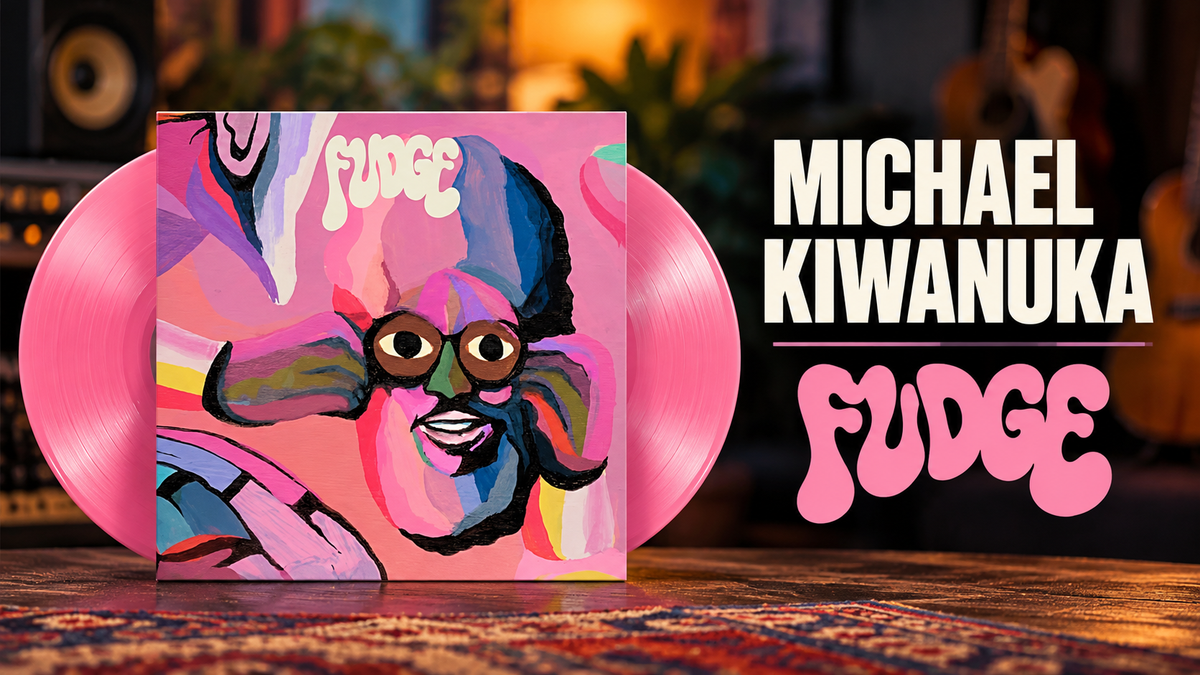
The Mercury Prize winner traded his familiar production partnership for a small studio, spontaneous performances, and a more independent creative process. His fifth album arrives on vinyl October 23.
Some albums begin with an elaborate production plan, a world-class recording studio, and a carefully assembled team of producers and engineers.
Michael Kiwanuka's FUDGE began somewhere considerably less glamorous.
In a one-room studio near Southampton, England, built from a traditional mixture of earth and other natural materials known as cob, Kiwanuka started experimenting with music without the expectations that had surrounded his previous records.
He called the space Dreamers.
There was no grand recording complex, no elaborate production schedule, and no guarantee that the experiments would become an album.
Instead, there was a mixing console, a collection of instruments, a trusted musician who lived nearby, and an increasingly important idea: perhaps the best way to make the next Michael Kiwanuka album was to stop worrying about what a Michael Kiwanuka album was supposed to sound like.
The result is FUDGE, his fifth studio album, arriving October 23, 2026, through Polydor Records.
And for listeners interested in how records are made, the story behind this album may be just as fascinating as the music itself.
From Elaborate Production to a One-Room Studio
Kiwanuka's previous three albums—Love & Hate, Kiwanuka, and Small Changes—were created with producers Danger Mouse and Inflo.
That partnership helped establish a distinctive musical identity, combining soul, psychedelic rock, orchestral arrangements, and atmospheric production.
But for FUDGE, Kiwanuka wanted to take greater control of the creative process.
It marks his first self-produced album since his 2012 debut, Home Again.
The starting point was Dreamers, a small, single-room studio near his Southampton home.
Kiwanuka used money from his Mercury Prize win to purchase a recording console and began assembling the equipment he needed.
The space wasn't designed to impress visiting executives or recreate the facilities of a famous recording studio.
It was designed to make creating music easier.
A place where he could walk in, experiment for an hour, and leave without the pressure of making every session productive.
That distinction matters.
When musicians work in large professional studios, time can be expensive. Sessions are often scheduled, personnel are coordinated, and there's an expectation that progress will be made.
A personal recording space can change that relationship.
An unfinished idea doesn't necessarily need to become a song before the session ends.
A musical mistake can lead somewhere unexpected.
And a performance can develop naturally without someone immediately asking whether it belongs on the finished record.
Dreamers gave Kiwanuka the freedom to explore those possibilities.
The Musician Who Helped Bring Dreamers to Life
One of the most important collaborators on FUDGE wasn't a famous producer.
It was Joe Connell, a multi-instrumentalist from Kiwanuka's live band who happened to live nearby.
Connell could contribute instruments and musical ideas that Kiwanuka couldn't necessarily perform himself.
That created an unusually flexible working relationship.
Rather than assembling a large group of session musicians every time a new idea emerged, the two could experiment together, move between instruments, and follow a piece of music wherever it led.
The breakthrough came when they were struggling to make progress on songs that had already been written.
Instead of forcing those compositions forward, they returned after dinner and decided to improvise.
What emerged was "Love in My Heart," a seven-minute recording that became one of the defining moments of the project.
For Kiwanuka, the experience helped establish that these informal sessions weren't merely a distraction from his other work.
They could form the foundation of an entirely different album.
And that raises an interesting recording question.
What happens when the performance becomes more important than the production plan?
Why Recording Live Can Change the Music
There's a fundamental difference between constructing a recording one part at a time and allowing musicians to develop an arrangement together.
Modern recording technology makes it possible to assemble extraordinarily complex productions.
A drummer can record separately from the bassist. Guitar parts can be layered across dozens of tracks. Vocals can be edited, rearranged, and refined long after the original performance.
Those capabilities aren't inherently good or bad.
They're tools.
But recording musicians together introduces something that can be difficult to manufacture afterward: interaction.
A guitarist responds to a change in the rhythm.
A drummer adjusts the intensity of a passage.
One musician extends a phrase, and another instinctively follows.
The performance develops through decisions made in real time.
According to the album's announcement, much of the music created at Dreamers was looser and more improvisational than the material Kiwanuka was writing for Small Changes.
Some performances were captured in single, extended takes.
The songs often stretched beyond the lengths he had originally been accustomed to working with.
That doesn't mean every instrument on FUDGE was recorded simultaneously, or that the finished album contains no overdubs or editing. The available production information doesn't establish either claim.
But the reported emphasis on spontaneous performance suggests a meaningful shift in how Kiwanuka approached the music.
Rather than constructing every moment toward a predetermined result, he allowed the recording process itself to influence the compositions.
For listeners who care about recording techniques, that's an intriguing distinction.
Two Albums, Two Different Creative Approaches
Perhaps the most surprising part of the FUDGE story is that it wasn't simply created after Small Changes.
The two projects developed alongside one another.
Small Changes, released in 2024, continued Kiwanuka's established partnership with Danger Mouse and Inflo.
Meanwhile, Dreamers became a place where he could experiment with a different approach.
When progress stalled on one project, he could return to the other.
The contrast gave him room to explore musical ideas without forcing them into the same production framework.
That helps explain why FUDGE shouldn't necessarily be understood as a rejection of his previous work.
It appears to represent a parallel creative direction.
One album emerged through an established collaborative process.
The other grew out of a small room, informal sessions, and the willingness to let the music take shape without knowing exactly where it was going.
The distinction is especially interesting for an artist whose recordings have often featured carefully developed arrangements and expansive sonic textures.
The Collaborators Who Helped Finish FUDGE
Although Kiwanuka took the lead in producing the album, FUDGE wasn't completed entirely inside Dreamers.
Once the core recordings had developed, he brought the material to producer and engineer Dom Monks, whose credits include work with Laura Marling and Big Thief.
Monks helped bring the project toward completion.
Kiwanuka also reunited with Rosie Danvers, his longtime string-arranging collaborator, whose work includes projects with Coldplay and Adele.
Strings have played an important role in Kiwanuka's music, often adding a cinematic dimension to his songwriting.
For FUDGE, however, not all the orchestral elements required moving into a conventional studio.
Some string arrangements were recorded directly at Dreamers by a quartet involving Henry Rankin and Harry Fausing Smith.
That detail is particularly revealing.
It suggests the small studio wasn't merely a place for rough demos before the recordings were recreated elsewhere.
At least some of its performances became part of the finished production.
The record was made across Southampton and Frome, combining the original Dreamers sessions with additional work needed to complete the album.
The result is a production process that appears to balance spontaneous musical performances with the careful finishing work required for a commercial release.
An Unexpected Source of Inspiration: Chick Corea
The creative philosophy behind FUDGE was influenced by an unlikely source.
During the pandemic lockdown, Kiwanuka encountered an interview with the late jazz pianist Chick Corea.
Corea's message encouraged artists to trust their own musical instincts rather than become overly concerned with how their work might be received.
That idea resonated with Kiwanuka.
It also helps explain the approach he adopted at Dreamers.
Instead of treating every recording decision as something that needed outside approval, he began giving himself permission to follow ideas simply because they interested him.
The album also draws from a broad musical background.
Kiwanuka has cited artists including Shuggie Otis and Elliott Smith in discussing individual songs and their influences.
That combination of soul, folk, psychedelia, and exploratory songwriting is familiar territory for Kiwanuka.
What appears different this time is the freedom with which those influences were allowed to interact.
An Album Completed Before a Difficult Period
There is another important part of the story.
FUDGE was recorded before Kiwanuka experienced a serious health crisis in 2025.
In September 2026, he publicly disclosed that he had suffered a hemorrhagic stroke and had been undergoing an extended recovery.
The album's release was delayed for almost a year while he dealt with his health.
With Kiwanuka's support, the project is now moving forward.
That chronology matters.
Although the album is arriving during his recovery, the music itself was created beforehand.
It shouldn't automatically be interpreted as a response to his illness.
Instead, FUDGE documents an earlier period of creative exploration, one in which Kiwanuka was working to overcome self-doubt and rediscover the enjoyment of making music.
The decision to release those recordings now gives listeners an opportunity to hear the results of that process.
FUDGE Arrives on Double Vinyl October 23
For record collectors, FUDGE is receiving several physical editions.
The standard release is a two-LP black vinyl set, accompanied by a 12-inch printed lyric booklet.
An exclusive pink double-LP edition is also available through Kiwanuka's official store. It features alternative artwork and the same booklet.
Independent record stores are offering a mint-green double-LP edition with alternative artwork.
The album contains 12 tracks:
- Summer Clothes
- California
- Just Another Moment
- Drowning in Your Heart
- Love in My Heart
- Across the Sky
- Stars
- You Sent Me Flying
- Move in My Direction
- Steve's Paradise
- Sing
- Swings and Roundabouts
The artwork comes from Stevie Gee, a longtime friend and visual collaborator of Kiwanuka.
Its colorful, psychedelic illustration is a significant departure from the visual presentation of some of his earlier releases.
One detail worth noting for vinyl collectors is that the album is spread across two records.
That gives the cutting engineer potentially more flexibility than fitting the entire program onto a single LP.
However, the number of records alone doesn't tell us how the album was mastered or whether the vinyl offers a sonic advantage over the digital release.
Those are questions that require actual listening and, ideally, more information about the mastering and cutting process.
Will FUDGE Sound Different From His Previous Albums?
This is where the recording story becomes especially interesting.
An album created through extended improvisation and relatively informal sessions might retain characteristics that are less prominent in a more meticulously assembled production.
Those could include natural variations in timing, changes in intensity, and the subtle interactions between musicians responding to one another.
But we should be careful about drawing conclusions before hearing the finished record.
A spontaneous performance doesn't automatically produce better sound.
A smaller studio doesn't guarantee greater intimacy.
And a self-produced album isn't necessarily more authentic than one created with outside producers.
What matters is how the artistic choices translate into the finished recording.
For FUDGE, the most interesting listening questions will be whether the arrangements preserve the spontaneity described in the recording sessions, how the rhythm section interacts, and whether the production retains the sense of space and musical expression associated with Kiwanuka's previous work.
It will also be worth exploring how the string arrangements integrate with the original performances.
Do they support the improvisational character of the recordings, or create a more polished presentation?
Those are questions for a future listening review, not conclusions we can responsibly draw from the album announcement.
The Vinyl Latte Take
Michael Kiwanuka's FUDGE is interesting for a reason that has little to do with vinyl variants, limited editions, or audiophile marketing.
It's a record built around a different way of making music.
After years of working with an acclaimed production team, Kiwanuka created a space where he could experiment without the usual expectations.
He worked closely with a musician he trusted.
He allowed performances to develop naturally.
And when the results began to take shape, he brought in collaborators who could help finish the recordings without abandoning the project's original creative direction.
For listeners interested in how music is made, that story is worth paying attention to.
Not because one-room studios are inherently superior to professional recording facilities.
And not because live recording is automatically better than multitracking.
But because the environment in which musicians create can influence the decisions they make.
Sometimes a different room, a different collaborator, or a different approach is enough to unlock something unexpected.
FUDGE arrives October 23.
Whether the finished album delivers on the promise of those Dreamers sessions remains to be heard.
But its recording story already gives us a compelling reason to listen.
What matters more to you in a recording: the precision of a carefully constructed production, or the spontaneity of musicians playing together?
Share your thoughts in the comments.
Release Details
Artist: Michael Kiwanuka
Album: FUDGE
Release date: October 23, 2026
Label: Polydor Records
Format: Digital, CD, and double vinyl
Vinyl editions: Standard black 2LP, exclusive pink 2LP, and independent-store mint-green 2LP
Recording locations: Southampton and Frome, England
Production: Michael Kiwanuka, with additional production and completion work involving Dom Monks
String arrangements: Rosie Danvers, with additional string performances recorded at Dreamers
Artwork: Stevie Gee
Sources and Further Reading
Official album announcement, Universal Music Canada:
https://www.universalmusic.ca/2026/09/24/michael-kiwanuka-announces-new-album-fudge-out-october-23/
Michael Kiwanuka — Official FUDGE 2LP:
https://shop.michaelkiwanuka.com/products/fudge-2lp
Michael Kiwanuka — Exclusive Pink 2LP:
https://shop.michaelkiwanuka.com/products/fudge-exclusive-pink-2lp
Rough Trade — FUDGE Vinyl Editions:
https://www.roughtrade.com/en-us/product/michael-kiwanuka/fudge-1



Comments ()