
The Black Parade Turns 20. Its Haunted Recording Sessions Reveal Why It Sounds So Different.
Twenty years after The Black Parade, producer Rob Cavallo reveals new details about My Chemical Romance's haunted mansion sessions. We examine the recording process, original analog master tapes, and anniversary vinyl editions.
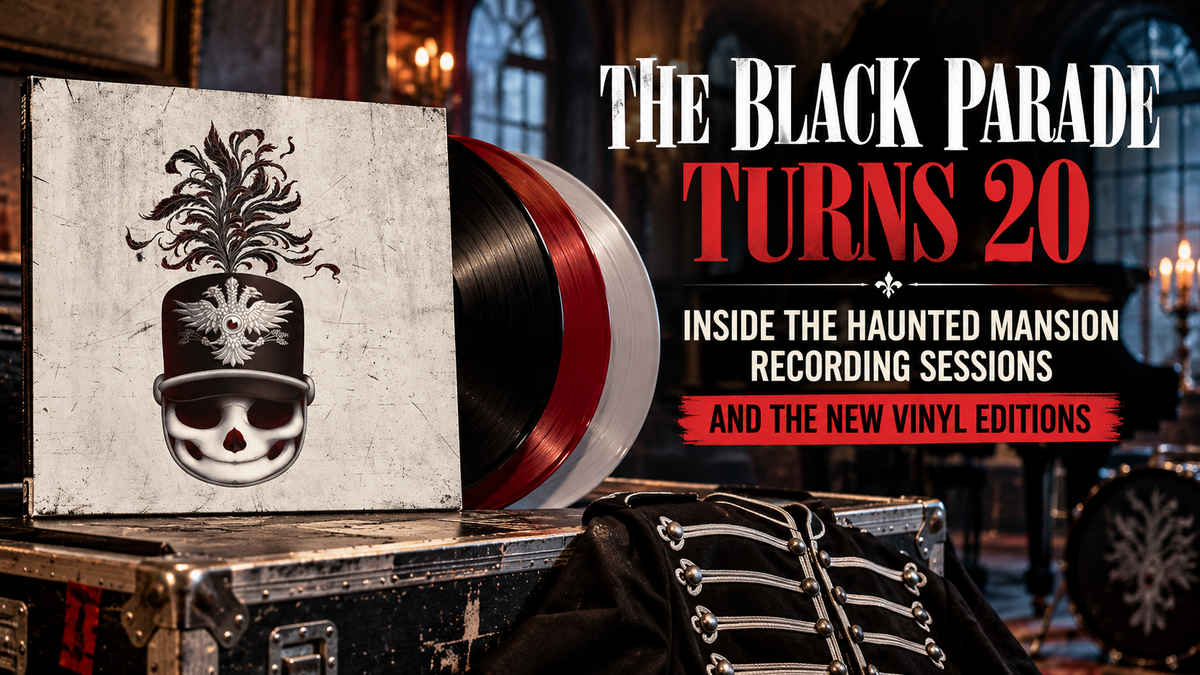
Twenty years after My Chemical Romance recorded their defining album, producer Rob Cavallo has revealed new details about the eerie mansion, unconventional recording setup, and creative decisions behind The Black Parade. Now, an anniversary vinyl edition cut from the original analog master tapes offers another reason to revisit it.
There are plenty of reasons to remember The Black Parade.
The marching-band introduction. The theatrical arrangements. Gerard Way's dramatic vocals. The way the album moves between explosive guitars, intimate moments, and songs that sound almost designed for a Broadway stage.
But there's another part of the story that deserves attention.
Some of this music was recorded inside a freezing, supposedly haunted Los Angeles mansion.
And according to producer Rob Cavallo, the recording setup was anything but conventional.
As The Black Parade approaches its 20th anniversary on October 23, 2026, a newly published interview offers a fascinating look at the environment where My Chemical Romance created one of the most recognizable rock albums of the 2000s.
Meanwhile, a new audiophile vinyl edition promises something particularly interesting for collectors: a mastering cut from the original analog master tapes.
The two stories raise different questions.
How much did the recording environment contribute to the album's identity?
And what might a new vinyl mastering reveal about a recording that has been part of so many listeners' lives for two decades?
A Haunted Mansion Became Part of the Recording Process
In an October 16 interview with MusicRadar, Cavallo revisited the sessions at Paramour Mansion in Los Angeles' Silver Lake neighborhood.
The property already had a reputation for being haunted.
For a band developing a theatrical concept album about death, memory, and the afterlife, it was certainly an unusual setting.
Cavallo recalled the mansion's atmosphere, including a particularly large room without adequate heating.
"It was absolutely haunted and freezing in there," he told MusicRadar.
Whether the mansion was genuinely haunted is another matter.
What's more interesting from a recording perspective is what Cavallo did with the space.
Rather than treating the building simply as somewhere to rehearse or write, he turned part of it into a recording environment.
According to Cavallo, the team installed a PA system and suspended stereo microphones in the enormous room to capture the band performing live.
That's a detail worth examining.
Because a large room doesn't just provide somewhere for musicians to stand.
It becomes part of the sound.
Why Recording in a Giant Room Matters
Imagine playing a guitar through an amplifier inside a small, heavily treated recording booth.
Most of what the microphone captures comes directly from the amplifier, with relatively little contribution from the room.
Now move that amplifier into a large, reflective space.
The sound travels outward, strikes walls and other surfaces, and returns as a series of reflections.
Those reflections can contribute a sense of scale, distance, and ambience.
Depending on the room's dimensions and construction, certain frequencies may linger longer than others.
A pair of microphones positioned farther from the instruments can capture more of that environment.
The result isn't necessarily cleaner.
But it can sound larger.
And that's particularly relevant to an album like The Black Parade.
Listen to the transitions between its quieter passages and its enormous choruses.
The production frequently creates a sense of physical space around the performances, even when the arrangements become dense.
Cavallo's description provides a glimpse into one technique used during the sessions.
However, it's important not to overstate what we know.
His interview doesn't establish that every song was recorded live in that room, that all of the room microphones made it into the final mixes, or that the entire album was recorded without overdubs.
Those details would require a more complete recording breakdown.
What Cavallo does confirm is that the team deliberately used the mansion's large room to capture live performances in stereo.
For anyone interested in recording techniques, that's more revealing than another story about the building's ghosts.
The Atmosphere Wasn't Entirely Comfortable
The mansion's unsettling reputation wasn't simply a marketing detail added years later.
During the sessions, Gerard Way reportedly experienced recurring night terrors.
Cavallo also recalled the building's uncomfortable temperature and eerie atmosphere.
It's tempting to connect those experiences directly to the album's darker musical themes.
But that would be difficult to prove.
The band was already developing a concept centered on mortality and a character known as The Patient.
What the mansion may have provided was an environment that reinforced the project's theatrical character.
Creative spaces can affect how musicians work.
An unfamiliar room may encourage experimentation. An unusual acoustic environment may inspire different arrangements. The atmosphere can change the way performers interact.
None of that guarantees a better recording.
But it helps explain why some producers deliberately take artists away from conventional studios.
The goal isn't always technical perfection.
Sometimes it's creating conditions in which something unexpected can happen.
Rob Cavallo Was Thinking Beyond Individual Songs
Cavallo's involvement was significant.
By 2006, he had already established himself through recordings with Green Day, including Dookie and American Idiot.
But in the new interview, he draws an interesting distinction between those projects and his work with My Chemical Romance.
With American Idiot, Cavallo describes a deliberate effort to create an album that demanded to be heard as a complete work, rather than a collection of individual downloads.
With My Chemical Romance, he emphasizes Gerard Way's elaborate storytelling and the layers of narrative behind the music.
That distinction matters.
The Black Parade isn't simply a sequence of unrelated songs with a recurring visual theme.
Its central character, The Patient, confronts death while reflecting on his life.
The songs move through different emotional states, and the arrangements shift accordingly.
There's theatrical rock, punk energy, piano-driven intimacy, and moments of almost operatic excess.
The production needed to support all of it.
A conventional approach built around making every song sound identical would have worked against that ambition.
Instead, the album frequently changes scale.
One moment feels intimate.
The next sounds enormous.
The mansion recordings are one part of that larger production story.
Twenty Years Later, the Original Analog Master Tapes Return
The anniversary brings another development.
My Chemical Romance is releasing a new One Step audiophile edition of The Black Parade, scheduled for October 23.
According to the band's official store, the double LP has been cut from the original analog master tapes.
Mastering was handled by Chris Bellman at Bernie Grundman Mastering.
The One Step manufacturing process was carried out by Dorin Sauerbier at Record Technology, Inc. (RTI).
The edition uses Neotech VR900-D2 180-gram vinyl and is limited to 7,000 individually numbered copies worldwide.
Those are substantial production details.
But they also deserve careful interpretation.
The phrase "cut from the original analog master tapes" describes the source used for this vinyl edition.
It does not, by itself, establish that every stage of the album's original recording, editing, and mixing process was exclusively analog.
Nor does it prove that the new pressing will outperform every previous edition.
Those are separate questions.
What we can say is that the label has identified the mastering source, engineer, pressing material, and manufacturing process.
That's useful information for collectors who want to understand what they're purchasing.
What Makes the One Step Different?
The One Step process is intended to reduce the number of electroforming stages between the lacquer and the finished record.
In conventional vinyl manufacturing, the lacquer typically goes through multiple plating generations to produce the stampers used for pressing.
A One Step process eliminates intermediate generations.
The theory is that reducing those steps can help preserve information from the original lacquer.
But the process alone doesn't determine the final sound.
The quality of the mastering, lacquer cut, plating, pressing, and source material all matter.
So does the condition of the finished record.
For The Black Parade, there's another significant distinction.
The One Step spreads the original album across four sides of two LPs.
That gives the cutting engineer more room to work with than a single-LP configuration.
Longer sides can require compromises in cutting level, groove spacing, and low-frequency handling.
Distributing the program across four sides provides additional flexibility.
It doesn't guarantee a dramatic sonic improvement.
But it is a meaningful technical difference.
And unlike colored vinyl or elaborate packaging, it directly affects how the music is accommodated on the record.
Three Anniversary Editions, Three Different Priorities
Collectors should pay close attention to the track listings.
The anniversary releases are not simply different colors of the same record.
The One Step Audiophile Edition
The premium edition contains the original album across four sides, plus a live performance of "Someone Out There Loves You," recorded at Maxwell's in Hoboken, New Jersey, on October 24, 2007.
It is pressed on 180-gram vinyl, cut from the original analog master tapes, and limited to 7,000 numbered copies.
The band's official store lists it at $124.98.
Its primary attraction is the mastering and manufacturing approach, not the amount of bonus material.
The Deluxe Double LP
The deluxe edition includes the original album and six additional tracks.
Three are rare B-sides:
- "Heaven Help Us"
- "Kill All Your Friends"
- "My Way Home Is Through You"
The remaining three are live performances from the 2007 Black Parade tour:
- "Dead!"
- "The Sharpest Lives"
- "Someone Out There Loves You"
The last song is particularly notable.
Long known to fans as "Stay," it was performed during the tour but had not previously received an official recording release.
The deluxe edition is available in multiple colors, including Bloodline Red through the band's store and Baby Pink through independent retailers.
The band's store lists the Bloodline Red double LP at $39.98.
The Standard Anniversary LP
There's also a single-LP edition pressed on Concrete Grey vinyl.
It contains the original fourteen-track album without the deluxe bonus material.
The official store lists it at $27.98.
For listeners who simply want the album on vinyl, this is the most straightforward option.
For collectors interested in the archival material, the deluxe double LP offers more content.
And for listeners specifically interested in a different mastering and pressing approach, the One Step is the edition worth investigating.
Which Edition Would We Choose?
That depends on what you're trying to get from the record.
If your priority is the music and the additional recordings, the deluxe double LP is the most compelling package.
You receive the original album, three B-sides, and three live performances.
If you're interested in comparing mastering approaches, the One Step is the more intriguing edition.
Its identified analog tape source, Chris Bellman mastering credit, and four-side album sequence make it a legitimate candidate for a careful listening comparison.
But I wouldn't recommend purchasing it solely because the words "One Step" appear on the packaging.
The real question is whether the finished record offers a meaningful improvement.
That requires listening.
Ideally, it also requires comparing the new edition against an existing pressing under controlled conditions.
Without that comparison, declaring the One Step definitive would be premature.
And there's one more consideration.
The deluxe double LP includes more music.
The One Step doesn't.
That's an important distinction for anyone deciding where to spend their money.
The Recording and the Mastering Tell Different Stories
This is where the anniversary becomes especially interesting.
Cavallo's newly reported comments focus on how the performances were captured.
The new vinyl edition focuses on how those recordings are being prepared for playback twenty years later.
Those are related, but distinct, parts of the process.
The original sessions involved musicians, microphones, rooms, instruments, and production decisions.
The anniversary mastering involves an existing source, a mastering engineer, a cutting system, and a manufacturing process.
A new pressing cannot recreate the atmosphere inside Paramour Mansion.
It can only reproduce the recorded information that survived the original production process.
And that's worth remembering whenever a new mastering is described as revealing what was always on the tape.
The tape is a source.
It isn't a time machine.
The musical decisions were made long before the lacquer was cut.
Why The Black Parade Still Deserves Attention
Twenty years after its release, The Black Parade remains a remarkable example of ambitious rock production.
It's theatrical without abandoning the band's punk roots.
It's densely arranged without losing its sense of narrative.
And it moves between intimacy and spectacle in ways that make the album feel larger than its individual songs.
Cavallo's new comments add a valuable detail to that history.
They remind us that recordings aren't created in abstract digital spaces.
They're made by people in actual rooms, responding to instruments, sounds, and one another.
Sometimes those rooms are conventional studios.
Sometimes they're freezing mansions with reputations for being haunted.
And sometimes the producer decides to hang microphones in an enormous space simply to hear what happens.
Twenty years later, we're still listening to the result.
The Vinyl Latte Take
The most compelling part of The Black Parade anniversary isn't the limited-edition number or the colored vinyl.
It's the opportunity to connect the album's original recording process with the way it's being presented today.
Rob Cavallo's comments offer a glimpse into the creative environment behind the music.
The One Step edition provides a documented mastering and manufacturing approach worth examining.
And the deluxe edition gives fans access to additional material from the album's original era.
Those are three different reasons to revisit the record.
For me, the most interesting question isn't whether a $125 pressing will transform The Black Parade into an audiophile demonstration album.
It's whether a carefully prepared new edition can offer another perspective on the performances and production decisions that made the album distinctive in the first place.
Because the real achievement happened twenty years ago.
Inside the songs.
Inside the performances.
And, at least for part of the recording process, inside a very unusual mansion.
Which version of The Black Parade do you own, and are you planning to pick up one of the 20th anniversary editions?
If you already have an earlier pressing, we'd especially like to hear whether you're interested in comparing it with the new One Step.
Sources and Further Reading
MusicRadar — Rob Cavallo Interview, October 16, 2026
My Chemical Romance — The Black Parade 20th Anniversary One Step Audiophile Edition
https://mychemicalromance.warnerrecords.com/products/the-black-parade-xx-one-step-180g-2lp
My Chemical Romance — Deluxe Bloodline Red 2LP
My Chemical Romance — Concrete Grey Standard LP
https://mychemicalromance.warnerrecords.com/products/the-black-parade-xx-concrete-grey-vinyl-1-lp
Vinyl Latte — The Rolling Stones Recorded Without a Click Track. Then Their Producer Added Synth Bass.
Comments ()