
Queens of the Stone Age Announce Perfecth. Maybe Imperfection Is the Point.
Queens of the Stone Age are back with 'Perfecth', a new album built around the idea that perfection may be overrated. With “Insignificant Other” captured in just two takes, the band is leaning into groove, feel, and the imperfections that make rock music sound alive.
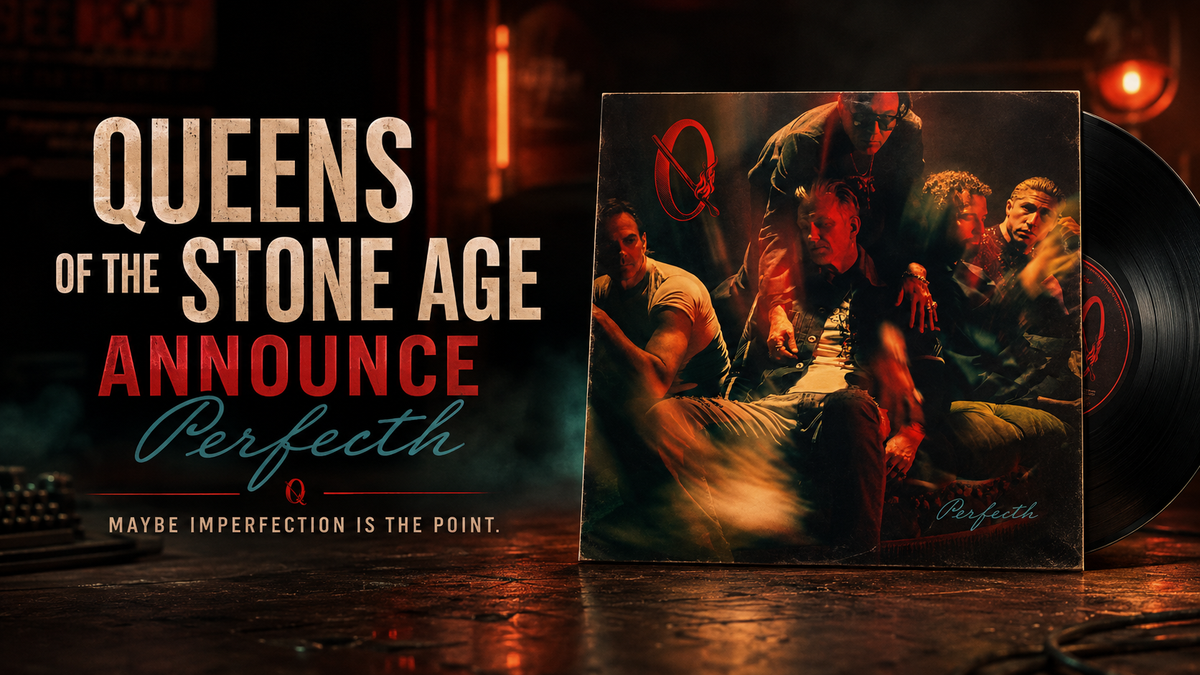
Queens of the Stone Age have announced a new album, Perfecth, arriving October 30 through Matador Records.
The band also released a new single, “Insignificant Other,” following last month’s “Easy Street,” their first new song in three years. The album was recorded between New Orleans and Los Angeles and will contain nine tracks.
But the title may tell us more about the record than the track list does.
Josh Homme coined Perfecth as a deliberate corruption of “perfect,” describing perfection as something that does not really exist. That idea seems to extend beyond the name and into how the band approached the music itself.
That is where this becomes interesting.
Queens of the Stone Age have never sounded particularly interested in perfection anyway.
Their best records feel dangerous because they leave room for groove, friction, distortion, repetition, and personality. The guitars can sound abrasive. The drums can feel physical rather than polished. Homme’s vocals often sit somewhere between swagger, vulnerability, and menace.
The imperfections are part of the sound.
And in a time when modern recording tools make it easier than ever to remove almost every rough edge, maybe that is exactly the point.
“Insignificant Other” Was Captured in Two Takes
The production detail that immediately caught my attention is how “Insignificant Other” was recorded.
According to material released with the album announcement, the finished version came from the second of only two takes, with the band playing together loosely and making space for one another in real time.
That matters.
Modern records can be built piece by piece.
Drums can be quantized.
Vocals can be assembled from dozens of takes.
Guitar parts can be edited until every entrance is exact.
None of that automatically makes a record bad. Some extraordinary albums are constructed that way.
But there is another kind of energy that appears when musicians are responding to each other rather than a grid.
Tiny changes in timing.
A drummer reacting to a guitar accent.
A bassist leaning into a phrase.
A vocal changing because the band underneath it changed.
Those details are difficult to manufacture after the fact because they come from interaction.
Listening to “Insignificant Other,” that looseness is noticeable.
It does not sound unfinished.
It sounds alive.
Queens of the Stone Age Have Always Understood Groove
For a band often categorized simply as hard rock, Queens of the Stone Age have always been unusually dependent on rhythm.
The riffs matter, obviously.
But the reason songs like “No One Knows,” “Go With the Flow,” “Make It Wit Chu,” and “The Way You Used to Do” work is not merely guitar tone.
They move.
There is swing buried inside the heaviness.
Repetition becomes hypnotic rather than mechanical.
That is an important distinction because rock music can easily lose something when every beat is corrected into place.
Perfect timing is not necessarily better timing.
A drummer sitting slightly behind the beat can create weight.
A guitar pushing forward can create urgency.
Musicians pulling against each other can create tension.
Remove all of those inconsistencies and you can end up with something technically flawless that somehow feels smaller.
Queens of the Stone Age have rarely had that problem.
The New Music Sounds Less Interested in Showing Off
The first two songs from Perfecth also suggest a band that may be less interested in proving how heavy it can be.
“Easy Street” was an unexpectedly relaxed introduction to the new era. ABC described the song as a significant departure from the harder rhythmic attack most listeners associate with the band, and Homme has spoken recently about reaching a different place personally after three decades of making music.
“Insignificant Other” continues in a similarly restrained direction.
It still sounds unmistakably like Queens of the Stone Age, but it feels more interested in space and feel than impact.
That makes the album more intriguing to me.
A band with this much history does not need to recreate Songs for the Deaf.
In fact, trying to do that would probably be the least interesting thing they could do.
The better question is what Queens of the Stone Age sound like when the people making the music are no longer trying to be the version of themselves listeners expect.
Every Song Is Supposed to Sound Different
Homme says each song on Perfecth sounds as if it came from a different world, intentionally stitching together emotions around love, lust, foolishness, and the wisdom that sometimes follows them.
That can be risky.
Albums with too much stylistic variety can become collections of songs rather than coherent records.
But Queens of the Stone Age may be unusually suited to it.
Their identity has never depended entirely on one production style.
They can move from massive riffs to falsetto vocals, desert rock to glam, mechanical repetition to acoustic passages without completely losing themselves.
The connective tissue is usually Homme’s sense of rhythm, melody, and atmosphere.
If Perfecth really does move between different musical worlds, that could make it one of the more interesting records in their catalog.
Or it could become disjointed.
That uncertainty is part of why I want to hear it.
There Is an Audiophile Lesson Here Too
This is not an audiophile record announcement.
And that is exactly why I think it is relevant to people who care about sound.
Audiophiles sometimes talk about recordings as if the goal is to remove every flaw.
Lower noise.
Lower distortion.
Better separation.
Greater precision.
Those are legitimate goals in playback equipment.
But music itself is different.
Some of the things that make recordings memorable are technically imperfect.
Tape saturation.
Amplifiers pushed too hard.
Microphones picking up bleed from other instruments.
A singer moving slightly away from the microphone.
A drummer whose timing breathes rather than lands perfectly on a grid.
A second take that captures something a twentieth take might lose.
We want playback systems capable of revealing what happened in the recording.
That does not mean what happened in the recording needs to be flawless.
Sometimes the flaw is exactly what we want to hear.
The Pursuit of Perfect Can Flatten Personality
There is an irony in modern recording.
Technology has never been better at helping musicians achieve precision.
Yet some of the records we return to most often are filled with things engineers could easily “fix” today.
Tempo movement.
Amplifier noise.
Vocal cracks.
Instrument bleed.
Uneven dynamics.
Slight timing differences.
Those things remind us that people were in a room making decisions in real time.
The danger is not digital technology itself.
The danger is using it automatically.
Correct everything because it can be corrected.
Tune everything because it can be tuned.
Align everything because it can be aligned.
Eventually, the music becomes technically better while losing some of the characteristics that made the performance distinctive.
Queens of the Stone Age seem to understand that instinctively.
Their music has always benefited from control without becoming sterile.
Perfecth Might Be the Right Name
It would be premature to judge an entire album from two songs.
Perfecth could still surprise us completely when it arrives October 30.
But the philosophy behind it is already interesting.
Homme has taken a word associated with impossible standards and deliberately made it wrong.
Then the band released a song built from one of only two takes.
There is something appealing about that combination.
Not sloppy.
Not careless.
Just unwilling to confuse precision with personality.
For a band that has spent decades building its identity around tension, groove, texture, and controlled chaos, Perfecth might be exactly the right title.
The new album arrives October 30.
I am already curious to hear what they decided not to fix.



Comments ()