
Orianthi Built a Supergroup With Prince and Santana Alumni. Then They Recorded the Album Entirely in Analog
Orianthi, Cindy Blackman Santana and Rhonda Smith form The Power of 3, recording their debut entirely in analog with legendary producer Eddie Kramer.
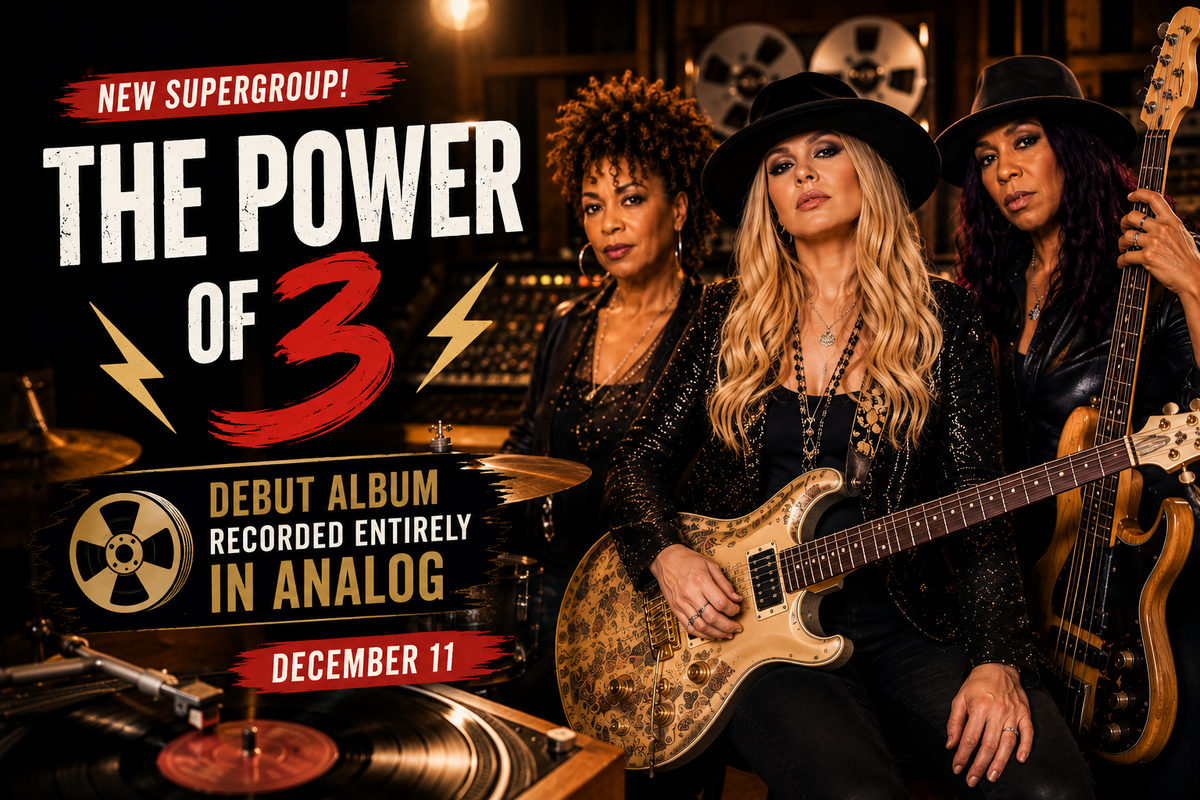
There are supergroups that look impressive on paper. Then there are bands where the lineup immediately makes you wonder what happened when everyone actually got into the same room.
The Power of 3 belongs in the second category.
Guitarist and singer Orianthi has joined forces with drummer Cindy Blackman Santana and bassist Rhonda Smith for a new power trio whose collective résumé is almost ridiculous. Between them, they have played with Michael Jackson, Prince, Jeff Beck, Alice Cooper, Beyoncé, Lenny Kravitz, Carlos Santana and Pharoah Sanders.
Their self titled debut album arrives December 11 through She2Music, with Carlos Santana making a guest appearance. But for record collectors and anyone interested in how albums are actually made, there is another detail that makes this project particularly interesting.
They recorded the entire thing in analog.
And the man behind the console was Eddie Kramer.
An Old School Approach to a New Band
Kramer's name is inseparable from some of the most important recordings in rock history. His credits include Jimi Hendrix, Led Zeppelin, The Rolling Stones, Kiss and David Bowie.
That history is especially relevant here because The Power of 3 began with the idea of creating a modern power trio inspired by Hendrix's Band of Gypsys.
Las Vegas Raiders owner Mark Davis originally encouraged Orianthi to assemble the group. She brought in Blackman Santana, whose career has crossed jazz and rock through her work with artists including Lenny Kravitz and Santana, and Rhonda Smith, whose bass playing has supported everyone from Prince and Jeff Beck to Beyoncé.
Instead of simply assembling three accomplished musicians and polishing everything in production, the goal appears to have been capturing what happens when three distinctive players react to each other.
Recording in analog became part of that process.
Kramer's approach was appropriately old school. Orianthi has described him as being intensely focused on things such as microphone placement, amplifiers, guitars and effects before committing the performance to tape.
In an era when nearly anything can be changed after a recording is made, there is something refreshing about putting that much emphasis on getting the sound right before hitting record.
They Even Kept a 25 Minute Jam
Perhaps the most revealing detail about the sessions is that the band recorded a roughly 25 minute jam.
And apparently, it is going on the album.
Orianthi told Guitar World that Kramer had to mix the entire performance and joked that he was sweating afterward.
That detail may tell us more about this record than the fact that it was recorded to analog tape.
Analog recording alone doesn't make a record better. There are incredible digital recordings and terrible analog ones. Tape isn't magic.
What matters is what the recording process encourages musicians to do.
A 25 minute jam suggests The Power of 3 wasn't simply recording individual parts and assembling an album afterward. They were playing together, allowing songs and ideas to develop in real time and preserving some of those moments.
That philosophy has far more to do with the potential sound and feel of this record than the format used to capture it.
Two Songs Already Show Very Different Sides of the Band
The group has released its first two songs, "War In The Streets" and "Treat Me Like A Lady."
"War In The Streets" leans toward the heavier side of the trio, built around a muscular rock groove and Orianthi's guitar playing. The chorus was written by Davis, while the band developed the verses and music before taking the song into the studio with Kramer.
"Treat Me Like A Lady" heads in another direction.
The track is driven by Smith's Motown influenced bass line and puts more emphasis on groove, giving an early indication that The Power of 3 isn't simply going to be an excuse for extended guitar solos.
With musicians of this caliber, restraint and interaction may ultimately be more interesting than virtuosity.
The Vinyl Connection Is Intentional
The analog recording process also wasn't chosen simply as a marketing bullet point.
Orianthi has previously spoken about wanting The Power of 3 to represent what she calls "real music," while specifically mentioning the experience of listening to music on vinyl.
She acknowledged the convenience of streaming, but contrasted that with the experience of putting a record on a turntable and actually sitting down to listen.
For vinyl collectors, that makes the eventual physical release especially interesting.
There is an important distinction, however.
An album being recorded entirely in analog does not automatically mean the vinyl release will be an all analog pressing. Those are two different things. The recording may begin on tape and still pass through a digital stage during mixing, mastering or cutting.
So until the production chain for the vinyl edition is confirmed, I wouldn't put an AAA sticker on this one just yet.
But starting with an analog recording made by Eddie Kramer certainly gets my attention.
Maybe the Process Matters More Than the Format
The part of this story I find most interesting isn't that a new rock record was recorded on tape.
It's why.
Modern recording gives artists an extraordinary amount of control. Performances can be edited, corrected, layered and manipulated almost endlessly. That isn't inherently bad. Some incredible records could not exist without those tools.
But sometimes limitations create something different.
Put three musicians in a room. Get the microphones right. Find the right amplifier. Commit to a sound. Start the tape.
Then play.
That appears to be what Kramer and The Power of 3 were chasing.
And when your rhythm section consists of Cindy Blackman Santana and Rhonda Smith, letting the musicians play might be a pretty good production strategy.
The Power of 3's self titled debut arrives December 11. The album contains 10 tracks, with "War In The Streets" and "Treat Me Like A Lady" available now.
I'll be particularly interested to learn more about how the vinyl edition is being mastered and cut.
Because if the philosophy behind the recording carries all the way through to the finished record, this could be one worth hearing on a turntable.


Comments ()