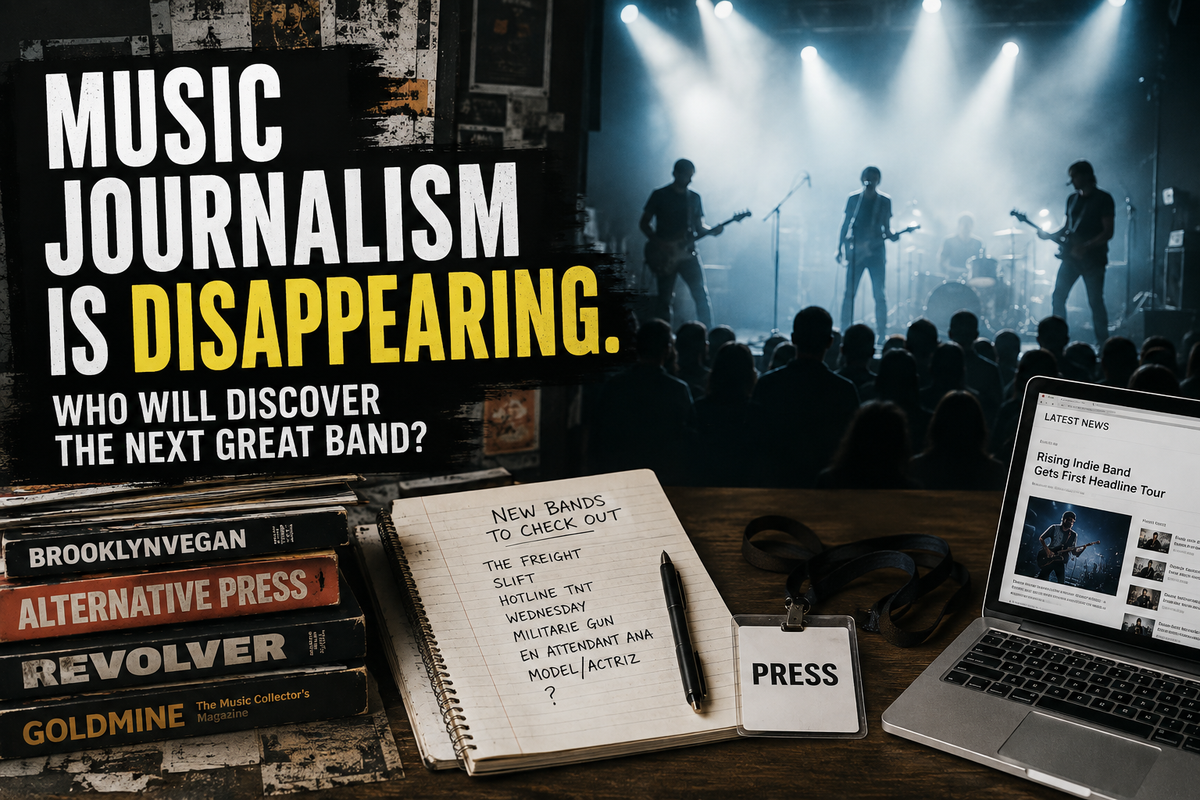
Music Journalism Is Disappearing. Who Will Discover the Next Great Band?
Music publications are shrinking, consolidating, and cutting editorial staff. As discovery shifts toward algorithms, creators, and social platforms, who will take a chance on the next great band before anyone is searching for them?
A music publication does not necessarily have to shut down to disappear in the way that matters.
It can keep the website. It can keep the logo. It can keep publishing content.
But if you remove enough of the people who know the music, understand the scene, build relationships with artists, and are willing to champion something most people have never heard of, you risk losing the very thing that made the publication valuable.
That is why the latest shakeup at Veeps should matter to music fans.
Veeps, the ticketed livestream and media company in which Live Nation owns a majority stake, recently cut editorial positions across publications including BrooklynVegan, Alternative Press, Revolver, and Goldmine. Initial reports painted an especially dramatic picture, with Pitchfork reporting that nearly all staff at some of the publications appeared to have been laid off.
Subsequent reporting from Music Business Worldwide offered a somewhat different picture. According to a source familiar with the restructuring, seven employees were cut across five publications, with approximately 25 editorial staff remaining. The publications continue to operate and publish.
That distinction matters.
This is not an obituary for BrooklynVegan, Revolver, Alternative Press, or Goldmine.
But it should still make us ask a much bigger question.
Who Is Going to Discover the Music Nobody Is Searching For Yet?
For decades, music publications did something that is surprisingly difficult to replace.
They introduced us to things we did not already know we wanted.
BrooklynVegan grew from a New York focused site launched in 2004 into an influential voice in independent music. Alternative Press dates back to 1985. Revolver has spent decades covering hard rock and metal. Goldmine has been serving record collectors since 1974.
These publications were not interchangeable.
They developed audiences because somebody behind the curtain had taste.
Editors made decisions. Writers went to shows. Reviewers listened to albums from artists without millions of followers. Someone decided that a band most people had never heard of deserved 800 words and a photograph.
That role is becoming increasingly difficult to find.
And somewhat remarkably, Veeps itself describes Alternative Press, BrooklynVegan, and Revolver as publications that connect with highly engaged music communities and help shape trends among audiences that value discovery and individuality.
That word, discovery, is important.
Because I think discovery is exactly what is at risk.
The Algorithm Knows What You Like. That Is Not the Same Thing.
We have more access to music today than at any other point in history.
Spotify can recommend a playlist. YouTube can suggest another video. TikTok can turn thirty seconds of a song into a global phenomenon. Instagram can introduce an artist to millions of people overnight.
Those tools can be incredibly effective.
But an algorithm generally works best when it has signals.
What have people clicked? What are they watching? What sounds similar to something already successful? What is generating engagement right now?
There is an enormous difference between finding something that is gaining momentum and deciding that something deserves momentum in the first place.
Music journalism traditionally helped perform that second function.
A critic could hear something unusual and say, "Pay attention to this."
There did not have to be search volume first.
There did not have to be a trend first.
There did not have to be an audience first.
Sometimes the coverage helped create the audience.
This Is Bigger Than Veeps
The changes at Veeps are also not happening in isolation.
Music Business Worldwide points to a broader pattern of music companies reducing or divesting editorial operations. Warner Music Group sold media properties including Uproxx, HipHopDX, and Dime Magazine in 2024 as part of a larger restructuring. Earlier this year, Sony Music owned The Orchard reportedly made significant cuts affecting Metal Injection and MetalSucks.
That does not mean every corporate owner is hostile to journalism, nor does ownership automatically compromise editorial independence.
There is also no evidence in the reporting I reviewed that Live Nation was dictating what these Veeps publications could or could not cover.
The concern is more fundamental.
Does music journalism still make economic sense inside companies whose primary businesses are somewhere else?
Live Nation's core business is live entertainment. Veeps began as a ticketed livestreaming platform. When editorial media lives inside a much larger entertainment organization, journalism ultimately has to compete internally with businesses that may have clearer paths to revenue.
That is a difficult equation.
And it becomes particularly concerning when the wider music business itself is healthy. Live Nation reported $403 million in net income for its second quarter and record event related deferred revenue of $6.4 billion.
This is not simply a story about music disappearing.
It is a story about where the industry believes value resides.
Can Independent Creators Fill the Gap?
This is where I have to acknowledge something slightly uncomfortable.
Vinyl Latte is part of the change.
Independent YouTube channels, podcasts, newsletters, websites, reviewers, and creators are increasingly doing work that once belonged primarily to traditional music publications.
I interview artists.
I review records.
I talk about the business surrounding physical music.
And occasionally I put something in front of you that I think deserves more attention, even if relatively few people are searching for it.
Yesterday was a good example.
I published a video about a record from The Freight, a band most people watching Vinyl Latte probably had not encountered before. What caught my attention was not celebrity, chart position, or an expensive reissue campaign.
It was the record.
It sounded good. The music was interesting. The band appeared to care about how its music was recorded, produced, and presented on vinyl.
So I wanted to talk about it.
That is discovery.
But I do not think independent creators completely replace music journalism.
Creators have our own incentives. YouTube rewards clicks. Search rewards popular topics. Thumbnails need attention. Successful videos frequently lead us toward artists, albums, and debates audiences already recognize.
Writing about an unknown band can be one of the least rational things you can do if your only objective is traffic.
And yet somebody needs to do it.
The Next Great Band Probably Isn't Trending Yet
This may ultimately be the part of the story that concerns me most.
We spend a lot of time discussing the health of the music industry through numbers.
Vinyl sales are up.
Concert revenues are strong.
Streaming generates billions.
Deluxe editions sell out.
Collectors line up for limited releases.
Those numbers tell us music is commercially valuable.
They do not necessarily tell us that the ecosystem surrounding music is healthy.
A healthy music culture needs people willing to explore.
It needs record stores recommending an album you did not walk in intending to buy.
It needs radio hosts willing to play something unfamiliar.
It needs writers willing to spend time with a record that will never generate enormous page views.
It needs reviewers, bloggers, YouTubers, podcasters, editors, collectors, and fans willing to say:
You probably don't know this. You should hear it.
Maybe the future of music discovery will be more decentralized.
Maybe publications like BrooklynVegan, Alternative Press, Revolver, and Goldmine will continue evolving while independent creators and smaller communities take on a larger role.
That might not necessarily be a bad thing.
But we should recognize what could be lost during the transition.
Because the easiest music to cover is music everyone already knows.
Another Beatles story will generate traffic.
Another Taylor Swift story will generate traffic.
Another ranking of the greatest albums ever made will generate traffic.
The harder job is finding tomorrow's story before everyone else realizes it is a story.
And if we continue shrinking the number of people paid to do that work, eventually we have to ask:
Who will discover the next great band?
Comments ()